
FREE FLIGHT DURATION
Louis Joyner 4221 Old Leeds Road, Birmingham, AL 35213
THE 1998 SYMPO
I hope that many of you have now seen the 1997 National Free Flight Society Sympo. Like all of the previous Sympos, it was a volunteer collaborative effort that we all can enjoy and share. Many thanks to those who participated as writers, artists, editors, or patrons.
Now it's time to start work on the 1998 Sympo, and NFFS needs your help. The 1998 Sympo editor, Dan Tracy, is soliciting proposals for technical articles. Send a brief description of the proposed article to:
Daniel Tracy Box 244, Maple Valley, WA 98038
Deadlines:
- Proposal due: January 15, 1998
- Finished manuscript due (if accepted): March 15, 1998
Sympo articles don't have to be filled with complicated equations or computer-generated graphs and charts. A look through a few back issues will show the wide range of possible subjects. As with writing about anything, it's best to pick a topic you know very well. Writing a Sympo article takes a lot of work, and the pay is nonexistent, but it is your opportunity (and duty) to add to the cumulative knowledge base of Free Flight.
In addition to technical articles, each Sympo contains the Ten Models of the Year. For 1998, Bob Perkins will head up the committee to select the winners. Categories include:
- F1A towline glider
- F1B Wakefield rubber
- F1C power
- Small Gas
- Large Gas
- Indoor
- Small Rubber
- HLG
If possible, nominations should include a description of the model, its contest record, the reasons for nomination, photographs of the model, and accurate three-view drawings. Remember that special awards are sometimes given for things other than models (engines, timers, etc.) that have had a positive impact on Free Flight. Send nominations to:
Bob Perkins 2285 Pinebrook Road, Columbus, OH 43220
Another important part of the Sympo is the Free Flight Hall of Fame. This is an opportunity to honor someone who has made an outstanding contribution to Free Flight as a designer, builder, competitor, manufacturer, or administrator. Send nominations to the Hall of Fame chairman:
Jim Haught 4629 E. 150 North, Anderson, IN 46012-9436
Please include a biographical sketch of the nominee, your reasons for induction, and photographs if available.
Bill Vanderbeek will be in charge of fund-raising again this year. His efforts last year garnered more than 400 Sympo patrons, raising in excess of $20,000. If you are an NFFS member, expect a letter from Bill asking for your contribution sometime this spring. If you are not an NFFS member and are interested in becoming a Sympo patron, write:
Bill Vanderbeek 13300 Simon Lane, Los Altos Hills, CA 94022
For information on NFFS membership, write:
NFFS Membership Office 3317 Pine Timbers Drive, Johnson City, TN 37604-1404
Dues:
- Adult (age 19 and over): $20 per year
- Junior (age 18 or under): $7.50 per year
Membership includes a subscription to Free Flight, the NFFS Digest, published 10 times a year.
If you missed getting a 1997 Sympo, copies are still available:
- Cost: $20 for NFFS members, $24 for non-members
- Postage: additional $4 anywhere in the world
For copies and a price list of other NFFS Sympos and Free Flight books, write:
NFFS Publications 4858 Moorpark Ave., San Jose, CA 95129
The 1998 Sympo is scheduled for Summer 1998 publication; the price has not been set.
Building with Carbon
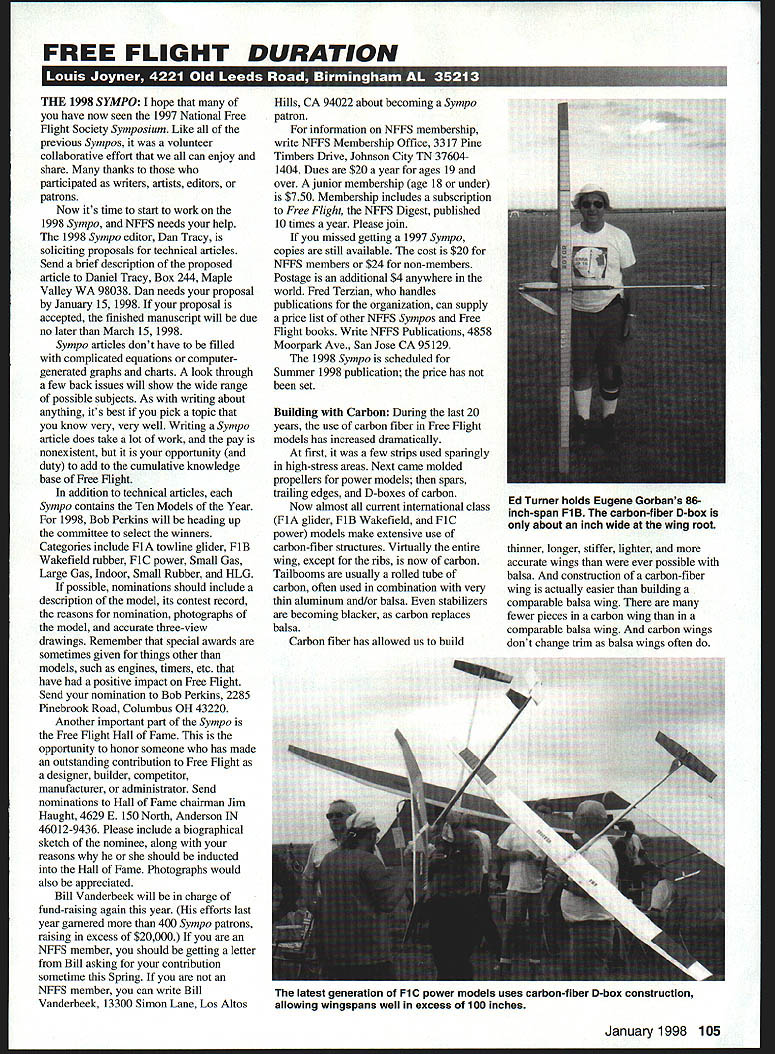
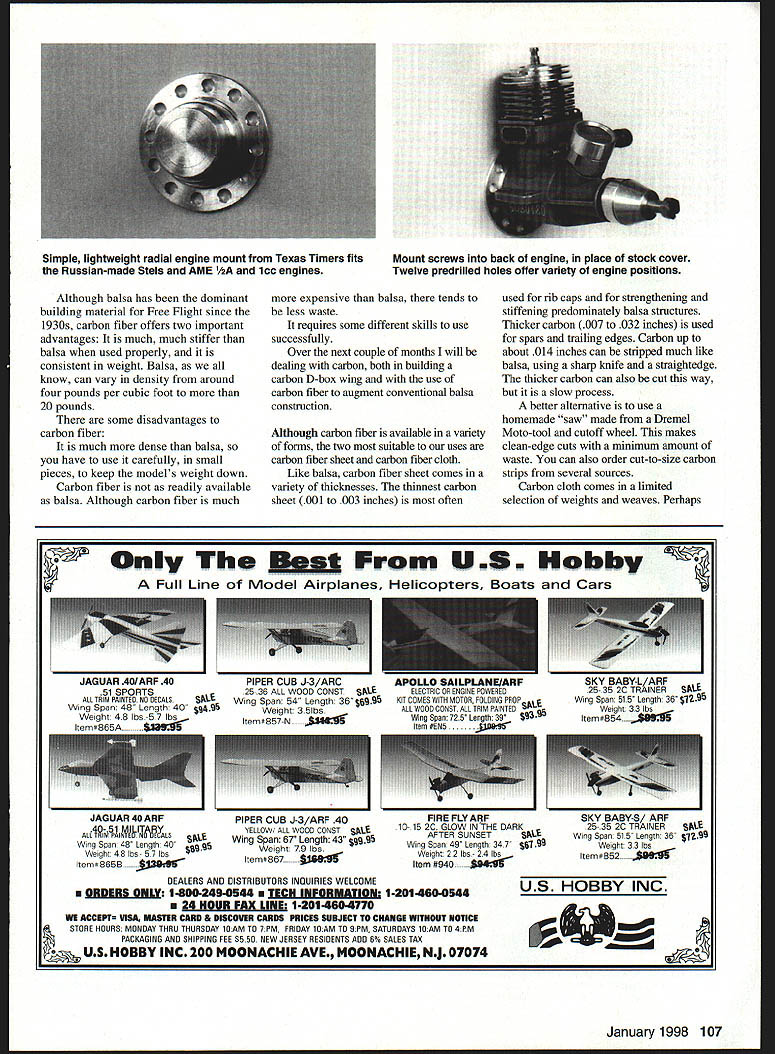
During the last 20 years the use of carbon fiber in Free Flight models has increased dramatically. At first it was a few strips used sparingly in high-stress areas. Next came molded propellers for power models; then spars, trailing edges, and D-boxes of carbon. Now almost all current international-class (F1A glider, F1B Wakefield, and F1C power) models make extensive use of carbon-fiber structures. Virtually the entire wing, except for the ribs, is now carbon. Tailbooms are usually a rolled tube of carbon, often used in combination with thin aluminum and/or balsa. Even stabilizers are becoming blacker as carbon replaces balsa.
Carbon fiber has allowed us to build thinner, longer, stiffer, lighter, and more accurate wings than were ever possible with balsa. Construction of a carbon-fiber wing is actually easier than building a comparable balsa wing: there are many fewer pieces in a carbon wing, and carbon wings don't change trim as balsa wings often do.
Disadvantages and cautions:
- Carbon is much denser than balsa, so use it carefully and sparingly to keep weight down.
- Carbon fiber is not as readily available as balsa and is more expensive, though there tends to be less waste.
- It requires some different skills to use successfully.
Over the next couple of months I will be dealing with carbon, both in building a carbon D-box wing and in using carbon fiber to augment conventional balsa construction.
Forms of carbon useful to modelers:
- Carbon fiber sheet: comes in a variety of thicknesses.
- Very thin sheet (0.001 to 0.003 inches): used for rib caps and for strengthening/stiffening predominantly balsa structures.
- Thicker sheet (0.007 to 0.032 inches): used for spars and trailing edges.
- Sheets up to about 0.014 inches can be stripped like balsa with a sharp knife and straightedge; thicker material can be cut that way but more slowly.
- A homemade "saw" made from a Dremel Moto-Tool and cutoff wheel makes clean-edge cuts with minimal waste. Cut-to-size carbon strips are also available from suppliers.
- Carbon cloth: available in a limited selection of weights and weaves.
- A common choice is 2.9 ounce per square yard plain-weave cloth, often used for vacuum-bag molding D-boxes.
- For maximum torsional strength, carbon cloth is laid up with fibers at +/-45°. Use balanced-weave cloth (same number of warp and fill threads per inch).
- Some suppliers offer bias-cut carbon cloth to minimize waste when cutting pieces for D-boxes.
- Ready-made carbon fiber D-boxes are available from several sources.
Vacuum-bagging D-boxes:
- The cloth is wetted out with epoxy, draped over a simple form, and inserted into a vacuum bag. The vacuum pulls the cloth to the shape of the form and holds it until the resin hardens.
- Vacuum-bagging a carbon-fiber D-box is often easier than building one from balsa and yields a stiffer, more consistent, and possibly lighter leading edge.
Structural use:
- For maximum strength and minimum weight, use carbon where it does the most good — typically as the top and bottom flanges of an I-beam with a lighter material (balsa or Rohacell foam) forming the web.
- Most carbon D-box wings use a full-depth spar built this way, with balsa ribs capped top and bottom with thin strips of carbon. The carbon spar provides bending strength; the carbon D-box handles torsional loads; and carbon-capped ribs support the trailing edge and covering. Because the wing is inherently stiff, it is less dependent on the covering for rigidity than a typical balsa-and-tissue structure.
Next month we'll take a closer look at working with carbon fiber.
Transcribed from original scans by AI. Minor OCR errors may remain.

