

FREE FLIGHT DURATION
Louis Joyner 4221 Old Leeds Road, Birmingham AL 35213
LAST MONTH I talked about some of the basics of carbon-fiber (CF) construction. This time we'll delve a little farther into the specifics.
Carbon-fiber types
A quick recap of the two main types of carbon fiber used for wing construction: woven cloth and unidirectional strip.
- Woven carbon cloth is similar to fiberglass cloth but is black in color. Available weights and weaves are limited; the most useful for Free Flight purposes is 2.9-ounce plain-weave cloth. Lighter carbon cloths exist but can be very expensive. Like fiberglass cloth, carbon-fiber cloth is limp and pliable and is used with epoxy resin and a form to produce a rigid molded shell (for example, a D-box). The cloth can be cut easily with sharp scissors.
- Unidirectional strip is a rigid sheet or strip of carbon fiber, available in various thicknesses, widths, and lengths. Thicknesses range from .001 to .060 inch. The thinner strips (.001–.003) are used primarily for rib capstrips. Thicker strips (.007–.042) are used for spar caps. The thickest strips (.030–.060) are used for trailing edges.
Carbon strip up to about .014 can be cut easily with a sharp knife or single-edge razor blade, much like stripping balsa. Thicker carbon is best cut with a Dremel cutoff wheel or another abrasive saw blade. Because setting up a suitable saw can be time-consuming and expensive, it's often easier to use ready-cut carbon-fiber spar or trailing-edge pieces than to strip your own. These spar sets are often sold with four matching tapered carbon-fiber pieces (an upper and lower spar cap for each wing half).
Unidirectional carbon strip requires some surface preparation to ensure a good glue bond: sand the surface lightly with fine sandpaper to remove the gloss, then wipe with lacquer thinner to remove fine dust. It's much easier to do this to a whole sheet than to individual strips.
CF D-box wing structure
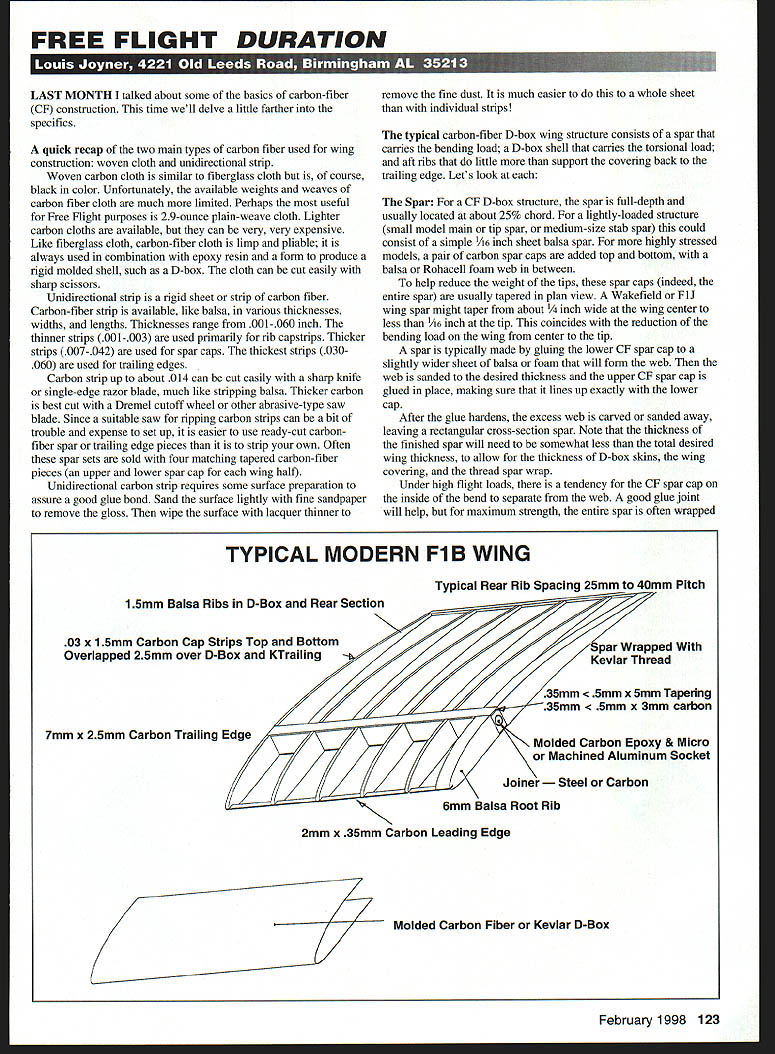
The typical carbon-fiber D-box wing structure consists of a spar that carries the bending load; a D-box shell that carries the torsional load; and aft ribs that primarily support the covering back to the trailing edge. Below are details of each main component.
The Spar
For a CF D-box structure, the spar is full-depth and usually located at about 25% chord. For a lightly loaded structure (small model main or tip spar, or medium-size stab spar) this could be a simple 1/16-inch sheet balsa spar. For more highly stressed models, a pair of carbon spar caps are added top and bottom, with a balsa or Rohacell foam web between to help reduce weight. In many tip spars, indeed the entire spar, are tapered in plan view. A Wakefield or F1J wing spar might taper from about 1/4 inch wide at the wing center to less than 1/8 inch at the tip, matching the reduction of bending load from center to tip.
Typical spar construction:
- Glue the lower CF spar cap to a slightly wider sheet of balsa or foam that will form the web.
- Sand the web to the desired thickness.
- Glue the upper CF spar cap in place, making sure it lines up exactly with the lower cap.
- After glue hardens, carve and sand away excess web, leaving a rectangular cross-section spar.
Note: the finished spar thickness must allow for the D-box skins, the wing covering, and the thread spar wrap.
Under high flight loads, the CF spar cap on the inside of the bend can separate from the web. A good glue joint helps, but for maximum strength the entire spar is often wrapped with thin Kevlar thread.
Spar wrapping procedure:
- Round off spar corners slightly with sandpaper to avoid cutting the thread on sharp edges.
- Attach the end of the thread with a drop of cyanoacrylate (CyA) at one end of the spar and spiral-wrap the thread around the spar.
- Space wraps closely near the wing center, gradually opening spacing toward the tip.
- Avoid introducing twist in the spar while wrapping.
- At the far end, tack the thread in place; this allows it to compress slightly later when the D-box skin is glued in place.
Alternatives to thread wrapping:
- Use a CF "sock" slipped over the spar and pulled tight.
- Glue a piece of D-box material to the back side of the spar. This is usually adequate for smaller or less highly stressed models.
The D-box
Most widely used material for CF D-box skins is 2.9-ounce plain-weave carbon cloth. For maximum torsional strength, lay the cloth with the threads at 45° (bias-cut).
Form and layup:
- The form consists of a piece of basswood at least an inch wider than the desired D-box width and approximately the desired wing thickness, and 3–4 inches longer than the longest wing panel. For example: a two-inch-wide piece of 1/4" basswood, 24 inches long, with one edge planed and sanded to the approximate shape of the first 15% of the airfoil.
- The leading edge radius of the form should be slightly sharper than the desired finished wing to allow for the thickness of the D-box skin.
- Glue the basswood to a 1x2 or strip of 3/4" plywood so the leading edge of the basswood stands up. There is no need to finish or wax the form, though a few coats of nonshrinking dope won't hurt.
- Cover the form with a single layer of plastic kitchen wrap and smooth out wrinkles.
- Cut a piece of carbon cloth slightly oversize and lay it on waxed paper. (For a 1"-wide by 18" D-box, start with cloth about 3" x 20".)
- Mix laminating resin (such as West Systems epoxy), pour over the cloth, and squeegee it into the cloth.
- Blot with absorbent paper towels until they come up dry.
- Draped wetted-out carbon cloth over the form, position a piece of Teflon-coated fiberglass cloth over it (slightly larger than the carbon cloth), and hold in position with small pieces of masking tape.
- Add a clean piece of kitchen towel over everything, top with plastic kitchen wrap, insert into a vacuum bag, seal, and pull a vacuum.
Vacuum-bagging notes:
- As the bag deflates it will pull down tightly over the form; excess epoxy will wick through the Teflon-coated fiberglass cloth and be absorbed by the paper towel.
- Allow the pump to run for at least six hours and wait at least 24 hours before removing from the bag.
- Use a purpose-made vacuum pump that will pull at least 20 inches of mercury under continuous operation. You can add a vacuum gauge in the line to check pressure.
- If this sounds complicated, you can order ready-made CF D-box shells; but for repeated projects, owning a vacuum pump and bag offers considerable savings and is a good item for a club to share.
After cure:
- Remove all plastic wrapping carefully and avoid bending the shell as you remove it from the form.
- Add front ribs to the spar (typically 1/16" balsa spaced about 15–20 mm apart). This spar–rib assembly is often called "the fishbone."
- For light models, a separate leading edge is often omitted; sometimes a thin carbon strip is used as leading-edge reinforcement, inserted into slots in the front of the ribs. Another alternative is a narrow balsa leading edge to hold ribs in place during construction.
Fitting the shell to the fishbone:
- Trial-fit the shell over the fishbone and trim so it overlaps the back of the spar slightly.
- Sand the inside of the shell for better adhesion and wipe with lacquer thinner.
- Coat spar and ribs with slow-curing epoxy glue and blot off any excess. Using a small, fine-textured sponge to apply epoxy works well.
- Insert the fishbone into the shell, cover with plastic wrap, place on a flat surface, and use rubber bands or masking tape to hold the shell down tight against the ribs and spar until epoxy sets.
- After glue dries, unwrap the D-box and sand excess shell off at the back and sides. The main structural part of the wing is finished.
Aft ribs and trailing edge
- Position the completed D-box on an undercambered building board and hold down with masking tape, rubber bands, or weights. Do not pin through the D-box; pins along the front and rear can help locate it.
- Position the carbon-fiber trailing edge, then add balsa ribs in the usual manner using CyA or epoxy.
- Remove the almost-finished wing from the board and carefully sand the bottom. Because of the trailing edge's small cross-section, the rib-to-trailing-edge joint is prone to breakage at this stage—be careful and keep CyA handy.
- Strip a plentiful supply of rib caps from thin (.001–.003) carbon sheet. Cut the sheet to approximate length (spar to trailing edge distance plus ~1/2") and strip individual capstrips. A simple stripper can be made from a single-edge razor blade and two pieces of scrap 1/16" plywood, or use ready-made rib caps from suppliers.
- Glue the caps in place on the bottom of the wing starting about 1/8" forward of the rear of the D-box and extending past the trailing edge. Apply gap-filling CyA to the capstrip, place it, and smooth it down with a finger covered in plastic wrap.
- After bottom caps are in place, trim excess cap material by breaking it off. Sand the top smooth and add upper caps with the wing panel strapped down on the undercambered board.
Since the wing gets its strength from the carbon structure and not from the covering, you can use very light plastic films for covering.
For more on carbon D-box wing construction, see:
- "Notes on High-Tech Wing Construction" by Aram Schlosberg, 1995 Symposium Report.
- "Quicker Composite Structures" by Chris Edge and Mike Fantham, British Free Flight Forum 1995.
Both available from NFFS Publications. Also see the NFFS International Planbook for construction articles and three-view drawings.
If you have never tried building with carbon fiber, give it a try—the results are stronger, stiffer, and more consistent than conventional balsa-and-tissue methods.
CF Stabs & Rudders
Although some suggest that building F1B stabs and rudders from carbon fiber is structural overkill, it is nice to have tail surfaces that absolutely do not warp. Building time is often less than for conventional all-balsa structures, and weights are comparable; strength and stiffness are greatly improved.
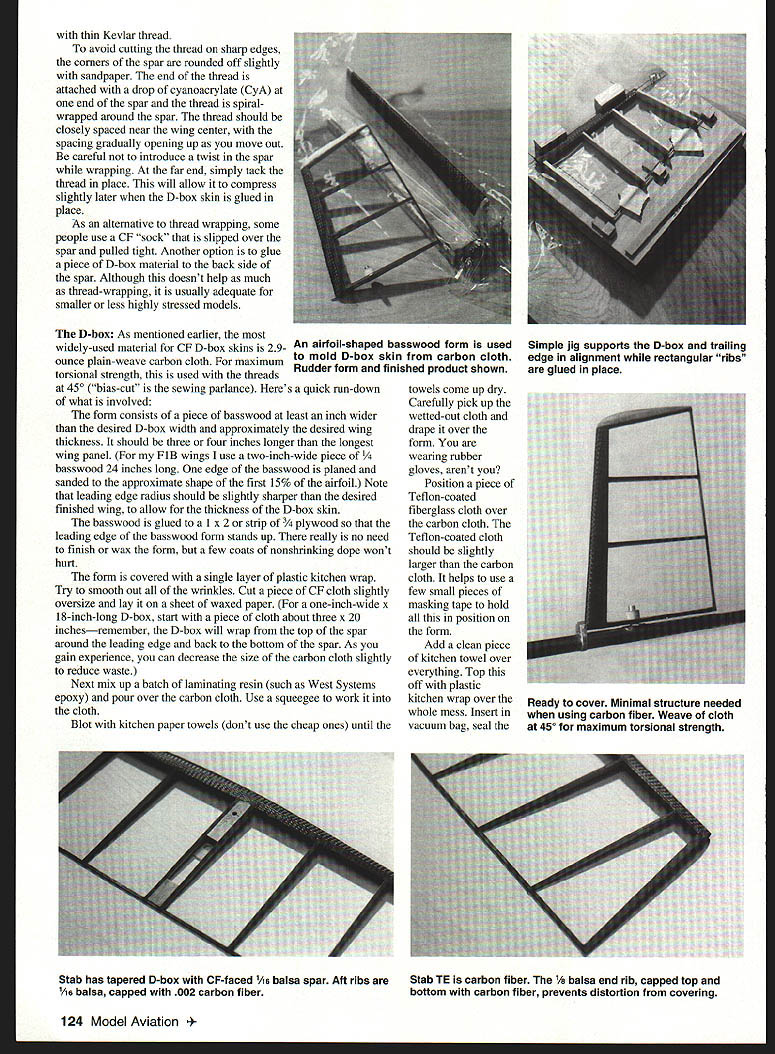
Rex Hinson and I have collaborated on Wakefield design and construction. The stab described here is my version of Rex's latest stab, with a tapered planform to reduce weight by decreasing D-box width toward the tips.
Construction highlights:
- A special tapered form was carved to follow the desired swept-back D-box shape. We swept back the D-box and kept the trailing edge straight.
- The carbon-fiber shell required only minor pulling and tugging to get the wetted-out carbon cloth to lay smoothly over the form. The Teflon-coated glass cloth can be cut in two at the center to conform to the sweep.
- After curing, the shell was trimmed to exact shape, tapering from about 3/8" at the center to about 1/4" at the tips.
- A 1/16" balsa center rib was added, extending back to the rear of the stab and serving as the stab mounting system where the stab hammer comes up through the middle of the stab. The stab overhangs the rear of the tailboom by about 1 1/4". For a "normal" mounting system with the stab hammer at the rear, the center rib could extend all the way to the rear.
- Spars are stripped from 1/16" balsa that has CF cloth epoxied to one side and then vacuum-bagged. Full-depth spars taper from about 5/32" in the center to about 1/8" at the tip. Spars are glued in place, butting against the center rib.
- Tip structure uses a soft 1/8" balsa rib; there are no other ribs in the D-box.
- The remainder consists of a carbon-fiber trailing edge and 1/8" ribs. End ribs are 1/8" balsa to prevent the rib from bending inward after covering. All ribs are capped with .002" carbon fiber.
- These roughly 2.8 sq. cm. stabs come out around 3.2 to 3.5 grams uncovered.
Rudder construction is similar. To speed construction, I use a simple jig to hold the finished D-box and trailing edge in alignment. "Ribs" can be rectangular pieces of 1/16" x 1/4" balsa; after gluing, remove the rudder from the jig, sand to a symmetrical airfoil, then add carbon rib caps. One caution: avoid making the bottom rib too light—the bottom rib can bend inward under the tension of very light coverings (quarter-mil Mylar). Later rudders used a 1/8" lower rib with wider carbon caps.
Carbon-fiber sources
- Composite Structures Technology (carbon cloth and strip, epoxy, vacuum pumps, Teflon-coated glass cloth, bagging supplies, etc.), P.O. Box 642, Tehachapi, CA 93581; Tel.: (805) 822-4162; Web: www.tmnet.com/cst
- Bradley Model Supply (carbon strip, spar sets), 1337 Pine Sap Ct., Orlando, FL 32825
- Starline International (spar sets, D-box shells), 6146 E. Cactus Wren Rd., Scottsdale, AZ 85253; Tel.: (602) 948-5798; e-mail: starline@aol.com
- A-B-C Free Flight Supplies (spar sets, D-box shells), Melis Jos, Winterbeekstraat 1, 3730 Hoeselt, Belgium; E-mail: Jos.Melis@ping.be
Transcribed from original scans by AI. Minor OCR errors may remain.

