
FREE FLIGHT DURATION
Louis Joyner 4221 Old Leeds Road, Birmingham, AL 35213
For the last few months I've talked about the uses for carbon fiber and how to get started with "high-tech" construction. If you have any questions or comments about building with carbon fiber, please drop me a line. A stamped, self-addressed envelope included with your letter will be appreciated (and you'll get your letter answered that day, not the next time I happen by the post office).
One of the best uses for carbon fiber is for fuselages and tail booms. The early "skinny" booms were often remnants of fiberglass or carbon-fiber fishing rods; they were usually too heavy and never exactly the right size. Then modelers around the world began to try their hands at making carbon-fiber tailbooms and fuselages.
The big breakthrough came when modelers discovered that the thin aluminum sheet popular for F1C wing skins could be combined with unidirectional carbon fiber to make a strong, light, and stiff boom. These were much better than anything you could make using traditional modeling materials.
For example, the lightest Wakefield tailboom I ever made was about 12 grams (bare boom, no rudder or fittings). A typical carbon-fiber/aluminum boom a good four inches longer weighs only about eight grams. And it is stiffer and more durable.
But making these carbon-aluminum booms is not easy. In fact, I found it impossible. For one thing, working with the aluminum requires a very clean workshop! It's a lot easier and less time-consuming to order a finished boom than to clean up my workshop. The carbon-aluminum tailbooms are available from several sources, including Ken Oliver.
Oliver Booms
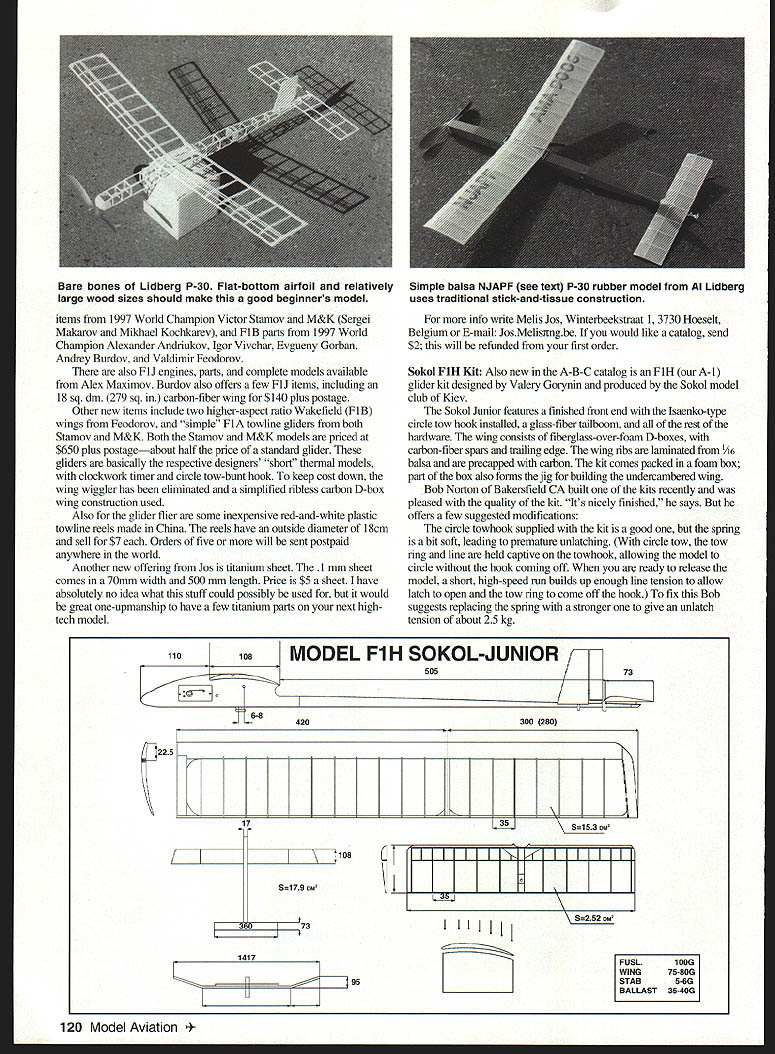
For the last dozen years or so, the standard "high-tech" fuselage for most of the large gas classes has been the ones made by Ken Oliver. He doesn't just sell tailbooms, but offers a complete "fuselage system." This includes a front end to mount the engine, a timer-mounting plate, and a stab mount.
Sizes and prices:
- F1J-A/2A: $50
- A/B gas with firewall: $125
- F1C: $90
- F1C with two-piece fuselage and coupler: $125
Also available:
- Coupe tube and tailboom, complete with coupler and stab mount: $75
- F1B tailboom with stab mount: $35
Note: an F1B motor tube is not available from Ken.
I examined Ken's Coupe motor tube and tailboom unit closely; it is very, very nice. The motor tube measures 15 inches (380 mm) long and is about 5/8 inch in diameter (22.5 mm) at the front. Weight is 8.2 grams. The boom, including connector, is 27 3/4 inches (700 mm) long and weighs 10.1 grams. The molded carbon-fiber stab mount is 0.3 gram. With the elimination of the cross-section rule for Coupes a few years back, there is no reason not to go "skinny."
For more information or to place an order, write: Ken Oliver 2213 El Cejo Cir., Rancho Cordova, CA 95670 Tel.: (916) 363-2017
A-B-C Free Flight Supplies
For the last few years, Belgian glider flier Jos Melis has been developing his part-time Free Flight supply business into a comprehensive source for parts and models for most of the international classes.
Virtually all of the catalog offerings come from modelers in the countries of the former Soviet Union. Included in the catalog:
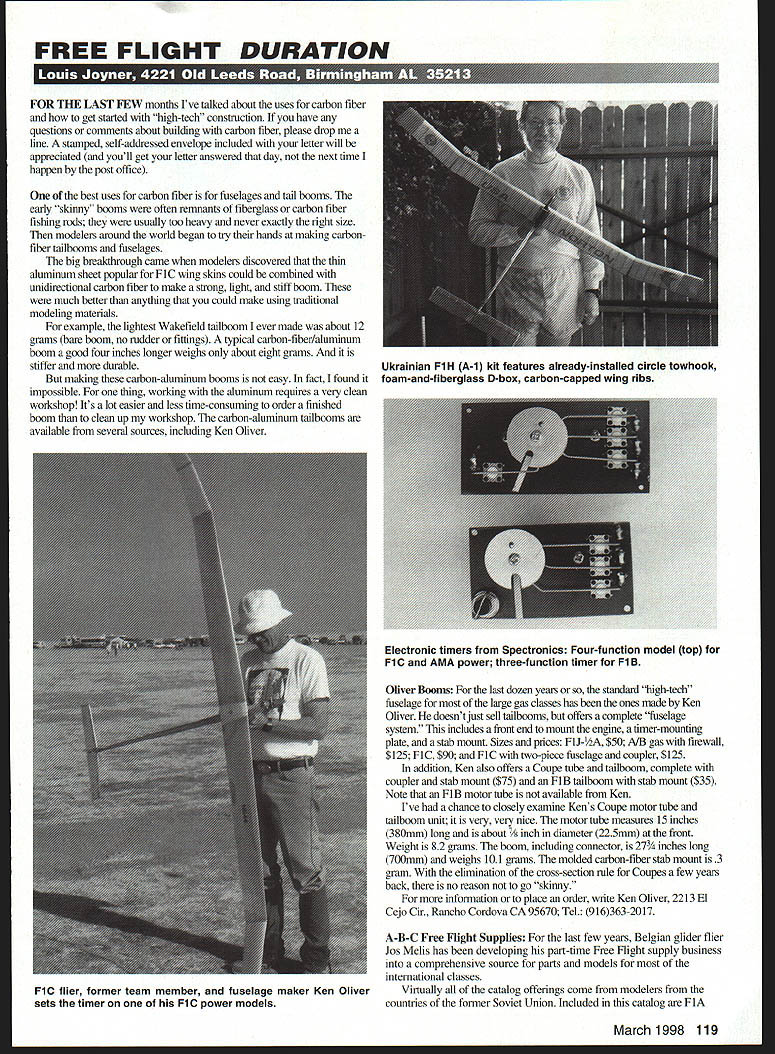
- F1H (A-1) kits featuring an installed circle tow hook, foam-and-fiberglass D-box, and carbon-capped wing ribs.
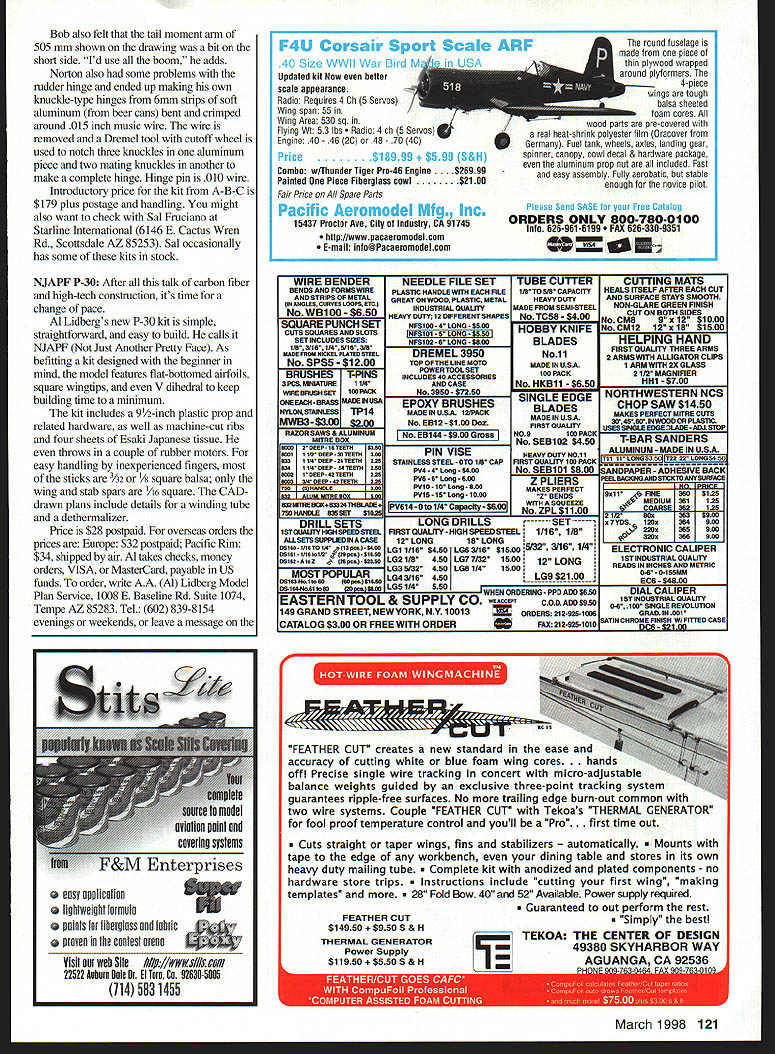
- Electronic timers from Spectronics: four-function model for F1C and AMA power; three-function timer for F1B.
- F1J engines, parts, and complete models from Alex Maximov.
- Select items from Burdov, including an 18 sq dm (279 sq in) carbon-fiber wing for $140 plus postage.
- Two higher-aspect-ratio Wakefield (F1B) wings from Feodorov.
- "Simple" F1A towline gliders from Stamov and M&K. Both the Stamov and M&K models are priced at $650 plus postage—about half the price of a standard glider. These gliders are the designers' short thermal models, with clockwork timer and circle tow hook. To keep costs down, the wing wiggler has been eliminated and a simplified ribless carbon D-box wing construction used.
Other items:
- Inexpensive red-and-white plastic towline reels made in China: 18 cm outside diameter, $7 each. Orders of five or more will be sent postpaid anywhere in the world.
- Titanium sheet: 0.1 mm (.004") sheet, 70 mm width by 500 mm length, $5 per sheet. (I have no idea what this could be used for, but it would be a cool bit of one-upsmanship on a high-tech model.)
For more info write: Melis Jos Winterbeekstraat 1, 3730 Hoeselt, Belgium E-mail: Jos.Melis@tng.be If you would like a catalog, send $2; this will be refunded from your first order.
Sokol F1H Kit
Also new in the A-B-C catalog is an F1H (our A-1) glider kit designed by Valery Gorynin and produced by the Sokol model club of Kiev.
The Sokol Junior features a finished front end with the Isaenko-type circle tow hook installed, a glass-fiber tailboom, and all of the hardware. The wing consists of fiberglass-over-foam D-boxes, with carbon-fiber spars and trailing edge. The wing ribs are laminated from 1/16" balsa and are prepregged with carbon. The kit comes packed in a foam box; part of the box also forms the jig for building the undercambered wing.
Bob Norton of Bakersfield, CA, built one of the kits recently and was pleased with the quality. "It's nicely finished," he says, but he offers a few suggested modifications:
- The circle tow hook supplied is good, but the spring is a bit soft, leading to premature unlatching. The ring and line are held captive on the tow hook, allowing the model to circle without the hook coming off. When ready to release the model, a short, high-speed run builds up enough line tension to allow the ring to open and the tow ring to come off the hook. To fix this, Bob suggests replacing the spring with a stronger one to give an unlatch tension of about 2.5 kg.
- Bob felt that the tail moment arm of 505 mm shown on the drawing was a bit short. "I'd use all the boom," he adds.
Norton also had problems with the rudder hinge and ended up making his own knuckle-type hinges from 6 mm strips of soft aluminum (from beer cans) bent and crimped around 0.015-inch music wire. The wire is removed and a Dremel tool with a cutoff wheel is used to notch three knuckles in one aluminum piece and two mating knuckles in another to make a complete hinge. Hinge pin is 0.010-inch wire.
Introductory price for the kit from A-B-C is $179 plus postage and handling. You might also check with Sal Fruciano of Starline International (6146 E. Cactus Wren Rd., Scottsdale, AZ 85253). Sal occasionally has some of these kits in stock.
NJAPF P-30
After all this talk of carbon fiber and high-tech construction, it's time for a change of pace.
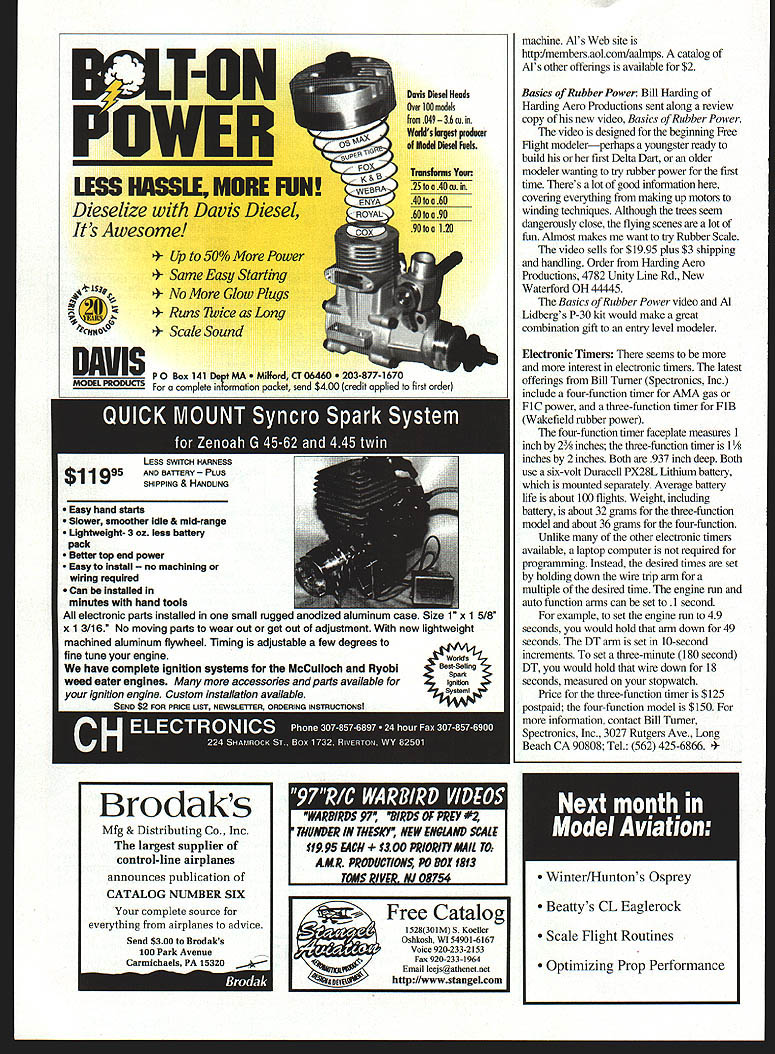
Al Lidberg's new P-30 kit is simple, straightforward, and easy to build. He calls it NJAPF (Not Just Another Pretty Face). As befitting a kit designed with the beginner in mind, the model features foam-bonded airfoils, square wingtips, and even V dihedral to keep building time to a minimum.
The kit includes a 9-1/2-inch plastic prop and related hardware, as well as machine-cut ribs and four sheets of Esaki Japanese tissue. He even includes a couple of rubber motors. For easy handling by inexperienced flyers most of the sticks are 3/32" or 1/8" square balsa; only the wing and stab spars are 1/8" square. The CAD-drawn plans include details for a winding tube and a dethermalizer.
Price is $28 postpaid. Overseas prices:
- Europe: $32 postpaid
- Pacific Rim: $34 (shipped by air)
Al takes checks, money orders, VISA, or MasterCard, payable in US funds. To order, write: A.A. (Al) Lidberg Model Plan Service 1008 E. Baseline Rd., Suite 1407, Tempe, AZ 85283 Tel: (602) 839-8154 (evenings or weekends; leave a message on the machine) Web: http://members.aol.com/aamps A catalog of Al's other offerings is available for $2.
Basics of Rubber Power
Bill Harding of Harding Aero Productions sent along a review copy of his new video, Basics of Rubber Power.
The video is designed for the beginning Free Flight modeler—perhaps a youngster ready to build his or her first Delta Dart, or an older modeler wanting to try rubber power for the first time. There's a lot of good information here, covering everything from making up motors to winding techniques. Although the trees seem dangerously close, the flying scenes are a lot of fun. Almost makes me want to try Rubber Scale.
The video sells for $19.95 plus $3 shipping and handling. Order from: Harding Aero Productions 4782 Unity Line Rd., New Waterford, OH 44445
The Basics of Rubber Power video and Al Lidberg's P-30 kit would make a great combination gift to an entry-level modeler.
Electronic Timers
There seems to be more and more interest in electronic timers. The latest offerings from Bill Turner (Spectronics, Inc.) include:
- A four-function timer for AMA gas or F1C power
- A three-function timer for F1B (Wakefield) rubber power
Specifications:
- Four-function timer faceplate: 1 by 2 3/8 inches
- Three-function timer faceplate: 1 1/4 by 2 inches
- Both are 0.937 inch deep
- Both use a six-volt Duracell PX28L lithium battery, which is mounted separately
- Average battery life: about 100 flights
- Weight (including battery): about 32 grams for the three-function model, about 36 grams for the four-function model
Programming is simple and does not require a laptop. Desired times are set by holding down the wire trim arm for a multiple of the desired time. The engine run and auto function arms can be set to 1 second.
Examples:
- To set the engine run to 4.9 seconds, hold the engine-run wire down for 49 seconds.
- The DT arm is set in 10-second increments. To set a three-minute (180-second) DT, hold the DT wire down for 18 seconds (timed on a stopwatch).
Prices:
- Three-function timer: $125 postpaid
- Four-function timer: $150 postpaid
For more information, contact: Bill Turner Spectronics, Inc. 3027 Rutgers Ave., Long Beach, CA 90808 Tel.: (562) 425-6866
Transcribed from original scans by AI. Minor OCR errors may remain.

