
FREE FLIGHT DURATION
Louis Joyner, 4221 Old Leeds Road, Birmingham AL 35213
CO2
My youthful memories of CO2 motors are somewhat limited. I do remember seeing one or two around, but I don't ever remember seeing one in the air.
(I do, however, remember the Monogram CO2-powered rocket—it looked like a V-2. These didn't use a motor: just a CO2 cartridge stuck in the back of a solid balsa model. The rocket ran horizontally along a wire, guided by a couple of eye hooks in the body. Lots of fun.)
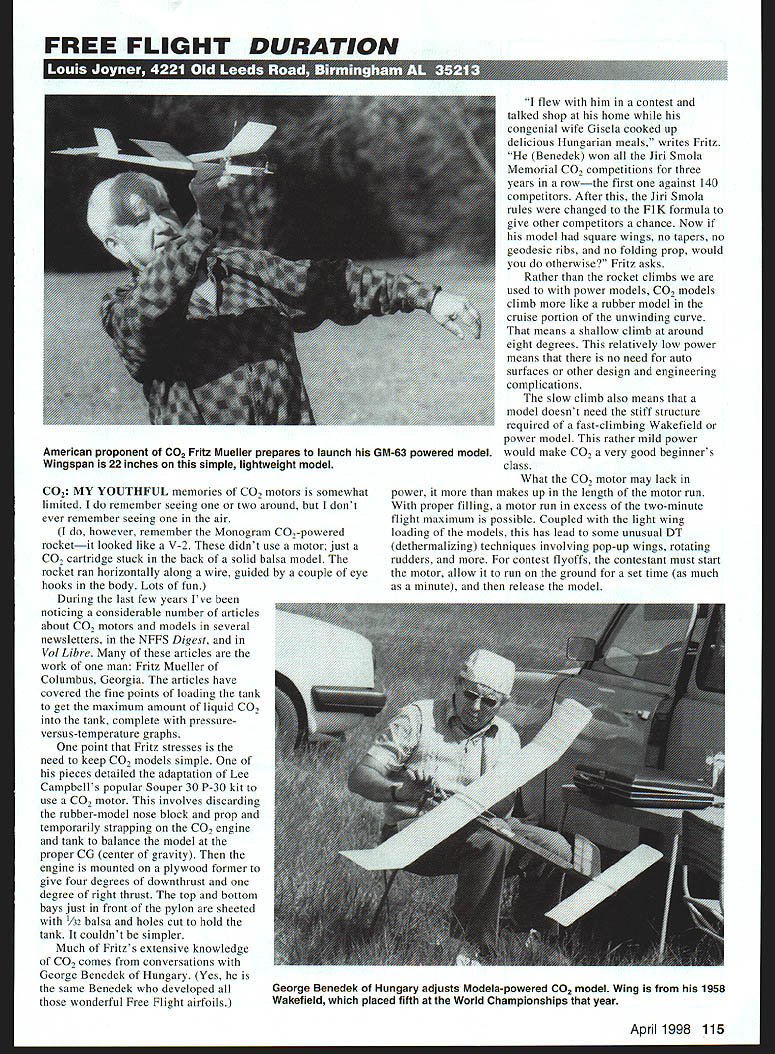
During the last few years I've noticed a considerable number of articles about CO2 motors and models in several newsletters, in the NFFS Digest, and in Vol Libre. Many of these articles are the work of one man: Fritz Mueller of Columbus, Georgia. The articles have covered the fine points of loading the tank to get the maximum amount of liquid CO2 into the tank, complete with pressure-versus-temperature graphs.
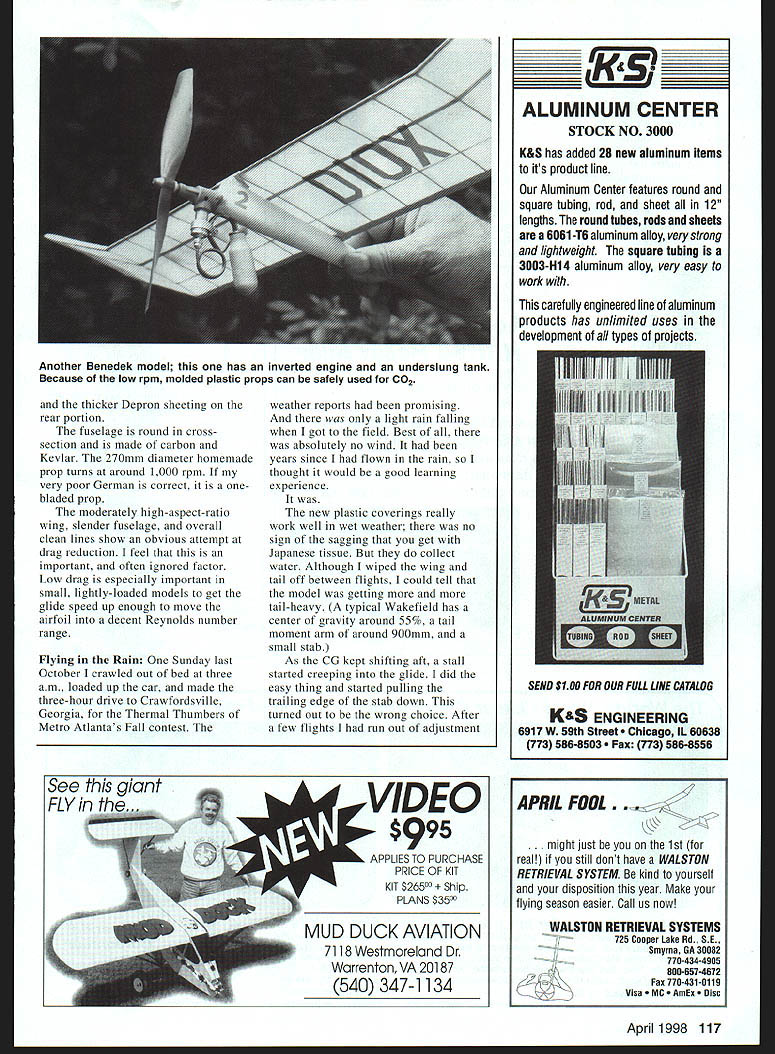
One point that Fritz stresses is the need to keep CO2 models simple. One of his pieces detailed the adaptation of Lee Campbell's popular Souper 30 P-30 kit to use a CO2 motor. This involves discarding the rubber-model nose block and prop and temporarily strapping on the CO2 engine and tank to balance the model at the proper CG (center of gravity). Then the engine is mounted on a plywood former to give four degrees of downthrust and one degree of right thrust. The top and bottom bays just in front of the pylon are sheeted with 1/32" balsa and holes cut to hold the tank. It couldn't be simpler.
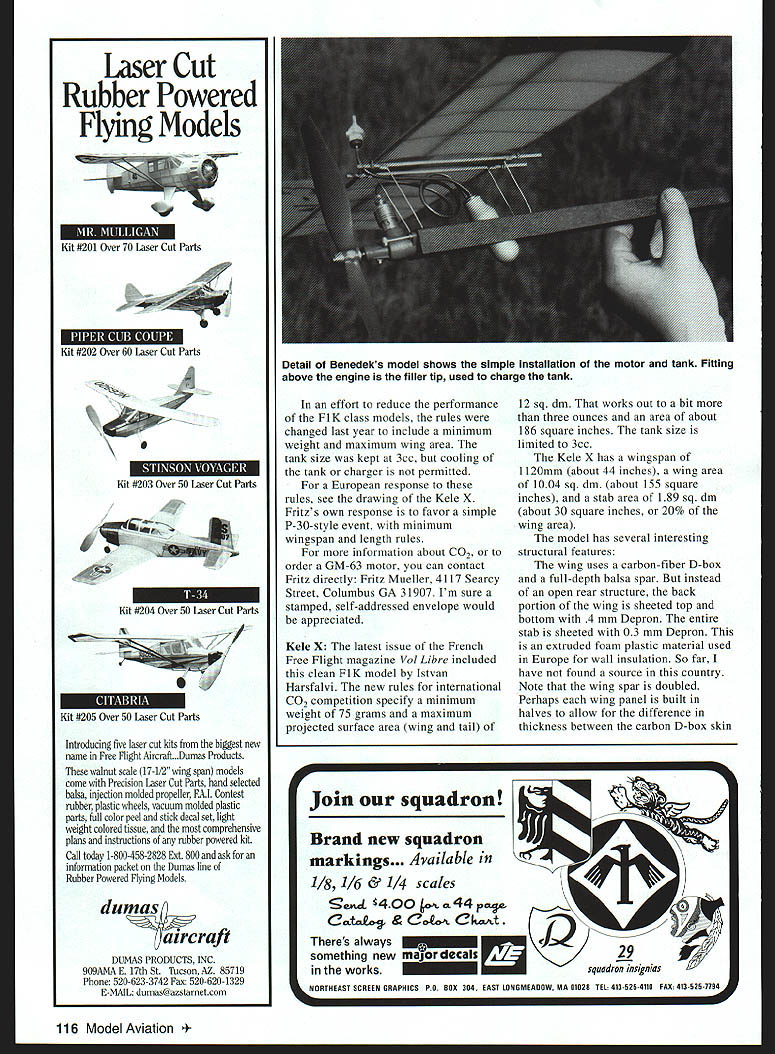
Much of Fritz's extensive knowledge of CO2 comes from conversations with George Benedek of Hungary. (Yes, he is the same Benedek who developed all those wonderful Free Flight airfoils.)
"I flew with him in a contest and talked shop at his home while his congenial wife Gisela cooked up delicious Hungarian meals," writes Fritz. "He (Benedek) won all the Jiri Smola Memorial CO2 competitions for three years in a row—the first one against 140 competitors. After this, the Jiri Smola rules were changed to the F1K formula to give other competitors a chance. Now if his model had square wings, no tapers, no geodesic ribs, and no folding prop, would you do otherwise?" Fritz asks.
Rather than the rocket climbs we are used to with power models, CO2 models climb more like a rubber model in the cruise portion of the unwinding curve. That means a shallow climb at around eight degrees. This relatively low power means that there is no need for auto surfaces or other design and engineering complications.
The slow climb also means that a model doesn't need the stiff structure required of a fast-climbing Wakefield or power model. This rather mild power would make CO2 a very good beginner's class.
What the CO2 motor may lack in power, it more than makes up in the length of the motor run. With proper filling, a motor run in excess of the two-minute flight maximum is possible. Coupled with the light wing loading of the models, this has led to some unusual DT (dethermalizing) techniques involving pop-up wings, rotating rudders, and more. For contest flyoffs, the contestant must start the motor, allow it to run on the ground for a set time (as much as a minute), and then release the model.
In an effort to reduce the performance of the F1K class models, the rules were changed last year to include a minimum weight and maximum wing area. The tank size was kept at 3 cc, but cooling of the tank or charger is not permitted.
For a European response to these rules, see the drawing of the Kele X. Fritz's own response is to favor a simple P-30-style event, with minimum wingspan and length rules.
For more information about CO2, or to order a GM-63 motor, you can contact Fritz directly:
- Fritz Mueller, 4117 Searcy Street, Columbus GA 31907.
A stamped, self-addressed envelope would probably be appreciated.
Kele X
The latest issue of the French free flight magazine Vol Libre included this clean F1K model by Istvan Harsfalvi. The new rules for international CO2 competition specify:
- Minimum weight: 75 grams (a bit more than three ounces)
- Maximum projected surface area (wing and tail): 12 sq. dm (about 186 sq. in.)
- Tank size: limited to 3 cc
The Kele X has:
- Wingspan: 1120 mm (about 44 inches)
- Wing area: 10.04 sq. dm (about 155 sq. in.)
- Stab area: 1.89 sq. dm (about 30 sq. in.), or 20% of the wing area
The model has several interesting structural features:
- The wing uses a carbon-fiber D-box and a full-depth balsa spar. Instead of an open rear structure, the back portion of the wing is sheeted top and bottom with 4 mm Depron.
- The entire stab is sheeted with 0.3 mm Depron. Depron is an extruded foam plastic material used in Europe for wall insulation; so far, I have not found a source in this country.
- The wing spar is doubled. Perhaps each wing panel is built in halves to allow for the difference in thickness between the carbon D-box skin and the thicker Depron sheeting on the rear portion.
- The fuselage is round in cross-section and is made of carbon and Kevlar.
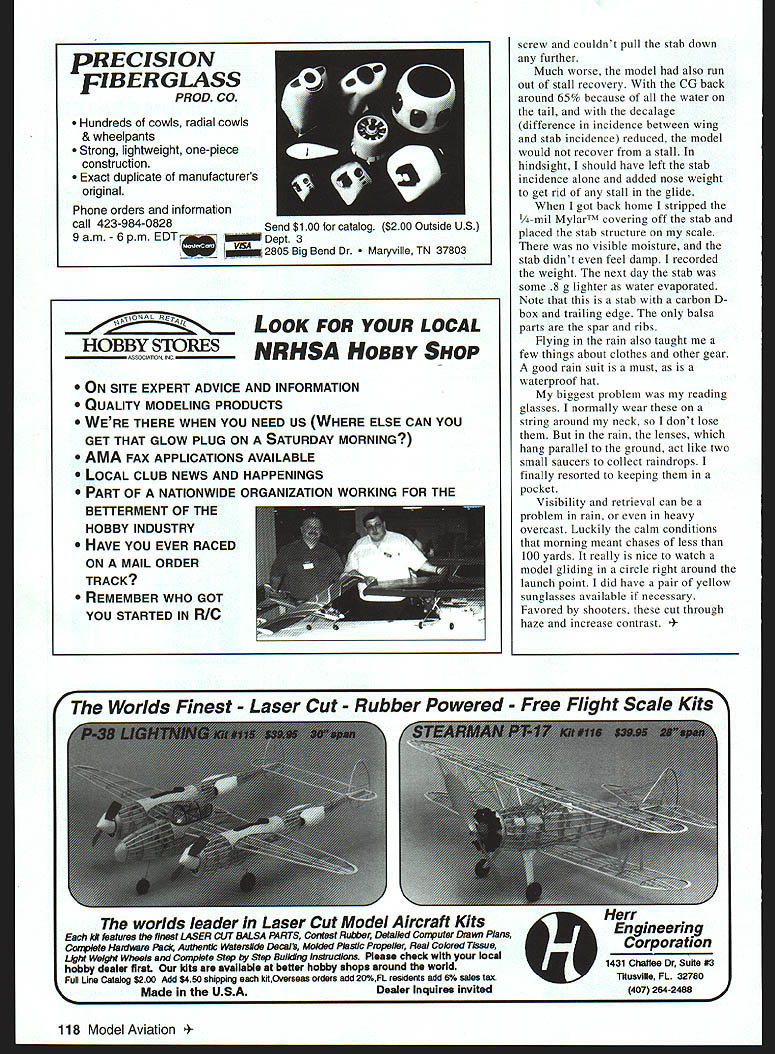
- The 270 mm-diameter homemade prop turns at around 1,000 rpm. If my very poor German is correct, it is a one-bladed prop.
The moderately high-aspect-ratio wing, slender fuselage, and overall clean lines show an obvious attempt at drag reduction. I feel that this is an important, and often ignored, factor. Low drag is especially important in small, lightly-loaded models to get the glide speed up enough to move the airfoil into a decent Reynolds-number range.
Flying in the Rain
One Sunday last October I crawled out of bed at three a.m., loaded up the car, and made the three-hour drive to Crawfordsville, Georgia, for the Thermal Thumbers of Metro Atlanta's fall contest. The weather reports had been promising. And there was only a light rain falling when I got to the field. Best of all, there was absolutely no wind. It had been years since I had flown in the rain, so I thought it would be a good learning experience.
It was.
The new plastic coverings really work well in wet weather; there was no sign of the sagging that you get with Japanese tissue. But they do collect water. Although I wiped the wing and tail off between flights, I could tell that the model was getting more and more tail-heavy. (A typical Wakefield has a center of gravity around 55%, a tail moment arm of around 900 mm, and a small stab.)
As the CG kept shifting aft, a stall started creeping into the glide. I did the easy thing and started pulling the trailing edge of the stab down. This turned out to be the wrong choice. After a few flights I had run out of adjustment screw travel and couldn't pull the stab down any further.
Much worse, the model had also run out of stall recovery. With the CG back around 65% because of all the water on the tail, and with the decalage (difference in incidence between wing and stab) reduced, the model would not recover from a stall. In hindsight, I should have left the stab incidence alone and added nose weight to get rid of any stall in the glide.
When I got back home I stripped the 1/4-mil Mylar™ covering off the stab and placed the stab structure on my scale. There was no visible moisture, and the stab didn't even feel damp. I recorded the weight. The next day the stab was some 0.8 g lighter as water evaporated. Note that this is a stab with a carbon D-box and trailing edge. The only balsa parts are the spar and ribs.
Flying in the rain also taught me a few things about clothes and other gear:
- A good rain suit is a must, as is a waterproof hat.
- My biggest problem was my reading glasses. I normally wear these on a string around my neck so I don't lose them. But in the rain, the lenses, which hang parallel to the ground, act like two small saucers to collect raindrops. I finally resorted to keeping them in a pocket.
- Visibility and retrieval can be a problem in rain, or even in heavy overcast. Luckily the calm conditions that morning meant chases of less than 100 yards. It really is nice to watch a model gliding in a circle right around the launch point. I did have a pair of yellow sunglasses available if necessary; favored by shooters, these cut through haze and increase contrast.
Transcribed from original scans by AI. Minor OCR errors may remain.

