
FREE FLIGHT DURATION
Louis Joyner, 4221 Old Leeds Road, Birmingham, AL 35213
JUNIOR TEAM UPDATE
Last month's column listed the members of the United States team that will be flying in the Junior World Championships in Sibiu, Romania, August 15–21.
Since that column was written, there has been an addition to the team. Justin Aronhalt of Bumpass, Virginia, will be flying F1J. Justin is a 17-year-old 11th-grader at Louisa County High School. He was introduced to Free Flight by his fifth-grade science teacher, Jim Snider. With additional help from the late Bill Saunders, Justin has become a very good power flier (he currently holds the Junior B-gas record).
In addition to flying Free Flight and doing farm work after school and on weekends, Justin is restoring a 1965 Ford pickup. He also does some black-powder deer hunting; his latest score was an eight-point buck. Best of all, Justin has been helping his former science teacher work with younger modelers.
As I pointed out in last month's column, this country's participation at the Junior World Championships depends entirely on voluntary contributions; the team does not receive funds from the AMA. If you would like to help, send a check to the junior team manager, George Batiuk. Any amount would be appreciated by the team. The address is:
- George Batiuk Jr., 1759 Southwood, San Luis Obispo, CA 93401.
Ten Models of the Year
Each year, the Symposium of the National Free Flight Society names the Ten Models of the Year. This year, chairman Bob Perkins and his committee have assembled an impressive group of models:
- F1A towline glider — Allard Van Wallene's Hi-Bird
- F1B Wakefield rubber — Victor Rosonoks
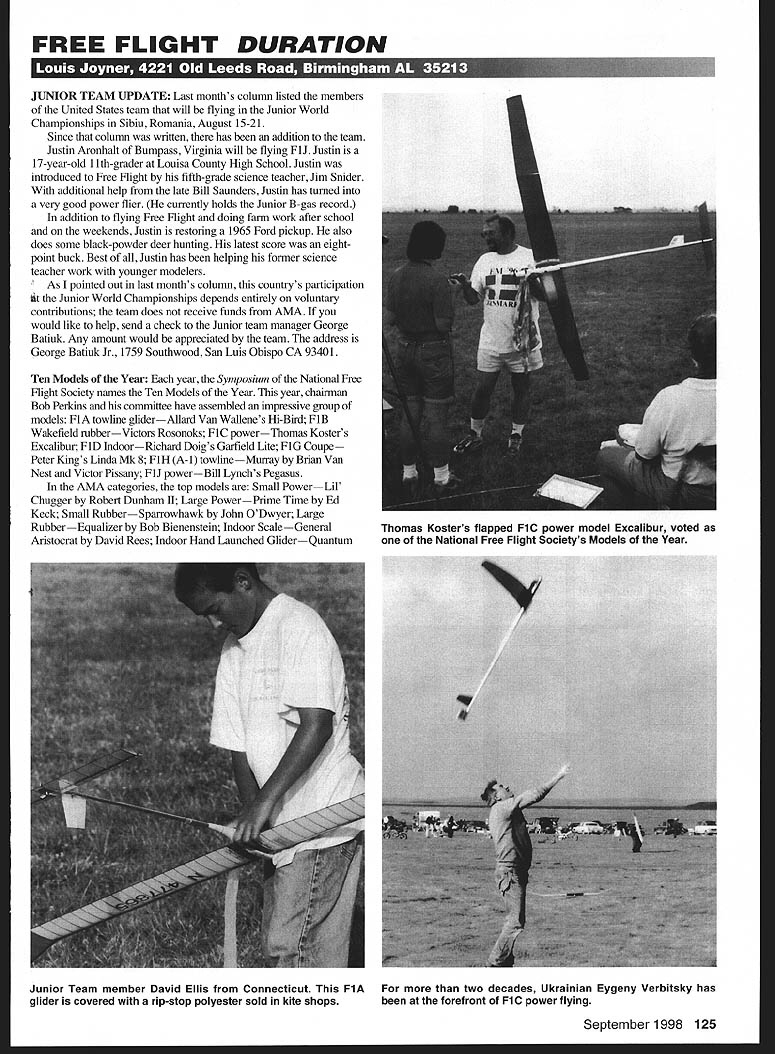
- F1C power — Thomas Koster's Excalibur
- F1D indoor — Richard Doig's Garfield Lite
- F1G coupe — Peter King's Linda Mk 8
- F1H (A-1) towline — Murray by Brian Van Nest
- F1J power — Bill Lynch's Pegasus
In the AMA categories, the top models are:
- Small Power — Lil' Chugger by Robert Dunham II
- Large Power — Prime Time by Ed Keck
- Small Rubber — Sparrowhawk by John O'Dwyer
- Large Rubber — Equalizer by Bob Bienenstein
- Indoor Scale — General Aristocrat by David Rees
- Indoor Hand-Launched Glider — Quantum
For information on Models of the Year, including three-view drawings, order the 1998 NFFS Symposium package from NFFS Publications, 4858 Moorpark Ave., San Jose, CA 95129.
Scatter
Scatter is the monthly newsletter of the Southern California Aero Team (SCAT). It is by far the best conduit of information on international Free Flight events in the United States.
Longtime editor Bill Bogart is taking a well-deserved rest; the new editor is Tom Coussens. You can contact him at:
- Tom Coussens, 25442 Via Dona Christa, Valencia, CA 91342
- E-mail: coussenst@thevine.net
In addition to the monthly newsletter, SCAT also hosts an excellent web site: www.mmb.com/scatnet. The site includes contest results, links to Free Flight suppliers around the world, a question-and-answer forum, and much more. Roger Morrell is the driving force behind the web site.
If you haven't gotten hooked up on the Internet, the SCAT web site is reason enough—it's amazing how fast news can travel around the world of Free Flight.
A good example is Ukrainian F1C power flier Evgeny Verbitsky's new geared model, which was test-flying at a contest in New Zealand. Within a matter of days, detailed photographs were available on the SCAT web site. (For more on the gears, see below.)
Even if you are not interested in the latest technology, the SCAT site provides access to informative and useful web pages on every type of Free Flight, from Peanut Scale to Indoor.
Verbitsky F1C Models
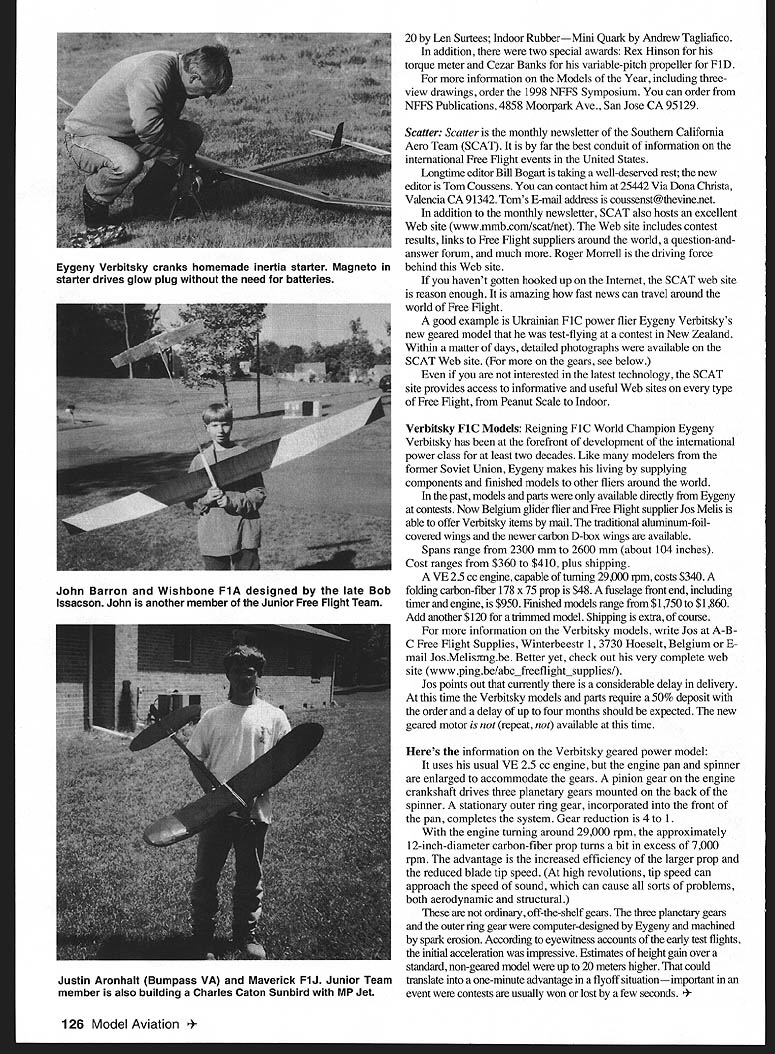
Reigning F1C World Champion Evgeny Verbitsky has been at the forefront of development of the international power class for at least two decades. Like many modelers from the former Soviet Union, Evgeny makes his living by supplying components and finished models to other fliers around the world.
In the past, models and parts were only available directly from Evgeny at contests. Now, Belgium glider flier and Free Flight supplier Jos Melis is able to offer Verbitsky items by mail. The traditional aluminum-foil-covered wings and the newer carbon D-box wings are available.
- Spans range from 2300 mm to 2600 mm (about 90 to 102 inches).
- Cost ranges from $360 to $410, plus shipping.
- A VE 2.5 cc engine, capable of turning 29,000 rpm, costs $340.
- A folding carbon-fiber 178 x 75 prop is $48.
- A fuselage front end, including timer and engine, is $950.
- Finished models range from $1,750 to $1,860; add another $120 for a trimmed model. Shipping is extra.
For more information on the Verbitsky models, write Jos at A-B-C Free Flight Supplies, Winterbeek 1, 3730 Hoeselt, Belgium, or e-mail Jos.Melis@ping.be. Better yet, check out his very complete web site: www.ping.be/abc_freeflight_suppliers.
Jos points out that currently there is a considerable delay in delivery. Verbitsky models and parts require a 50% deposit with the order and a delay of up to four months should be expected. The new geared motor is not (repeat, not) available at this time.
Here's the information on the Verbitsky geared power model
The geared model uses his usual VE 2.5 cc engine, but the engine pan and spinner are enlarged to accommodate the gears. A pinion gear on the engine crankshaft drives three planetary gears mounted on the back of the spinner. A stationary outer ring gear, incorporated into the front of the pan, completes the system. Gear reduction is 4:1.
With the engine turning around 29,000 rpm, the approximately 12-inch-diameter carbon-fiber prop turns a bit in excess of 7,000 rpm. The advantage is the increased efficiency of the larger prop and the reduced blade tip speed. At high revolutions, tip speed can approach the speed of sound, which can cause aerodynamic and structural problems.
These are not ordinary, off-the-shelf gears. The three planetary gears and the outer ring gear were computer-designed by Evgeny and machined by spark erosion. According to eyewitness accounts of the early test flights, the initial acceleration was impressive. Estimates of height gain over a standard, non-geared model were up to 20 meters higher. That could translate into a one-minute advantage in a flyoff situation—important in an event where contests are usually won or lost by a few seconds.
Transcribed from original scans by AI. Minor OCR errors may remain.

