
FREE FLIGHT DURATION
Louis Joyner, 4221 Old Leeds Road, Birmingham AL 35213
Ed Dolby and FAI Model Supply
It used to be that you could find just about everything needed to build a competitive Free Flight model at your local hobby shop. Balsa, tissue, dope, music wire, engines, and timers were really all that was needed 30 or 40 years ago. Most hobby shops stocked the latest Free Flight kits, which were mass-produced by the hundreds, if not thousands.
In the 1960s about the only specialty Free Flight mail-order supplier was Ed Dolby's New England Wakefield Supply. He offered prebent 2 mm Swedish wire prop shafts, brass ball bearings, tension springs, and a turned aluminum fitting that could be inserted into your own balsa-and-plywood nose block. The NEWS front end sold for about $2.50 and was the standard of the day.
Ed also offered some excellent Finnish plywood and Pirelli rubber from Italy. Between Ed's mail-order operation and the local hobby shop, you had everything necessary to be competitive in Wakefield.
Ed moved to Arizona, and later to California, necessitating a name change to FAI Model Supply. He developed the Zona razor saw and added a wide variety of Free Flight items to his catalog.
With the demise of Pirelli rubber, Ed worked with a U.S. manufacturer to develop a rubber strip. Years of development led eventually to the Tan II rubber that is now used by almost every rubber flier in the world.
After seeing his Tan II rubber power the Wakefield world champions in 1993 and 1995, Ed decided to sell the business and take a well-earned rest. It was the new owner, John Clapp, a long-time friend of Ed's, who called me recently with the news of Ed's death this May after a long illness.
The image I will always remember is watching Ed at the 1993 World Champs in Lost Hills, cigar in hand and wearing a Hawaiian shirt, selling boxes of that wonderful August 1993 batch of Tan II from the back of his car.
Woodhouse Supplies
Ed Turner passed along a copy of Mike Woodhouse's catalog of Free Flight supplies from England. Like many other mail-order sources for Free Flight necessities, Mike's is a one-man operation.
Although the catalog includes a wide range of supplies, notable items not readily available in this country include:
- 5-micron and 10-micron Mylar covering, in clear and chrome (use the lighter for stabs, the heavier for wings).
- Russian carbon-fiber sock (an open-weave tube used for spar binding or to make carbon-tube spars).
- Russian unidirectional carbon cloth.
- A variety of ready-cut carbon fiber spars and trailing edges.
Mike also sells a wing wiggler for F1B, made by Vladimir Fedorov to Mike's specifications. An extensive range of full-size plans includes several of Mike's own Wakefield and glider designs (though not the latest Whiskas shown in this column). Also available are excellent rubber scale plans by Lubomir Koutny of the Czech Republic. Some of the more interesting offerings include:
- A Peanut Scale Macchi M.67 Schneider Trophy seaplane.
- A 37-inch-span Dornier Do 335 push-pull fighter.
- A 31-inch-span F-82 Twin Mustang.
- A 34-inch-span McDonnell XP-67 bat-wing fighter.
There are enough plans available to keep even the most prolific Rubber Scale builder busy for months, if not years.
For an up-to-date catalogue, contact: Michael J. Woodhouse 12 Marston Lane, Eaton Norwich, Norfolk NR4 6LZ, U.K. Please include a dollar or a couple of international reply coupons to cover postage. E-mail: mjwffs@aol.com
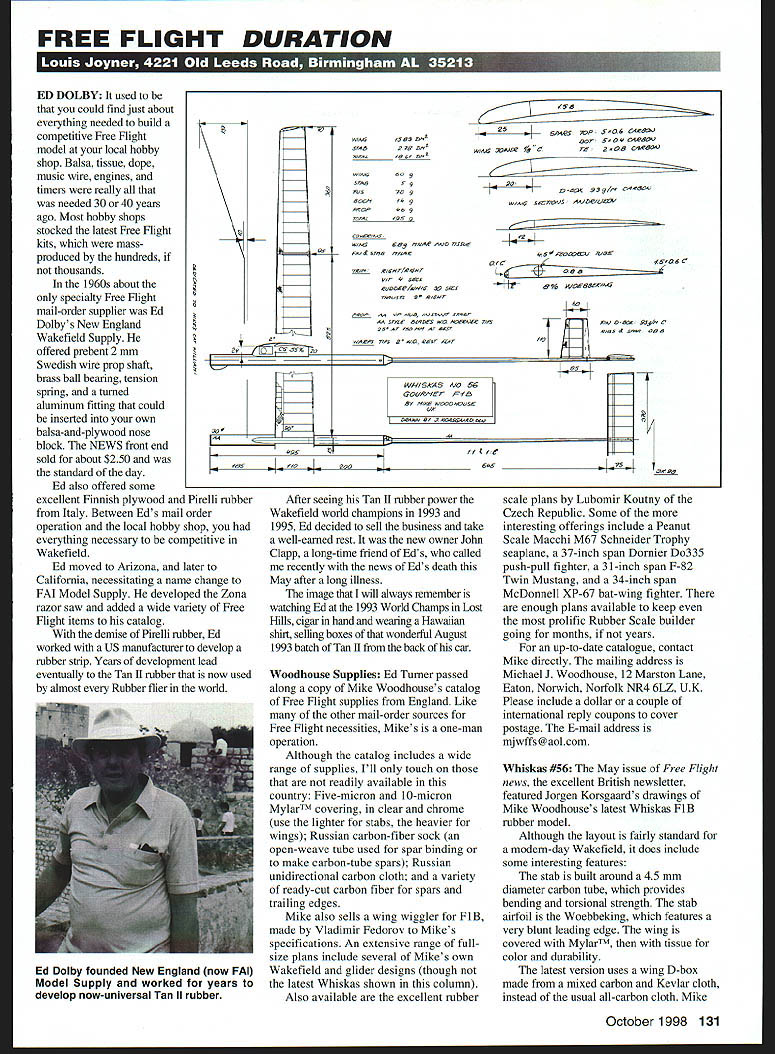
Whiskas #56
The May issue of Free Flight News, the excellent British newsletter, featured Jorgen Korsgaard's drawings of Mike Woodhouse's latest Whiskas F1B rubber model.
Although the layout is fairly standard for a modern Wakefield, it does include some interesting features:
- The stab is built around a 4.5 mm diameter carbon tube, which provides bending and torsional strength. The stab airfoil is the Woebbeking, which features a very blunt leading edge. The wing is covered with Mylar, then with tissue for color and durability.
- The latest version uses a wing D-box made from a mixed carbon-and-Kevlar cloth, instead of the usual all-carbon cloth. This switch saves about five grams in weight. The 66-gram-per-square-meter cloth is available from Mike at the above address. The price is 35 pounds sterling per square meter; it is supplied cut on a bias for minimum waste. (For maximum torsional strength, D-boxes are laid up with the threads at 45° to the span.)
I have seen that same cloth used on some Ukrainian Wakefields. In addition to the interesting checkerboard appearance, it should yield a tougher, less-brittle wing than using carbon alone.
Multifunction Button Timers
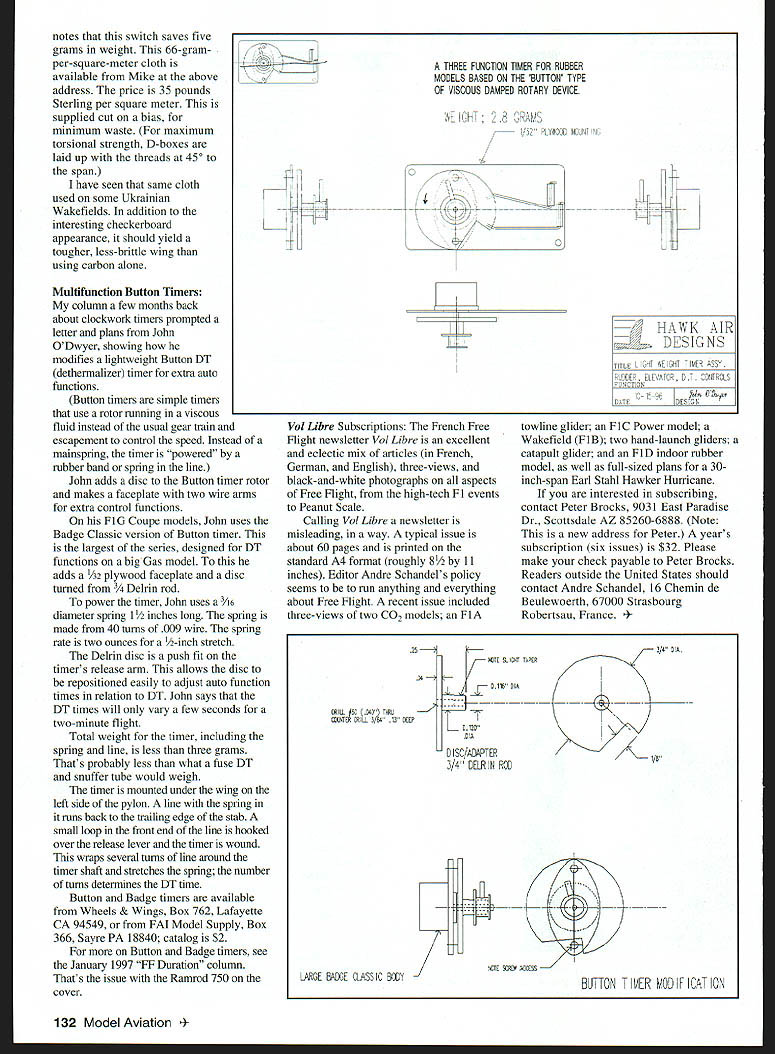
My column a few months back about clockwork timers prompted a letter and plans from John O'Dwyer, showing how he modifies a lightweight Button DT (dethermalizer) timer for extra auto functions.
(Button timers are simple timers that use a rotor running in a viscous fluid instead of the usual gear train and escapement to control speed. Instead of a mainspring, the timer is "powered" by a rubber band or spring in the line.)
John adds a disc to the Button timer rotor and makes a faceplate with two wire arms for extra control functions.
On his F1G Coupe models, John uses the Badge Classic version of the Button timer. This is the largest of the series, designed for DT functions on a big gas model. To this he adds a 1/32" plywood faceplate and a disc turned from 3/4" Delrin rod.
To power the timer, John uses a 3/16" diameter spring 1½ inches long. The spring is made from 40 turns of .009" wire. The spring rate is about two ounces for a 1/2-inch stretch.
The Delrin disc is a push fit on the timer's release arm. This allows the disc to be repositioned easily to adjust auto-function times in relation to DT. John says that the DT times will only vary a few seconds for a two-minute flight.
Total weight for the timer, including the spring and line, is less than three grams — probably less than what a fuse DT and snuffer tube would weigh.
The timer is mounted under the wing on the left side of the pylon. A line with the spring in it runs back to the trailing edge of the stab. A small loop in the front end of the line is hooked over the release lever and the timer is wound. This wraps several turns of line around the timer shaft and stretches the spring; the number of turns determines the DT time.
Button and Badge timers are available from:
- Wheels & Wings, Box 762, Lafayette CA 94549
- FAI Model Supply, Box 366, Sayre PA 18840
Catalog: $2.
For more on Button and Badge timers, see the January 1997 "FF Duration" column (the issue with the Ramrod 750 on the cover).
Vol Libre Subscriptions
The French Free Flight newsletter Vol Libre is an excellent and eclectic mix of articles (in French, German, and English), three-views, and black-and-white photographs on all aspects of Free Flight, from the high-tech F1 events to Peanut Scale.
Calling Vol Libre a newsletter is misleading: a typical issue is about 60 pages and printed on A4 format (roughly 8½ by 11 inches). Editor Andre Schandel's policy seems to be to run anything and everything about Free Flight. A recent issue included three-views of two CO2 models; an F1A towline glider; an F1C power model; a Wakefield (F1B); two hand-launch gliders; a catapult glider; and an F1D indoor rubber model, as well as full-size plans for a 30-inch-span Earl Stahl Hawker Hurricane.
If you are interested in subscribing, contact: Peter Brooks 9031 East Paradise Drive Scottsdale, AZ 85260-6888 (Note: this is a new address for Peter.) A year's subscription (six issues) is $32. Please make your check payable to Peter Brooks.
Readers outside the United States should contact: Andre Schandel 16 Chemin de Beulewoerth 67000 Strasbourg Robertsau France
Transcribed from original scans by AI. Minor OCR errors may remain.

