
Free Flight: Duration
Bob Meuser
CIRCULAR ARCS.
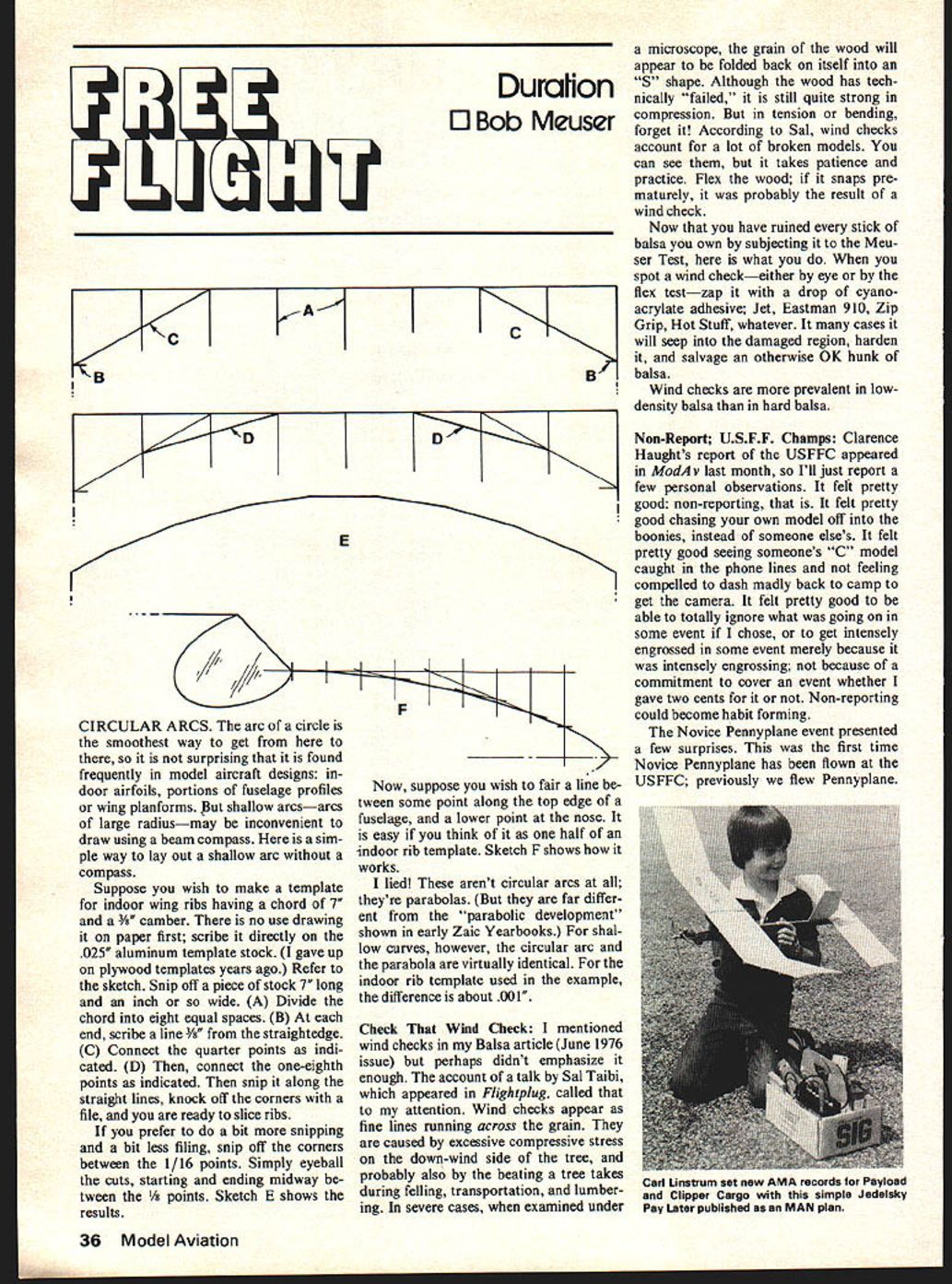
The arc of a circle is the smoothest way to get from here to there, so it is not surprising that it is found frequently in model aircraft designs: indoor airfoils, portions of fuselage profiles or wing planforms. But shallow arcs—arcs of large radius—may be inconvenient to draw using a beam compass. Here is a simple way to lay out a shallow arc without a compass.
Suppose you wish to make a template for indoor wing ribs having a chord of 7" and a 3/8" camber. There is no use drawing it on paper first; scribe it directly on the .025" aluminum template stock. (I gave up on plywood templates years ago.) Refer to the sketch. Snip off a piece of stock 7" long and an inch or so wide. (A) Divide the chord into eight equal spaces. (B) At each end, scribe a line 3/8" from the straightedge. (C) Connect the quarter points as indicated. (D) Then, connect the one-eighth points as indicated. Then snip it along the straight lines, knock off the corners with a file, and you are ready to slice ribs.
If you prefer to do a bit more snipping and a bit less filing, snip off the corners between the 1/16 points. Simply eyeball the cuts, starting and ending midway between the 1/16 points. Sketch E shows the results.
Now, suppose you wish to fair a line between some point along the top edge of a fuselage, and a lower point at the nose. It is easy if you think of it as one half of an indoor rib template. Sketch F shows how it works.
I lied! These aren't circular arcs at all; they're parabolas. (But they are far different from the "parabolic development" shown in early Zaic Yearbooks.) For shallow curves, however, the circular arc and the parabola are virtually identical. For the indoor rib template used in the example, the difference is about .001".
Check That Wind Check:
I mentioned wind checks in my Balsa article (June 1976 issue) but perhaps didn't emphasize it enough. The account of a talk by Sal Taibi, which appeared in Flightplug, called that to my attention. Wind checks appear as fine lines running across the grain. They are caused by excessive compressive stress on the down-wind side of the tree, and probably also by the beating a tree takes during felling, transportation, and lumbering. In severe cases, when examined under a microscope, the grain of the wood will appear to be folded back on itself into an "S" shape. Although the wood has technically "failed," it is still quite strong in compression. But in tension or bending, forget it! According to Sal, wind checks account for a lot of broken models. You can see them, but it takes patience and practice. Flex the wood; if it snaps prematurely, it was probably the result of a wind check.
Now that you have ruined every stick of balsa you own by subjecting it to the Meuser Test, here is what you do. When you spot a wind check—either by eye or by the flex test—zap it with a drop of cyanoacrylate adhesive; Jet, Eastman 910, Zip Grip, Hot Stuff, whatever. In many cases it will seep into the damaged region, harden it, and salvage an otherwise OK hunk of balsa.
Wind checks are more prevalent in low-density balsa than in hard balsa.
Non-Report: U.S.F.F. Champs:
Clarence Haught's report of the USFFC appeared in ModAv last month, so I'll just report a few personal observations. I felt pretty good: non-reporting, that is. It felt pretty good chasing your own model off into the boonies, instead of someone else's. It felt pretty good seeing someone's "C" model caught in the phone lines and not feeling compelled to dash madly back to camp to get the camera. It felt pretty good to be able to totally ignore what was going on in some event if I chose, or to get intensely engrossed in some event merely because it was intensely engrossing; not because of a commitment to cover an event whether I gave two cents for it or not. Non-reporting could become habit forming.
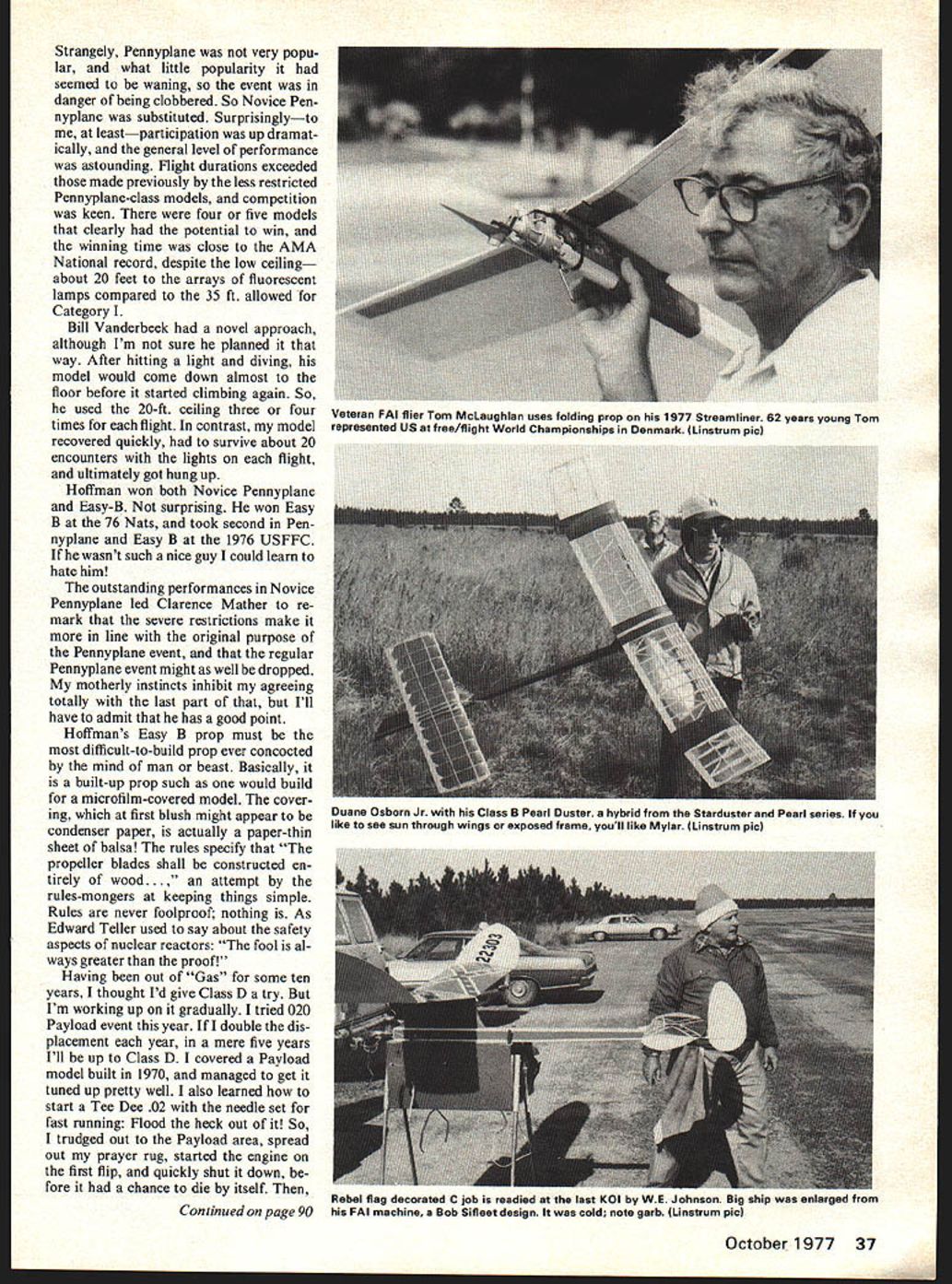
The Novice Pennyplane event presented a few surprises. This was the first time Novice Pennyplane has been flown at the USFFC; previously we flew Pennyplane. Strangely, Pennyplane was not very popular, and what little popularity it had seemed to be waning, so the event was in danger of being clobbered. So Novice Pennyplane was substituted. Surprisingly — to me, at least — participation was up dramatically, and the general level of performance was astounding. Flight durations exceeded those made previously by the less restricted Pennyplane-class models, and competition was keen. There were four or five models that clearly had the potential to win, and the winning time was close to the AMA National record, despite the low ceiling — about 20 feet to the arrays of fluorescent lamps compared to the 35 ft. allowed for Category I.
Bill Vanderbeek had a novel approach, although I'm not sure he planned it that way. After hitting a light and diving, his model would come down almost to the floor before it started climbing again. So, he used the 20-ft. ceiling three or four times for each flight. In contrast, my model recovered quickly, had to survive about 20 encounters with the lights on each flight, and ultimately got hung up.
Hoffman won both Novice Pennyplane and Easy-B. Not surprising. He won Easy B at the '76 Nats, and took second in Pennyplane and Easy B at the 1976 USFFC. If he wasn't such a nice guy I could learn to hate him!
The outstanding performances in Novice Pennyplane led Clarence Mather to remark that the severe restrictions make it more in line with the original purpose of the Pennyplane event, and that the regular Pennyplane event might as well be dropped. My motherly instincts inhibit my agreeing totally with the last part of that, but I'll have to admit that he has a good point.
Hoffman's Easy B prop must be the most difficult-to-build prop ever concocted by the mind of man or beast. Basically it is a built-up prop such as one would build for a microfilm-covered model. The covering, which at first blush might appear to be condenser paper, is actually a paper-thin sheet of balsa! The rules specify that "The propeller blades shall be constructed entirely of wood..." an attempt by the rules-mongers at keeping things simple. Rules are never foolproof; nothing is. As Edward Teller used to say about the safety aspects of nuclear reactors: "The fool is always greater than the proof!"
Having been out of "Gas" for some ten years, I thought I'd give Class D a try. But I'm working up on it gradually. I tried 020 Payload event this year. If I double the displacement each year, in a mere five years I'll be up to Class D. I covered a Payload model built in 1970, and managed to get it tuned up pretty well. I also learned how to start a Tee Dee .02 with the needle set for fast running: Flood the heck out of it! So, I trudged out to the Payload area, spread out my prayer rug, started the engine on the first flip, and quickly shut it down, before it had a chance to die by itself. Then, still pretending to know what I was doing. I threw cat-tail seeds in every possible direction as I had seen the big-time Wakefielders do. What didn't hit the ground so hard that it bounced, blew back in my face. But then, some of it started going up, so I retired the engine, dropped the model onto the takeoff board, and laid it into the nicest thermal you could hope for. Somehow I managed to pull off the fraud three times in a row.
The only other maxer—Edward Eliot, who holds the national record for the event—bombed on his fourth flight with a mere 1:05. I figured I had it cinched; I'd have to try real hard to get a flight as bad as 1:05. I then inquired in a loud voice as to what it would take to beat the national record, pondered thoughtfully whether I could get that many maxes in before the end of the contest, and proceeded to put my model into a large downer for a mere 55 seconds, comforted only by how neat my model looked landing on its wheels. You don't have to try very hard to get a flight as bad as 1:05 in Payload.
Early on in the meet, Will Nakashima mentioned that he had about run out of material for his cartons. By the end of Day Three, he had enough to last a decade.
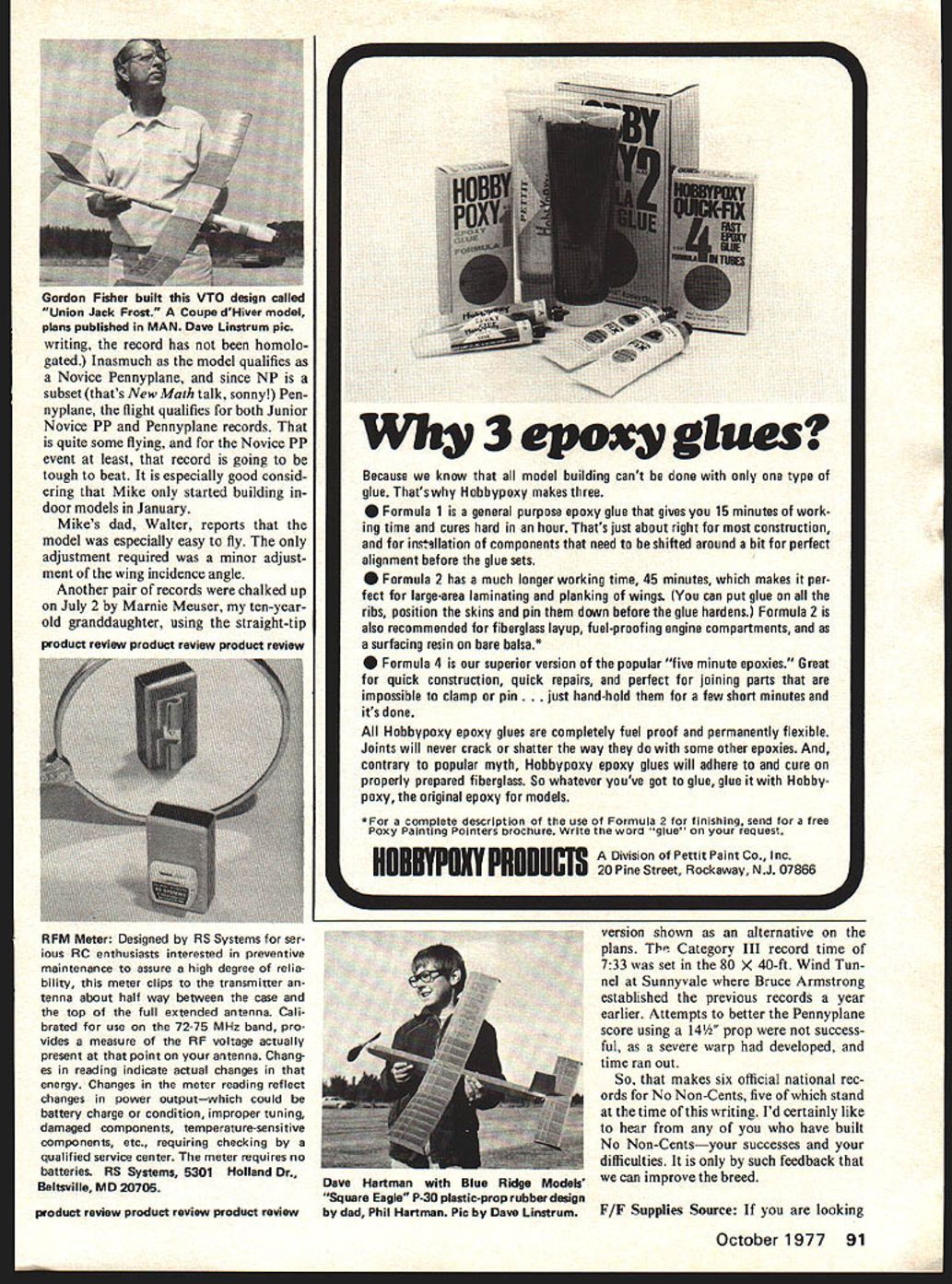
No Non-Cents Strikes Again: Chalk up another four AMA national records for the No Non-Cents. (See construction article in June issue.) Mike Van Gorder, age 11, put it all together for a flight of 9:31 under Category II ceiling height at the Second NIMAS International Record Trials at West Baden, Indiana, in June. (As of this (writing, the record has not been homologated.) Inasmuch as the model qualifies as a Novice Pennyplane, and since NP is a subset (that's New Math talk, sonny!) Pennyplane, the flight qualifies for both Junior Novice PP and Pennyplane records. That is quite some flying, and for the Novice PP event at least, that record is going to be tough to beat. It is especially good considering that Mike only started building indoor models in January.
Mike's dad, Walter, reports that the model was especially easy to fly. The only adjustment required was a minor adjustment of the wing incidence angle.
Another pair of records were chalked up on July 2 by Marnie Meuser, my ten-year-old granddaughter, using the straight-tip version shown as an alternative on the plans. The Category III record time of 7:33 was set in the 80 x 40-ft. wind tunnel at Sunnyvale where Bruce Armstrong established the previous records a year earlier. Attempts to better the Pennyplane score using a 14½" prop were not successful, as a severe warp had developed, and time ran out.
So, that makes six official national records for No Non-Cents, five of which stand at the time of this writing. I'd certainly like to hear from any of you who have built No Non-Cents—your successes and your difficulties. It is only by such feedback that we can improve the breed.
F/F Supplies Source: If you are looking for a one-stop mail-order source, try The Creative Native, 14548 Seventh St., Victorville, CA 92392. Twenty-five cents will get you an eight-page price list. Included are such things as nitrate dope, Floquil paint, balsa and spruce from 1/32-square upward; Peck, Sig, Sterling, Tern Aero, and Micro-X kits; tissue; Wylam plans; Williams Bros. parts; chemicals; and all sorts of goodies.
Country Boy Kit: Jim Clem's Country Boy featured in the March issue, is now available in kit form. If your dealer doesn't have it, order direct from Clemcraft, P.O. Box 524, Sand Springs, OK 74063, or from FAI Supply.
Attention, Modelers' Wives! On Saturday I bought a new garden hose of the highest quality, and a new power lawn mower. On Sunday, I accidentally cut the new hose in half with the new lawn mower. Now, the moral of this story is that modelers' wives should not require their husbands to take time away from modeling in order to water the garden, mow the lawn, and such . . . .
Bob Meuser, 4200 Gregory St., Oakland, CA 94619.
Transcribed from original scans by AI. Minor OCR errors may remain.

