
FREE FLIGHT: DURATION
Louis Joyner, 4221 Old Leeds Rd., Birmingham, AL 35213
Site and conditions
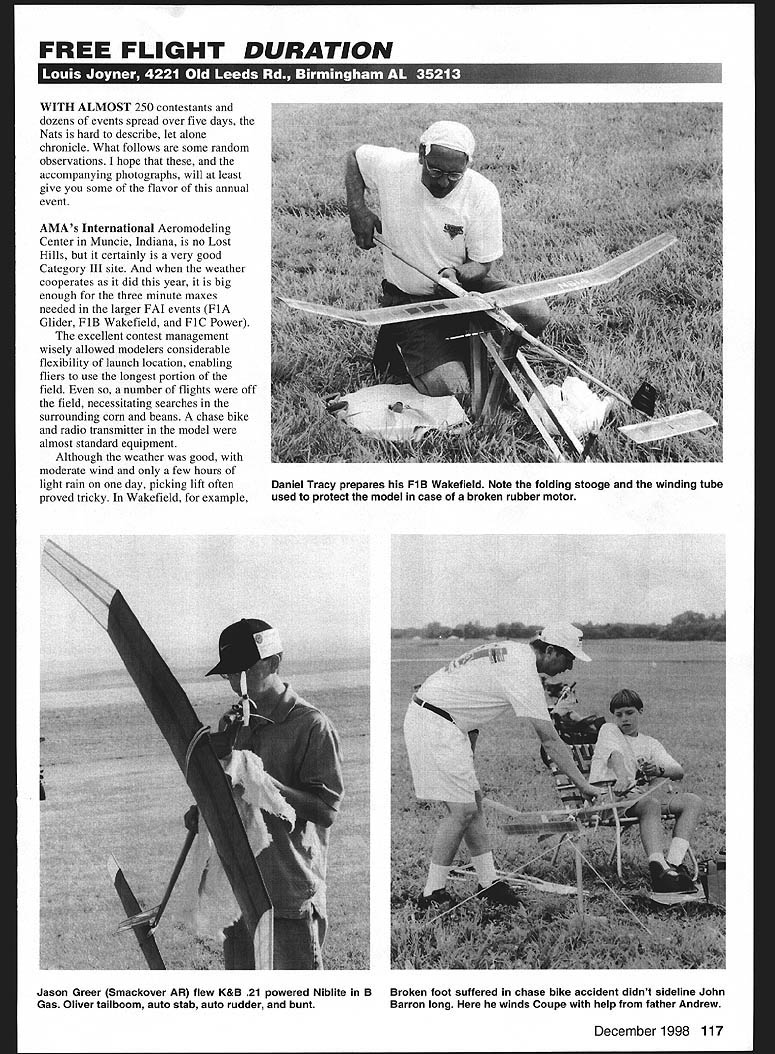
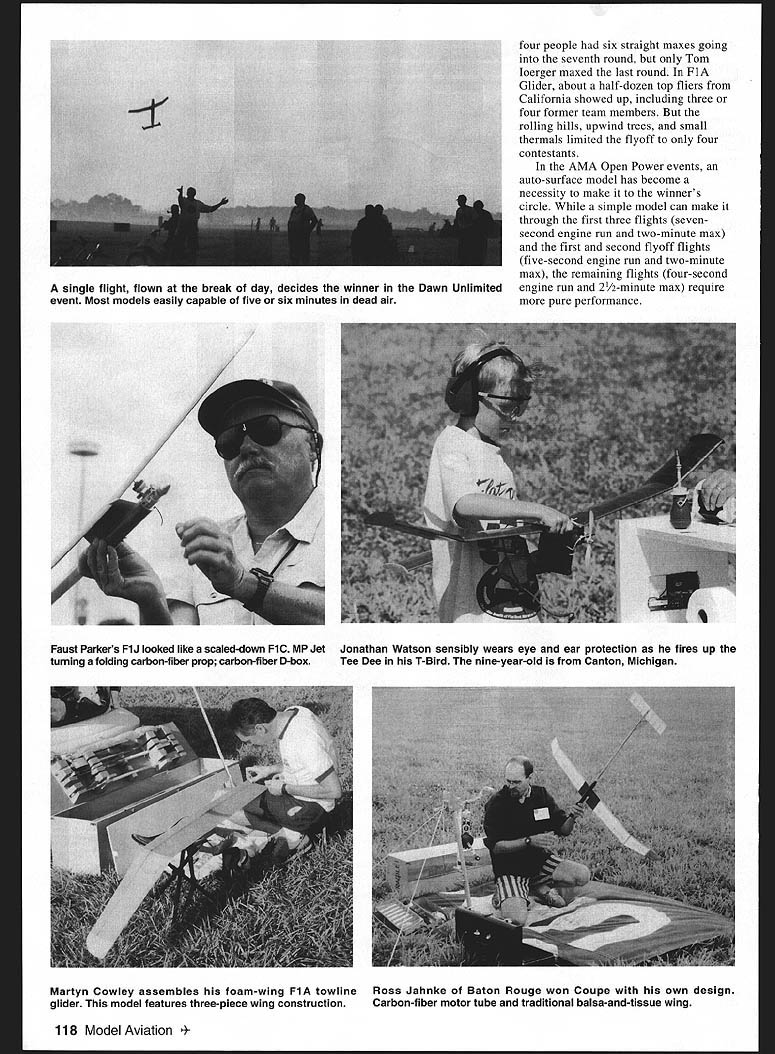
With almost 250 contestants and dozens of events spread over five days, the Nats is hard to describe, let alone chronicle. What follows are some random observations. I hope that these, and the accompanying photographs, will at least give you some of the flavor of this annual event.
AMA's International Aeromodeling Center in Muncie, Indiana, is no Lost Hills, but it certainly is a very good Category III site. And when the weather cooperates as it did this year, it is big enough for the three-minute maxes needed in the larger FAI events:
- F1A Glider
- F1B Wakefield
- F1C Power
The excellent contest management wisely allowed modelers considerable flexibility of launch location, enabling fliers to use the longest portion of the field. Even so, a number of flights were off the field, necessitating searches in the surrounding corn and beans. A chase bike and a radio transmitter in the model were almost standard equipment.
Although the weather was good, with moderate wind and only a few hours of light rain on one day, picking lift often proved tricky. In Wakefield, for example, four people had six straight maxes going into the seventh round, but only Tom Loerger maxed the last round. In F1A Glider, about a half-dozen top fliers from California showed up, including three or four former team members. But the rolling hills, upwind trees, and small thermals limited the flyoff to only four contestants.
Open Power trends and models
In the AMA Open Power events, an auto-surface model has become a necessity to make it to the winner's circle. While a simple model can make it through the first three flights (seven-second engine run and two-minute max) and the first and second flyoff flights (five-second engine run and two-minute max), the remaining flights (four-second engine run and 2½-minute max) require more pure performance.
Winning not only requires a high-performance model, it also requires a consistent one. It also requires careful attention to detail, and a good chase crew to rack up the two dozen or more flights needed to win.
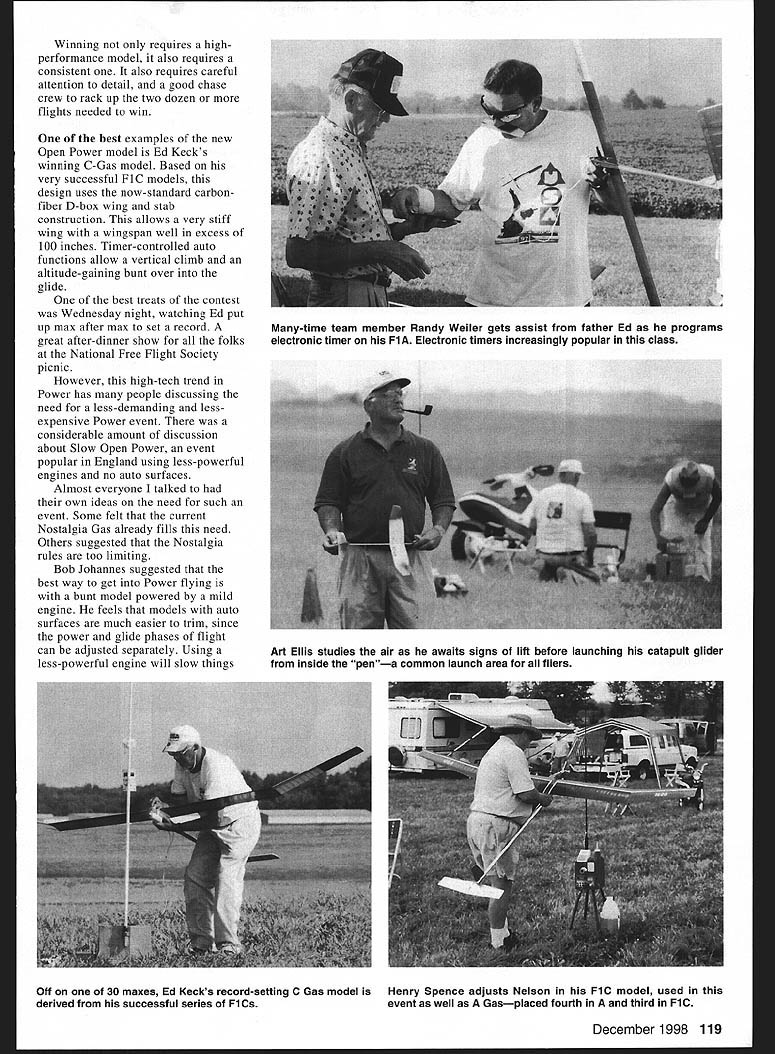
One of the best examples of the new Open Power model is Ed Keck's winning C-Gas design. Based on his very successful F1C models, this design uses the now-standard carbon-fiber D-box wing and stab construction. This allows a very stiff wing with a wingspan well in excess of 100 inches. Timer-controlled auto functions allow a vertical climb and an altitude-gaining bunt over into the glide.
One of the best treats of the contest was Wednesday night, watching Ed put up max after max to set a record. A great after-dinner show for the folks at the National Free Flight Society picnic.
However, this high-tech trend in Power has many people discussing the need for a less-demanding and less-expensive Power event. There was a considerable amount of discussion about Slow Open Power, an event popular in England using less-powerful engines and no auto surfaces.
Almost everyone I talked to had their own ideas on the need for such an event. Some felt that the current Nostalgia Gas already fills this need. Others suggested that the Nostalgia rules are too limiting.
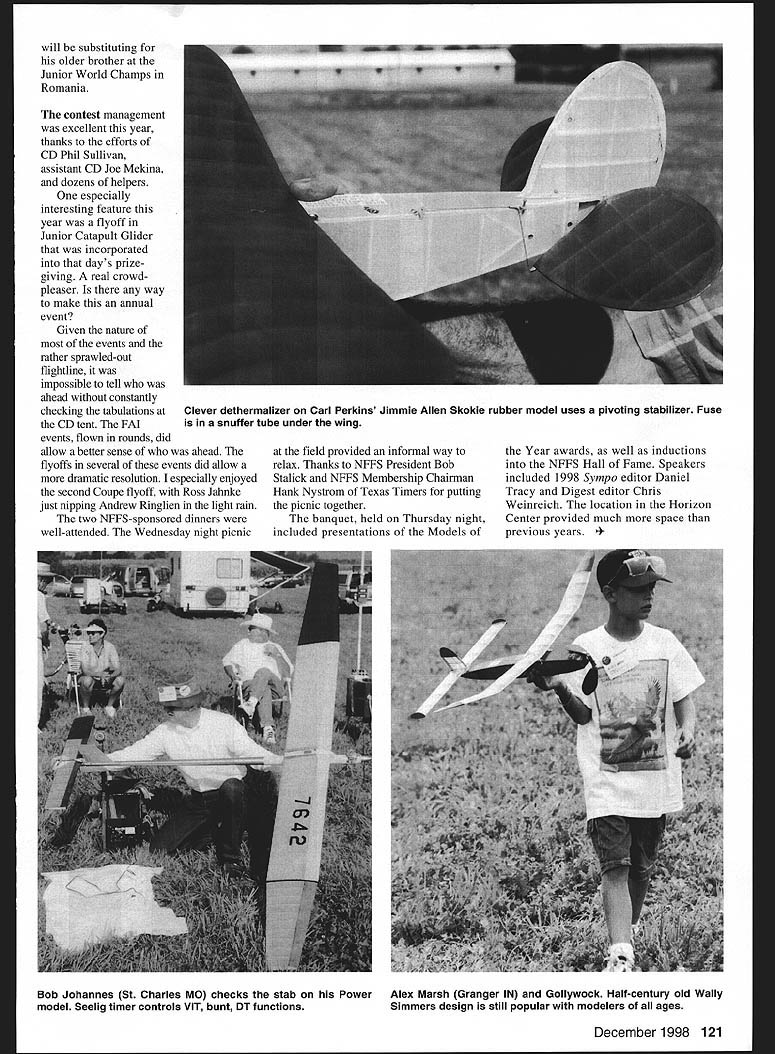
Bob Johannes suggested that the best way to get into Power flying is with a bunt model powered by a mild engine. He feels that models with auto surfaces are much easier to trim, since the power and glide phases of flight can be adjusted separately. Using a less-powerful engine will slow things down and make adjustments less critical.
Nostalgia and one-design events
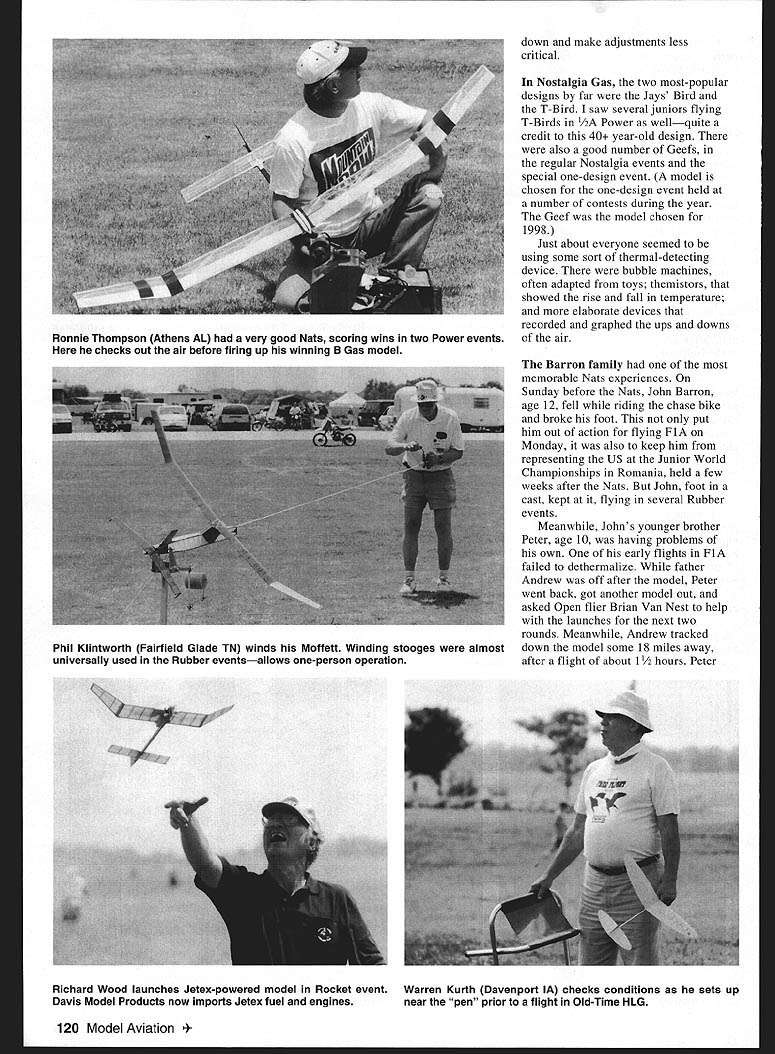
In Nostalgia Gas, the two most-popular designs by far were the Jay's Bird and the T-Bird. I saw several juniors flying T-Birds in 1/2A Power as well—quite a credit to this 40+ year-old design. There were also a good number of Geefs, in the regular Nostalgia events and the special one-design event. (A model is chosen for the one-design event held at a number of contests during the year. The Geef was the model chosen for 1998.)
Just about everyone seemed to be using some sort of thermal-detecting device. There were bubble machines, often adapted from toys; thermistors that showed the rise and fall in temperature; and more elaborate devices that recorded and graphed the ups and downs of the air.
Junior highlights and memorable stories
The Barron family had one of the most memorable Nats experiences. On the Sunday before the Nats, John Barron, age 12, fell while riding the chase bike and broke his foot. This not only put him out of action for flying F1A on Monday, it also kept him from representing the US at the Junior World Championships in Romania, held a few weeks after the Nats. But John, foot in a cast, kept at it, flying in several Rubber events.
Meanwhile, John's younger brother Peter, age 10, was having problems of his own. One of his early flights in F1A failed to thermalize. While father Andrew was off after the model, Peter went back, got another model out, and asked Open flier Brian Van Nest to help with the launches for the next two rounds. Meanwhile, Andrew tracked down the lost model some 18 miles away, after a flight of about 1½ hours. Peter will be substituting for his older brother at the Junior World Champs in Romania.
Contest management and flyoffs
The contest management was excellent this year, thanks to the efforts of Contest Director Phil Sullivan, assistant CD Joe Mekina, and dozens of helpers.
One especially interesting feature this year was a flyoff in Junior Catapult Glider that was incorporated into that day's prize-giving. A real crowd-pleaser. Is there any way to make this an annual event?
Given the nature of most of the events and the rather sprawled-out flightline, it was impossible to tell who was ahead without constantly checking the tabulations at the CD tent. The FAI events, flown in rounds, did allow a better sense of who was ahead. The flyoffs in several of these events did allow a more dramatic resolution. I especially enjoyed the second Coupe flyoff, with Ross Jahnke just nipping Andrew Ringlien in the light rain.
Social events and awards
The two NFFS-sponsored dinners were well-attended. The Wednesday night picnic at the field provided an informal way to relax. Thanks to NFFS President Bob Stacklin and NFFS Membership Chairman Hank Nystrom of Texas Timers for putting the picnic together.
The banquet, held on Thursday night, included presentations of the Models of the Year awards, as well as inductions into the NFFS Hall of Fame. Speakers included 1998 Sympo editor Daniel Tracy and Digest editor Chris Weinreich. The location in the Horizon Center provided much more space than previous years.
Transcribed from original scans by AI. Minor OCR errors may remain.

