
FREE FLIGHT DURATION
SERENA
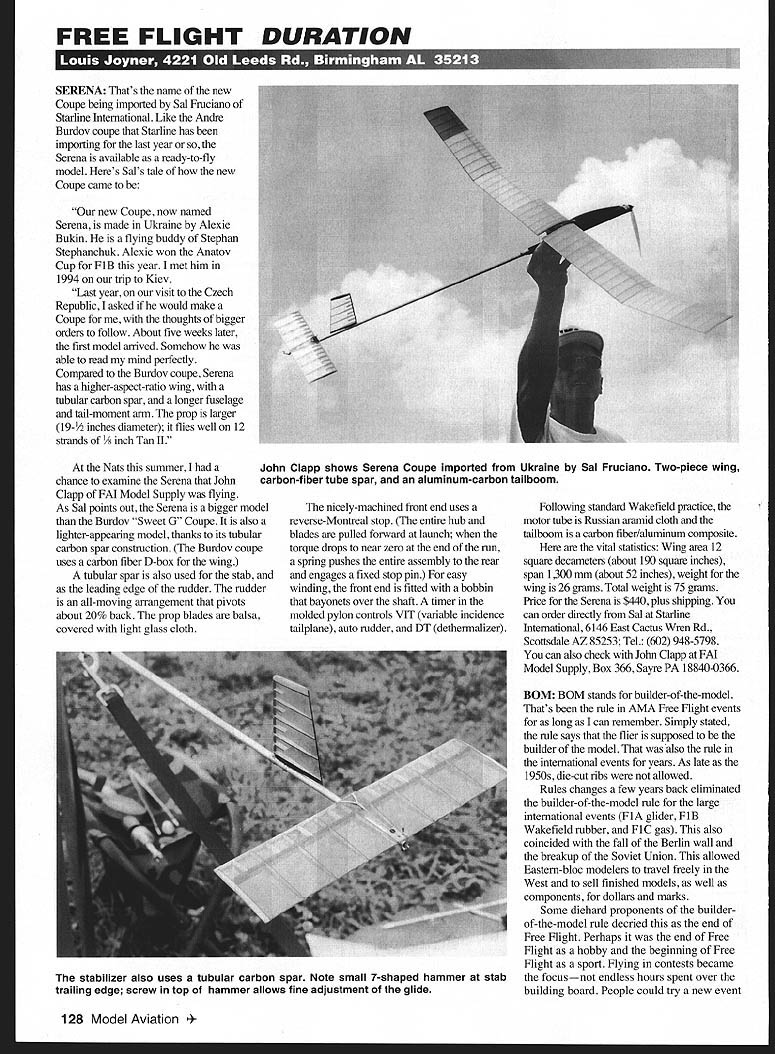
"Serena" is the name of the new Coupe being imported by Sal Fruciano of Starline International. Like the Andre Burdov coupe that Starline has been importing for the last year or so, the Serena is available as a ready-to-fly model. Here's Sal's tale of how the new Coupe came to be:
"Our new Coupe, now named Serena, is made in Ukraine by Alexie Bukin. He is a flying buddy of Stephan Stephanchuk. Alexie won the Anatov Cup for F1B this year. I met him in 1994 on our trip to Kiev.
"Last year, on our visit to the Czech Republic, I asked if he would make a Coupe for me, with the thoughts of bigger orders to follow. About five weeks later, the first model arrived. Somehow he was able to read my mind perfectly.
"Compared to the Burdov coupe, Serena has a higher-aspect-ratio wing, a tubular carbon spar, and a longer fuselage and tail-moment arm. The prop is larger (19-1/4 inches diameter); it flies well on 12 strands of 1/8 inch Tan II.
"At the Nats this summer, I had a chance to examine the Serena that John Clapp of FAI Model Supply was flying."
As Sal points out, the Serena is a bigger model than the Burdov "Sweet G" Coupe. It is also a lighter-appearing model, thanks to its tubular carbon spar construction. (The Burdov coupe uses a carbon fiber D-box for the wing.)
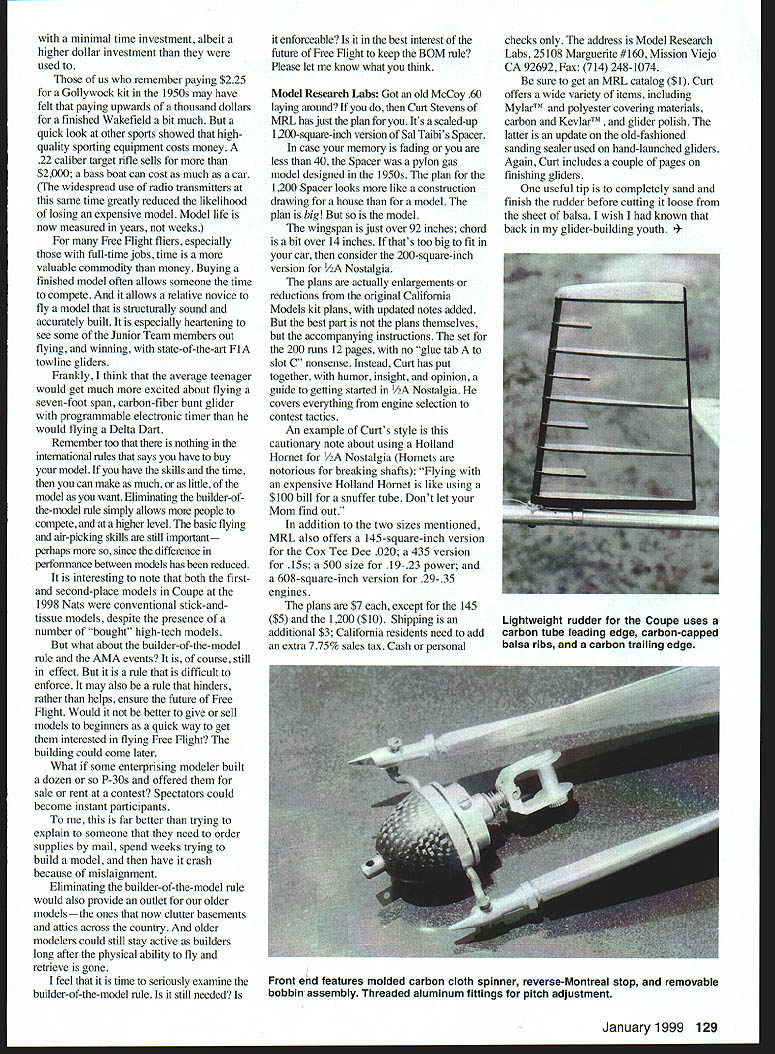
A tubular spar is also used for the stab, and as the leading edge of the rudder. The rudder is an all-moving arrangement that pivots about 20% back. The prop blades are balsa covered with light glass cloth.
The nicely machined front end uses a reverse-Montreal stop. The entire hub and blades are pulled forward at launch; when the torque drops to near zero at the end of the run, a spring pushes the entire assembly to the rear and engages a fixed stop pin. For easy winding, the front end is fitted with a bobbin that bayonets over the shaft. A timer in the molded pylon controls VIT (variable incidence tailplane), auto rudder, and DT (dethermalizer).
Following standard Wakefield practice, the motor tube is Russian aramid cloth and the tailboom is a carbon fiber/aluminum composite.
Vital statistics
- Wing area: 12 square decameters (about 190 square inches)
- Span: 1300 mm (about 52 inches)
- Wing weight: 26 grams
- Total weight: 75 grams
- Price: $440, plus shipping
You can order directly from Sal at Starline International, 6146 East Cactus Wren Rd., Scottsdale, AZ 85253; Tel. (602) 948-5798. You can also check with John Clapp at FAI Model Supply, Box 366, Sayre, PA 18840-0366.
BOM
BOM: BOM stands for builder-of-the-model. That's been the rule in AMA Free Flight events for as long as I can remember. Simply stated, the rule says that the flier is supposed to be the builder of the model. That was also the rule in the international events for years. As late as the 1950s, die-cut ribs were not allowed.
Rules changes a few years back eliminated the builder-of-the-model rule for the large international events (F1A glider, F1B Wakefield rubber, and F1C gas). This also coincided with the fall of the Berlin Wall and the breakup of the Soviet Union. This allowed Eastern-bloc modelers to travel freely in the West and to sell finished models, as well as components, for dollars and marks.
Some diehard proponents of the builder-of-the-model rule decried this as the end of Free Flight. Perhaps it was the end of Free Flight as a hobby and the beginning of Free Flight as a sport. Flying in contests became the focus—not endless hours spent over the building board. People could try a new event with a minimal time investment, albeit a higher dollar investment than they were used to.
Those of us who remember paying $2.25 for a Gollywock kit in the 1950s may have felt that paying upwards of a thousand dollars for a finished Wakefield was a bit much. But a quick look at other sports showed that high-quality sporting equipment costs money. A .22 caliber target rifle sells for more than $2,000; a bass boat can cost as much as a car. The widespread use of radio transmitters at this same time greatly reduced the likelihood of losing an expensive model. Model life is now measured in years, not weeks.
For many Free Flight fliers, especially those with full-time jobs, time is a more valuable commodity than money. Buying a finished model often allows someone the time to compete, and it allows a relative novice to fly a model that is structurally sound and accurately built. It is especially heartening to see some of the Junior Team members out flying, and winning, with state-of-the-art F1A towline gliders.
Frankly, I think that the average teenager would get much more excited about flying a seven-foot span, carbon-fiber bunt glider with a programmable electronic timer than he would flying a Delta Dart.
Remember too that there is nothing in the international rules that says you have to buy your model. If you have the skills and the time, then you can make as much, or as little, of the model as you want. Eliminating the builder-of-the-model rule simply allows more people to compete, and at a higher level. The basic flying and air-picking skills are still important—perhaps more so, since the difference in performance between models has been reduced.
It is interesting to note that both the first- and second-place models in Coupe at the 1998 Nats were conventional stick-and-tissue models, despite the presence of a number of "bought" high-tech models.
But what about the builder-of-the-model rule and the AMA events? It is, of course, still in effect. But it is a rule that is difficult to enforce. It may also be a rule that hinders, rather than helps, the future of Free Flight. Would it not be better to give or sell models to beginners as a quick way to get them interested in flying Free Flight? The building could come later.
What if some enterprising modeler built a dozen or so P-30s and offered them for sale or rent at a contest? Spectators could become instant participants. To me, this is far better than trying to explain to someone that they need to order supplies by mail, spend weeks trying to build a model, and then have it crash because of misalignment.
Eliminating the builder-of-the-model rule would also provide an outlet for our older models—those that now clutter basements and attics across the country. Older modelers could still stay active as builders long after the physical ability to fly and retrieve is gone.
I feel that it is time to seriously examine the builder-of-the-model rule. Is it still needed? Is it enforceable? Is it in the best interest of the future of Free Flight to keep the BOM rule? Please let me know what you think.
MODEL RESEARCH LABS
Got an old McCoy .60 laying around? If you do, Curt Stevens of Model Research Labs (MRL) has just the plan: a scaled-up 1,200-square-inch version of Sal Taibi's Spacer.
In case your memory is fading or you are less than 40, the Spacer was a pylon gas model designed in the 1950s. The 1,200 Spacer plan looks more like a construction drawing for a house than for a model. The plan is big, because the model is big: the wingspan is just over 92 inches and the chord is a bit over 14 inches. If that's too big to fit in your car, consider the 200-square-inch version for 1/2 A Nostalgia.
The plans are enlargements or reductions from the original California Models kit plans, with updated notes added. The best part is the accompanying instructions. The 200-square-inch set runs 12 pages, with no "glue tab A to slot C" nonsense. Instead, Curt has put together, with humor, insight, and opinion, a guide to getting started in 1/2 A Nostalgia. He covers everything from engine selection to contest tactics.
An example of Curt's style is this cautionary note about using a Holland Hornet for 1/2 A Nostalgia (Hornets are notorious for breaking shafts): "Flying with an expensive Holland Hornet is like using a $100 bill for a snuffer tube. Don't let your Mom find out."
Plan sizes available from MRL:
- 1,435-square-inch version for the Cox Tee Dee .020
- 1,200-square-inch version (scaled Spacer)
- 608-square-inch version for .29–.35 engines
- 500-square-inch version for .19–.23 power
- 435-square-inch version for .15s
- 200-square-inch version for 1/2 A Nostalgia
Pricing:
- Most plans: $7 each
- 1,200: $10
- 1,435: $85
- Shipping: $3 additional
- California residents add 7.75% sales tax
- Payment: cash or personal check only
Contact: Model Research Labs, 25108 Marguerite #160, Mission Viejo, CA 92692 Fax: (714) 248-1074
Be sure to get an MRL catalog ($1). Curt offers a wide variety of items, including Mylar and polyester covering materials, carbon and Kevlar, and glider polish. The blaster is an update on the old-fashioned sanding sealer used on hand-launched gliders. Curt also includes a couple of pages on finishing gliders.
One useful tip: completely sand and finish the rudder before cutting it loose from the sheet of balsa. I wish I had known that back in my glider-building youth.
Transcribed from original scans by AI. Minor OCR errors may remain.

