
Free Flight: Duration
Louis Joyner, 4221 Old Leeds Road, Birmingham AL 35213
Team Selection Finals
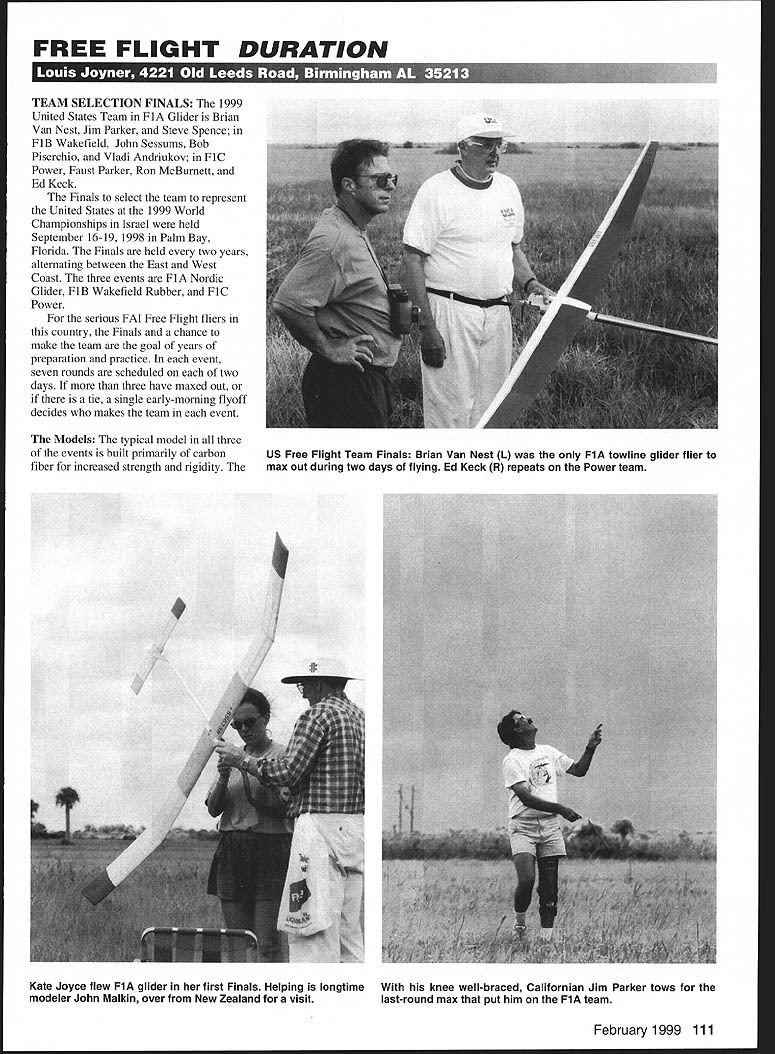
The 1999 United States Team selected at the Finals in Palm Bay, Florida:
- F1A (Glider): Brian Van Nest, Jim Parker, Steve Spence
- F1B (Wakefield): John Sessums, Bob Piserchia, Vladi Andriukov
- F1C (Power): Faust Parker, Ron McBurnett, Ed Keck
The Finals to select the team to represent the United States at the 1999 World Championships in Israel were held September 16–19, 1998, in Palm Bay, Florida. The Finals are held every two years, alternating between the East and West Coast. The three events are F1A Nordic Glider, F1B Wakefield Rubber, and F1C Power.
For serious FAI Free Flight fliers in the U.S., the Finals and a chance to make the team are the goal of years of preparation and practice. In each event, seven rounds are scheduled on each of two days. If more than three have maxed out, or if there is a tie, a single early-morning flyoff decides who makes the team in each event.
Models
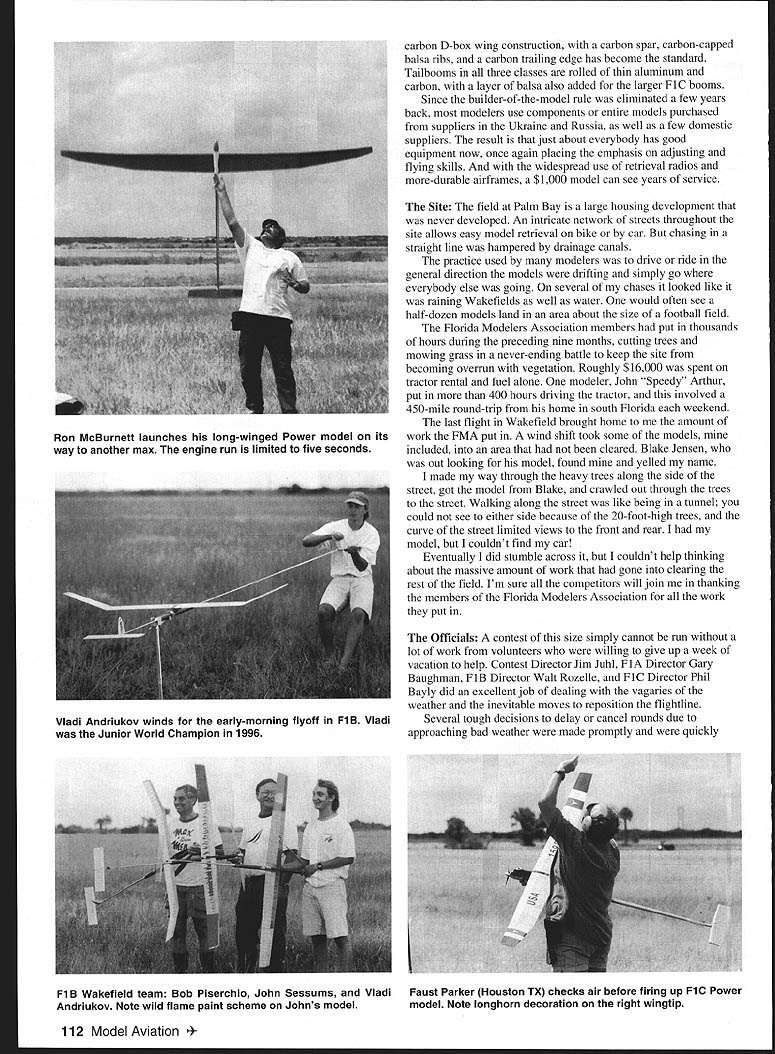
Typical competition models in all three events are built primarily of carbon fiber for increased strength and rigidity. Tailbooms are rolled thin aluminum with a carbon layer; balsa is also used. Larger booms have been added for F1C models.
Since the builder-of-the-model rule was eliminated a few years back, modelers now use components and entire models purchased from suppliers in Ukraine, Russia, and some domestic suppliers. As a result, almost everyone has good equipment now, placing renewed emphasis on flying skill. Widespread use of retrieval radios and more-durable airframes means a $1,000 model can see years of service.
The Site
The Palm Bay field is a large, never-developed housing site. An intricate network of streets throughout the area allows relatively easy model retrieval; however, drainage canals hamper straight-line bike or car chasing. Many modelers simply drive or ride in the general direction models are drifting — following where others go. Several chases resembled raining Wakefields: well-watered areas would often see half a dozen models land in roughly a football-field–sized area.
Florida Modelers Association members put in thousands of hours during the preceding nine months cutting trees and mowing grass — a never-ending battle to keep the site from becoming overrun with vegetation. Roughly $16,000 was spent for tractor rental and fuel alone. Modeler John "Speedy" Arthur logged about 400 hours driving the tractor; he even made a 450-mile round-trip from his home in south Florida one weekend to help retrieve a Wakefield from the last flight.
When a wind shift took some models into an uncleared area, Blake Jensen went out looking for a model. He found it, yelled a name, and made his way through heavy trees along a side street to get the model. Walking along that street felt like being in a tunnel — 20-foot-high trees curved over the road and limited views front and rear, so the modeler initially couldn't find his car. Eventually he stumbled across it.
The amount of work the FMA put in to prepare and maintain the field was enormous. Competitors owe the Florida Modelers Association thanks for their efforts.
Officials
A contest of this size cannot run without many volunteers willing to give up a week of vacation. Contest Director Jim Juhl, F1A Director Gary Baughman, F1B Director Walt Rozelle, and F1C Director Phil Bayly did an excellent job dealing with the vagaries of the weather and the inevitable moves to reposition the flightline. Several tough decisions to delay or cancel rounds due to approaching bad weather were made promptly.
Volunteer timers and scorekeepers pitched in and suffered through the rain. Thanks to everyone involved for a well-run contest.
Family Flying
A number of families were involved in the contest:
- Steve Spence (Glider) — his father Henry made the flyoffs in Power; had Henry flown a half-minute longer, we could have had a father-and-son team member duo.
- Doug Joyce (Power) and his daughter Kate (Glider).
- Three generations of Sessums in Wakefield: Herb, son John, and grandson Tim — John made the team.
- Three Jensens in Wakefield: father Gene, and sons Blake and Dane.
- Dallas Parker proved an able assistant for his dad Jim Parker (Glider), who was hampered by a leg brace from a previous towing accident and later a broken foot that happened at the Finals.
- First-time Wakefield team member Vladi Andriukov was assisted by his father Alex Andriukov, a three-time World Champion. The Andriukov family recently moved from Ukraine to California.
Note: The two Parkers on the teams — Jim (Glider) and Faust (Power) — are not related.
The Weather
In a word: wet. Rain on the first day left most competitors and their models soaked. The wet conditions caused a few problems, such as stalls caused by slats soaked with rain and premature D/Ts caused by nylon lines that had absorbed moisture and lengthened.
At the end of the first day, only Brian Van Nest had maxed out on Glider; eight competitors were "clean" in Wakefield.
The second day was dry and provided the only true thermals of the contest. This was the final day for Glider and the first day for Power (Wakefield fliers had the day off to time). A last-round drop by Hector Diez cost him a team spot, moving Texan Steve Spence into the third slot on the Glider team.
The third day brought overcast conditions but no rain. At the end of flying, six competitors were maxed out in Power and seven were still clean in Wakefield. The flyoff, held the following morning, would be a single flight in each event to determine the team.
The Flyoff
Wakefield flew first under heavily overcast skies with low clouds moving over the field. With a 10-minute window to wind and launch, a blown motor could be a serious problem.
Vladi Andriukov and John Sessums wound and launched early in the round. Both climbed well, but Vladi's model climbed higher — perhaps too high. Meanwhile, Bob Piserchia blew a motor, switched to his backup model, and blew another. Bill Shailor launched but the prop didn't start; he promptly began winding his backup model. The timers had clocked off Vladi at just over 3:30, and his model was lost high in the gray clouds. Bob ultimately got off a good flight and finished second behind John Sessums. Bill Shailor's model D/Td early, spoiling his chance. Vladi's 3:35 was enough for third place and a spot on the Wakefield team.
Power's flyoff offered less drama and more consistency: solid power patterns and excellent glides from the long-winged models. Faust Parker, Ron McBurnett, and Ed Keck earned the Power team spots.
Watch this column for more information about the American team and how you can help sponsor their trip to Israel in August.
Sympo
Bob Perkins, editor for the 1999 Symposium of the National Free Flight Society, is requesting articles on a variety of topics related to AMA and FAI Free Flight.
Categories and topics of interest include:
- Competition model design theory and application
- Avionics and the future of competition modeling
- Selection of ideal airfoils
- Advanced construction methods
- Best propeller design
- Coordinating purchasable model components and accessories
- Optimizing flight adjustments for high performance
- Competing maximally in contests; winning flying tactics in rounds and flyoffs
- AMA builder-of-the-model rule issues and needed AMA rules changes
- Potential guiding role of SIGs (Special Interest Groups) in FAI, AMA, and Nostalgia rules changes
- Low-tech versus high-tech modeling as a divisive issue among competitors
- Opportunities for greater unity between FAI, AMA, Nostalgia, and Old Timer fliers
- Boosting development programs for Junior competition fliers
- Must-do solutions for the US flying-site crisis
If you are interested in contributing a paper, Bob needs an abstract as soon as possible and the completed manuscript by February 20. He would also like black-and-white or color photos, minimum 4 x 6 inches, of any aspect of Free Flight. Please include complete caption information (names, dates, location, etc.). Deadline for photos is March 20.
Send contributions to: Robert L. Perkins, Editor, 2285 Pinchbrook Rd., Columbus OH 43220 Tel: (614) 451-3558 E-mail: edsympo@columbus.rr.com
The 1999 Sympo will be available this July. Watch this column for more information.
New NFFS Publications Manager
After close to two decades handling the sale of Symposia and other NFFS publications, Fred Terzian is taking a well-earned rest.
Beginning in January, Bob McLinden will be running publications. Bob's address is 8256 W. Morraine Ave., #D, Littleton CO 80128. A stamped, self-addressed, legal-size envelope to Bob will get a price list for all available NFFS publications.
Transcribed from original scans by AI. Minor OCR errors may remain.

