
FREE FLIGHT: DURATION
Louis Joyner, 4221 Old Leeds Road, Birmingham AL 35213
MOTOR MAKEUP
When I first got started flying rubber-powered models, just about everybody used 1/4-inch-wide rubber strip. You'd check the plans for the suggested motor length and number of strands, measure out however many feet of rubber that was, tie the ends together, and by trial and error arrange this into a motor.
Sometime in the early 1960s I switched to 1 mm diameter Pirelli Lastex. A typical 50-gram Wakefield was 104 strands—well over 150 feet of spaghetti. I soon learned to make up motors by winding the rubber onto a sheet of thick balsa cut to the required length. Then I'd slip it off and bind the ends of the motor with small rubber bands.
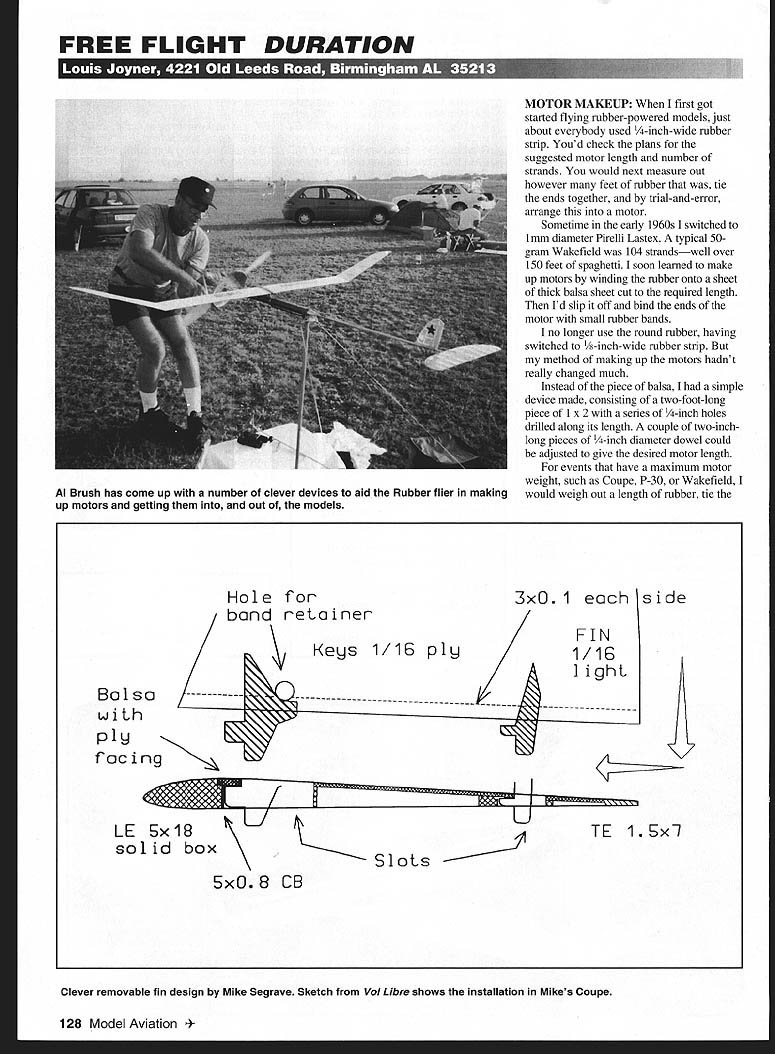
I no longer use the round rubber, having switched to 1/8-inch-wide rubber strip, but my method of making up the motors hasn't really changed much. Instead of the piece of balsa, I had a simple device made consisting of a two-foot-long piece of 1 x 2 with a series of 1/4-inch holes drilled along its length. A couple of two-inch-long pieces of 1/4-inch diameter dowel could be adjusted to give the desired motor length.
For events that have a maximum motor weight, such as Coupe, P-30, or Wakefield, I would weigh out a length of rubber, tie the ends together, and start winding it around the two dowels. Of course, things didn't work out evenly the first time, so I would have to unwind the rubber, move one of the dowels a fraction of an inch, and try again. It was time-consuming, but relatively mindless (I don't think I've ever made up a motor when I wasn't watching television).
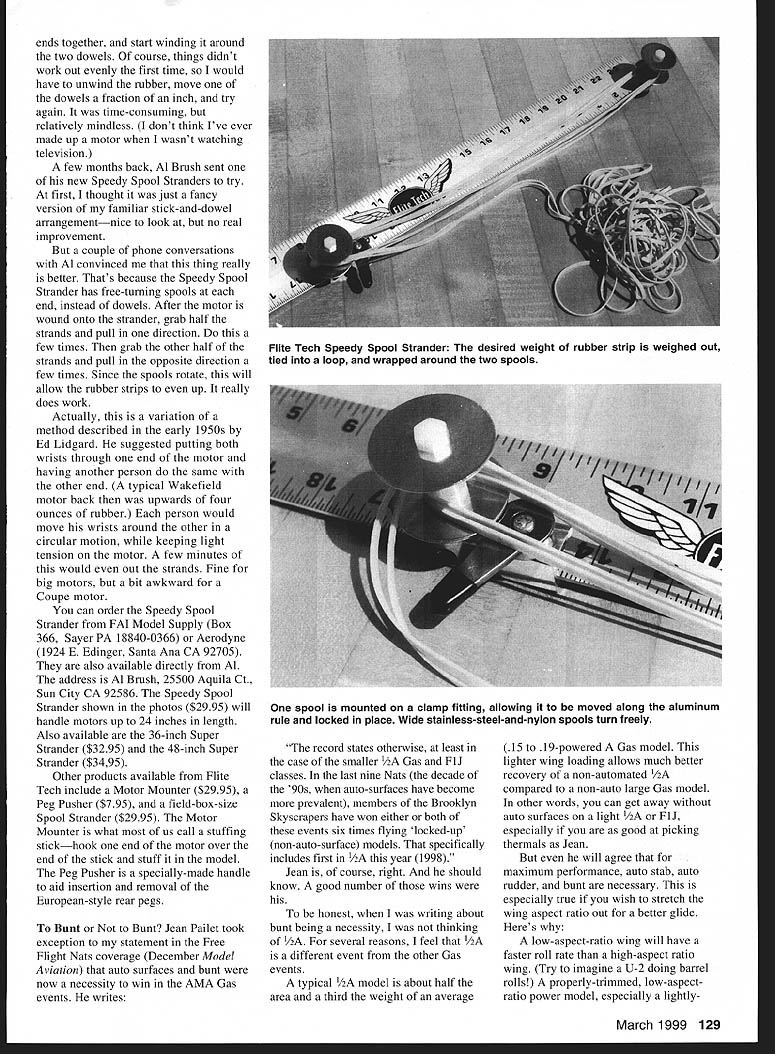
A few months back Al Brush sent one of his new Speedy Spool Stranders to try. At first I thought it was just a fancy version of my familiar stick-and-dowel arrangement—nice to look at, but no real improvement. After a couple of phone conversations with Al I was convinced this thing really is better. That's because the Speedy Spool Strander has free-turning spools at each end, instead of dowels. After the motor is wound onto the strander, grab half the strands and pull in one direction a few times, then grab the other half and pull in the opposite direction a few times. Since the spools rotate, this allows the rubber strips to even up. It really does work.
This is a variation of a method described in the early 1950s by Ed Lidgard. He suggested putting both wrists through one end of the motor and having another person do the same with the other end. Each person would move his wrists around the other in a circular motion while keeping light tension on the motor. A few minutes of this would even out the strands. Fine for big motors, but a bit awkward for a Coupe motor.
You can order the Speedy Spool Strander from FAI Model Supply (Box 366, Sayer PA 18840-0366) or Aerodyne (1924 E. Edinger, Santa Ana CA 92705). They are also available directly from Al Brush, 25500 Aquila Ct., Sun City CA 92586. The Speedy Spool Strander shown in the photos ($29.95) will handle motors up to 24 inches in length. Also available are the 36-inch Super Strander ($32.95) and the 48-inch Super Strander ($34.95).
Other products available from Flite Tech include:
- Motor Mounter ($29.95) — what most of us call a stuffing stick: hook one end of the motor over the end of the stick and stuff it in the model.
- Peg Pusher ($7.95) — a specially made handle to aid insertion and removal of the European-style rear pegs.
- Field-box-size Spool Strander ($29.95).
TO BUNT OR NOT TO BUNT?
Jean Pailet took exception to my statement in the Free Flight Nats coverage (December Model Aviation) that auto surfaces and bunt were now a necessity to win in the AMA Gas events. He writes:
"The record states otherwise, at least in the case of the smaller 1/2A Gas and F1J classes. In the last nine Nats (the decade of the '90s, when auto-surfaces have become more prevalent), members of the Brooklyn Skyscrapers have won either one or both of these events six times flying locked-up (non-auto-surface) models. That specifically includes first in 1/2A this year (1998)."
Jean is, of course, right, and he should know — a good number of those wins were his.
When I wrote that bunt was a necessity, I was not thinking of 1/2A. For several reasons, 1/2A is a different event from the larger Gas classes. A typical 1/2A model is about half the area and a third the weight of an average 1.5 to .19-powered A Gas model. This lighter wing loading allows much better recovery of a non-automated 1/2A compared to a non-auto large Gas model. In other words, you can get away without auto surfaces on a light 1/2A or F1J, especially if you are as good at picking thermals as Jean.
But even we will agree that for maximum performance, auto stab, auto rudder, and bunt are necessary—especially if you wish to stretch the wing aspect ratio out for a lot of glide. Here's why:
A low-aspect-ratio wing will have a faster roll rate than a high-aspect-ratio wing (try to imagine a U-2 doing barrel rolls!). A properly trimmed, low-aspect-ratio power model, especially a lightly loaded one, can roll easily from a spiral climb into its glide. With a high-aspect-ratio wing, a spiral climb is more difficult to achieve and the transition from power to glide can be problematic.
That's why just about all the F1C power models now use auto surfaces. The climb is typically near vertical with a slight roll (180° in five seconds). For the climb, the stab is held down at the trailing edge to give near zero decalage (the difference between the wing and stab incidence). After the engine stops, the model continues to coast upward, gaining more altitude. Then the stab is briefly tripped down at the back, pushing the model over from the vertical into the start of an outside loop—this is what's known as the bunt. When the model is approximately horizontal, the stab trailing edge comes up to the glide setting.
In addition to the performance advantage, trimming an auto-surface model to maximum performance is actually easier than for a non-auto model, because the various phases of the flight (climb, bunt, and glide) can be adjusted independently. The disadvantages are increased complexity of construction and a more involved flight preparation (you have to hook up the right lines). With a locked-up model, an adjustment to correct some problem in the power pattern will also affect the glide, and vice versa.
The advantages of non-auto-surface models are simpler construction and easier flight preparation. Because of these differences, there is a lot of discussion about dividing power into two categories: one for auto-surface models and another for locked-up models. You will be hearing more about this as various proposals such as Slow Open Power are discussed.
Jean also reminded me that I had neglected to mention that five Free Flight clubs helped with the daily running of the Nats. Basically each club took on a day to help with processing models, recording scores, and all the other tasks required to make a major meet function smoothly. Thanks to the Brainbusters, the Central Indiana Aeromodellers, the Central Ohio Free Flighters, the Skyscrapers, and the Tri-County Aero Club.
OFF WITH HIS FIN
I have never been a big fan of fins mounted on stabs. There is always the chance of something shifting back there with disastrous consequences. But the worst part of a stab-mounted fin is how to store it.
A stab without a fin is a slim thing that will fit easily into a narrow slot in your model box. Add the fin and you've got an awkward assembly that takes up ten times as much space. If you are designing your own model you can, of course, place the fin where it really belongs: firmly attached to the fuselage. However, many Nostalgia or Old-Timer designs have the fin attached to the stab (and often it is a very large fin). Making the fin removable will save a lot of storage space.
Through the years I've seen a few ideas for removable fins, usually involving some sort of wire-and-tubing arrangement. One or two even allowed for adjusting the entire fin for turn. Most depended on the friction of the wire in the tubing to hold everything in place.
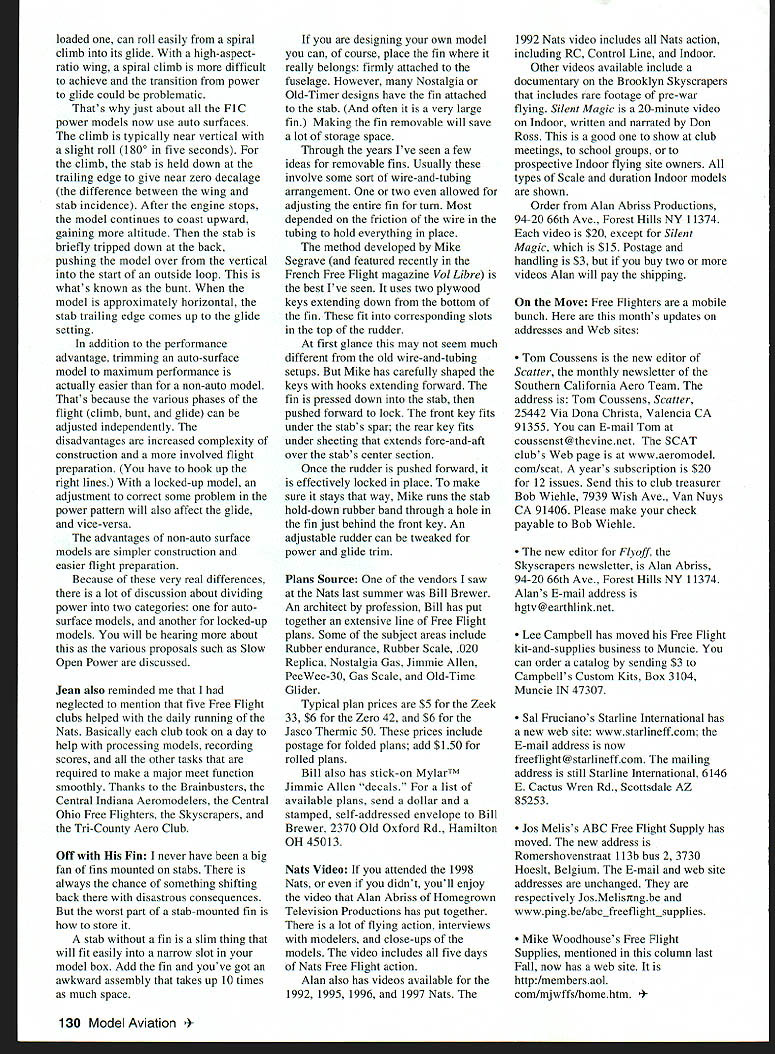
The method developed by Mike Segrave (featured recently in the French Free Flight magazine Vol Libre) is the best I've seen. It uses two plywood keys extending down from the bottom of the fin. These fit into corresponding slots in the top of the rudder. Mike carefully shapes the keys with hooks extending forward. The fin is pressed down into the stab, then pushed forward to lock: the front key fits under the stab's spar; the rear key fits under sheeting that extends fore-and-aft over the stab's center section.
Once the rudder is pushed forward, it is effectively locked in place. To make sure it stays that way, Mike runs the stab hold-down rubber band through a hole in the fin just behind the front key. An adjustable rudder can be tweaked for power and glide trim.
PLANS SOURCE
One of the vendors I saw at the Nats last summer was Bill Brewer. An architect by profession, Bill has put together an extensive line of Free Flight plans, including Rubber endurance, Rubber Scale, .020 Replica, Nostalgia Gas, Jimmie Allen, PeeWee-30, Gas Scale, and Old-Time Glider.
Typical plan prices are:
- $5 for the Zeek 33,
- $6 for the Zero 42,
- $6 for the Tasco Thermic 50.
These prices include postage for folded plans; add $1.50 for rolled plans. Bill also has stick-on Mylar "Jimmie Allen" decals. For a list of available plans, send a dollar and a stamped, self-addressed envelope to Bill Brewer, 2370 Old Oxford Rd., Hamilton OH 45013.
NATS VIDEO
If you attended the 1998 Nats, or even if you didn't, you'll enjoy the video that Alan Abriss of Homegrown Television Productions has put together. There is a lot of flying action, interviews with modelers, and close-ups of the models. The video includes all five days of Nats Free Flight action.
Alan also has videos available for the 1992, 1995, 1996, and 1997 Nats. The 1992 Nats video includes all Nats action, including RC, Control Line, and Indoor. Other videos include a documentary on the Brooklyn Skyscrapers with rare pre-war flying footage, and Silent Magic, a 20-minute video on Indoor written and narrated by Don Ross—good to show at club meetings, to school groups, or to prospective Indoor flying site owners. All types of Scale and duration Indoor models are shown.
Order from: Alan Abriss Productions, 94-20 66th Ave., Forest Hills NY 11374. Each video is $20, except Silent Magic which is $15. Postage and handling is $3, but if you buy two or more videos Alan will pay the shipping.
ON THE MOVE
Free Flighters are a mobile bunch. Here are this month's updates on addresses and Web sites:
- Tom Coussens is the new editor of Scatter, the monthly newsletter of the Southern California Aero Team. Address: Tom Coussens, Scatter, 25442 Via Dona Christa, Valencia CA 91355. E-mail: coussens@thevine.net. The SCAT club's Web page is www.aeromodel.com/scat. A year's subscription is $20 for 12 issues. Send this to club treasurer Bob Wiehle, 7939 Whis Ave., Van Nuys CA 91406. Please make your check payable to Bob Wiehle.
- The new editor for Flyoff, the Skyscrapers newsletter, is Alan Abriss, 94-20 66th Ave., Forest Hills NY 11374. Alan's e-mail address is abriss@earthlink.net.
- Lee Campbell has moved his Free Flight kit-and-supplies business to Muncie. You can order a catalog by sending $3 to Campbell's Custom Kits, Box 3104, Muncie IN 47307.
- Sal Fruciano's Starline International has a new web site: www.starlineff.com; the e-mail address is freeflight@starlineff.com. The mailing address is still Starline International, 6146 E. Cactus Wren Rd., Scottsdale AZ 85253.
- Jos Melis's ABC Free Flight Supply has moved. The new address is Rommershovenstraat 113 b 2, 3730 Hoeselt, Belgium. The e-mail and web site addresses are unchanged: Jos.Melis@telenet.be and www.ping.be/abc_freeflight_supplies.
- Mike Woodhouse's Free Flight Supplies now has a web site: http://members.aol.com/mjwffshome.htm
Transcribed from original scans by AI. Minor OCR errors may remain.

