
FREE FLIGHT DURATION
Louis Joyner, 4221 Old Leeds Road, Birmingham AL 35213
Tips
The shape we give the wingtips of our Free Flight models is based a bit on aerodynamic theory, some on the practicalities of construction, and—perhaps, more than we care to admit—on fashion.
The tip of a wing, or any flying surface for that matter, is an aerodynamic special case. At the tip, the air is not flowing straight from front to rear, as it is over the rest of the wing. Instead, it is curling up from beneath the wingtip, rolling and wrapping itself into a spiraling vortex trailing off the tip. This vortex produces quite a bit of drag. (That is why wind-tunnel test airfoils extend the full width of the tunnel.)
For generations, modelers, as well as designers of full-scale aircraft, have tried a number of things to reduce the size and effect of the tip vortex.
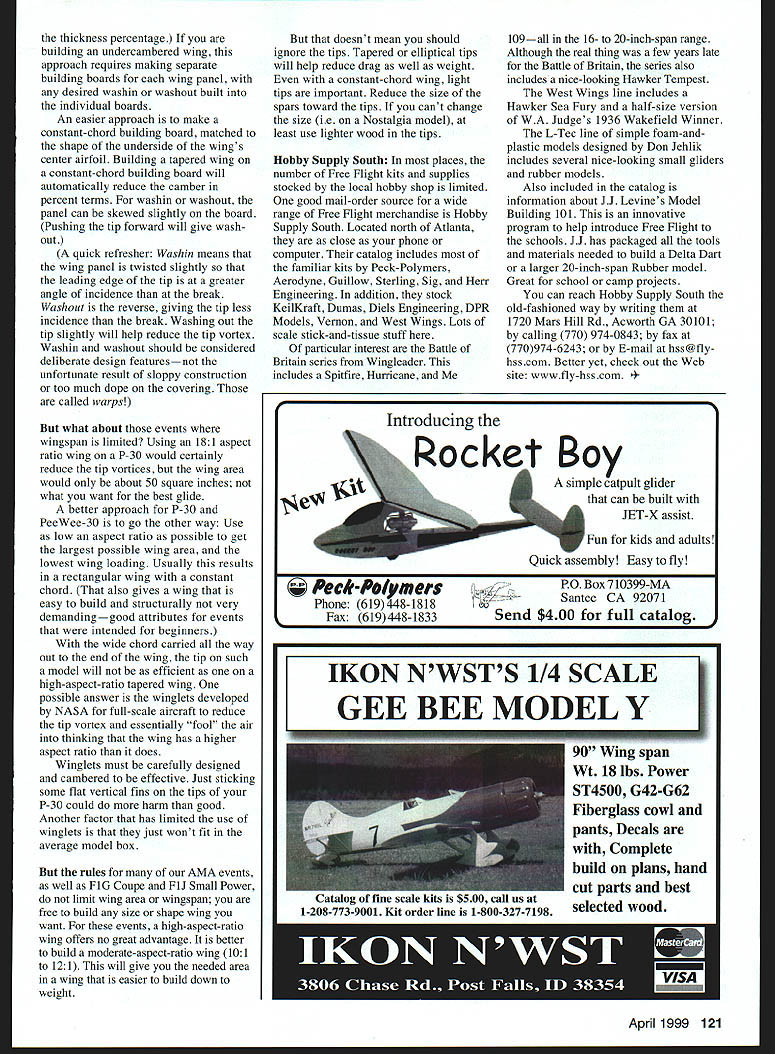
The easiest way is to simply reduce the size of the tip itself. By increasing the aspect ratio (the ratio of span to average chord) you reduce the chord at the tip. There are some other aerodynamic advantages for increasing the wing aspect ratio for certain model classes.
With the improvements in construction materials over the last two decades, aspect ratios for area-restricted events such as F1A Glider, F1B Wakefield, and F1C Power have increased dramatically. A typical power model of the 1970s had a wing aspect ratio of around 10:1; the latest models are pushing 18:1.
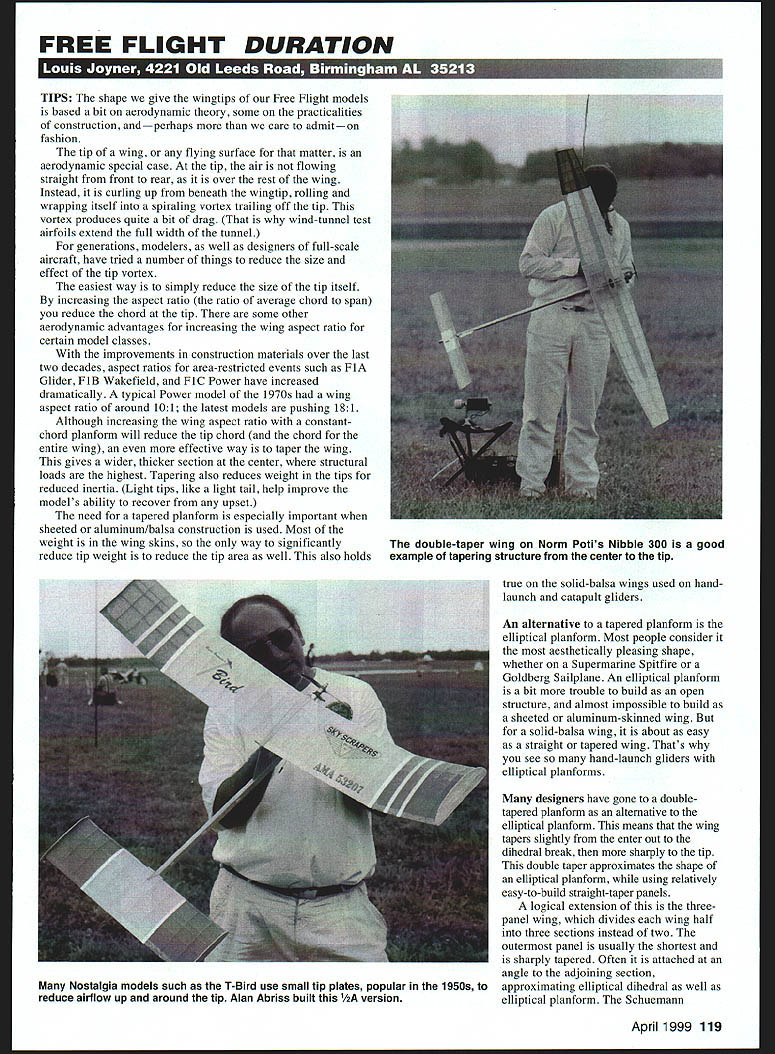
Although increasing the wing aspect ratio with a constant-chord planform will reduce the tip chord (and the chord for the entire wing), an even more effective way is to taper the wing. This gives a wider, thicker section at the center, where structural loads are the highest. Tapering also reduces weight in the tips for reduced inertia. (Light tips, like a light tail, help improve the model's ability to recover from any upset.)
The need for a tapered planform is especially important when sheeted or aluminum/balsa construction is used. Most of the weight is in the wing skins, so the only way to significantly reduce tip weight is to reduce the tip area as well. This also holds true on the solid-balsa wings used on hand-launch and catapult gliders.
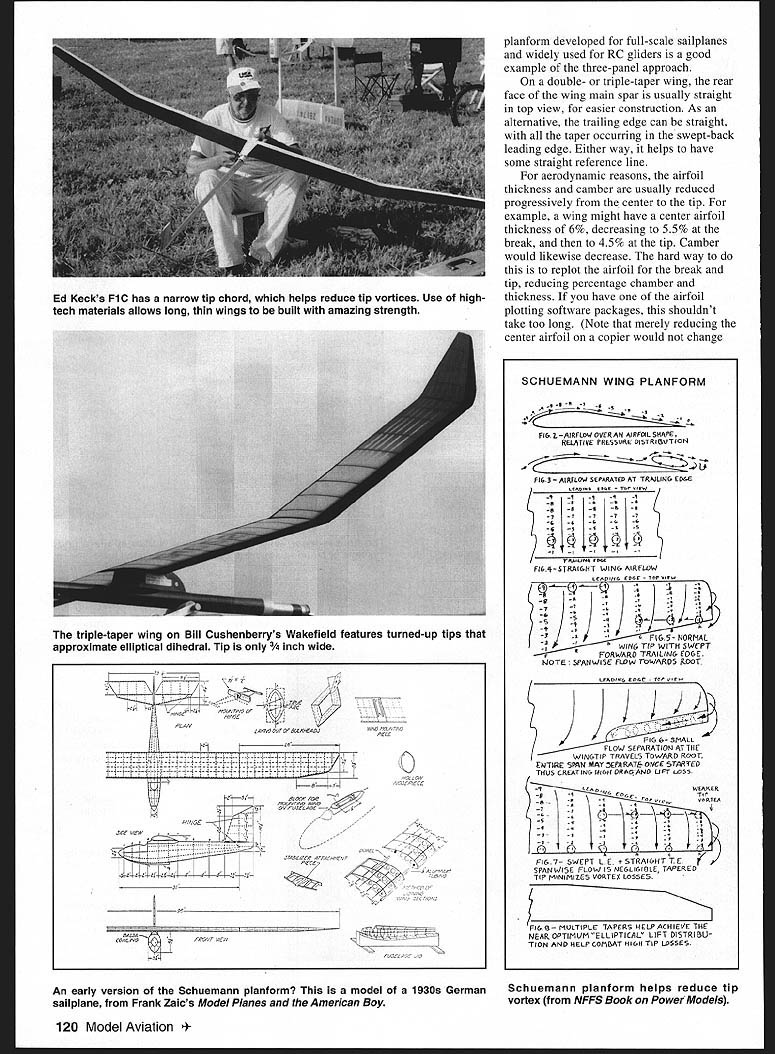
An alternative to a tapered planform is the elliptical planform. Most people consider it the most aesthetically pleasing shape, whether on a Supermarine Spitfire or a Goldberg sailplane. An elliptical planform is a bit more trouble to build as an open structure, and almost impossible to build as a sheeted or aluminum-skinned wing. But for a solid-balsa wing, it is about as easy as a straight or tapered wing. That's why you see so many hand-launch gliders with elliptical planforms.
Many designers have gone to a double-tapered planform as an alternative to the elliptical planform. This means that the wing tapers slightly from the center out to the dihedral break, then more sharply to the tip. This double taper approximates the shape of an elliptical planform while using relatively easy-to-build straight-taper panels.
A logical extension of this is the three-panel wing, which divides each wing half into three sections instead of two. The outermost panel is usually the shortest and is sharply tapered. Often it is attached at an angle to the adjoining section, approximating elliptical dihedral as well as an elliptical planform. The Schuemann planform, developed for full-scale sailplanes and widely used for RC gliders, is a good example of the three-panel approach.
On a double- or triple-taper wing, the rear face of the wing main spar is usually straight in top view, for easier construction. As an alternative, the trailing edge can be straight, with all the taper occurring in the swept-back leading edge. Either way, it helps to have some straight reference line.
For aerodynamic reasons, the airfoil thickness and camber are usually reduced progressively from the center to the tip. For example, a wing might have a center airfoil thickness of 6%, decreasing to 5.5% at the break, and then to 4.5% at the tip. Camber would likewise decrease. The hard way to do this is to replot the airfoil for the break and tip, reducing percentage camber and thickness. If you have one of the airfoil-plotting software packages, this shouldn't take too long. (Note that merely reducing the center airfoil on a copier would not change the percentages.)
If you are building an undercambered wing, this approach requires making separate building boards for each wing panel, with any desired wash-in or washout built into the individual boards. An easier approach is to make a constant-chord building board, matched to the shape of the underside of the wing's center airfoil. Building a tapered wing on a constant-chord building board will automatically reduce the camber in percent terms. For wash-in or washout, the panel can be skewed slightly on the board. (Pushing the tip forward will give washout.)
Wash-in and Washout (a quick refresher)
Wash-in means that the wing panel is twisted slightly so that the leading edge of the tip is at a greater angle of incidence than at the break. Washout is the reverse, giving the tip less incidence than the break. Washing out the tip slightly will help reduce the tip vortex. Wash-in and washout should be considered deliberate design features — not the unfortunate result of sloppy construction or too much dope on the covering. Those are called warps!
But what about those events where wingspan is limited? Using an 18:1 aspect-ratio wing on a P-30 would certainly reduce the tip vortices, but the wing area would only be about 50 square inches: not what you want for the best glide.
A better approach for P-30 and PeeWee-30 is to go the other way: use as low an aspect ratio as possible to get the largest possible wing area and the lowest wing loading. Usually this results in a rectangular wing with a constant chord. (That also gives a wing that is easy to build and structurally not very demanding — good attributes for events that were intended for beginners.)
With the wide chord carried all the way out to the end of the wing, the tip on such a model will not be as efficient as on a high-aspect-ratio tapered wing. One possible answer is the winglets developed by NASA for full-scale aircraft to reduce the tip vortex and essentially "fool" the air into thinking that the wing has a higher aspect ratio than it does.
Winglets must be carefully designed and cambered to be effective. Just sticking some flat vertical fins on the tips of your P-30 could do more harm than good. Another factor that has limited the use of winglets is that they just won't fit in the average model box.
But the rules for many of our AMA events, as well as F1G Coupe and F1J Small Power, do not limit wing area or wingspan; you are free to build any size or shape wing you want. For these events, a high-aspect-ratio wing offers no great advantage. It is better to build a moderate-aspect-ratio wing (10:1 to 12:1). This will give you the needed area in a wing that is easier to build down to weight.
But that doesn't mean you should ignore the tips. Tapered or elliptical tips will help reduce drag as well as weight. Even with a constant-chord wing, light tips are important. Reduce the size of the spars toward the tips. If you can't change the size (i.e., on a Nostalgia model), at least use lighter wood in the tips.
Hobby Supply South
In most places, the number of Free Flight kits and supplies stocked by the local hobby shop is limited. One good mail-order source for a wide range of Free Flight merchandise is Hobby Supply South. Located north of Atlanta, they are as close as your phone or computer. Their catalog includes most of the familiar kits by Peck-Polymers, Aerodyne, Guillow, Sterling, Sig, and Herr Engineering. In addition, they stock KeilKraft, Dumas, Dels Engineering, DPR Models, Vernon, and West Wings. Lots of scale stick-and-tissue stuff here.
Of particular interest are the Battle of Britain series from Wingleader. This includes a Spitfire, Hurricane, and Me 109 — all in the 16- to 20-inch-span range. Although the real thing was a few years late for the Battle of Britain, the series also includes a nice-looking Hawker Tempest.
The West Wings line includes a Hawker Sea Fury and a half-size version of W.A. Judge's 1936 Wakefield Winner.
The L-Tec line of simple foam-and-plastic models designed by Don Jehlik includes several nice-looking small gliders and rubber models.
Also included in the catalog is information about J.I. Levine's Model Building 101. This is an innovative program to help introduce Free Flight to the schools. J.I. has packaged all the tools and materials needed to build a Delta Dart or a larger 20-inch-span rubber model. Great for school or camp projects.
You can reach Hobby Supply South:
- Mail: 1720 Mars Hill Rd., Acworth, GA 30101
- Phone: (770) 974-0843
- Fax: (770) 974-6243
- E-mail: hss@fly-hss.com
- Web: www.fly-hss.com
Transcribed from original scans by AI. Minor OCR errors may remain.

