
FREE FLIGHT — DURATION
Louis Joyner, 4221 Old Leeds Road, Birmingham, AL 35213
As can be expected, my remarks about the Builder of the Model (BOM) rule in the January column aroused considerable interest. I've included excerpts from some of the letters I received on the topic. Most were long—three or four pages—so I have edited them down. I hope what remains captures the essence of what each writer intended.
John O'Leary and Minneapolis Model Airplane Club
John O'Leary and 10 other members of the Minneapolis Model Airplane Club sent these thoughts:
"I view our hobby/sport as a combination of design, construction, trimming, flying, and contest strategy skills. In my opinion, the design and construction elements share equal weight with the flying phase. I find great satisfaction in ever-improving construction skills over the years. I have learned something from every model I've built.
"Model construction affords me the opportunity to engineer and develop my conceptualizations. I find delight in sharing my models with peers and enjoying mutual admiration for each other's construction techniques. I find no joy in your proposal that the BOM rule be abolished for AMA events. Competing against contestants who have purchased their aircraft has absolutely zero appeal for me, and I suspect this attitude is shared by the largest percentage of Free Fliers. Furthermore, I fail to see how a contestant, should he win with a purchased or rented aircraft, could feel a lasting and genuine sense of accomplishment.
"A most common complaint regarding the elimination of the BOM rule is the concern over the injection of money and the ability to pay into the contest equation. Free Fliers build and compete with models deemed affordable relative to income, family economics, etc. Contestants are rightfully concerned that the playing field be level. Purchased or rented aircraft upset that playing field. With enough credit cards you too can be a world champion."
Gary Seckel, Lebanon, OH
Gary Seckel offered these comments:
"I would feel absolutely no honor at having won a contest using a $500 purchased model. The buying of model components to help achieve a win is an issue that I believe every contestant must agree on or he simply does not compete. By this I mean that apparently all Wakefield fliers know that purchase of aircraft components and support equipment takes place. [Editor’s note: It is allowed by the rules.]
"What is the accepted norm for purchased equipment in any given event? I would venture that competitors could define what is acceptable in their events. The 51% EAA homebuilt aircraft rule is not without controversy. However, any rule lacking 100% interpretation, application, and/or compliance does render that rule as worthless.
"Let's say there is an issue of honesty as to whether a contestant is the builder of the model. The honor system exists every time a stopwatch button is pressed. The honor system exists every time a contestant mails in flight times for a postal meet. The honor system exists every time a rules-governed engine is fueled with rules-governed fuel. For the most part, golf clubs are purchased. The same for .22 target rifles. That would, hopefully, automatically provide a level playing field. Possibly someday all model airplanes in an event will be purchased. That would, however, represent an evolution of the sport/hobby that is not representative of the here and now. It seems to me that if FAI already caters to the non-BOM situation, why change AMA?"
Bob Johannes, Saint Charles, MO
"As you may recall from our conversation at the Nats, I'm somewhat ambivalent about the BOM rule. However, I do have some opinions.
"I sorta feel it has outlived its usefulness. It was probably instituted to keep some kid from flying a model that Daddy built, and thereby having an unfair advantage. Maybe that's where it belongs—rules governing Junior (and Senior maybe) competition.
"I have no concern about competing against a model that was not built by the guy flying it. There's a lot more to winning than building the model. I think Doug Galbreath made some good points in his recent letter to the NFFS Digest (January 1999). If eliminating the BOM rule for the Open class would increase participation, I'd be all for it.
"However, as long as the rule exists in its present form, ready-built models or ready-built major components are not allowed. In my opinion, any major component (wing, tail, or fuselage) obtained in its final shape, covered or not, is not allowed. I think the shape criteria answers your question on percentages."
Bob Klipp, Saint Louis, MO
"First, to let you know where I'm coming from, I'd like to quote Tim 'The Tool Man' Taylor: 'If you didn't build it with your own hands, it's not really yours.'
"You mention busy people who likely don't have time to build models. Surely you know someone among our own ranks who are airline pilots, physicists, engineers, CEOs, etc. They've all been building for many years under the BOM rule. How did they manage? Perhaps they were intelligent enough to realize retiring to one's workshop to do some work with one's hands is a form of therapy."
Bob Hatschek
Bob Hatschek, who wrote this column for many years, wrote:
"I most strongly disagree with your opinions on the BOM rule. Unlike lotteries and other crapshoots, all competition seeks to determine who does something best. In a foot race, it's speed and stamina of the competitor. In a wrestling match, it's strength and cunning. In a chess game, it's skill and strategy. In full-scale air racing and many RC and Control Line events, it's piloting skills. What is it in Free Flight?
"According to your column, it is apparently only the basic flying and air-picking skills. But all the competitor is required to do in F1B (Wakefield) is wind the rubber motor and launch the aircraft. You are permitted to buy a trimmed model. You can wind under the direction of a rubber expert. And you can launch when a micrometeorologist, reading sophisticated instrumentation, tells you to.
"What's left for you to prove? Winning just means you were lucky in a crapshoot.
"The principal argument in favor of its elimination a decade ago was that certain European governments subsidized model aviation as a sport, and their bureaucrats had never heard of a sport where it was required to build your own equipment. They simply did not recognize that this requirement was what made Free Flight unique and justified its support.
"In this country, the principal argument is that it is unenforceable. The vast majority of Free Fliers that I have known in the past 60 years of competition are honest and honorable. They obey the regulations.
"Eliminating the BOM does not convert Free Flight competition from a hobby to a sport. The BOM requirement is what makes Free Flight truly unique among all sports. To eliminate it converts Free Flight into a dice game."
Thanks to the writers for their comments. As you can tell, most feel very passionately that the BOM rule is a vital part of Free Flight.
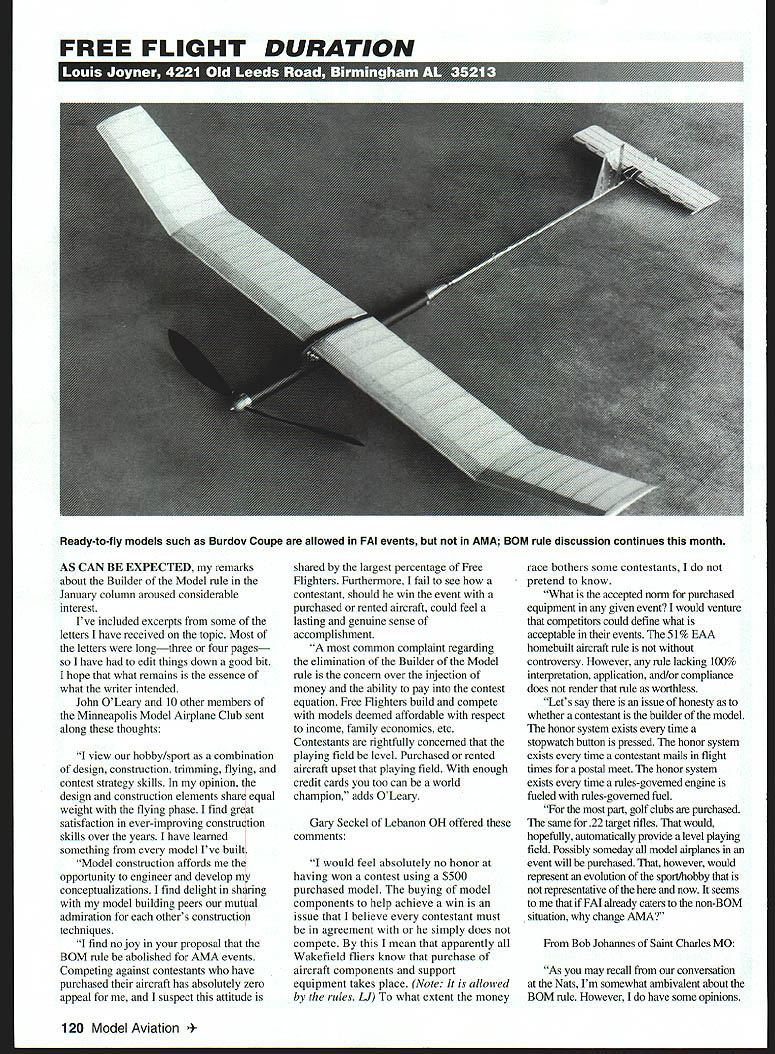
I do not suggest that the BOM rule should be eliminated for events such as Scale or Indoor duration, where the quality of model construction is far more important than the flying skills of the participant. (In Scale, the quality of construction is actually judged.) Some people would argue this is the case for all Free Flight events; I disagree. At the last Nats there were half a dozen people using the "ready-to-fly" Burdov Coupes, as permitted in FAI competition. These models did not sweep away all the homemade models. In fact, the first two places went to traditional stick-and-tissue models. In events where the skills of towing, throwing, winding and air-picking are involved, you cannot necessarily buy your way to success.
However, I do think the infusion of high-quality models and components from the countries of the former Soviet Union has raised the quality of flying in this country. It used to be that you had to have a machine shop to be competitive in Wakefield. Now you can purchase high-quality front ends and other parts.
More importantly, the widespread availability of quality models and components has allowed people in more isolated Free Flight areas the chance to study first-hand models of high quality and increase their own skills in building.
I long resisted the idea of eliminating the BOM rule. As a junior in the 1950s, I flew against a number of kids who did not build their own models. But the rule was unenforceable then, and it is unenforceable now. I still enjoy building and make all my own models, using some purchased components. I do not feel that I am at a disadvantage compared to someone who purchases complete models.
Perhaps a bigger problem than enforcement of the rule is the very definition of "build." A few models at the local (mostly RC) hobby shop point this out. Interestingly, all are from the Czech Republic.
- One is the ready-to-fly Butterfly indoor rubber model. I've got one and it is a lot of fun to fly in my living room. The model does not meet the BOM rule, but allowing its use in a club indoor contest might attract some new people to Free Flight.
- The next model is an "almost ready-to-fly" CO2 model. It is a traditional balsa-and-tissue model that comes completely covered. All that's necessary is to glue on the wingtip panels and install the motor. I think most people would agree that this does not meet the BOM rule. The local hobby shop has sold a number of these models to people who could not care less about rules and competition.
- The third model is more problematic. It's a Scale rubber model of one of the more obscure German World War I biplanes. Again it is of traditional stick-and-tissue construction, but the wings, tail, and fuselage are already framed up. Sanding, covering, and final assembly are required. It is my understanding that existing Scale rules cover manufactured parts, such as dummy engines. But could I fly the model in Mulvihill? How much "building" is required to meet the BOM rules?
When we deal with traditional materials, we could all agree on the amount of prefabrication in an "average kit." But with new materials and construction technologies, "building" gets harder to define.
Let's look at one important component—the wing. Currently you can buy, and legally use, a finished wing for FAI events, but not for AMA events. You can also buy the components of the wing (spar, D-box skins, trailing edge) and add your own ribs. I think most people would consider this "building" the wing and that it would meet the AMA BOM rule. But where between these two situations does it cease to be "building" and become "buying"?
If it is not spelled out in the rules, then interpretation is left to the judgment, and perhaps whim, of the Contest Director. Imagine going to a contest never knowing whether you would be allowed to fly a model or not. I believe that some people feel that "high-tech" construction is beyond the scope of the average modeler, and therefore any carbon-fiber D-box wing must have been purchased from some factory in Eastern Europe. People are wrongfully thought to be violating the BOM rule because their models seem too "high-tech" or even look too good.
The BOM rule needs to be eliminated or changed to something that can be fairly and accurately enforced.
Free Flight Forum Report 98
Each year, on January 1, the British Model Flying Association presents a forum on Free Flight. The printed Forum is a compilation of the papers presented. The report comes out late in the year (I received my copy just before Christmas and am writing this column in early January). Hopefully this explains the 1998 dating.
Here's a quick review of some articles in the 1998 Forum Report:
- Mike Farnham (former Glider World Champion) contributed three papers:
- The use of computer drawing software to lay out moving parts of a glider towhook, check clearances and free movement, and print drawings to use as cutting guides on sheet aluminum.
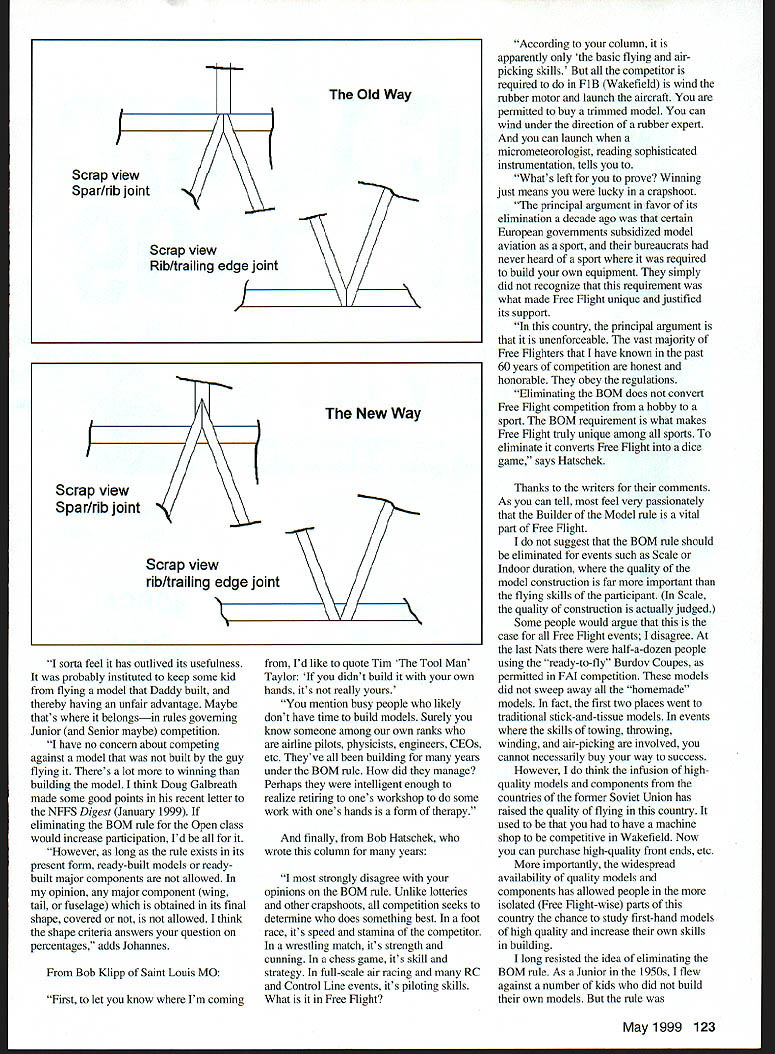
- Efforts to build stronger and lighter stabilizers. The tails are surprisingly low-tech: careful combinations of traditional balsa techniques with judicious uses of carbon fiber for trailing edges and rib caps. He details how caps come together at the juncture of diagonal ribs—ideas useful for lightweight wings or stabs.
- Avionics and the future of Free Flight. The development of "intelligent systems" with onboard sensors may require rules action to avoid making the sport more expensive and complex.
- Julian McCormick wrote on using GPS (Global Positioning System) as an aid to tracking and recovery of Free Flight models.
- Mark Gibbs authored a piece on micrometeorology and thermals.
- Peter King presented a paper on F1B trimming similar to the one featured in the 1998 NFFS Symposium. It is an excellent treatment of Wakefield trimming.
- John Cuthbert's article was particularly interesting. He decided to take up F1C Power in September 1996 and describes a "fast track" approach to designing and building models for a new event. He explains his rationale for each decision—what component to select and which construction technique to use. He started construction in November 1996 and had three models completed by the end of February. He has since made the British team for the World Championships.
You can order a copy of the 1998 Free Flight Forum Report from:
- Martin Dail, 20 Links Road, West Wickham, Kent BR4 0QV, Great Britain.
- Price: 9.00 pounds sterling, including airmail postage.
- Payment: check or credit card. Checks should be made payable to BMFA F/F Team Support Fund and drawn on a bank with a branch in the UK.
Transcribed from original scans by AI. Minor OCR errors may remain.

