
FREE FLIGHT DURATION
Louis Joyner, 4221 Old Leeds Rd., Birmingham AL 35213
SOGGY STABS
Flying in the rain is not my idea of fun. I doubt that anyone really enjoys getting soaked through and through while having to deal with wet equipment, slippery models, and trim changes. But the rain falls on everyone at the contest, so we muddle through.
At the last team selection finals, held at Palm Bay, Florida, it rained most of the first day when I was flying Wakefield (F1B). Experience had taught me that the extra weight of raindrops on the tail will cause the center of gravity (CG) to shift rearward. If it shifts far enough, the model will stall.
I had also learned—the hard way—that cranking down the trailing edge of the stab is not the thing to do. It may eliminate the stall, at least temporarily, but it also decreases the decalage (difference between wing and stab angles) and hurts the cruise portion of the climb and the stall recovery in the glide. With reduced decalage and a more-rearward CG, the model might glide OK for a while, but any upset would send it into a series of stalls.
So I left the stab alone and strapped some weight on the nose to get the CG back where it was supposed to be. I wish I could say that I had tested all this beforehand and had weights made up for each model. Actually, it was more a matter of unrolling some solder, guessing at the correct amount, and then strapping it around the nose with a rubber band. It worked fine.
Afterward, I wrote my Danish friend and fellow Wakefield flier Jorgen Korsgaard about the Finals and mentioned the wet-weather problem and my makeshift solution. Jorgen promptly performed some tests and wrote back with his results. He found that a typical 28 cm² stab gained 0.8 g, and the fin gained 0.44 g, for a total weight increase of 1.25 g.
That doesn't sound like much extra weight, but remember that the stab is at the end of a very long boom. Jorgen then measured the tail-to-CG distance and found that it was four times the nose-to-CG distance. Multiplying the 1.25 g by four gave Jorgen a suggested nose weight of 5.0 g. His line in his letter to me was, "How much nose weight did you add?"
As soon as I read his letter, I weighed the strip of solder and rubber band that I had used—4.8 g. Not bad for a guess.
I was relaying this story to 1998 F1B America's Cup winner Al Brush, and asked him what he had done about the rain at the Finals. Al told me he had followed the suggestion of three-time world champion Alexander Andriukov and taped a spare steel wing wire along the nose. A 3-mm wing wire, 80 mm long, weighs 4.3 g. Adding a bit of tape gets the total up to the 5.0 g that Jorgen suggests.
One surprising thing I noticed about my rainy-day experiences was how much water had gotten inside the clear Mylar™-covered stab. It looked like water vapor had condensed inside. There were no tears in the covering, and the moisture was equally distributed over the stab. (It did dry out after a few days.)
I e-mailed Mike Woodhouse in England about this; Mike has written several articles in AeroModeller about covering with Mylar™, and he also sells it through his MJ Woodhouse Free Flight Supplies mail order business.
Mike suggested that the problem was the clear 1/4-mil Mylar™ I was using. He said that clear Mylar™, though seemingly airtight, is actually porous enough to allow water vapor to pass through. The chrome Mylar™ that he uses is much less porous.
An offshoot of all this is that Mike has written an excellent piece on wet-weather flying for the 1999 National Free Flight Society Symposium. Here's a sample:
"I have to confess that I do not like flying in the rain. In fact, the last event I attended where it rained very heavily was the 1998 Bilzen contest. My reaction was simply to go back to bed."
Despite his protestations, Mike goes on to list a number of things you can do to prepare for the rain and compete in it. Look for more information about the 1999 Sympo in upcoming columns.
O'Reilly Plans
Jim O'Reilly must really have CAD (Computer Aided Drafting) figured out; he cranks out plans faster than anyone I know.
His latest list of full-size plans offers:
- 26 Old-Timer rubber models
- 20 Old-Timer gas models
- About a dozen Nostalgia gas models
- 16 other models
His very complete catalog includes reduced-size copies of many plans. Included in the list are many popular old-timer models, such as Ed Lamb's Climber, Chet Lanzo's Puss Moth semiscale rubber model, the Comet Interceptor, and the Cleveland Playboy. Nostalgia offerings include the Gilliam Civvy Boy 84, Phil Kraft's Upstart, and Frank Ehling's Show Off.
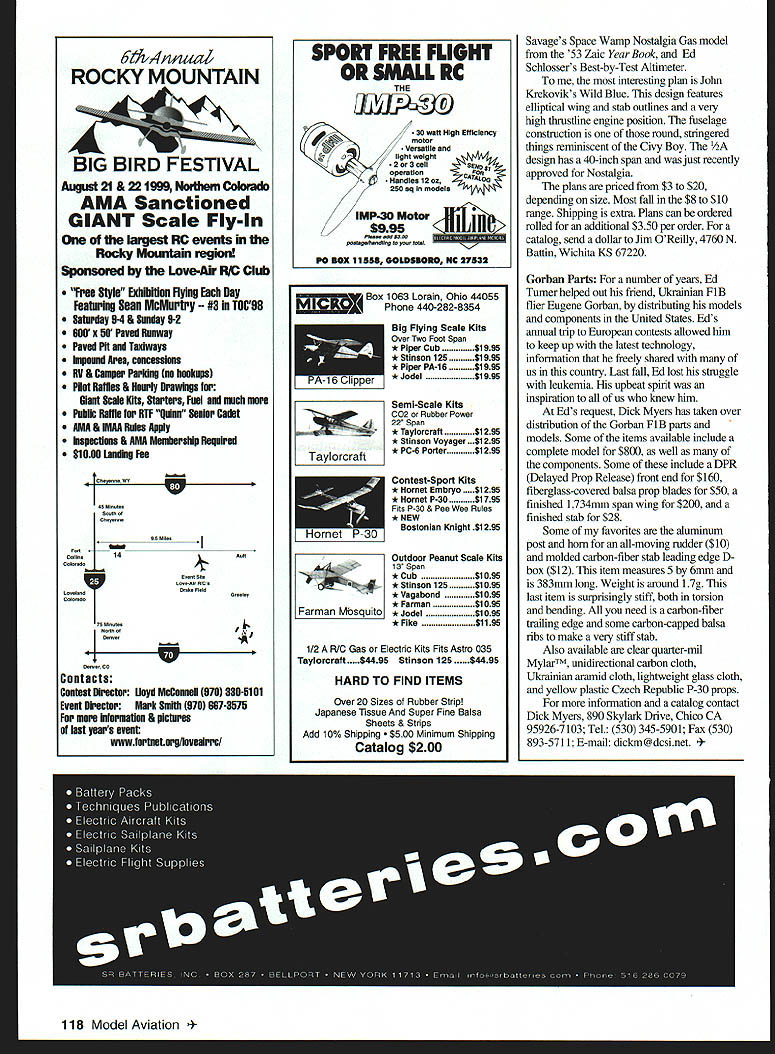
Jim also offers plans for his own popular Tubestake 250 Mulvihill model. There are several Rubber Scale models, including the P-51D Mustang, P-47 Thunderbolt, Bolton-Paul Defiant, and Bell P-63 Kingcobra.
(I digression: I have always liked the looks of the midengine Bell Cobra series. A few months ago I saw a full-size Cobra in Soviet colors at the traveling exhibit "World War II Through Russian Eyes." It was great to see the P-63 up close. Try to see the exhibit as it travels around the country. It was a very well-put-together exhibit about a part of World War II that we in the West are not familiar with. The website for the exhibit is www.throughrussianeyes.com.)
Some of Jim's more unusual offerings include Bob DeLaMater's twin pusher, Stuart Savage's Space Warp Nostalgia Gas model from the 1953 Zaic Year Book, and Ed Schlosser's Best-by-Test Altimeter.
To me, the most interesting plan is John Krekovich's Wild Blue. This design features elliptical wing and stab outlines and a very high thrustline engine position. The fuselage construction is one of those round, stringered types reminiscent of the Clive Boy. The 1/2A design has a 40" span and was recently reproofed for Nostalgia.
Plans are priced from $3 to $20, depending on size. Most fall in the $8–$10 range. Shipping is extra. Plans can be ordered rolled for an additional $3.50 per order. For a catalog, send $1 to: Jim O'Reilly, 4760 N. Battin, Wichita KS 67220.
Gorban Parts
For a number of years, Ed Turner helped his friend, Ukrainian F1B flier Eugene Gorban, by distributing his models and components in the United States. Ed's annual trips to European contests allowed him to keep up with the latest technology, information that he freely shared with many of us. Last fall, Ed lost his struggle with leukemia. His upbeat spirit was an inspiration to all who knew him.
At Ed's request, Dick Myers has taken over distribution of the Gorban F1B parts and models. Some items available include:
- Complete model: $80
- DPR (Delayed Prop Release) front end: $160
- Fiberglass-covered balsa prop blades: $50
- Finished 1,734-mm span wing: $200
- Finished stab: $28
- Aluminum nose and motor for an all-moving rudder: $10
- Molded carbon-fiber stab leading-edge D-box (5 x 6 mm, 383 mm long, ~1.7 g): $12
Also available:
- Clear 1/4-mil Mylar™
- Unidirectional carbon cloth
- Ukrainian aramid cloth
- Lightweight glass cloth
- Yellow plastic Czech Republic P-30 props
The carbon-fiber stab leading-edge D-box is surprisingly stiff in both torsion and bending. All you need is a carbon-fiber trailing edge and some carbon-capped balsa ribs to make a very stiff stab.
For more information and a catalog contact: Dick Myers, 890 Skylark Drive, Chico CA 95926-7103 Tel: (530) 345-5901 Fax: (530) 893-5711 E-mail: dickm@dcsinet
Transcribed from original scans by AI. Minor OCR errors may remain.

