

FREE FLIGHT
Duration
Bob Meuser
BEYOND BELIEF: Beyond Belief: No matter how you spell it, it is correct, for Dan Belieff's Indoor Category I Hand Launch Glider record has been topped, and by a margin of 38%!
Stan Stoy did it with a mite of a Stoy toy called The Coot, which was presented in this column in the December 1975 issue.
In Indoor H.L.G., the flier gets a total of nine flights, and the total duration of the best two counts. Stoy's 108.8-second best score was made during the first of his four nine-flight record attempts. All four series bettered the record handily, so it wasn't a fluke, but rather a repeatable performance.
For a quarter of a century the Category I (35-ft. max. ceiling height) record has been inched up a second at a time by fellows like Lee Hines, Ron Wittman, and Dan Belieff's record of 78.8 seconds has been on the books since 1969. How then was this quantum jump in performance achieved?
The flights were made in a gym at Texas Christian University. The air-conditioning system was running, so the air was extremely turbulent. Normally, turbulence spells death for a low-ceiling indoor flight. But Stoy's model was trimmed to take advantage of the turbulence. The CG was well forward at about 25% of the root chord, making it extremely stable, so that the model would respond rapidly to the changing wind direction. The model tended to zip through the downdrafts, then slow down in the updrafts, spending more time in the ups than in the downs. On several occasions it actually gained altitude—about three feet at a crack—during its longer flights, which lasted over a minute.
The air vents were near the ceiling, and there were an equal number of inlets and outlets, so there was no net vertical air flow; the model was not flying in a vertical wind tunnel.
FF Duration/Meuser
to electric pump.
Ear Protectors: You must wear ear protectors! Whether muff or plug type. Permanent hearing loss will result if you do not use them.
Engine: The one you intend to run.
Props: As recommended by manufacturer.
Plugs: A good idea to have two brands of the same type recommended by manufacturer.
Tools: Enough to tighten engine in mount, change prop and plug, plus the correct tools to dismantle engine.
Fuel: As recommended by manufacturer.
Battery: To fire glow plug.
Lots of clean rags to wipe it all clean.
Notebook: To keep records of engine performance.
Optional Equipment
Tachometer: Mechanical or optical.
Stopwatch: To time duration of runs when using a small volume tank.
Electric Starter: Do not use on bushing engines.
Examine your flying equipment and put together a special test stand set up as described above. The next column will describe how to prepare a new engine for test running and the following column will take you out to run the engine and develop some really important skills.
Don Jehlik, 438A Schweer Dr., Star Route 1, Hawthorne, NV 89415.
About Rules: Rules are never foolproof. There always are loopholes simply because no rules-maker's crystal ball is all that good. So what do you do when a loophole is found that changes the character of an event from that originally intended? You change the rules! Sometimes.
There are dozens of examples; here are a few that come to mind. The original rules for Indoor Paper Stick inadvertently permitted the use of a microfilm covered prop; that got fixed. Drop gliders — small microfilm-covered gliders that were held overhead and dropped into a thermal rising from a section of the floor heated by sunlight — were ruled out of the Indoor H.L. Glider events. Vertical takeoff of hydro models was eliminated by a rules change.
While such changes are often in the best interests of the sport as a whole, someone suffers. National records made under the old rules go down the crack, as does the development of models to fit the loopholes in the old rules. I have made several rules-change proposals, currently being weighed by the FF Contest Board, that will cause some suffering if they are passed. The CB members will have to decide whether the suffering of a few is compensated by the benefit to many, and the decisions, I'm sure, will not come easily.
So already I have heard of a proposal to re-rig the rules in such a way that dynamic soaring of the sort utilized by Stan Stoy's Indoor H.L. Glider record breaker will not be legal. While such a change in the rules would wipe Stoy's record from the books, and render impotent his development of the skills that utilize dynamic soaring to advantage, such changes would seem to be in the best interest of the sport.
Perhaps I should mention that the proposal to re-rig the rules to prohibit dynamic soaring came to me from Stan Stoy. A rules-change proposal I once made included provision for "permanent national records" to be established when records are dropped from the books as a result of a rules change, and for the publication of a list of such permanent records every few years so that those accomplishments would not be forgotten. Your Contest Board representatives threw out my proposal so hard that it bounced! Well, you can't win 'em all.
Outstanding Performances: Outstanding, record-breaking performances they are to be sure, but you'll never see them on the AMA National Records list! At the Fifth Max-Men FAI Annual, Bob White put up 14 consecutive maxes in the Wakefield event, nosing out Bill Bogart's record. But it was a two-day affair, and to qualify as a national record all flights must be made on the same day. Lee Hines did the same in the Nordic glider event at the fourth an- nual. Nineteen consecutive 5-minute maxes, for a total score of 98 min. 14 sec. is by far the most astounding gas model performance since the Max was invented. Bob Scully did it with his big Supertigre 65-powered Satellite 1188 at the Thunderbugs Annual. But, it doesn't qualify as an official record because it was done at night! To qualify, all flights must be made between sunrise and sunset.
And, incidentally, Satellites took top honors in every gas-power event.
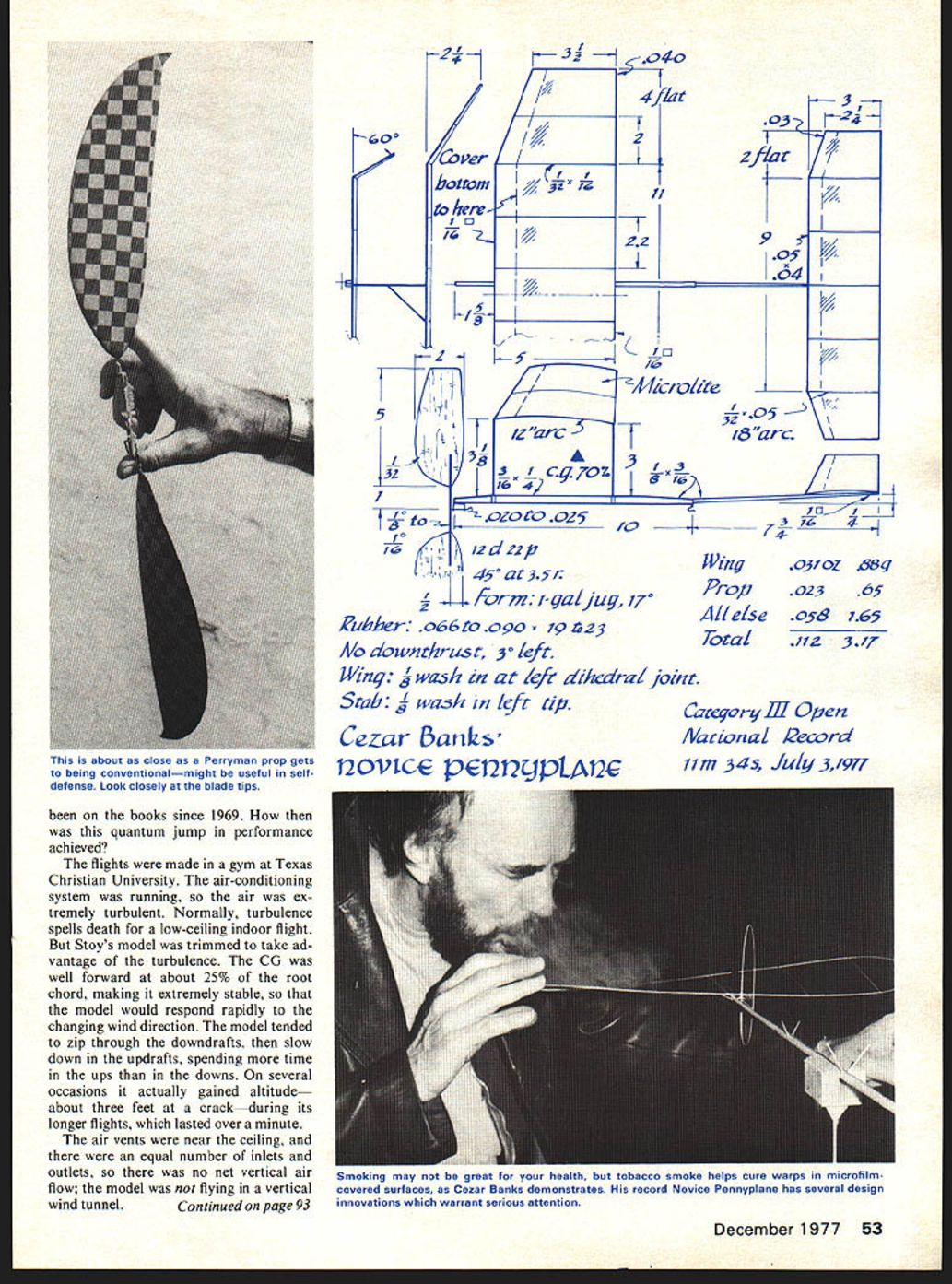
Sometimes I Hate This Job: I especially hate it when I have to make a hero out of some upstart who undermines the foundation of my fragile pillar of glory, and beats me at my own game! I keep telling myself that winning isn't everything. But then that little feller inside my headbone says: "Yes, but it sure beats the heck out of losing!" So it is with teary eye and heavy heart that I hereby discharge the duties imposed on me by fate, and the Editor, and tell you how Cezar J. Banks copped the Category III Novice Pennyplane record. And the worst part is that he did it fair and square; golly, I wish he had cheated just a little!
Actually, my record time didn't even equal that of Bill Xenakis' year-old Senior record, so it is only fitting that it was clobbered. I doubt, however, if Banks' time of 11:34 will be beaten for awhile, at least by any substantial margin. Banks' model isn't simply an ordinary model well flown, but has some unique innovations. Whether those innovations are significant improvements is anybody's guess, but they surely didn't hurt anything.
One innovation is the fairing behind the leading-edge spar. Certainly the turbulence induced behind a conventional spar can serve no useful purpose, and a simple fairing such as Banks used must eliminate the major part of that turbulence, and its associated drag. Fairing the rear spar, however, might be a mistake. When one does purposely what happens to an indoor model trailing edge automatically, it is called a Blubaugh or Gieseking fence—or more recently a Gurney fence—and all sorts of good things are attributed to it.
The substitution of stab-tip rudders for a conventional single rudder is another innovation, at least in relation to contemporary indoor modeling. Stab-tip rudders probably act as tip plates, increasing the effective aspect ratio and stabilizing influence of the stab. But is it significant? Who knows? Such an arrangement might have practical advantages, however. My underslung rudders have broken occasionally, and although the breaks have been easily fixed, once when I didn't notice the break the price of my sloppy pre-flight inspection was a poor official flight. I like to think, though, that the underslung rudder protects the stab during a landing. Perhaps Banks' arrangement is sturdier overall.
One of Banks' innovations—at least I think it is an innovation with respect to Novice Pennyplane modeling—that I am dead certain is a step in the right direction is his extremely wide prop blades, and moderate pitch. Now, kiddies, slump in your seats and shut your eyes, for I am about to theory you half to death.
The result of a simple but rather easily defended theory is that, for maximum flight duration, the rubber weight should be twice the weight of the model without rubber. There are quite a few conditions or assumptions to be met, however, for that theory to be applicable. One is that the structural weight is independent of the rubber weight, and that assumption is certainly valid for conventional Pennyplanes because of the 3.1-gram minimum weight rule. Another assumption is that the prop efficiency is independent of the rubber weight. Here, I think, is where theory and practice might diverge, not because there's anything wrong with the theory, but because the conditions underlying it are violated.
To increase the rubber weight, first, let's say, you increase the width of the rubber. Then the model climbs with gusto, dead-sticks a mile from the floor, and flight duration suffers. So, you increase the length of the rubber—thereby also increasing its weight—until the model lands with just enough turns left to keep the slack out of the motor. Although the prop rpm has been increased because of the greater rubber cross section and the greater gross weight of the model, the turns wound into the motor have been increased by a greater factor, because of the increased motor length, and duration of flight has increased. That is, if you haven't already exceeded the motor-weight-equals-twice-the-structural-weight rule, and if the conditions of the theory haven't been violated.
To the best of my knowledge, nobody has ever even approached the theoretical optimum with any degree of success. At best, the rubber weight about equals the structural weight, for weight-rule-limited models. After an unsuccessful attempt to improve the performance of my Novice Pennyplane by using a 30-in. loop of 1/4-in. rubber, weighing 30% more than the structural weight, I mentioned the results to Clarence Mather. He replied something to the effect that increasing the rubber weight doesn't always increase flight performance, even when the rubber length is tuned so that the model neither lands with too many turns left, nor dead-sticks. I countered with an excuse based on the fact that such a long motor—3.3 times the hook spacing—knots up easily, but Clarence made it clear that his remark applied even in the absence of that effect. Well, Clarence is not given to squandering words with reckless abandon, so I did a bit of head-scratchin' over Clarence's remark in relation to several rather unsuccessful attempts to increase duration by increasing the rubber weight, and ol' baldy here is about to lay it all on you.
Novice Pennyplanes have a prop-diameter limitation of 12-in. In order to get such a relatively small prop to absorb lots of power, thereby requiring lots of rubber, it is tempting to increase the pitch. That's great, up to a point. But, it is easy to get to the point where the blades aren't up to the job; they stall! And while power input has been increased by the increase in pitch, power output from the prop has not increased in proportion and, in fact, might even have decreased.
The following pearls of wisdom follow, and seem to be substantiated by my most recent experiences: High pitch is OK, so long as it is coupled with a large blade width; pushing the rubber-weight-syndrome beyond all reason might not lead to success; you might be better off with a short, skinny motor.
The above remarks apply to high-ceiling flying; they might not, and indeed they probably do not, apply to low-ceiling flying. Here, prop efficiency during the initial power burst is probably not important. The model is going to get up to the ceiling, anyhow, and if it doesn't climb so hot, it simply will be required to bang its head against the ceiling for a shorter time. What counts most in low-ceiling flying, where rafter-banging is the name of the game, is prop efficiency during the cruise and descent. In this game, it might well be that skinny high-pitch props are optimum.
Meanwhile, Banks' formula—2-in. wide blades and a pitch of 22 in.—seems pretty close to optimum for all conditions.
Whew!
Incidentally, don't let this Banks fellow out of your sight. He has only recently returned to modeling after an absence of a quarter of a century. My spies tell me he has been seen in the company of Clarence Mather, so maybe some of that good stuff is coming off on him, and what's worse, he seems to have a few ideas of his own. In any event, he bears watching.
Tenth Annual NFFS Sympo:
A whompin' 152 pages long, the 1977 edition signals the tenth anniversary of this unique publication. Included is a large section covering the ten Models of the Year, with a fine three-view drawing of each model by Bruce and Elwanda Hannah, photos, and descriptions of the models and their development. Model types include indoor and outdoor, rubber and gas power, and towline gliders.
The bulk of the report is devoted to technical papers. These range from the extremely "theoretical" to the down-home practical. Included are papers on towline glider design and performance analysis; rubber-power and gas-power props; tricky airfoils; wing and wing-tip shapes; warp and flutter-resistant structures; rubber-power and gas model performance analysis; and one about finding thermals.
The prices are (please fasten your seat belts): For members of both the NFFS and the AMA residing in the U.S.A., and for non-residents, $8.00; for others, $9.00. Mailing charges are: Fourth class in the U.S., Canada, and Mexico, 75¢; airmail to Canada and Mexico, $2.25; Europe, $3.35; the Far East, $4.65. Special deals are available for bulk orders. Order from Jack Brown, 20267 Northbrook Sq., Cupertino, CA 92067. While the price may seem high, it is actually less per page than in recent years.
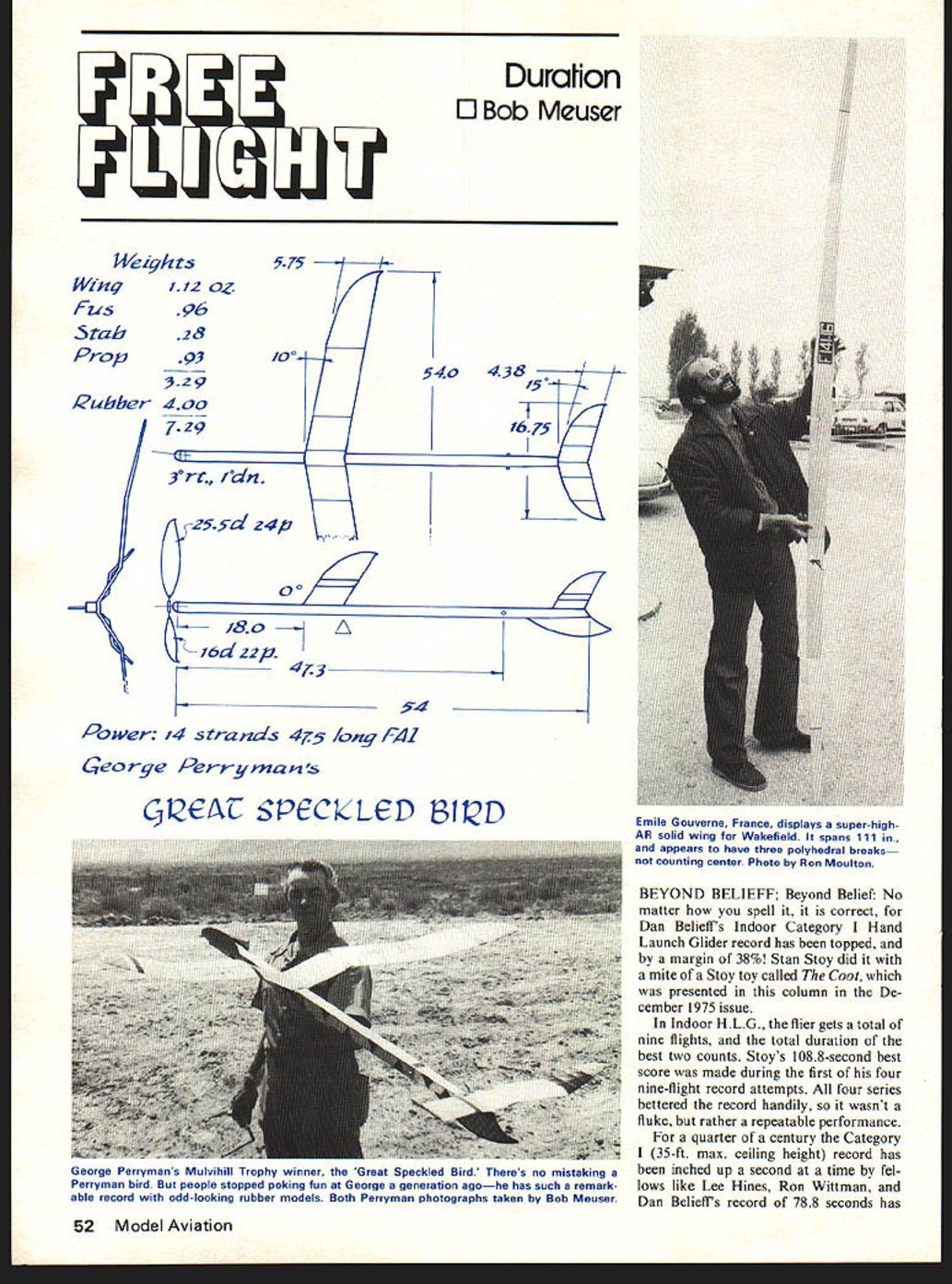
Great Speckled Bird: You can say what you like about the aesthetics of George Perryman's models, but it is highly unlikely that a timer would confuse George's models with someone else's. The Great Speckled Bird is no exception. The G.S.B. took first place at the unofficial Unlimited event at the 1976 Nats. That event consisted of a single flight with no max, just after dawn, and was as close as you can get to a test of a model's performance without the aid of thermals.
And at the 1977 Nats, George's G.S.B. helped him qualify for the Mulvihill Trophy—awarded for highest time in the Unlimited Rubber event, regardless of the age of the contestant—which George has tried desperately to win for many years.
The drawing shows one of George's in- ventions, the one-and-one-half-blade prop. George calls the little feller a "mini-blade," and the theory is that it evens out the hole in the lift distribution left by the main blade. Or something like that. The main blade, incidentally, is of built-up, tissue-covered construction. That prop was used to win the 1976 Unlimited event, and it now resides on display in the rotunda of the Meuser Memorial Library and Museum.
The prop used to win the Mulvihill is, for George at least, more conventional. We can't say for sure whether those little hooks on the ends of the blades help much, but they sure can't hurt.
For Scale Nats Only: The National Air and Space Museum has published a volume called Aircraft of the National Air and Space Museum. It is a comprehensive catalog of the Museum's extensive aeronautical collection. It includes historical information and three-view drawings for all the planes on display in the Museum and lists, with locations, all the remaining aircraft. There are 225 black-and-white photos in this 128-page soft-cover book, and 12 color photos on the covers. The price is $2.75, postpaid. Checks or money orders should be made payable to Smithsonian Institution; don't send cash. Order from the National Air and Space Museum Publications, Smithsonian Institution, Washington, DC 20560.
Bob Meuser, 4200 Gregory St., Oakland, CA 94619.
Transcribed from original scans by AI. Minor OCR errors may remain.

