
FREE FLIGHT: DURATION
Louis Joyner, 4221 Old Leeds Rd., Birmingham, AL 35213
GROOVY TUNA
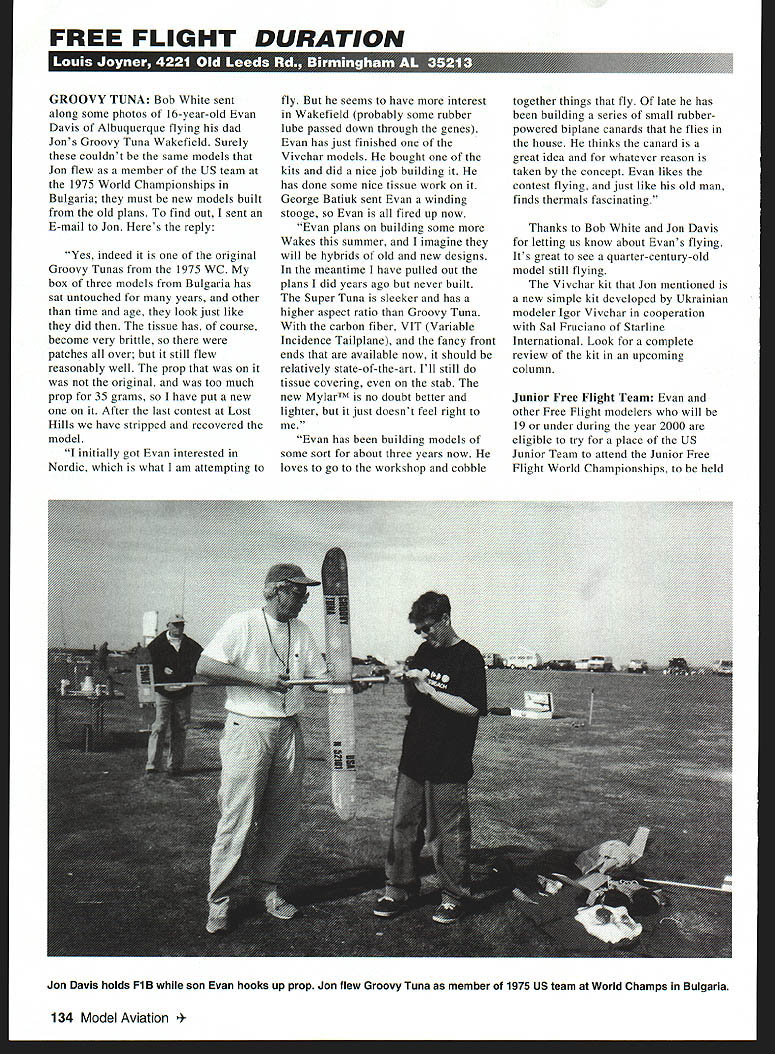
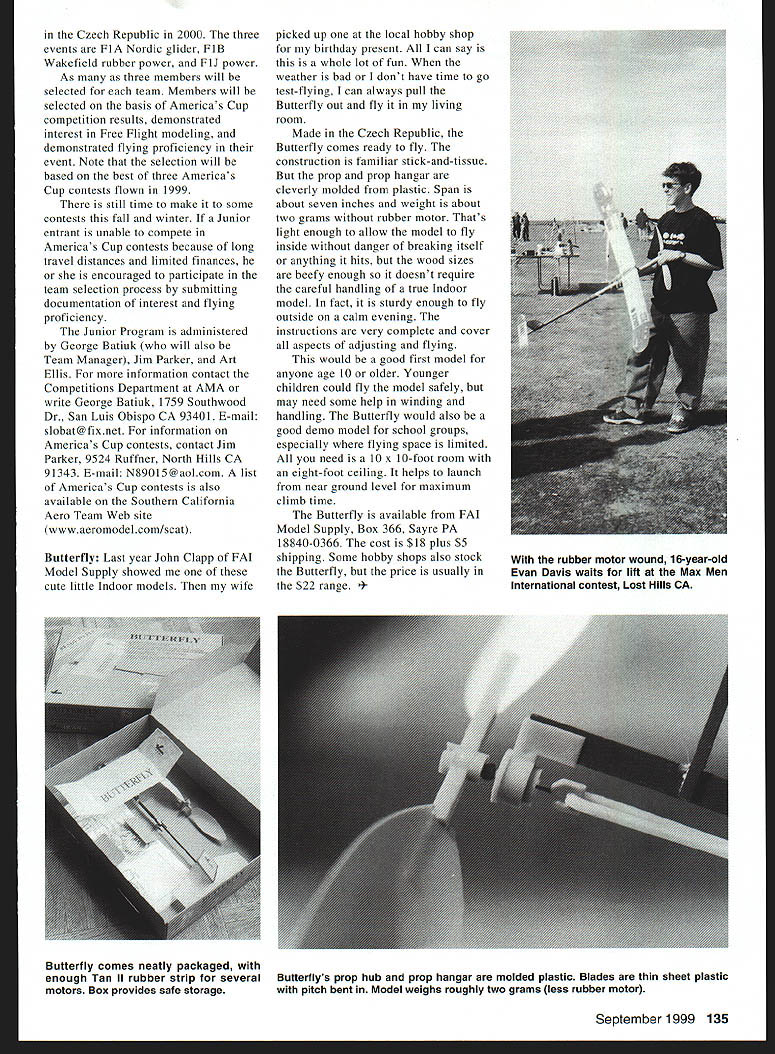
Bob White sent along some photos of 16-year-old Evan Davis of Albuquerque flying his dad Jon's Groovy Tuna Wakefield. Surely there couldn't be the same models Jon flew as a member of the U.S. team at the 1975 World Championships in Bulgaria; they must be new models built from the old plans. To find out, I sent an e-mail to Jon. Here's the reply:
"Yes, indeed it is one of the original Groovy Tunas from the 1975 WC. My box of three models from Bulgaria has sat untouched for many years, and other than time and age, they look just like they did then. The tissue has, of course, become very brittle, so there were patches all over; but it still flew reasonably well. The prop that was on it was not the original, and was too much prop for 35 grams, so I have put a new one on it. After the last contest at Lost Hills we have stripped and recovered the model.
"I initially got Evan interested in Nordic, which is what I am attempting to fly. But he seems to have more interest in Wakefield (probably some rubber lube passed down through the genes).
"Evan has just finished one of the Vivchar models. He bought one of the kits and did a nice job building it. He has done some nice tissue work on it. George Batiuk sent Evan a winding stooge, so Evan is all fired up now.
"Evan plans on building some more Wakes this summer, and I imagine they will be hybrids of old and new designs. In the meantime I have pulled out the plans I did years ago but never built. The Super Tuna is sleeker and has a higher aspect ratio than Groovy Tuna. With the carbon fiber, VIT (Variable Incidence Tailplane), and the fancy front ends that are available now, it should be relatively state-of-the-art. I'll still do tissue covering, even on the stab. The new Mylar™ is no doubt better and lighter, but it just doesn't feel right to me.
"Evan has been building models of some sort for about three years now. He loves to go to the workshop and cobble together things that fly. Of late he has been building a series of small rubber-powered biplane canards that he flies in the house. He thinks the canard is a great idea and, for whatever reason, is taken by the concept. Evan likes the contest flying, and just like his old man, finds thermals fascinating."
Thanks to Bob White and Jon Davis for letting us know about Evan's flying. It's great to see a quarter-century-old model still flying.
The Vivchar kit that Jon mentioned is a new simple kit developed by Ukrainian modeler Igor Vivchar in cooperation with Sal Fruciano of Starline International. Look for a complete review of the kit in an upcoming column.
JUNIOR FREE FLIGHT TEAM
Evan and other free flight modelers who will be 19 or under during the year 2000 are eligible to try for a place on the U.S. Junior Team to attend the Junior Free Flight World Championships, to be held in the Czech Republic in 2000.
Three events:
- F1A Nordic glider
- F1B Wakefield rubber power
- F1J power
Three members will be selected for the team. Members will be selected on the basis of Americas Cup competition results and demonstrated interest in free flight modeling and demonstrated flying proficiency at the event. Note: selection will be based on the best three Americas Cup contests flown in 1999; there is still time to make some contests in the fall/winter. Junior entrants unable to compete in Americas Cup contests because of long travel distances or limited finances are encouraged to participate in the team selection process by submitting documentation of interest and flying proficiency.
The Junior Program is administered by George Batiuk, who will also be Team Manager. For information contact the Competitions Department, AMA, or write George Batiuk, 1759 Southwood Dr., San Luis Obispo, CA 93401. E-mail: slobat@fixnet.com.
Information on Americas Cup contests: contact Jim Parker, 9524 Ruffner, North Hills, CA 91343. E-mail: N89015@aol.com. A list of Americas Cup contests is also available on the Southern California Aero Team website: www.aeromodel.com/scat
BUTTERFLY
Last year John Clapp of FAI Model Supply showed me one of these cute little indoor models. Then my wife picked up one at the local hobby shop for my birthday present. All I can say is this is a whole lot of fun. When the weather is bad or I don't have time to go test-flying, I can always pull the Butterfly out and fly it in my living room.
Made in the Czech Republic, the Butterfly comes ready to fly. The construction is the familiar stick-and-tissue. But the prop and prop hangar are cleverly molded from plastic. Span is about seven inches and weight is about two grams without the rubber motor. That's light enough to allow the model to fly inside without danger of breaking itself or anything it hits, but the wood sizes are beefy enough so it doesn't require the careful handling of a true indoor model. In fact, it is sturdy enough to fly outside on a calm evening. The instructions are very complete and cover all aspects of adjusting and flying.
This would be a good first model for anyone age 10 or older. Younger children could fly the model safely, but may need some help in winding and handling. The Butterfly would also be a good demo model for school groups, especially where flying space is limited. All you need is a 10 x 10-foot room with an eight-foot ceiling. It helps to launch from near ground level for maximum climb time.
The Butterfly is available from FAI Model Supply, Box 366, Sayre, PA 18840-0366. The cost is $18 plus $5 shipping. Some hobby shops also stock the Butterfly, but the price is usually in the $22 range.
Transcribed from original scans by AI. Minor OCR errors may remain.

