
FREE FLIGHT DURATION
Louis Joyner 4221 Old Leeds Rd., Birmingham, AL 35213
PRIMA KIT
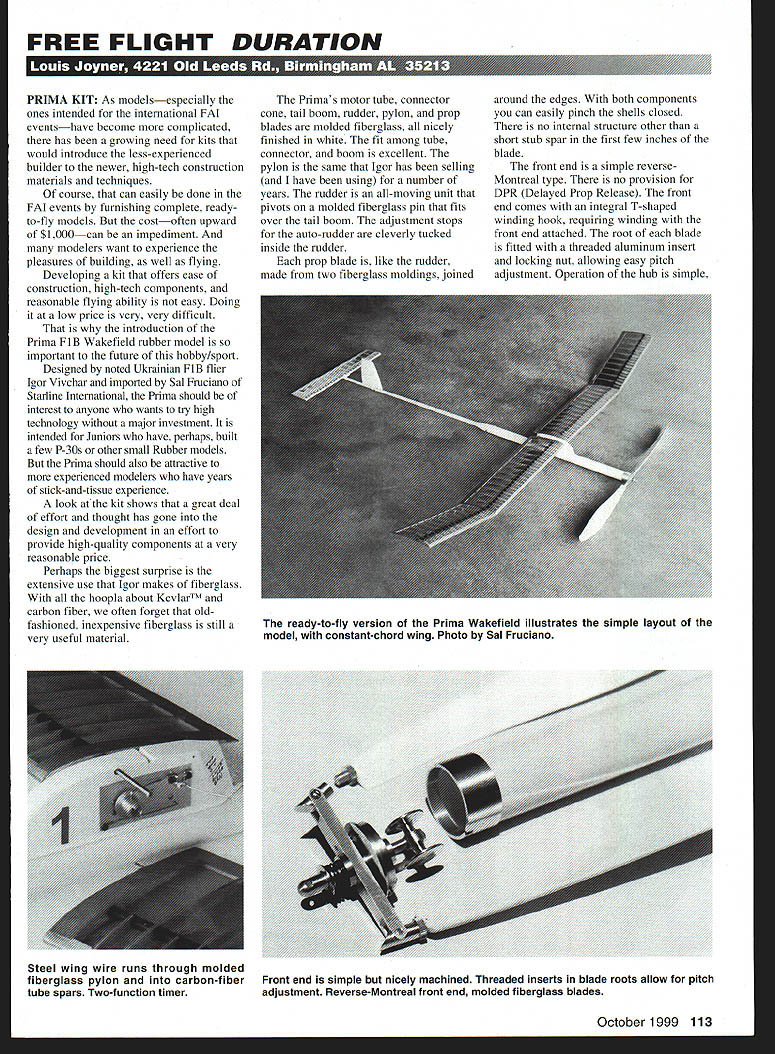
As models—especially those intended for international FAI events—have become more complicated, there has been a growing need for kits that introduce less-experienced builders to newer, high-tech construction materials and techniques.
Complete, ready-to-fly models can provide that introduction, but the cost—often upward of $1,000—can be an impediment. Many modelers also want the pleasures of building as well as flying. Developing a kit that offers ease of construction, high-tech components, and reasonable flying ability is not easy; doing it at a low price is very difficult. That is why the introduction of the Prima F1B Wakefield rubber model is so important to the future of this hobby/sport.
Designed by noted Ukrainian F1B flier Igor Vivchar and imported by Sal Fruciano of Starline International, the Prima should interest anyone who wants to try high technology without a major investment. It is intended for juniors who have perhaps built a few P-30s or other small rubber models, but it should also appeal to more experienced modelers with years of stick-and-tissue experience.
A look at the kit shows that a great deal of effort and thought went into the design and development to provide high-quality components at a very reasonable price. Perhaps the biggest surprise is the extensive use of fiberglass. With all the hoopla about Kevlar and carbon fiber, we often forget that old-fashioned, inexpensive fiberglass is still a very useful material.
Key molded fiberglass components (all nicely finished in white) include:
- Motor tube
- Connector cone
- Tail boom
- Rudder
- Pylon
- Prop blades
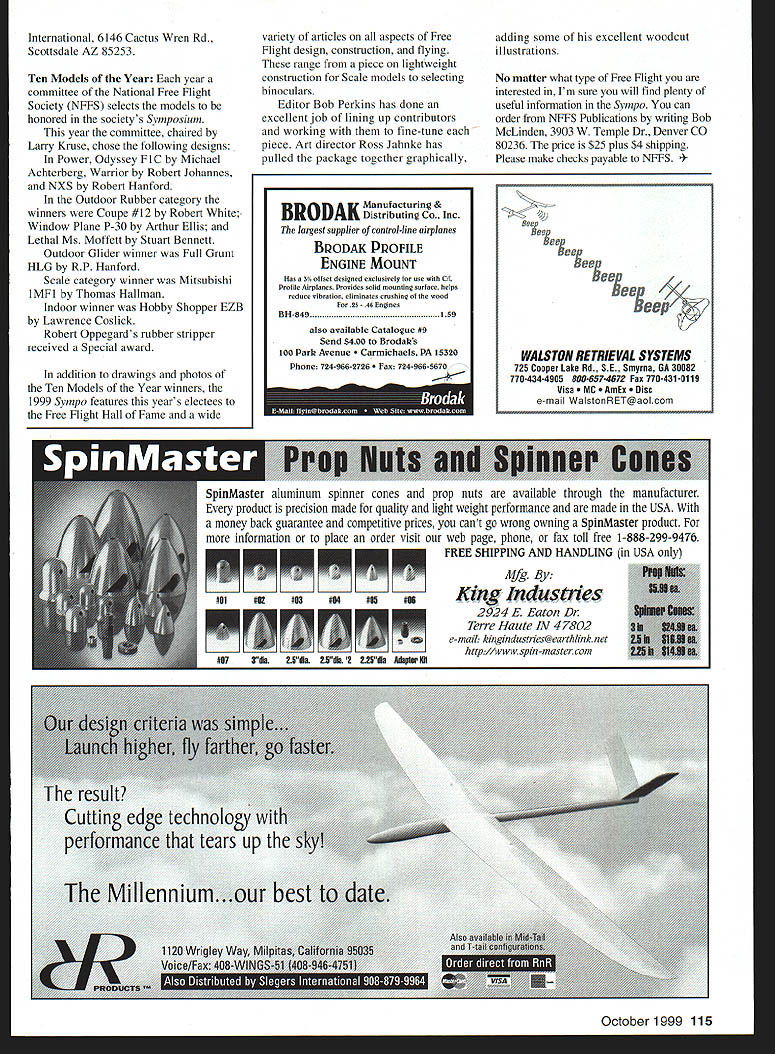
The fit among tube, connector, and boom is excellent. The pylon is the same one Igor has been selling (and I have been using) for a number of years. The rudder is an all-moving unit that pivots on a molded fiberglass pin fitting over the tail boom; the adjustment stops for the auto-rudder are cleverly tucked inside the rudder.
Each prop blade, like the rudder, is made from two fiberglass moldings joined around the edges. You can easily pinch the shells closed; there is no internal structure other than a short stub spar in the first few inches of the blade. The front end is a simple reverse-Montreal type with no provision for DPR (Delayed Prop Release). The front end comes with an integral T-shaped winding hook, requiring winding with the front end attached. The root of each blade is fitted with a threaded aluminum insert and locking nut for easy pitch adjustment. Operation of the hub is simple, with no catches to set—just pull the hub forward when ready to launch.
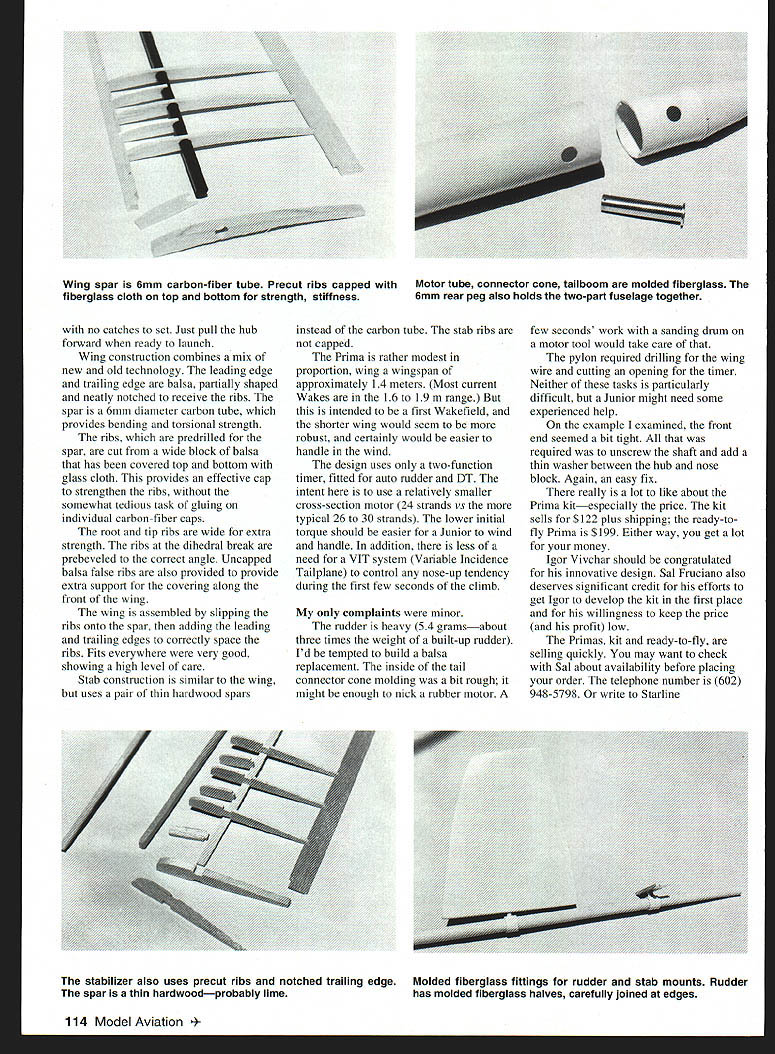
Wing construction combines new and old technology. The leading and trailing edges are balsa, partially shaped and neatly notched to receive the ribs. The spar is a 6 mm diameter carbon tube, providing bending and torsional strength. The ribs are predrilled for the spar and are cut from a wide block of balsa covered top and bottom with glass cloth. This provides an effective cap to strengthen the ribs without the tedious task of gluing on individual carbon-fiber caps.
Other wing features:
- Root and tip ribs are wide for extra strength.
- Ribs at the dihedral break are pre-beveled to the correct angle.
- Uncapped balsa false ribs are provided to support the covering along the front of the wing.
The wing is assembled by slipping the ribs onto the spar, then adding the leading and trailing edges to correctly space the ribs. Fit everywhere was very good, showing a high level of care.
Stab construction is similar to the wing but uses a pair of thin hardwood spars instead of the carbon tube; the stab ribs are not capped.
The Prima is modestly proportioned, with a wingspan of approximately 1.4 meters (most current Wakefields are in the 1.6 to 1.9 m range). This shorter wing is intended for a first Wakefield—more robust and easier to handle in wind.
The design uses only a two-function timer, fitted for auto-rudder and DT. The intent is to use a relatively smaller cross-section motor (24 strands vs. the more typical 26 to 30 strands). The lower initial torque should be easier for a junior to wind and handle. In addition, there is less need for a VIT system (Variable Incidence Tailplane) to control any nose-up tendency during the first few seconds of climb.
Minor complaints:
- The rudder is heavy (5.4 grams—about three times the weight of a built-up rudder). A balsa replacement might be desirable.
- The inside of the tail connector cone molding was a bit rough and might nick a rubber motor; a few seconds with a sanding drum on a motor tool will fix that.
- The pylon required drilling for the wing wire and cutting an opening for the timer. Neither task is difficult, but a junior might need some experienced help.
- On the example examined, the front end seemed a bit tight; unscrewing the shaft and adding a thin washer between the hub and the nose block was an easy fix.
Price and availability:
- Kit: $122 plus shipping
- Ready-to-fly: $199
Igor Vivchar should be congratulated for his innovative design, and Sal Fruciano deserves credit for getting Igor to develop the kit and for keeping the price (and his profit) low. The Primas, both kit and ready-to-fly, are selling quickly; check with Sal about availability before ordering.
Starline International contact:
- Phone: (602) 948-5798
- Address: Starline International, 6146 Cactus Wren Rd., Scottsdale, AZ 85253
---
TEN MODELS OF THE YEAR
Each year a committee of the National Free Flight Society (NFFS) selects models to be honored in the society's Symposium. This year the committee, chaired by Larry Kruse, chose the following designs.
Winners:
- Power
- Odyssey F1C by Michael Achterberg
- Warrior by Robert Johannes
- NXS by Robert Hanford
- Outdoor Rubber
- Coupe #12 by Robert White
- Window Plane P-30 by Arthur Ellis
- Little Miss Moffett by Stuart Bennett
- Outdoor Glider
- Full Grunt HLG by R.P. Hanford
- Scale
- Mitsubishi 1MF1 by Thomas Hallman
- Indoor
- Hobby Shopper EZB by Lawrence Coslick
Robert Oppegaard's rubber stripper received a Special Award.
In addition to drawings and photos of the Ten Models of the Year winners, the 1999 Symposium features this year's electees to the Free Flight Hall of Fame and a wide variety of articles on all aspects of free flight design, construction, and flying. Topics range from lightweight construction for scale models to selecting binoculars.
Editor Bob Perkins has done an excellent job lining up contributors and fine-tuning each piece. Art director Ross Jahnke has pulled the package together graphically, adding some excellent woodcut illustrations.
No matter what type of free flight you are interested in, you should find plenty of useful information in the Symposium. Order from NFFS Publications:
- Write to: Bob McLinden, 3903 W. Temple Dr., Denver, CO 80236
- Price: $25 plus $4 shipping
- Make checks payable to: NFFS
Transcribed from original scans by AI. Minor OCR errors may remain.

