
FREE FLIGHT DURATION
Louis Joyner, 4221 Old Leeds Rd., Birmingham AL 35213
THE PERRIS SPECIAL
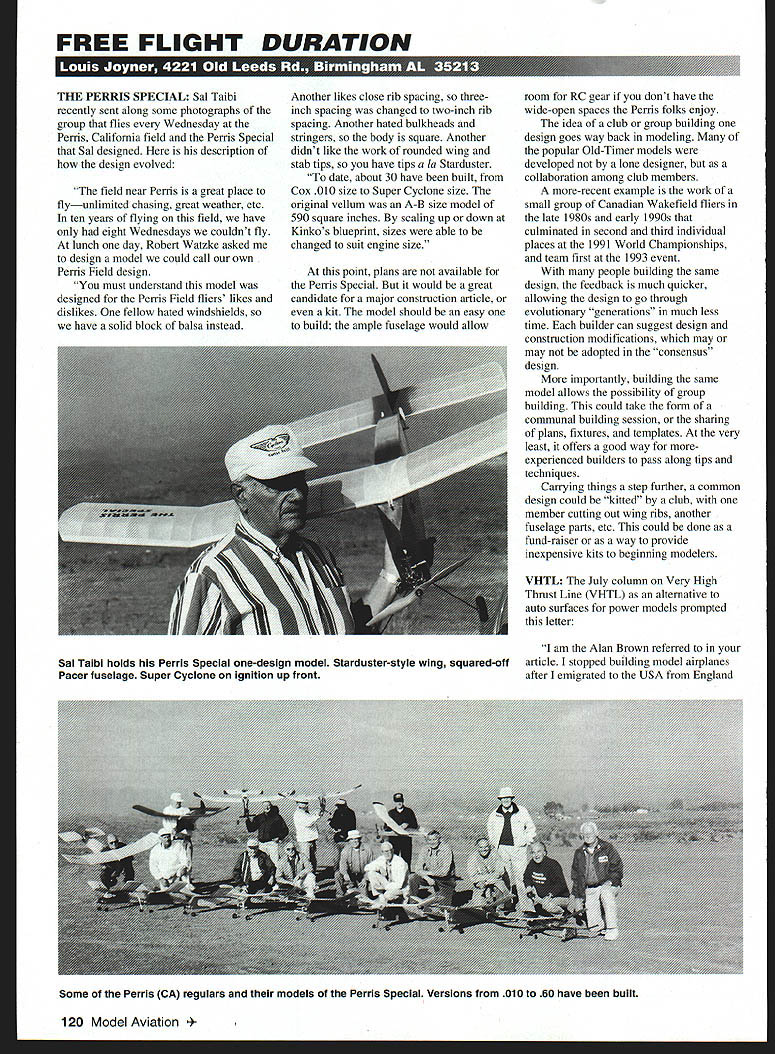
Sal Taibi recently sent along photographs of the group that flies every Wednesday at the Perris, California field and of the Perris Special that Sal designed. Here is his description of how the design evolved:
"The field near Perris is a great place to fly—unlimited chasing, great weather, etc. In ten years of flying on this field, we have only had eight Wednesdays we couldn't fly. At lunch one day, Robert Watzke asked me to design a model we could call our own Perris Field design.
"You must understand this model was designed for the Perris Field fliers' likes and dislikes:
- One fellow hated windshields, so we have a solid block of balsa instead.
- Another likes close rib spacing, so three-inch spacing was changed to two-inch rib spacing.
- Another hated bulkheads and stringers, so the body is square.
- Another didn't like the work of rounded wing and stab tips, so you have tips a la Starduster.
"To date, about 30 have been built, from Cox .010 size to Super Cyclone size. The original vellum was an A-B size model of 590 square inches. By scaling up or down at Kinko's, blueprint sizes were able to be changed to suit engine size.
"At this point, plans are not available for the Perris Special. But it would be a great candidate for a major construction article, or even a kit. The model should be an easy one to build; the ample fuselage would allow room for RC gear if you don't have the wide-open spaces the Perris folks enjoy."
The idea of a club or group building one design goes way back in modeling. Many of the popular Old-Timer models were developed not by a lone designer, but as a collaboration among club members.
A more recent example is the work of a small group of Canadian Wakefield fliers in the late 1980s and early 1990s that culminated in second and third individual places at the 1991 World Championships, and team first at the 1993 event.
With many people building the same design, feedback is much quicker, allowing the design to go through evolutionary "generations" in much less time. Each builder can suggest design and construction modifications, which may or may not be adopted in the "consensus" design.
More importantly, building the same model allows the possibility of group building. This could take the form of communal building sessions, or the sharing of plans, fixtures, and templates. At the very least, it offers a good way for more-experienced builders to pass along tips and techniques.
Carrying things a step further, a common design could be "kitted" by a club, with one member cutting out wing ribs, another fuselage parts, etc. This could be done as a fund-raiser or as a way to provide inexpensive kits to beginning modelers.
VHTL
The July column on Very High Thrust Line (VHTL) as an alternative to auto surfaces for power models prompted this letter:
"I am the Alan Brown referred to in your article. I stopped building model airplanes after I emigrated to the USA from England.
Like a lot of people, I put modeling aside while I worked and raised a family, and got back into modeling as a retiree about four years ago. So imagine how surprised I was to see my name in print in the 1957-58 Year Book article entitled 'Trajectory Stability.' That led to the high-thrustline approach and also discussed sidewash and other major aerodynamic actions on a model. Torque, motor sidewash, prop, wing and front fuselage will compensate slightly. You need force at the front of the model to give a yawing moment to stop roll tendencies caused by torque developing a spin. A yawing force can be provided by sidewash from the prop or the front fuselage to provide a rolling moment. Yaw of the model means side area above the model."
Alan's letter points out just how valuable the old Zaic Year Books are. If you hear about some new idea in Free Flight, look through dog-eared copies of the Year Books and you will find the idea has been tried before, often a half-century ago. The Year Books are still printed and available through the AMA; contact Frank Zaic.
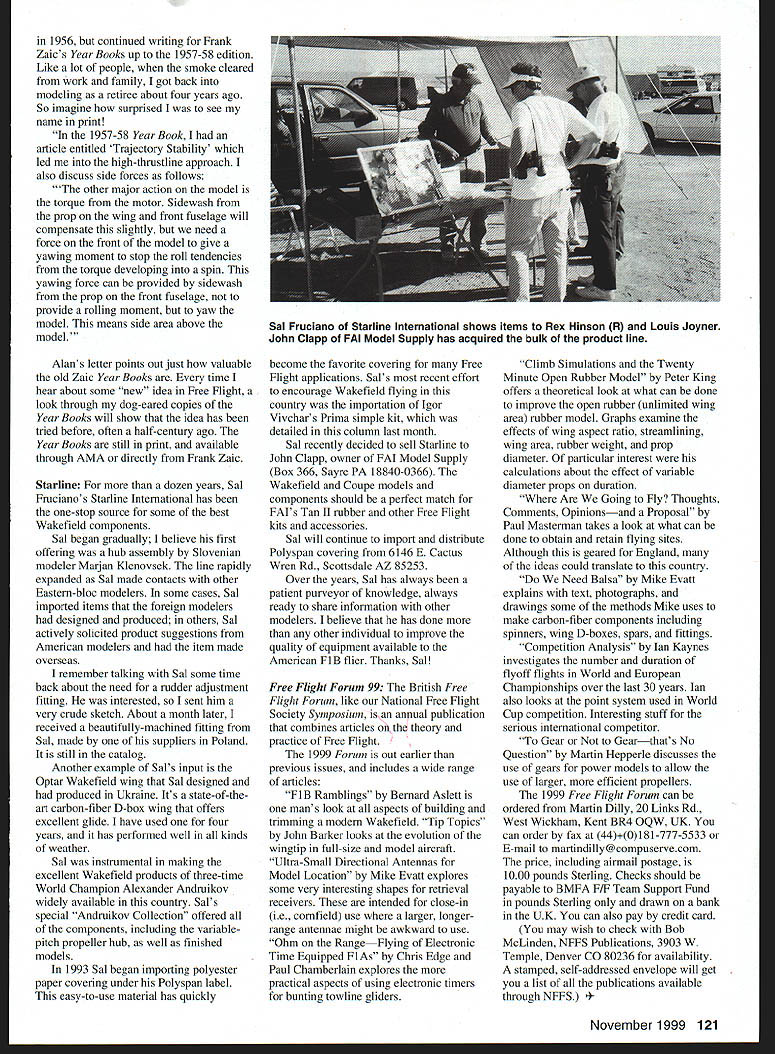
Sal Fruciano and Starline International
For a dozen years Sal Fruciano's Starline International has been a one-stop source for some of the best Wakefield components. Sal began gradually—I believe his first offering was a hub assembly from Slovenian modeler Marjan Klenovsek—and the line rapidly expanded. Sal made contacts with other Eastern-bloc modelers; in some cases he imported items that foreign modelers designed and produced, and in others he actively solicited product suggestions from American modelers and had the items made overseas.
I remember talking to Sal some time back about the need for a rudder adjustment fitting and I sent him a very crude sketch. About a month later I received a beautifully machined fitting; Sal had it made by suppliers in Poland and it is still in his catalog. Another example of Sal's input is the Optar Wakefield wing Sal designed and produced.
Polyspan has become the favorite covering for many Free Flight applications. Sal's most recent effort to encourage Wakefield flying in this country was the importation of Igor Vivchar's Prima simple kit, which was detailed in this column last month.
Sal recently decided to sell Starline to John Clapp, owner of FAI Model Supply (Box 366, Sayre PA 18840-0366). The Wakefield and Coupe models and components should be a perfect match for FAI's Tan II rubber and other Free Flight kits and accessories.
Sal will continue to import and distribute Polyspan covering from 6146 E. Cactus Wren Rd., Scottsdale AZ 85253.
Over the years, Sal has always been a patient purveyor of knowledge, always ready to share information with other modelers. I believe that he has done more than any other individual to improve the quality of equipment available to the American F1B flier. Thanks, Sal!
Free Flight Forum 99
The British Free Flight Forum, like our National Free Flight Society Symposium, is an annual publication that combines articles on the theory and practice of Free Flight.
The 1999 Forum is out earlier than previous issues, and includes a wide range of articles:
- "F1B Ramblings" by Bernard Aslett — one man's look at all aspects of building and trimming a modern Wakefield.
- "Tip Topics" by John Barker — looks at the evolution of the wingtip in full-size and model aircraft.
- "Ultra-Small Directional Antennas for Model Location" by Mike Evatt — explores interesting antenna shapes for retrieval receivers intended for close-in (confined) use where a larger, longer-range antenna might be awkward.
- "Ohm on the Range—Flying of Electronic Time Equipped F1As" by Chris Edge and Paul Chamberlain — explores practical aspects of using electronic timers for hunting towline gliders.
- "Climb Simulations and the Twenty Minute Open Rubber Model" by Peter King — a theoretical look at what can be done to improve the open rubber (unlimited wing area) rubber model. Graphs examine effects of wing aspect ratio, streamlining, wing area, rubber weight, and prop diameter. Of particular interest are calculations about the effect of variable-diameter props on duration.
- "Where Are We Going to Fly? Thoughts, Comments, Opinions—and a Proposal" by Paul Masterman — looks at what can be done to obtain and retain flying sites (geared to England, but many ideas translate elsewhere).
- "Do We Need Balsa?" by Mike Evatt — explains methods Mike uses to make carbon-fiber components including spinners, wing D-boxes, spars, and fittings, with text, photographs, and drawings.
- "Competition Analysis" by Ian Kaynes — investigates numbers and durations of Free Flight flights in World Championships over the last 30 years and looks at the point system used in World Cup competition.
- "To Gear or Not to Gear—that's No Question" by Martin Hepperle — discusses the use of gears for power models to allow the use of larger, more efficient propellers.
The 1999 Free Flight Forum can be ordered from Martin Dilly, 20 Links Rd., West Wickham, Kent BR4 0QW, UK. You can order by fax at (+44)-(0)181-777-5533 or by e-mail to martin@compuserve.com. The price is 10.00 pounds sterling, including airmail postage, payable to BMFA F/F Team Support Fund in pounds sterling only and drawn on a bank in the U.K. You can also pay by credit card.
You may wish to check with Bob McLinden, NFFS Publications, 3903 W. Temple, Denver CO 80236 for availability. A stamped, self-addressed envelope will get you a list of all the publications available through NFFS.
Transcribed from original scans by AI. Minor OCR errors may remain.

