
FREE FLIGHT DURATION
Louis Joyner, 4221 Old Leeds Road, Birmingham AL 35213
The Site
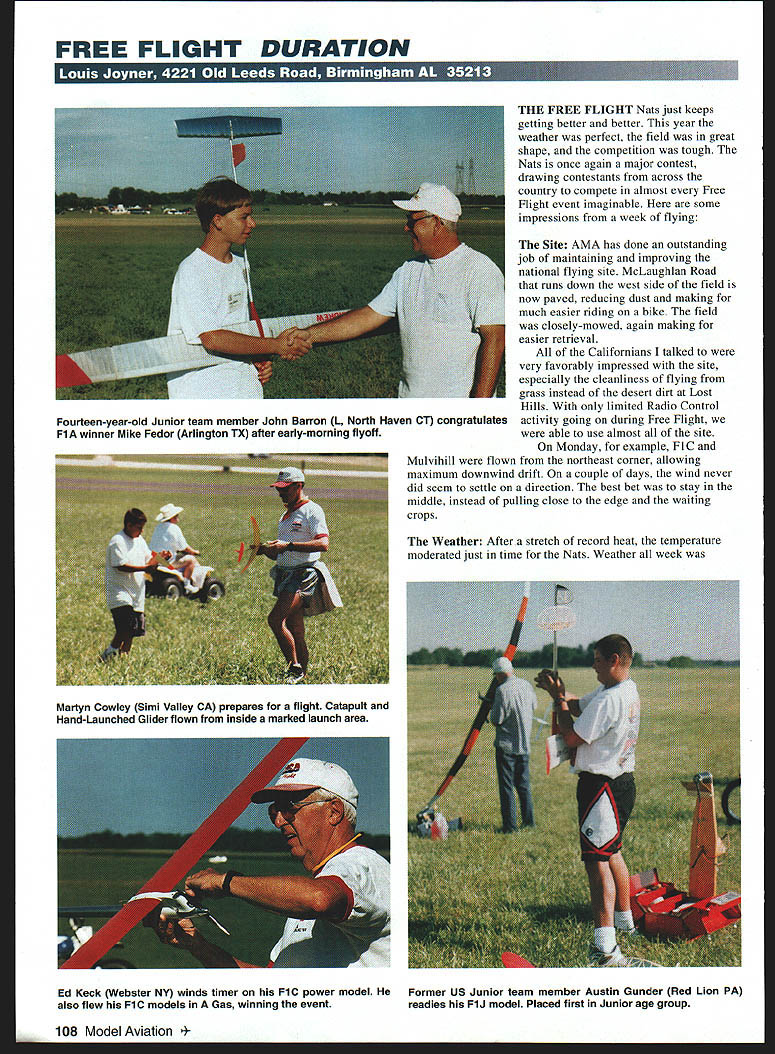
The Free Flight Nats just keeps getting better and better. This year the weather was perfect, the field was in great shape, and the competition was tough. The Nats is once again a major contest, drawing contestants from across the country to compete in almost every Free Flight event imaginable. Here are some impressions from a week of flying.
AMA has done an outstanding job of maintaining and improving the national flying site. McLaughlin Road that runs down the west side of the field is now paved, reducing dust and making for much easier riding on a bike. The field was closely mowed, again making for easier retrieval.
All of the Californians I talked to were very favorably impressed with the site, especially the cleanliness of flying from grass instead of the desert dirt at Lost Hills. With only limited radio-control activity going on during Free Flight, we were able to use almost all of the site.
On Monday, for example, F1C and Mulvihill were flown from the northeast corner, allowing maximum downwind drift. On a couple of days the wind never did seem to settle on a direction. The best bet was to stay in the middle, instead of pulling close to the edge and the waiting crops.
The Weather
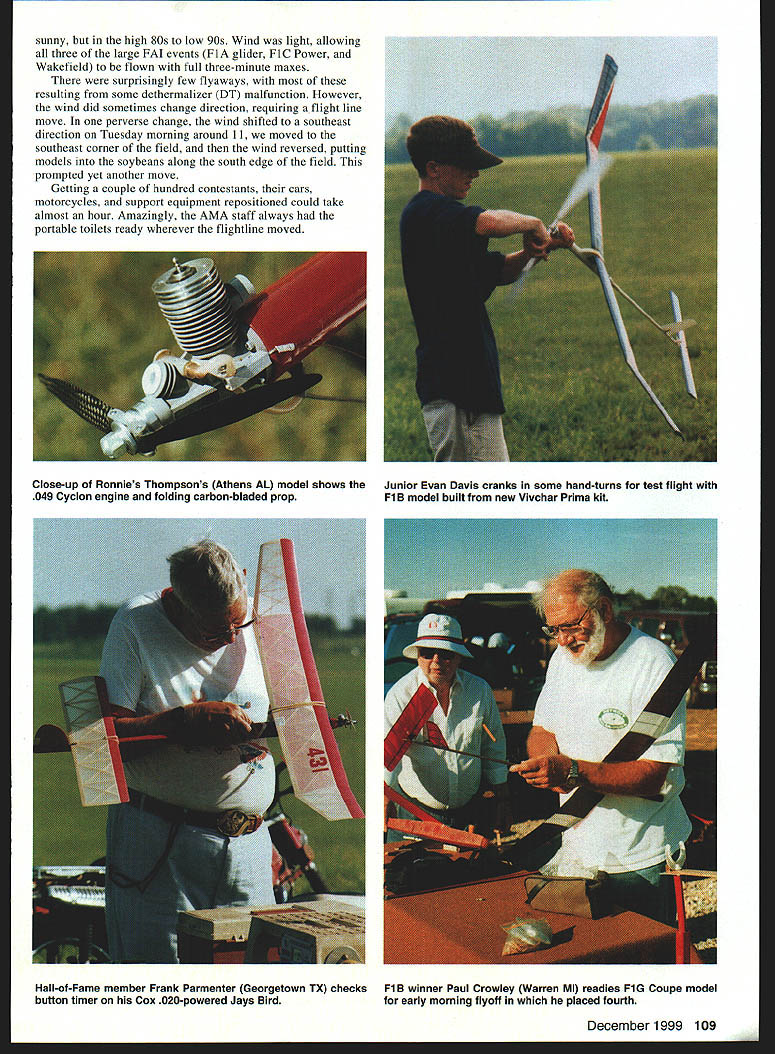
After a stretch of record heat, the temperature moderated just in time for the Nats. Weather all week was sunny, with highs in the low 80s to low 90s. Winds were light, allowing three large FAI events (F1A glider, F1C power, and Wakefield) to fly full three-minute maxes. Surprisingly few flyaways resulted, although there were some dethermalizer (DT) malfunctions.
However, the wind did sometimes change direction, requiring the flight line to be moved. A perverse change occurred when the wind shifted to the southeast Tuesday morning around 11 and moved the flight line to the southeast corner of the field. When the wind reversed, putting models in the soybeans along the south edge of the field, it prompted yet another move. Getting a couple hundred contestants, cars, motorcycles, and support equipment repositioned could take almost an hour. Amazingly, AMA staff always had portable toilets ready wherever the flight line moved.
The Competition
What everyone seemed particularly impressed with was the size and quality of the Junior and Senior competition. Several Juniors proved they can fly with the grownups.
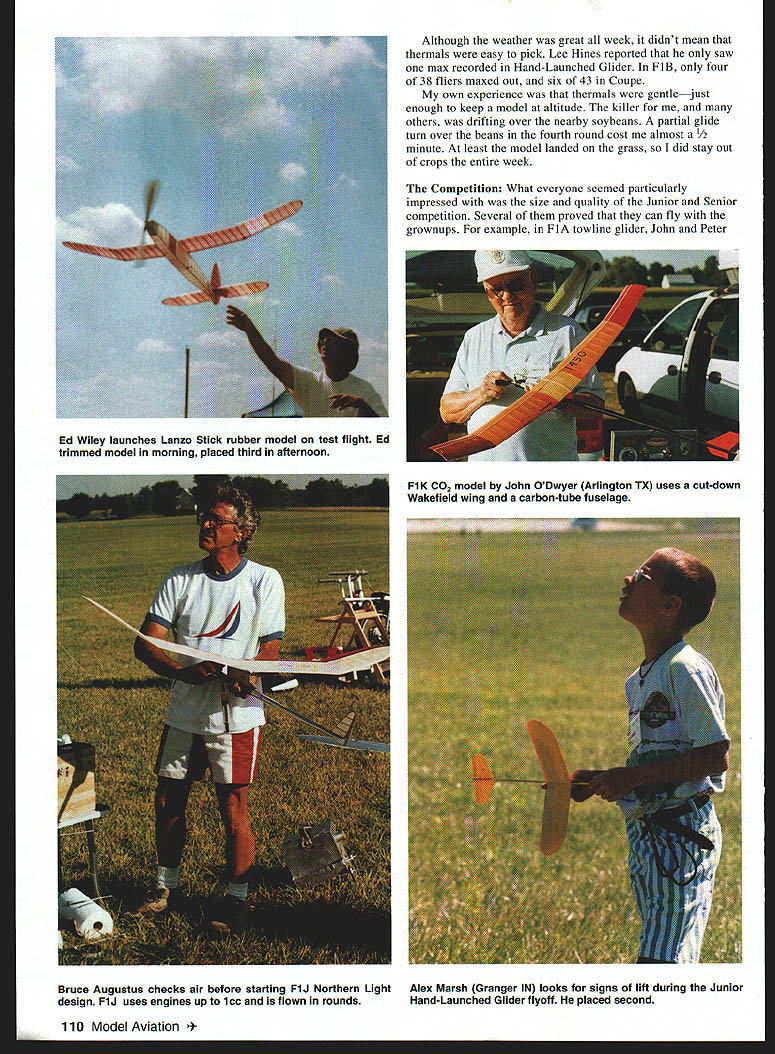
For example, in F1A towline glider, John Petty launched a Lanzo Stick rubber model; after a test flight and morning trimming he placed third in the afternoon. F1K CO2 modeler John O'Dwyer (Arlington, TX) used a cut-down Wakefield wing and a carbon-tube fuselage. Bruce Augustus checked the air before starting his F1J Northern Light design. F1J uses engines up to .049 and is flown in rounds.
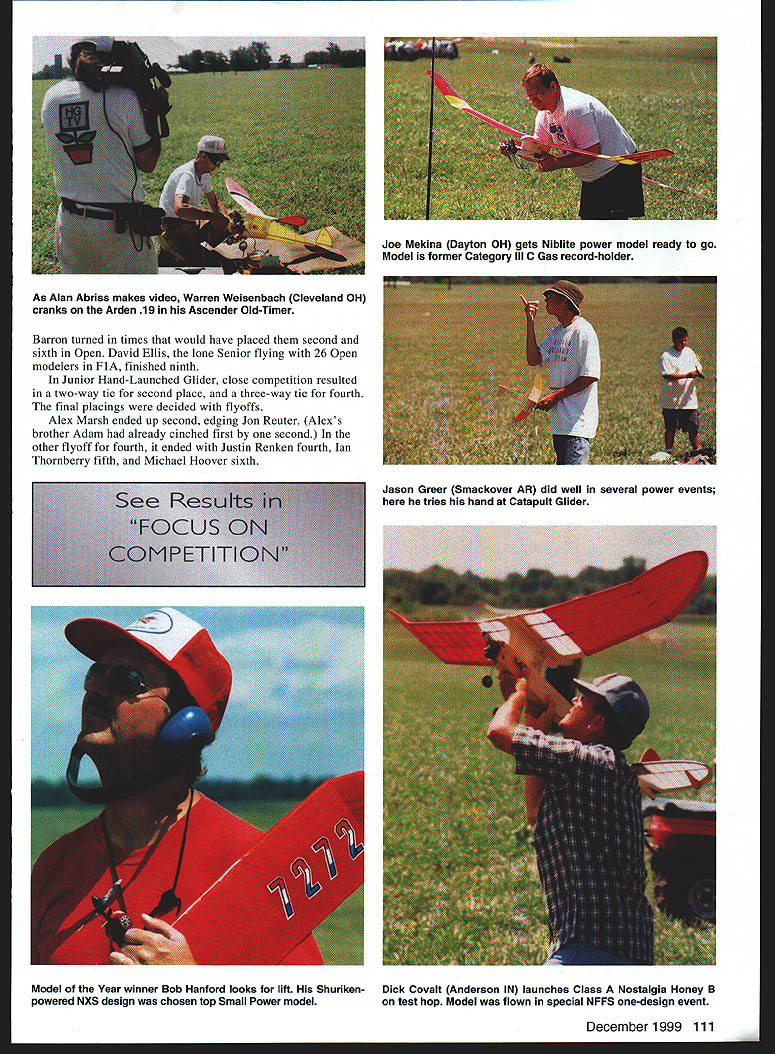
Junior Hand-Launched Glider was a close competition, resulting in a two-way tie for second place and a three-way tie for fourth; final placings were decided by flyoffs. Final placings:
- 1st: Adam Marsh
- 2nd: Alex Marsh (edged Jon Reuter)
- 3rd: Jon Reuter
- 4th: Justin Renken
- 5th: Ian Thornberry
- 6th: Michael Hoover
Alex Marsh (Granger, IN) looked for signs of lift during the Junior Hand-Launched Glider flyoff and placed second. Barron turned times that would have placed him second in Open events. David Ellis, the lone Senior flying among 26 Open modelers in F1A, finished ninth.
Although the weather was great all week, thermals were not always easy to pick. Lee Hines reported that he only saw one max recorded in Hand-Launched Glider. In F1B, only four of 38 fliers maxed out, and six of 43 in Coupe.
Model Year winner Bob Hanford looked for lift in his Shuriken. Dick Covalt (Anderson, IN) launched his Class Nostalgia Honey B–powered NXS design, chosen top Small Power.
There was also a surprisingly large number of Juniors competing in the all-ages-combined F1B Wakefield event. This was helped in large part by the Wakefield school that George Batiuk had put on the Saturday before the Nats. Top Junior in the event was all-arounder John Barron, finishing eighth.
My own experience was that thermals were gentle—just enough to keep a model at altitude. The killer for me, and many others, was drifting over the nearby soybeans. A partial glide turn over the beans in the fourth round cost me almost a half minute. At least the model landed on the grass, so I stayed out of crops the entire week.
The Banquet
Each year the National Free Flight Society sponsors a banquet for its members attending the Nats. This year the star was undoubtedly Bob White, who received a standing ovation when he came forward to accept the Model of the Year award for his Coupe No. 12 design.
Bob, who was Wakefield World Champion in 1987, won the Coupe event a few days later. After the banquet, guests had a chance to examine Bob’s model and several others up close. I wish that this aspect of the banquet could be expanded in the future.
The Picnic
Sponsored by Texas Timers and the NFFS, the picnic provides a relaxing, low-key opportunity for frankfurters and fellowship. This year even a sudden storm couldn’t dampen spirits, although it did slow down the hot-dog grilling process. Everyone eventually got served, the trophies were passed out, and then the race was over.
Art Ellis had brought along a supply of the Guillow sheet-balsa rubber models that he uses with his youth program in Connecticut. With the addition of a bit of extra dihedral and some better rubber, the models are capable of surprisingly good flights. It was great to watch kids of all ages (me included) trying to best Joe Mekina’s time of well over 50 seconds.
The Management
Contest Director Phil Sullivan and his crew of volunteers kept things operating smoothly all week. They all deserve our thanks. Processing of models was done efficiently, with a minimum of delay. Even the necessary moves were handled quickly.
One feature that helped is a new AMA low-power radio station that broadcasts weather reports, more information, and contest results. It should be even more useful next year as people become accustomed to using it.
Transcribed from original scans by AI. Minor OCR errors may remain.

