
Free Flight: Duration
Bob Meuser
CALL FOR PAPERS: Less than two months has passed since the tenth annual NFFS Symposium Report was published, and it is already time to start fretting about the next one.
The National Free Flight Society is soliciting papers for the 1978 Symposium report. Papers should treat some aspect of the art or science of Indoor or Outdoor Free Flight modeling: technical studies, practical design and engineering as applied to models, new or unusual model aircraft developments, or historical items. Please submit as much material as possible by December 31, 1977: the complete paper if possible; or failing that, an abstract; or if you haven't gotten past the title, submit that. Send it to Mr. Robert P. Dodds, Box 436, Rancho Santa Fe, CA 92067.
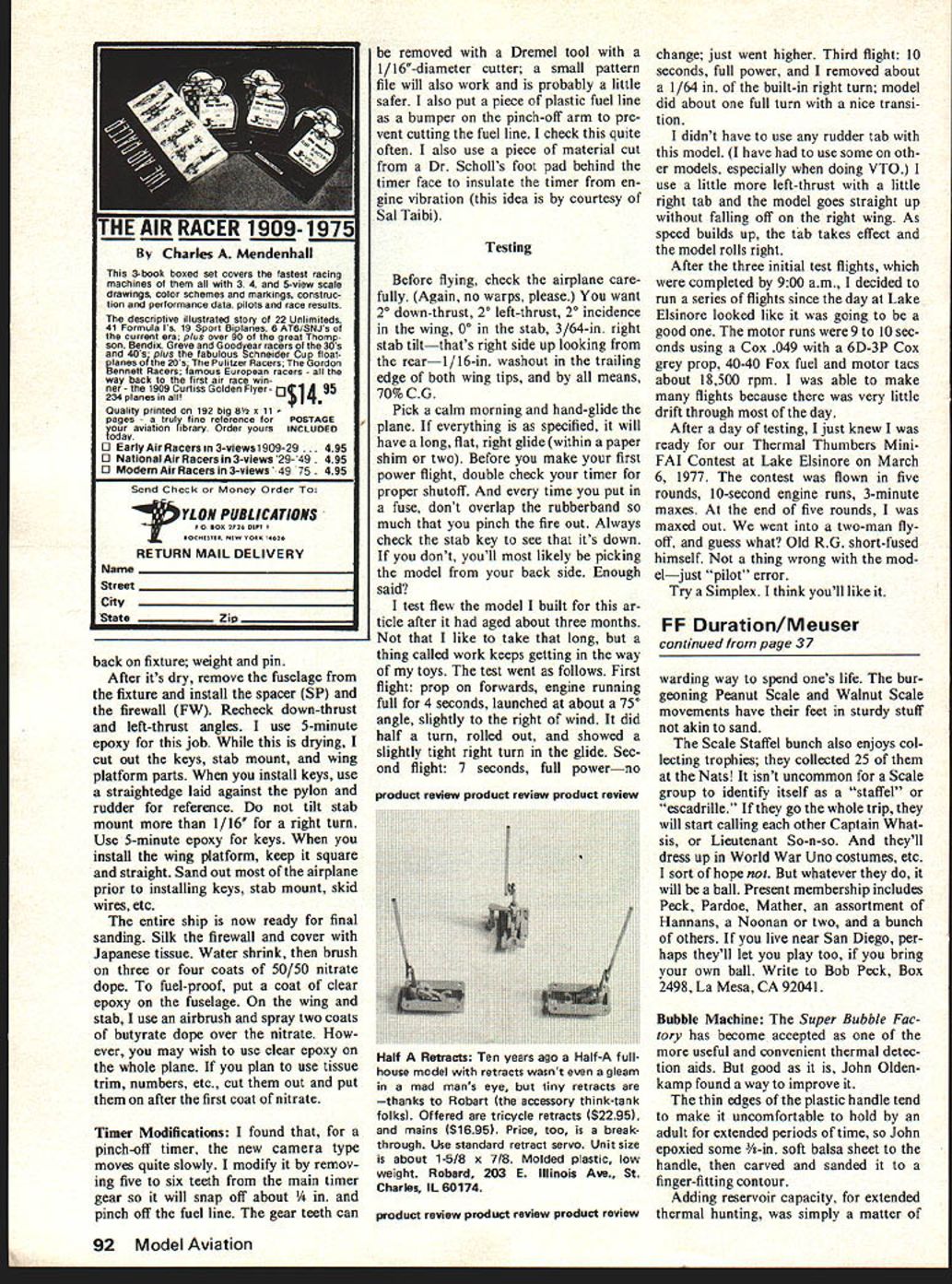
No Non-Cents Strikes Again! This is getting ridiculous. At the Nats, in addition to winning four events in which it was never intended to be competitive, plus achieving top score for Juniors in the FAI Indoor Stick event, No Non-Cents established a Category II Junior Pennyplane record with a time of over 10 min., in the hands of Marnie Meuser, a distant relative of mine. And...
At the First Annual Category I Indoor Record Trials and Box Social of the Oakland Cloud Dusters, held August 27–28 in Sunnyvale, Calif., five more records fell to No Non-Cents. Marnie put up flights of 4:17, 5:34, and finally 6:53 using her Novice version of the design. All of these bettered the existing Junior Novice Pennyplane and Pennyplane records, and the final flight topped the Senior and Open Novice marks as well. Then switching to a larger prop, she upped her Junior Pennyplane mark to 7:13, and finally to 7:38, which qualifies as a Paper Stick record as well.
Earlier in the proceedings, Bill Vanderbeek, using a rather successful, albeit 30% overweight model of doubtful lineage (not a No Non-Cents), had upped the Open Novice mark to 6 min. 50 sec. But it simply would not do to have the Junior record exceed the Open mark. So in order to restore the natural order of things, Marnie's grandpop topped Vanderbeek's Novice mark with a flight of 8:09, and later set a Pennyplane record of 9:25.
So, as of this writing, all six Junior Pennyplane and Novice Pennyplane records, for all three ceiling-height categories are held by No Non-Cents, plus three other records. Three additional records previously held by No Non-Cents have since been beaten, one by another No Non-Cents.
If you don't know what we're talking about, check out the June 1977 issue for the construction article about No Non-Cents, and pithy prose about the Pennyplane and Novice Pennyplane events.
To suggest that No Non-Cents is the best Pennyplane going, of conventional monoplane configuration, would be folly. There are probably many equally good designs around. The design was greatly influenced by Dennis Jaecks' highly successful monoplanes, and it would be difficult to prove that the small differences are truly significant as regards performance. In the last analysis, what you fly is not nearly as important as how you fly it. In any event, it certainly is a good design, and a good place to start if you want to take a crack at this crazy indoor stuff.
Having now had considerable experience with variations from the original design, I have reached some tentative conclusions:
For Pennyplane, an unbraced solid stick and boom are suitable, provided you use the lightest wood available, and keep the cross-section dimensions large. Tubular sticks and tailbooms, and external bracing, simply aren't worth the trouble. But if a solid stick comes out too limp, strands of silk or fiberglass thread, glued along the top, will stiffen it enormously while adding little weight. (Not legal for Novice Pennyplane.) A 7-in. chord appears to offer no performance advantage over a 6-in. chord, although a 6-in. chord seems to have a potential advantage over the 5-in. chord required by the Novice rules. Use plenty of side-thrust to keep the model in a tight circle, but don't use down-thrust or up-thrust.
It is easier to do a good covering job with condenser paper than with Micro-Lite, and wide variations in temperature and humidity will have no detrimental effect, provided the condenser paper is pre-shrunk. To do that, make frames from 1/8-in.-sq. balsa, cover them with condenser paper, and water-shrink it. Then cut out the condenser paper, and apply it to the model using condenser-paper cement.
The 50% CG position works fine with chords up to 6 in. With the 7-in. chord, however, stability is marginal and adjustments tricky. In any event, moving the wing back or putting ballast on the nose cures the problem.
Winglets, revisited:
In the April 1977 issue I showed drawings of NASA's "winglets," and mentioned their inventor, Dr. Richard Whitcomb. He is the fellow that worked out the "area rule" which led to the wasp-waist fuselages used on some supersonic aircraft. Whitcomb received the Collier trophy for his trouble. Well, did you know that Whitcomb is a former modeler? And not only that, he was a model-shop proprietor: Whitcomb Model Airplane Supply Company, in Worcester, Mass.
Dick Whitcomb started the shop in 1935 and ran it until 1939 when he sold it to Randy Wilson. Randy ran it until 1947, then closed the doors on it. Wilson is still an active modeler.
Front End:
In the early days of aeromodelling, virtually all models, except scale models, employed a simple stick for the fuselage. In the mid-thirties, for the larger outdoor "stick" models flown in competition, the simple stick gave way to a built-up fuselage enclosing the rubber motor. The distinction between "stick" and "cabin" or "fuselage" models no longer depended on the method of construction, but rather depended on how fat the fuselage was. True stick models are seldom seen in competition nowadays, although one won the U.S. Free Flight Champs Unlimited Rubber event a few years back, and one took a fourth-place trophy for Juniors at the Nats. For sport flying, or as an intermediate step between the Delta Dart and sophisticated competition models, the stick model holds its own.
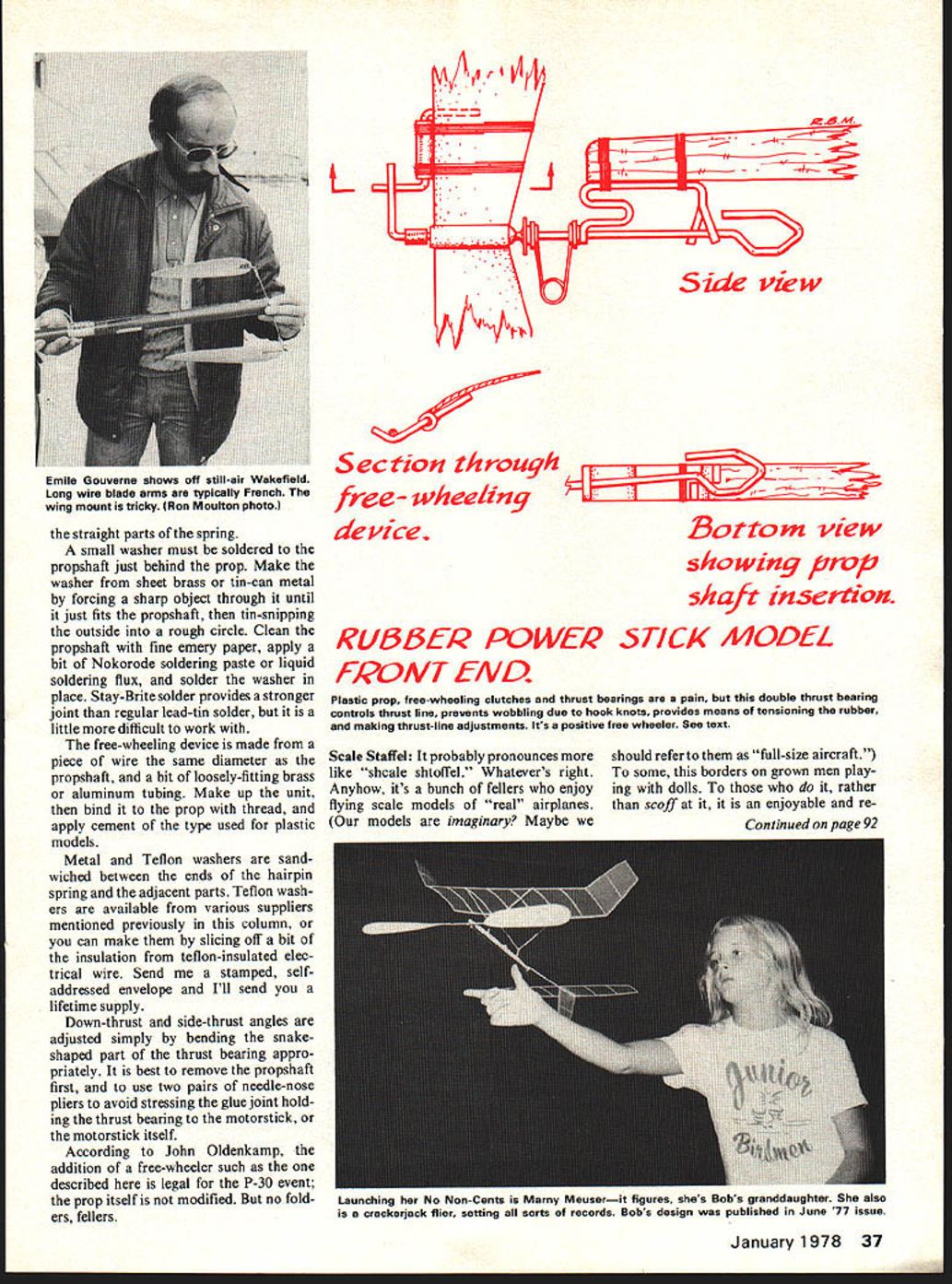
The availability of plastic props eliminates the prop-carving hassle, but the free-wheeling clutches and thrust bearings often leave a bit to be desired. The sketches show an alternative having features, some or all of which you might find useful. The thrust bearing is a double one, so it controls the thrust-line direction, and prevents prop wobble when the rubber knots around the hook; the prop and its shaft are removable as a unit; a rubber tensioner is provided, so rubber motors as long as twice the hook-to-hook spacing may be used; a no-nonsense, positive-action free-wheeling device is included; and both side-thrust and down-thrust angles can be adjusted.
The thrust bearing is made from aluminum sheet about .030" thick, and about as wide as the rubber strip, if a two-strand motor is used. The split rear hole is made by first drilling a hole in the strip, cutting through the center of the hole with tin snips, spreading the two sides apart, and finally cleaning up the halves of the hole by tweaking it with a twist drill held twixt thumb and forefinger.
The hairpin-type spring is made from .015" music wire using needle-nose pliers. Three or four full turns are about right. The number of turns, length of the straight parts, and wire size can be juggled until the end of the hook on the propshaft engages the back of the thrust bearing, just before the rubber goes completely slack. Fine adjustments can be made by bending the straight parts of the spring.
A small washer must be soldered to the propshaft just behind the prop. Make the washer from sheet brass or tin-can metal by forcing a sharp object through it until it just fits the propshaft, then tin-snipping the outside into a rough circle. Clean the propshaft with fine emery paper, apply a bit of Nokorode soldering paste or liquid soldering flux, and solder the washer in place. Stay-Brite solder provides a stronger joint than regular lead-tin solder, but it is a little more difficult to work with.
The free-wheeling device is made from a piece of wire the same diameter as the propshaft, and a bit of loosely-fitting brass or aluminum tubing. Make up the unit, then bind it to the prop with thread, and apply cement of the type used for plastic models.
Metal and Teflon washers are sandwiched between the ends of the hairpin spring and the adjacent parts. Teflon washers are available from various suppliers mentioned previously in this column, or you can make them by slicing off a bit of the insulation from teflon-insulated electrical wire. Send me a stamped, self-addressed envelope and I'll send you a lifetime supply.
Down-thrust and side-thrust angles are adjusted simply by bending the snake-shaped part of the thrust bearing appropriately. It is best to remove the propshaft first, and to use two pairs of needle-nose pliers to avoid stressing the glue joint holding the thrust bearing to the motorstick, or the motorstick itself.
According to John Oldenkamp, the addition of a free-wheeler such as the one described here is legal for the P-30 event; the prop itself is not modified. But no fliers, fellers.
CALL FOR PAPERS: Less than two months has passed since the tenth annual NFFS Symposium Report was published, and it is already time to start fretting about the next one. The National Free Flight Society is soliciting papers for the 1978 Symposium report. Papers should treat some aspect of the art or science of Indoor or Outdoor Free Flight modeling: technical studies, practical design and engineering as applied to models, new or unusual model aircraft developments, or historical items. Please submit as much material as possible by December 31, 1977: The complete paper if possible; or failing that, an abstract; or if you haven't gotten past the title, submit that. Send it to Mr. Robert P. Dodds, Box 436, Rancho Santa Fe, CA 92067.
No Non-Cents Strikes Again! This is getting ridiculous. At the Nats, in addition to winning four events in which it was never intended to be competitive, plus achieving top score for Juniors in the FAI Indoor Stick event, No Non-Cents established a Category II Junior Pennyplane record with a time of over 10 min., in the hands of Marnie Meuser, a distant relative of mine. And—
At the First Annual Category I Indoor Record Trials and Box Social of the Oakland Cloud Dusters, held August 27–28 in Sunnyvale, Calif., five more records fell to No Non-Cents. Marnie put up flights of 4:17, 5:34, and finally 6:53 using her Novice version of the design. All of these records beat the existing Junior Novice Pennyplane and Pennyplane records, and the final flight topped the Senior and Open Novice marks as well. Then switching to a larger prop, she upped her Junior Pennyplane mark to 7:13, and finally to 7:38, which qualifies as a Paper Stick record as well. Earlier in the proceedings, Bill Vanderbeek, using a rather successful, albeit 30% overweight model of doubtful lineage (not a No Non-Cents), had upped the Open Novice mark to 6 min. 50 sec. But it simply would not do to have the Junior record exceed the Open mark. So restore the natural order of things. Marnie's grandpop topped Vanderbeek's mark, in what seems to be a primitive prelude to more modern bubble-blowing devices.
There are references to Bubble Machines and related devices; John Oldenkamp improved a "Super Bubble Factory," a thermal-detection aid—be the first on your block. John took the photograph. NASA's winglets, mentioned by some, were part of the discussion about area rules and fuselage shapes; Dr. Richard Whitcomb, who worked out the area rule leading to wasp-waist fuselages used on some supersonic aircraft, received the Collier Trophy. Whitcomb was a modeler and a shop proprietor of Whitcomb Model Air.
To the point of the article, the whole business is meant to be fun and educational, not simply competitive. The emphasis remains on the craft, the tinkering, and the ingenuity of indoor free-flight design. If you don't know what we're talking about, check out the June 1977 issue for the construction article about No Non-Cents, and pithy prose about the Pennyplane and Novice Pennyplane events.
To suggest that No Non-Cents is the best Pennyplane going, of conventional monoplane configuration, would be folly. There are probably many equally good designs around. The design was greatly influenced by Dennis Jaecks' highly successful monoplanes, and it would be difficult to prove that the small differences are truly significant as regards performance. In the last analysis, what you fly is not nearly as important as how you fly it. A rewarding way to spend one's life. The burgeoning Peanut Scale and Walnut Scale movements have their feet in sturdy stuff not akin to sand.
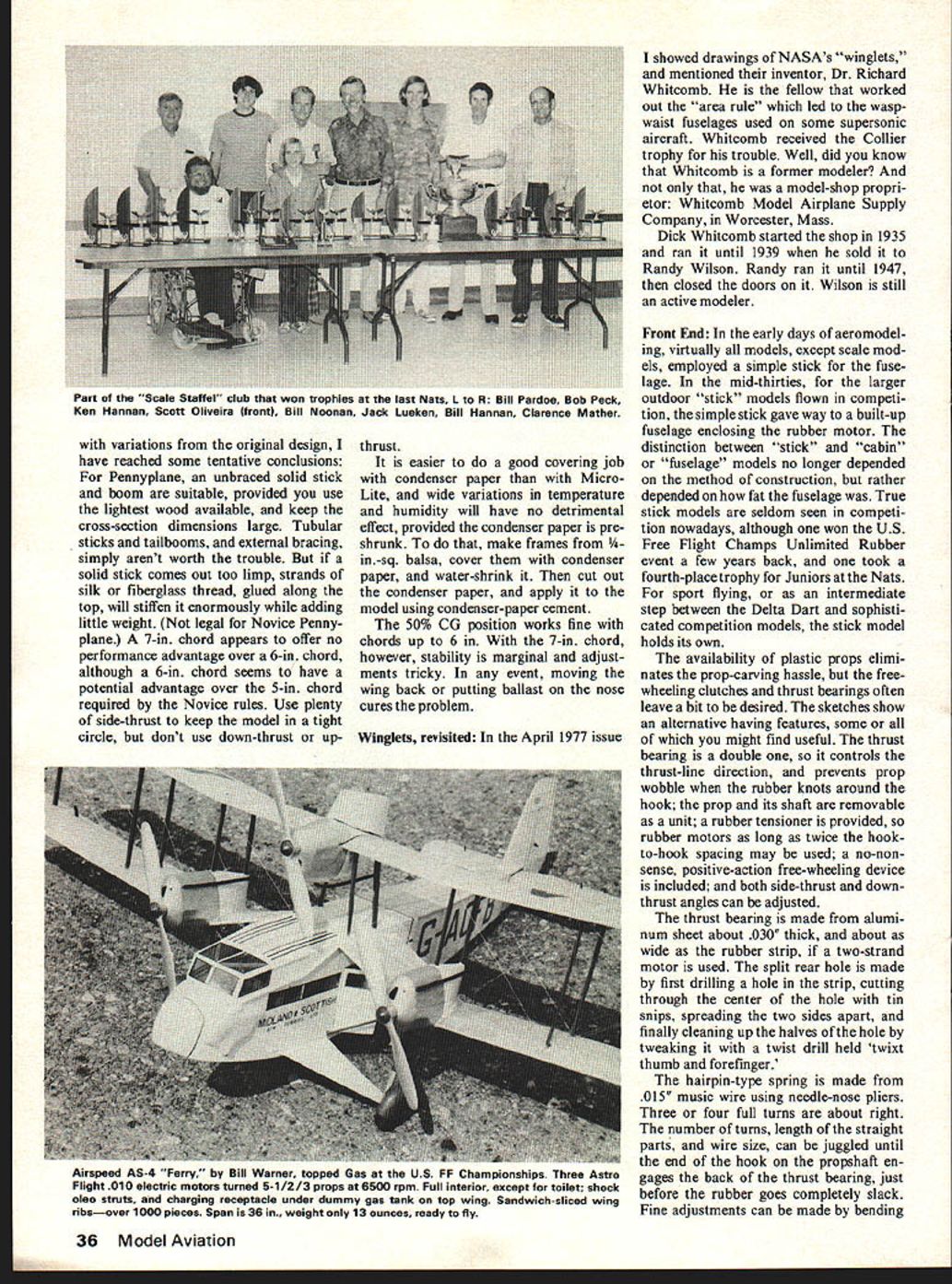
The Scale Staffel bunch also enjoys collecting trophies; they collected 25 of them at the Nats! It isn't uncommon for a Scale group to identify itself as a "staffel" or "escadrille." If they go the whole trip, they will start calling each other Captain Whatsis-or, Lieutenant So-n-so. And they'll dress up in World War Uno costumes, etc. I sort of hope not. But whatever they do, it will be a ball. Present membership includes Peck, Pardoe, Mather, an assortment of Hannans, a Noonan or two, and a bunch of others. If you live near San Diego, perhaps they'll let you play too, if you bring your own ball. Write to Bob Peck, Box 2498, La Mesa, CA 92041.
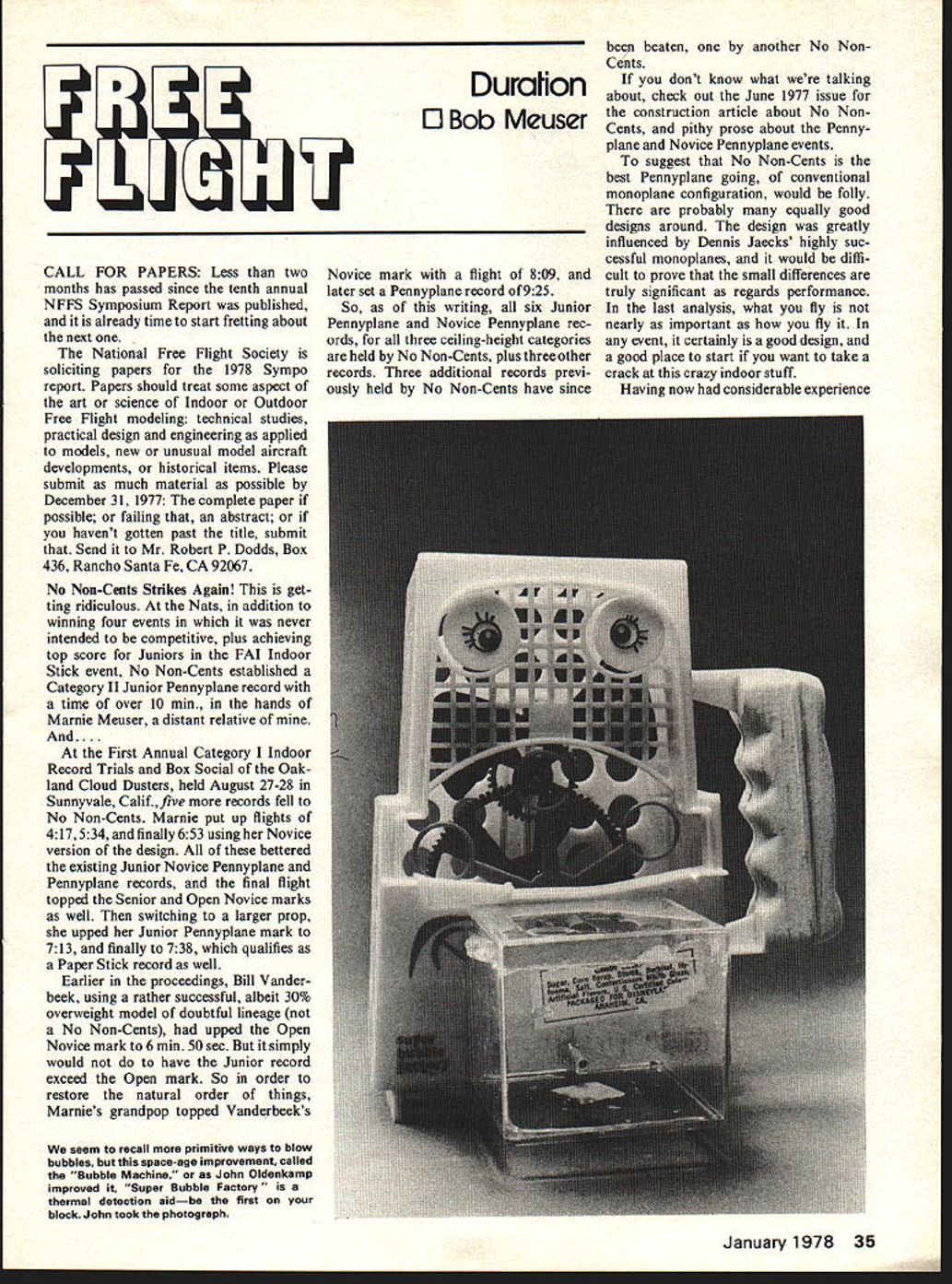
Bubble Machine: The Super Bubble Factory has become accepted as one of the more useful and convenient thermal detection aids. But good as it is, John Oldenkamp found a way to improve it.
The thin edges of the plastic handle tend to make it uncomfortable to hold by an adult for extended periods of time, so John epoxied some 3/8-in. soft balsa sheet to the handle, then carved and sanded it to a finger-fitting contour.
Adding reservoir capacity, for extended thermal hunting, was simply a matter of gluing a second bottle to the first and connecting them with a short piece of plastic tubing. adding a plastic candy box to the front of the unit, but John allows that it might be handier if it were on the side. Cut a hole into the bubble factory, and epoxy a short piece of brass tubing into it. Cut a matching hole in the plastic box, then epoxy the box in place. Finally, cut a filling hole into the top of the candy box.
A discarded plastic kitchen soap container—the kind with a spout—is ideal for filling the unit. John uses the bubble-making liquid sold in toy shops.
P-30 Kit: Blue Ridge Models appears to be sticking its corporate neck out by introducing a rather classy and correspondingly expensive kit designed specifically for an event that doesn't even have official AMA status. But perhaps it is a reasonable gamble, inasmuch as the P-30 event seems to be taking hold. The event has appeared at the U.S. Free Flight Championships, the AMA Nats, and is the subject of a mail-in contest sponsored by Model Airplane News, and appears to be turning people on.
There has been some confusion about the rules, especially as regards the prop. It was mistakenly stated in this column earlier, and elsewhere, that any plastic prop of 9 1/2-in. diameter or less was legal. That's wrong! The prop must be 9 1/2 in., period! The only 9 1/2-inchers on the market are the identical ones peddled by Peck Polymers and Vintage Aero. It is a rather heavy prop, and leads to relatively heavy models using standard outdoor type construction. The smaller and much lighter North Pacific type props lend themselves to much lighter "stick" models, which can put up terrific flight times in still air, but that isn't what the event originators (the San Diego Orbiters) had in mind. The prop must be unmodified, except for the addition of weight on one blade to bring the prop into balance, and the enlargement of the prop-shaft hole to accept larger wire. Additional rules are that no dimension may exceed 30 in., and that the rubber weight may not exceed 10 grams.
The balsa in the kit is carefully selected for weight and grain, and the parts are accurately cut. Fuselage sides are light quarter-sawn wood, accurately cut to outline, and accurately notched to accept the 1/16 x 1/8 cross members, which are furnished cut to length—all 40 of them! The ribs are not die-crunched, but are machine-sanded to shape from light quarter-sawn material, and are absolutely identical. Besides, the grooves actually fit the spars. What will modern technology bring us next? All sorts of hardware are included, including snuffer tube and a chunk of Blue Ridge's small-diameter DT fuse. Instructions for building and flying the model fill four single-spaced full-size pages. Plans are crystal clear. An ample quantity of real Japanese tissue is supplied. The proportions are typical of competition free-flight models, and there is no reason why it shouldn't fly extremely well. Construction is unusually simple for such a model, and it could well serve as a youngster's second or third model, or an adult's first one.
The price is $8.00 postpaid, which seems like a lot, but it really isn't considering the quality and the work that is already done for you. The kit is sold only by direct mail from Blue Ridge Models, P.O. Box 9188, Asheville, NC 28805. Blue Ridge has lots of other goodies, such as those snazzy Graupner prop spinners used on Wakefield models; send for its price list.
Rocket Plans: Full-size plans for Richard Wood's Nats-winning Jet Tube are available from the NFFS for a mere buck, postage paid. Send it to NFFS Plans and Publications, 20267 Northbrook Square, Cupertino, CA 95014. Ask for a complete plans list.
A three-view of this rather successful model was presented in this column in the October 1976 issue.
Bob Meuser, 4200 Gregory St., Oakland, CA 94619.
Transcribed from original scans by AI. Minor OCR errors may remain.

