
THE PENNY-BIPES, And Such:
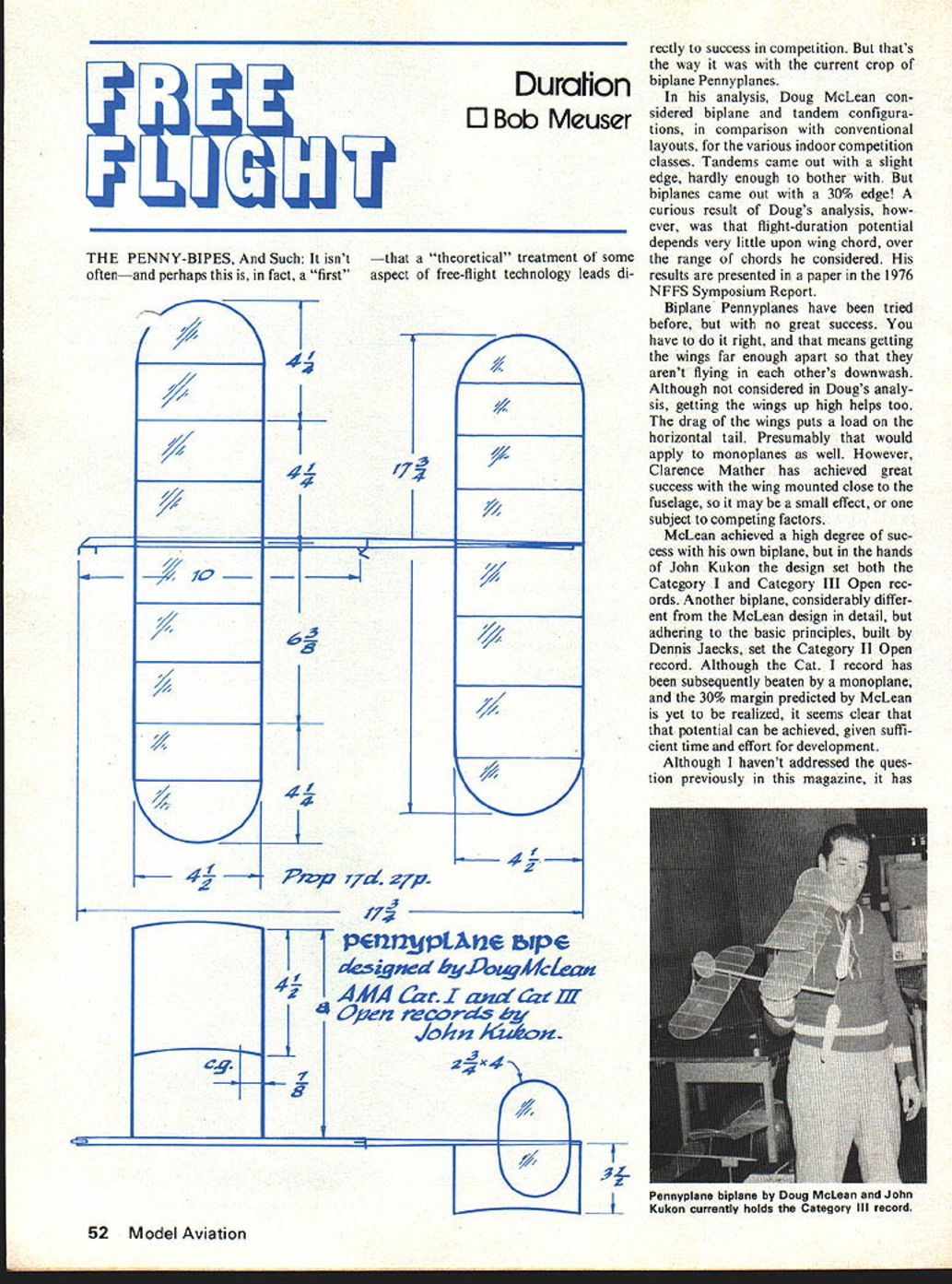
It isn't often—and perhaps this is, in fact, a "first"—that a "theoretical" treatment of some aspect of free-flight technology leads directly to success in competition. But that's the way it was with the current crop of biplane Pennyplanes.
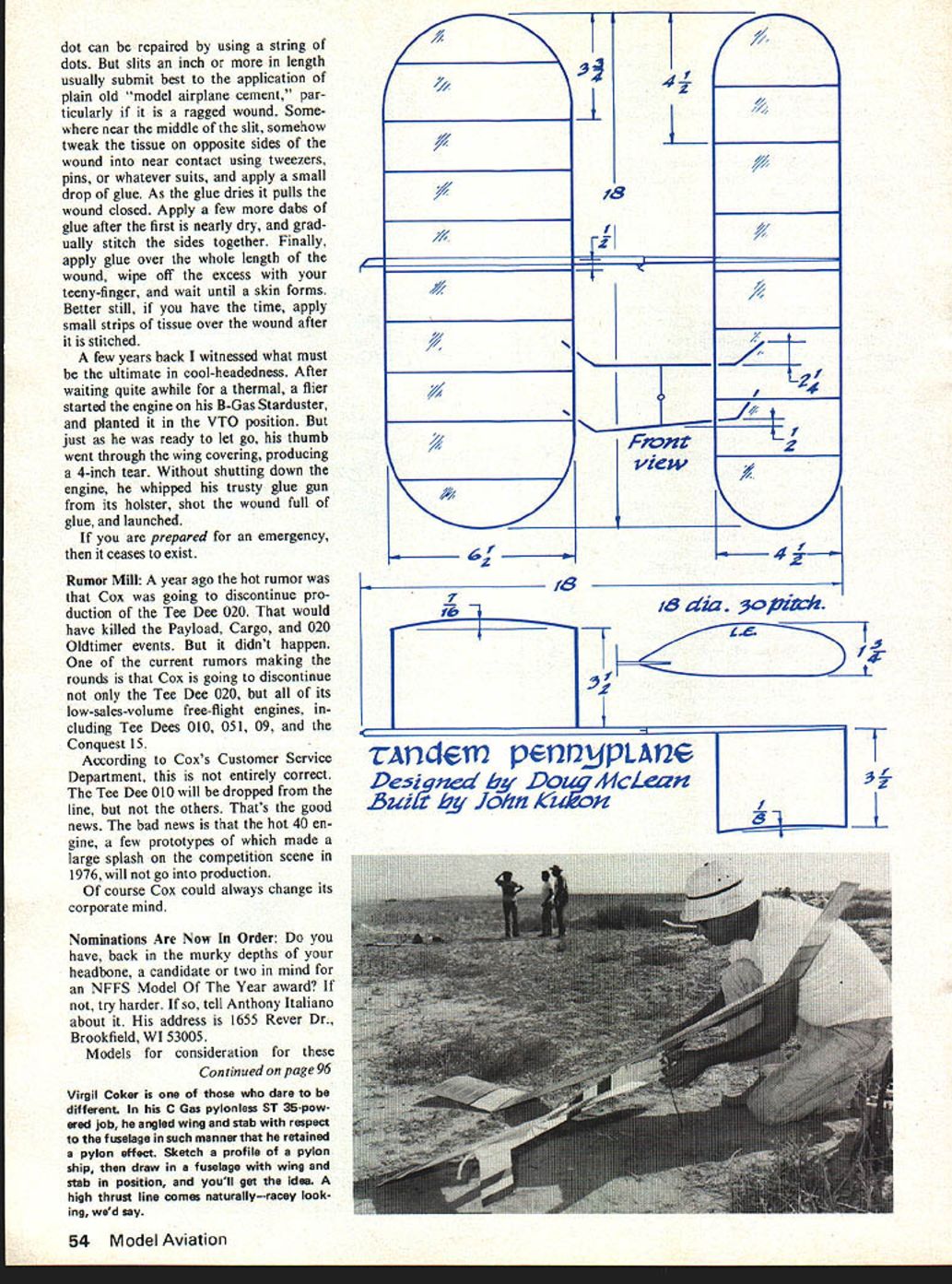
In his analysis, Doug McLean considered biplane and tandem configurations, in comparison with conventional layouts, for the various indoor competition classes. Tandems came out with a slight edge, hardly enough to bother with. But biplanes came out with a 30% edge! A curious result of Doug's analysis, however, was that flight-duration potential depends very little upon wing chord, over the range of chords he considered. His results are presented in a paper in the 1976 NFFS Symposium Report.
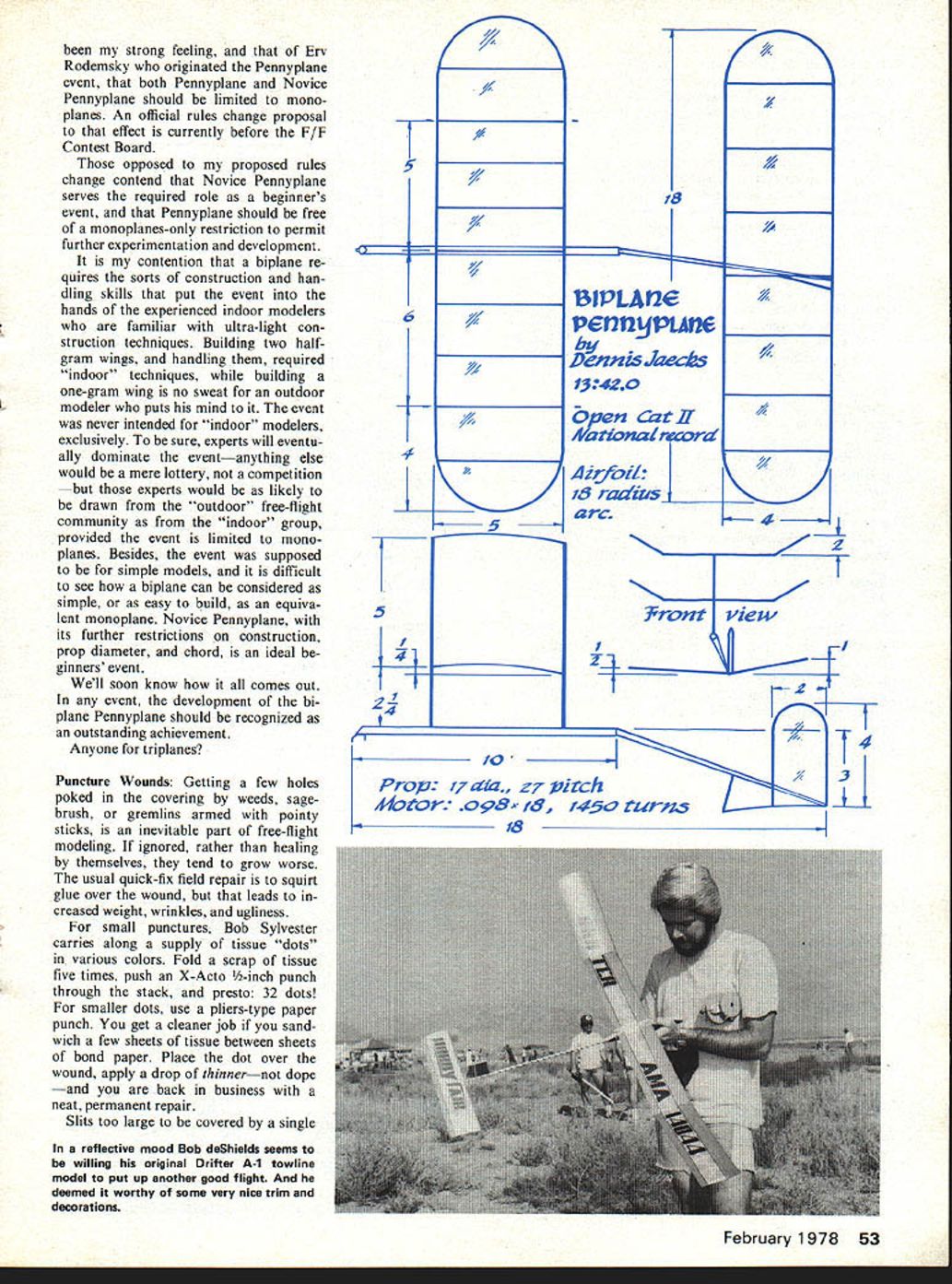
Biplane Pennyplanes have been tried before, but with no great success. You have to do it right, and that means getting the wings far enough apart so that they aren't flying in each other's downwash. Although not considered in Doug's analysis, getting the wings up high helps too. The drag of the wings puts a load on the horizontal tail. Presumably that would apply to monoplanes as well. However, Clarence Mather has achieved great success with the wing mounted close to the fuselage, so it may be a small effect, or one subject to competing factors.
McLean achieved a high degree of success with his own biplane, but in the hands of John Kukon the design set both the Category I and Category III Open records. Another biplane, considerably different from the McLean design in detail, but adhering to the basic principles, built by Dennis Jaecks, set the Category II Open record. Although the Cat. I record has been subsequently beaten by a monoplane, and the 30% margin predicted by McLean is yet to be realized, it seems clear that that potential can be achieved, given sufficient time and effort for development.
Although I haven't addressed the question previously in this magazine, it has been my strong feeling, and that of Erv Rodemsky who originated the Pennyplane event, that both Pennyplane and Novice Pennyplane should be limited to monoplanes. An official rules change proposal to that effect is currently before the F/F Contest Board.
Those opposed to my proposed rules change contend that Novice Pennyplane serves the required role as a beginner's event, and that Pennyplane should be free of a monoplanes-only restriction to permit further experimentation and development.
It is my contention that a biplane requires the sorts of construction and handling skills that put the event into the hands of the experienced indoor modelers who are familiar with ultra-light construction techniques. Building two half-gram wings, and handling them, required "indoor" techniques, while building a one-gram wing is no sweat for an outdoor modeler who puts his mind to it. The event was never intended for "indoor" modelers, exclusively. To be sure, experts will eventually dominate the event—anything else would be a mere lottery, not a competition—but those experts would be as likely to be drawn from the "outdoor" free-flight community as from the "indoor" group, provided the event is limited to monoplanes. Besides, the event was supposed to be for simple models, and it is difficult to see how a biplane can be considered as simple, or as easy to build, as an equivalent monoplane. Novice Pennyplane, with its further restrictions on construction, prop diameter, and chord, is an ideal beginner's event.
We'll soon know how it all comes out.
In any event, the development of the biplane Pennyplane should be recognized as an outstanding achievement.
Anyone for triplanes? dot can be repaired by using a string of dots. But slits an inch or more in length usually submit best to the application of plain old "model airplane cement," particularly if it is a ragged wound. Somewhere near the middle of the slit, somehow tweak the tissue on opposite sides of the wound into near contact using tweezers, pins, or whatever suits, and apply a small drop of glue. As the glue dries it pulls the wound closed. Apply a few more dabs of glue after the first is nearly dry, and gradually stitch the sides together. Finally, apply glue over the whole length of the wound, wipe off the excess with your teeny-finger, and wait until a skin forms. Better still, if you have the time, apply small strips of tissue over the wound after it is stitched.
A few years back I witnessed what must be the ultimate in cool-headedness. After waiting quite awhile for a thermal, a flier started the engine on his B-Gas Starduster, and planted it in the VTO position. But just as he was ready to let go, his thumb went through the wing covering, producing a 4-inch tear. Without shutting down the engine, he whipped his trusty glue gun from its holster, shot the wound full of glue, and launched.
If you are prepared for an emergency, then it ceases to exist.
Rumor Mill:
Rumor Mill: A year ago the hot rumor was that Cox was going to discontinue production of the Tee Dee 020. That would have killed the Payload, Cargo, and 020 Oldtimer events. But it didn't happen. One of the current rumors making the rounds is that Cox is going to discontinue not only the Tee Dee 020, but all of its low-sales-volume free-flight engines, including Tee Dees 010, 051, 09, and the Conquest 15.
According to Cox's Customer Service Department, this is not entirely correct. The Tee Dee 010 will be dropped from the line, but not the others. That's the good news. The bad news is that the hot 40 engine, a few prototypes of which made a large splash on the competition scene in 1976, will not go into production.
Of course Cox could always change its corporate mind.
Nominations Are Now In Order:
Nominations Are Now In Order: Do you have, back in the murky depths of your headbox, a candidate or two in mind for an NFFS Model Of The Year award? If not, try harder. If so, tell Anthony Italiano about it. His address is 1655 Revere Dr., Brookfield, WI 53005.
Models for consideration for these
Virgil Coker is one of those who dare to be different. In his C Gas pylonless ST 35-powered job, he angled wing and stab with respect to the fuselage in such manner that he retained a pylon effect. Sketch a profile of a pylon ship, then draw in a fuselage with wing and stab in position, and you'll get the idea. A high thrust line comes naturally—racey looking, we'd say.
FF Duration/Meuser
awards must somehow represent a significant contribution to the sport, perhaps as evidenced by an outstanding contest record. But under exceptional circumstances, awards have been presented for models not even intended for competition, and awards have been made for things other than specific models. To name a few: the Pennyplane event, the Rossi .15 Normal engine, the Peanut-Scale concept, the Seelig timer, the Old-Timer movement. Both domestic and foreign candidates are eligible.
Supply as much information as you can: Xeroxes of articles, lists of contest wins and National records, whatever. But if you can't supply that, then send in the name of the designer.
But whatever you do, do it soon! Time is a wastin'.
New Digest Editor: Free Flight, the NFFS Digest, known affectionately as simply The Digest, has a new editor. Several, in fact. After being editor for seven months, and just really getting into the swing of it, Keith Varnau found it necessary to give up the job. Bob Salick and Tom Hutchinson put together one interim issue, and Lee and Vicki Hines put out another. Now it's all in the hands of John Oldenkamp, who lives at 654 India St., San Diego, CA 92101.
Send him your good stuff: photos, sketches, stories, articles, contest results and reports, whatever. I'm sure he'd appreciate receiving club newsletters too.
Free Flight: Duration
By Bob Meuser
THE PENNY-BIPES
Such isn't often — and perhaps in fact the first theoretical treatment of some aspect of Free Flight technology leads directly to success in competition. That's the way the current crop of biplane Pennyplanes came about.
In an analysis Doug McLean considered biplane tandem configurations in comparison with conventional layouts for various indoor competition classes. Tandems came out a slight edge, hardly enough to bother with; biplanes came out a 30% edge. Curious result. Doug's analysis also showed flight-duration potential depends very little upon wing chord over the range of chords considered. His results were presented in a paper at the 1976 NFFS Symposium.
Biplane Pennyplanes have been tried before with no great success; the problem has been getting the wings far enough apart so they aren't in each other's downwash. Doug's analysis indicated getting the wings up high helps too (drag of the wings puts a load on the horizontal tail). Presumably this would apply to monoplanes as well. However, Clarence Mather has achieved great success with the wing mounted close to the fuselage; it may be a small effect subject to competing factors.
McLean achieved a high degree of success with his own biplane. John Kukon's design set Category III Open records. Another biplane, considerably different in detail but adhering to the basic principles, built by Dennis Jaecks, set the Category II Open record. Although the Cat II record has subsequently been beaten by a monoplane, the 30% margin predicted by McLean has yet to be fully realized. It seems clear that the potential can be achieved given sufficient time and development.
Although we haven't addressed the question previously, the magazine has a strong feeling that Erv Rodemsky originated the Pennyplane event. Both Pennyplane and Novice Pennyplane should be limited to monoplanes. An official rules-change proposal to that effect is currently before the Free Flight Contest Board. We oppose the proposed rules change. We contend Novice Pennyplane serves the required role for beginners, and Pennyplane should be free; a monoplanes-only restriction would prevent further experimentation and development.
Our contention is that the biplane requires sorts of construction and handling skills best left to experienced indoor modelers familiar with ultra-light construction techniques. Building two half-gram wings and handling the required indoor techniques is more demanding than building a one-gram wing. The event was never intended for indoor modelers exclusively; experts will eventually dominate the event — anything else would be a mere lottery. Competition experts would likely be drawn from the outdoor free-flight community rather than the indoor group if the event were limited to monoplanes.
Besides, the event is supposed to be for simple models. It's difficult to see how a biplane can be considered a simple, easy-build equivalent to a monoplane. Novice Pennyplane, with its further restrictions on construction, prop diameter and chord, is ideal for beginners. We'll soon know how this comes out as the event develops. The biplane Pennyplane should be recognized as an outstanding achievement.
Transcribed from original scans by AI. Minor OCR errors may remain.

