
Free Flight: Duration
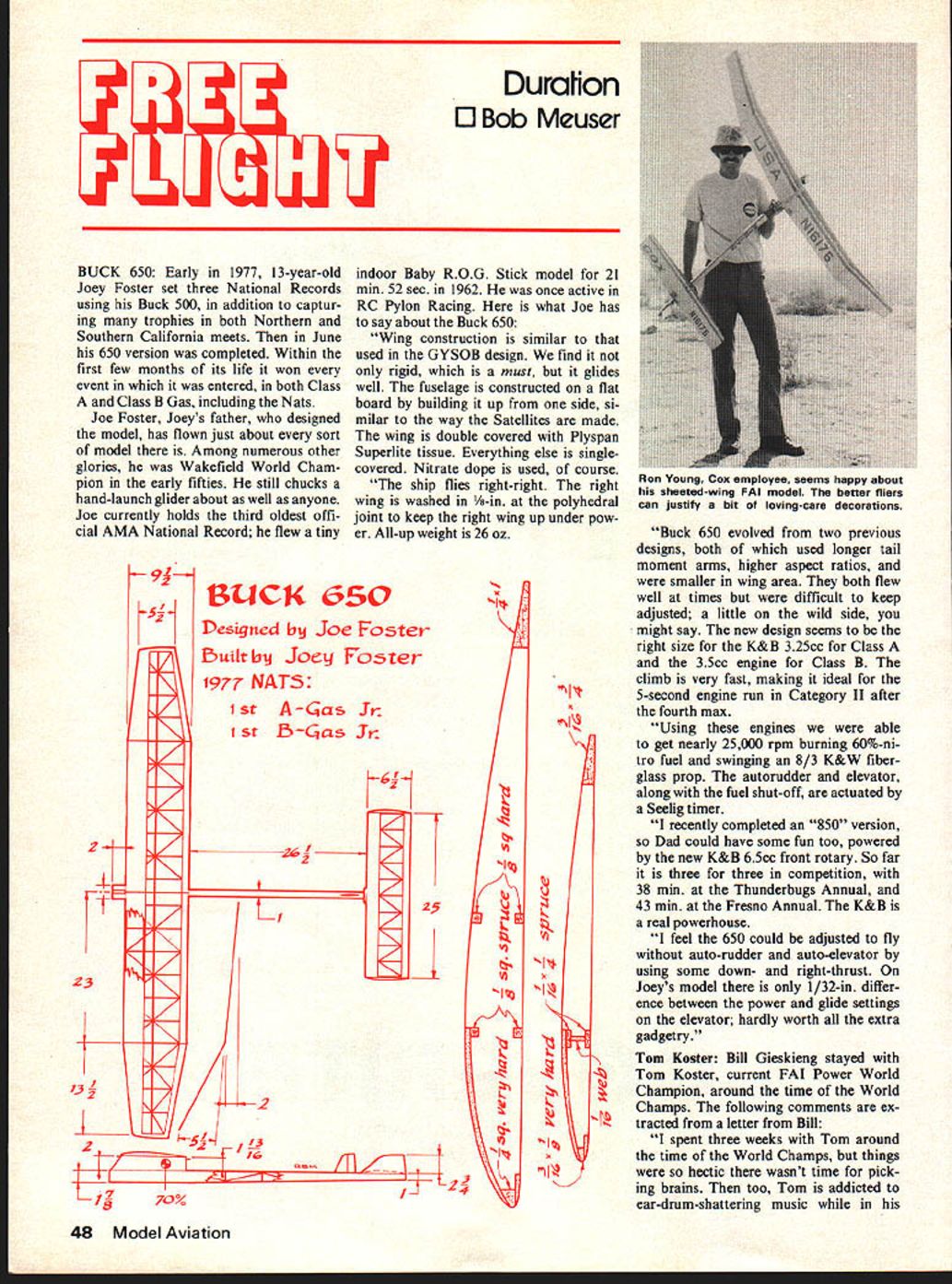
BUCK 650: Early in 1977, 13-year-old Joey Foster set three National Records using his Buck 500, in addition to capturing many trophies in both Northern and Southern California meets. Then in June his 650 version was completed. Within the first few months of its life it won every event in which it was entered, in both Class A and Class B Gas, including the Nats.
Joe Foster, Joey's father, who designed the model, has flown just about every sort of model there is. Among numerous other glories, he was Wakefield World Champion in the early fifties. He still chucks a hand-launched glider about as well as anyone.
Joe currently holds the third oldest official AMA National Record; he flew a tiny indoor Baby R.O.G. Stick model for 21 min. 52 sec. in 1962. He was once active in RC Pylon Racing. Here is what Joe has to say about the Buck 650:
"Wing construction is similar to that used in the GYSOB design. We find it not only rigid, which is a must, but it glides well. The fuselage is constructed on a flat board by building it up from one side, similar to the way the Satellites are made. The wing is double covered with Plyspan Superlite tissue. Everything else is single-covered. Nitrate dope is used, of course.
"The ship flies right-right. The right wing is washed in 1/8-in. at the polyhedral joint to keep the right wing up under power. All-up weight is 26 oz."
Buck 650 evolved from two previous designs, both of which used longer tail moment arms, higher aspect ratios, and were smaller in wing area. They both flew well at times but were difficult to keep adjusted; a little on the wild side, you might say. The new design seems to be the right size for the K&B 3.25cc for Class A and the .35cc engine for Class B. The climb is very fast, making it ideal for the 5-second engine run in Category II after the fourth max.
"Using these engines we were able to get nearly 25,000 rpm burning 60%-nitro fuel and swinging an 8/3 K&B fiberglass prop. The autorudder and elevator, along with the fuel shut-off, are actuated by a Seelig timer.
"I recently completed an '850' version, so Dad could have some fun too, powered by the new K&B 6.5cc front rotary. So far it is three for three in competition, with 38 min. at the Thunderbugs Annual, and 43 min. at the Fresno Annual. The K&B is a real powerhouse.
"I feel the 650 could be adjusted to fly without auto-rudder and auto-elevator by using some down- and right-thrust. On Joey's model there is only 1/32-in. difference between the power and glide settings on the elevator; hardly worth all the extra gadgetry."
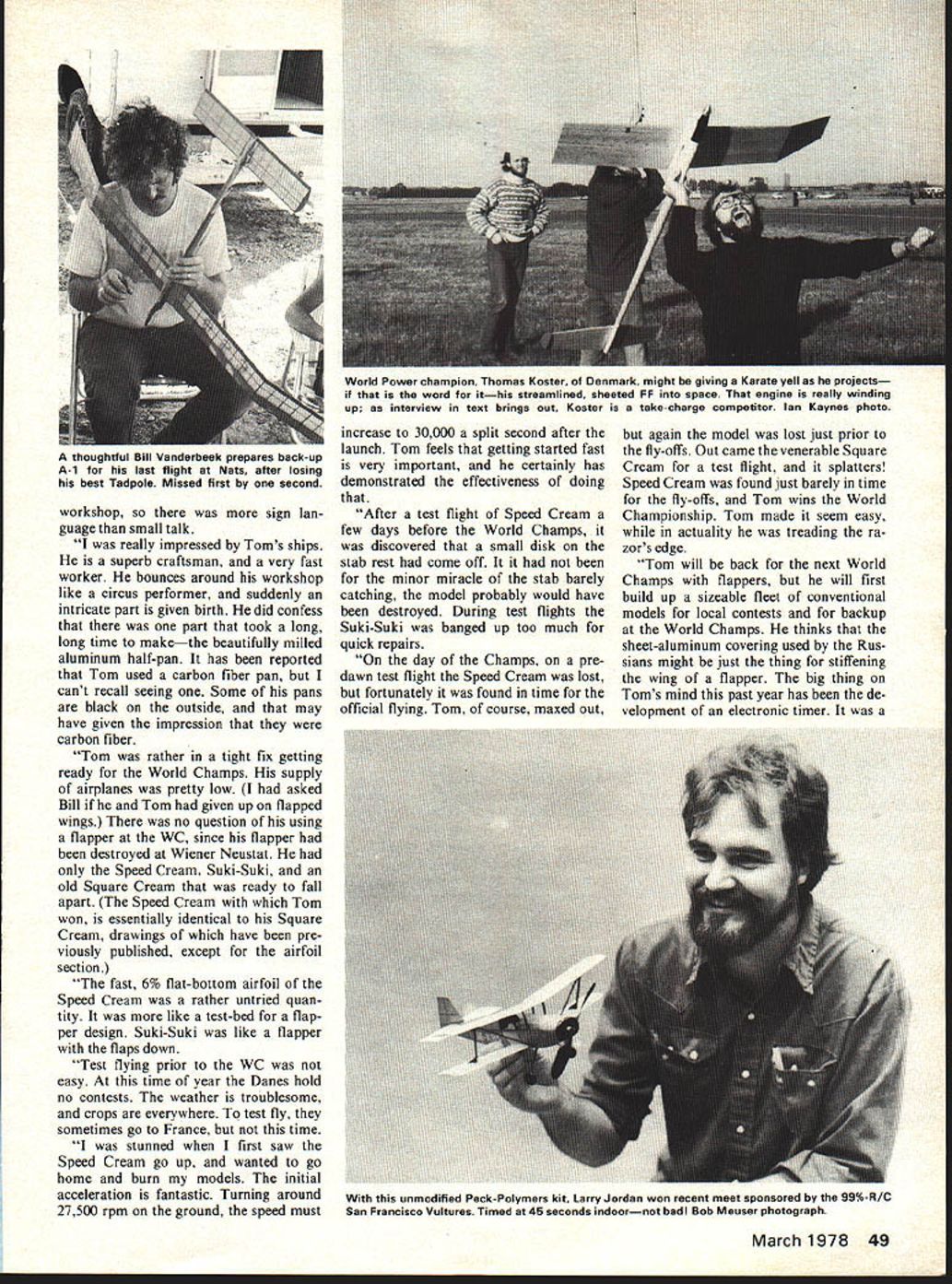
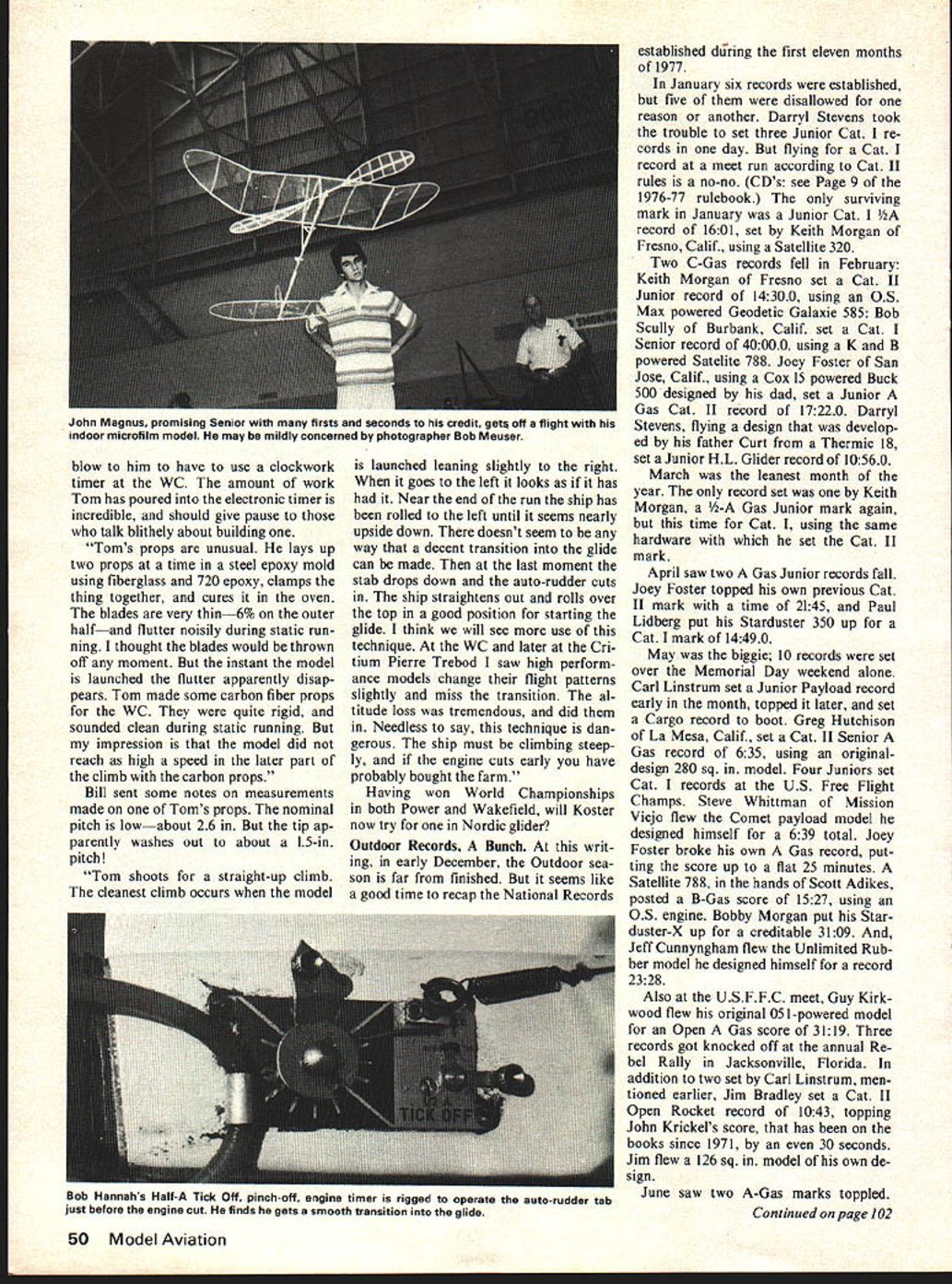
Tom Koster — Bill Gieskieng stayed with Tom Koster, current FAI Power World Champion, around the time of the World Champs. The following comments are extracted from a letter from Bill:
"I spent three weeks with Tom around the time of the World Champs, but things were so hectic there wasn't time for picking brains. Then too, Tom is addicted to ear-drum-shattering music while in his workshop. Small talk really impressed me; Tom's ships — superb craftsman, very fast worker — bounces around the workshop like a circus performer, suddenly an intricate part given birth. He did confess one part took a long, long time to make — the beautifully milled aluminum half-pan. It has been reported Tom used a carbon fiber pan; I can't recall seeing one. Some pans black outside may have given the impression of carbon fiber.
"Tom was rather tight for time getting ready for the World Champs; his supply of airplanes was pretty low. I asked Tom if he had given up flapped wings — no question, he was using a flapper at WC since his flapper was destroyed at Wiener Neustadt.
"Speed Cream (Suki-Suki), an old Square Cream ready to fall apart, is essentially identical to the Square Cream drawings previously published except for the airfoil section — a fast 6% flat-bottom airfoil. Speed Cream is rather an untried quantity, like a test-bed for the flap-per-design. Suki-Suki, like the flapper, has flaps down.
"Test flying prior to WC was easy one year; the Danes hold no contests, weather troublesome, crops everywhere, test fly sometimes go France. I was stunned the first time I saw Speed Cream go up — wanted to go home and burn my models. Initial acceleration is fantastic. Turning around 27,500 rpm, ground speed must increase to 30,000 split seconds after launch. Tom feels getting started fast is very important and certainly has demonstrated effectiveness doing so.
"After a test flight of Speed Cream a few days before the World Champs we discovered a small disk stab rest had come off — a minor miracle; the stab barely catching the model probably would have destroyed it. During test flights Suki-Suki was banged up too much; quick repairs were made the day before Champs. On a pre-dawn test flight Speed Cream was lost, fortunately..." but again the model was lost just prior to the fly-offs. Out came the venerable Square Cream for a test flight, and it splatters! Speed Cream was found just barely in time for the fly-offs, and Tom wins the World Championship. Tom made it seem easy, while in actuality he was treading the razor's edge.
Tom will be back for the next World Champs with flappers, but he will first build up a sizeable fleet of conventional models for local contests and for backup at the World Champs. He thinks that the sheet-aluminum covering used by the Russians might be just the thing for stiffening the wing of a flapper. The big thing on Tom's mind this past year has been the development of an electronic timer. It was a good time to recap the National Records established during the first eleven months of 1977.
In January six records were established, but five of them were disallowed for one reason or another. Darryl Stevens took the trouble to set three Junior Cat. I records in one day. But flying for a Cat. I record at a meet run according to Cat. II rules is a no-no. (CD's: see Page 9 of the 1976-77 rulebook.) The only surviving mark in January was a Junior Cat. I 1/2A record of 16:01, set by Keith Morgan of Fresno, Calif., using a Satellite 320.
Two C-Gas records fell in February: Keith Morgan of Fresno set a Cat. II Junior record of 14:30.0, using an O.S. Max powered Geodetic Galaxie 585; Bob Scully of Burbank, Calif., set a Cat. I Senior record of 40:00.0, using a K & B powered Satellite 788. Joey Foster of San Jose, Calif., using a Cox 15 powered Buck 500 designed by his dad, set a Junior A Gas Cat. II record of 17:22.0. Darryl Stevens, flying a design that was developed by his father Curt from a Thermic 18, set a Junior H.L. Glider record of 10:56.0.
March was the leanest month of the year. The only record set was one by Keith Morgan, a 1/2-A Gas Junior mark again, but this time for Cat. I, using the same hardware with which he set the Cat. II mark.
April saw two A Gas Junior records fall. Joey Foster topped his own previous Cat. II mark with a time of 21:45, and Paul Lidberg put his Starduster 350 up for a Cat. I mark of 14:49.0.
May was the biggie; 10 records were set over the Memorial Day weekend alone. Carl Linstrum set a Junior Payload record early in the month, topped it later, and set a Cargo record to boot. Greg Hutchison of La Mesa, Calif., set a Cat. II Senior A Gas record of 6:35, using an original-design 280 sq. in. model. Four Juniors set Cat. I records at the U.S. Free Flight Champs. Steve Whittman of Mission Viejo flew the Comet payload model he designed himself for a 6:39 total. Joey Foster broke his own A Gas record, putting the score up to a flat 25 minutes. A Satellite 788, in the hands of Scott Adkies, posted a B-Gas score of 15:27, using an O.S. engine. Bobby Morgan put his Starduster-X up for a creditable 31:09. And Jeff Cunyngham flew the Unlimited Rubber model he designed himself for a record 23:28.
Also at the U.S.F.F.C. meet, Guy Kirkwood flew his original .051-powered model for an Open A Gas score of 31:19. Three records got knocked off at the annual Rebel Rally in Jacksonville, Florida. In addition to two set by Carl Linstrum, mentioned earlier, Jim Bradley set a Cat. II Open Rocket record of 10:43, topping John Krickel's score that has been on the books since 1971, by an even 30 seconds. Jim flew a 126 sq. in. model of his own design.
June saw two A-Gas marks toppled.
Free Flight: Duration
Greg Hutchison of Chula Vista, Calif. set a Senior Cat. II record of 8:34, topping his own previous record set a month earlier, and William Morgan of Fresno, Calif. set an Open Cat. I record of 40:00 using a Supertrig 19 powered Satellite 450.
At the annual all-hydro Gathering of the Ducks meet in Gridley, Calif., John Drohoshf set an Open 1/2-A Cat. I R.O.W. mark of 11:14 with his Hydro-Star, the only R.O.W. kit on the market. Also in July, Darryl Stevens set a Junior Cargo record of 60 ounces.
At the Nats in August, two California Seniors set Cat. II Gas records. Tim Young put up the Supertrig 15-powered Bye Centennial, designed by his father Lou, for a Class B 16:47, and Fred Calhoun, Jr. put up his K&B .21-powered modified Satellite 588 for 15:00. In September, at the Planesmen Regionals in Ft. Worth, Texas, William Jenkins, of Memphis, Tenn., set a Cat. II Open 1/2-A Gas mark of 16:11, using his Clem-designed Country Boy, which appeared in the March, 1977 issue of Model Aviation. At various meets, three Californians set records in September. Jon De Fries set an Open Category I A-Gas mark of 52:12 using a Rossi-powered Satellite 450. A Nordic A-2 record of 24:00 was set by Jeff Livotto using an Ultimate Dragmaster, now kitted by its designer Tom Hutchinson, at the FAI Semi-Finals at Taft. And Howard Doering set an Open Cat. II B.R.O.W. mark of 6:27, using a Mel Schmidt designed Shocer 750 driven by a K&B .29. The motor, an ancient pre-green-head model, was so worn out that a starter was required to spin it fast enough to catch.
The only record set in October was one in Half-A Gas, Open, in Cat. II, by Glenn Schneider. Flying at one of the Northern California monthlies at Sacramento, Glen racked up a score of 18 min. flat, using a 325 sq. in. model of his own design, the Li'l Booger.
And then there were none. In November, that is.
HLG at the Nats: I goofed. In my F/F Nats story (November 1977) I neglected to mention that the highest outdoor HLG time for all age groups was posted by a Senior. James Leuken of Escondido, Calif. did it to the big kids with his FR's Glider, one of the new series kitted by M and P, and received the Tulsa Glue-Dobbers Trophy for his trouble.
Leuken has been active in CL flying but broke up too many models, and so he is making the switch to FF. He has been flying FF Gas Scale for some time. Some sort of Scale involvement would have been difficult for him to avoid, inasmuch as he lives around the corner from Bill Hannan. He has also dabbled in 1/2-A Gas FF, and is now starting to fly A-2 Nordic Glider, circle-zoom and all. Leuken has been flying Outdoor HLG for two or three years, and has tried most of the better standard designs before zeroing in on FR's Glider. But the 1977 Nats was his first try at HLG competition. Winning the Tulsa Glue-Dobbers is pretty good for starters.
James likes to pick his own air, but he admits it's comforting to have his glider roll out right next to a model that is already on the way up. At his second contest, the Orbiteer's Annual in November, James was 7 sec. out of first place in the combined Senior/Open OHLG event.
My statement that Bill Blanchard's winning both Indoor and Outdoor HLG events at a Nats "is an accomplishment not previously achieved in the history of model aviation" is true, but needs a little expansion. First of all, my records go back only to 1963, so anything prior to that I regard as prehistoric. Since that time, Blanchard is the only Open flyer to accomplish the double win, but it has happened three times in the other age groups. In 1974 Mike Stoy, a Senior at the time, copped firsts in both the high-ceiling Indoor HLG event and the Outdoor HLG event, and took second in low-ceiling Indoor HLG to boot. In 1965 Randal Richmond took two firsts in Junior, and in the same year John Manczuk did the same in Senior.
It is easy to ignore Junior and Senior accomplishment, since 99% of the action takes place in the Open age groups. Even in a jock event such as HLG, the senior citizens take home most of the bananas. For example, in the last 15 years a Senior has posted top Indoor time only once, and during the period from 1963 to 1973 top Outdoor times were all posted by Open contestants. However, perhaps times are changing, for Seniors have taken home the Tulsa Glue Dobbers Trophy, awarded for the highest overall Outdoor HLG score, at three out of the last four Nats.
Blanchard's consistent winning in Outdoor HLG, year after year, in the intense Southern Cal competition is nevertheless quite an accomplishment, and coupling that with two HLG Nats wins must be some sort of "an accomplishment not previously achieved in model aviation history."
Think Cheap! Writing in The Satellite, its editor, Ralph Prey, has been lamenting over the high cost of balsa and the newer hot Schnuerle-ported engines. A partial solution came in a reply from Tom Hutchinson:
"From personal experience, I find the cost of the new engines to be a bit off-putting. I've been thinking about making some new gassies. Such thoughts die quickly, however, when you see the cost of engines in the hobby shop.
"But, are the new hot engines really necessary to be competitive? In AMA gas, a high power-to-weight ratio is still the way to obtain hot performance from any engine/plane combination. So, a cheap solution would be to match the design of the plane to the power available. There is no rule requiring Classic C ships to have 800 sq. in. Think about something like a 400 sq. in. model with a Fox Stunt 35. The Fox doesn't have the horsepower of the K&B .40, but it is comparable in power to a good .15, and it only weighs 6 oz. (Prey suggests the K&B Stallion 35 as an alternative). With a 9" prop and a total weight of, say, 16 oz., you'd have a ship that could max easily on 12-sec. engine runs.
"The older plain-bearing engines have a good power-to-weight ratio. Such engines as the OS Max 29 or 35, or Johnsons, pose interesting possibilities when coupled to the proper design. (Some of the new Testor's engines are relatively cheap and offer surprising performance, although they are a bit heavy.) Other possible sources for economy engines are those used in the highly competitive events, such as FAI Power and Pylon Racing, that are no longer the current champ. Old Super Tigre 15s, Cox TD 15s, (an especially good choice because of its low weight), and the K&B rear-rotor Pylon 40s would make perfectly good FF engines, even though they are not the latest thing. If you approach competitors in these events they might be willing to part with such "obsolete" engines for reasonable prices.
Occasionally, some real bargains pop up on the dealer's shelves. I'm not sure whether this is the particular engine Tom is talking about, but Sig is selling off Fox 36 engines, No. 13800, at a list price of $12.00 through its dealers. This is the version having a needle valve calibrated for pressure-tank operation. Perhaps it is simply a matter of tweaking out the needle valve hole to switch to suction, if that is your preference. The standard suction engine, No. 13600, is available in combination with a number of C/L kits for a total price of about half of what a ball-bearing Schnuerle engine goes for. Come to think of it, Jim Clem seems to have done rather well over the years using Fox engines. Prey's new Class B model sports a Veco 29.
Ok, that takes care of the engine situation; now what about the high cost of balsa wood?
Bob Meuser, 4200 Gregory St., Oakland, CA 94619.
Transcribed from original scans by AI. Minor OCR errors may remain.

