
Free Flight Duration
Bob Meuser
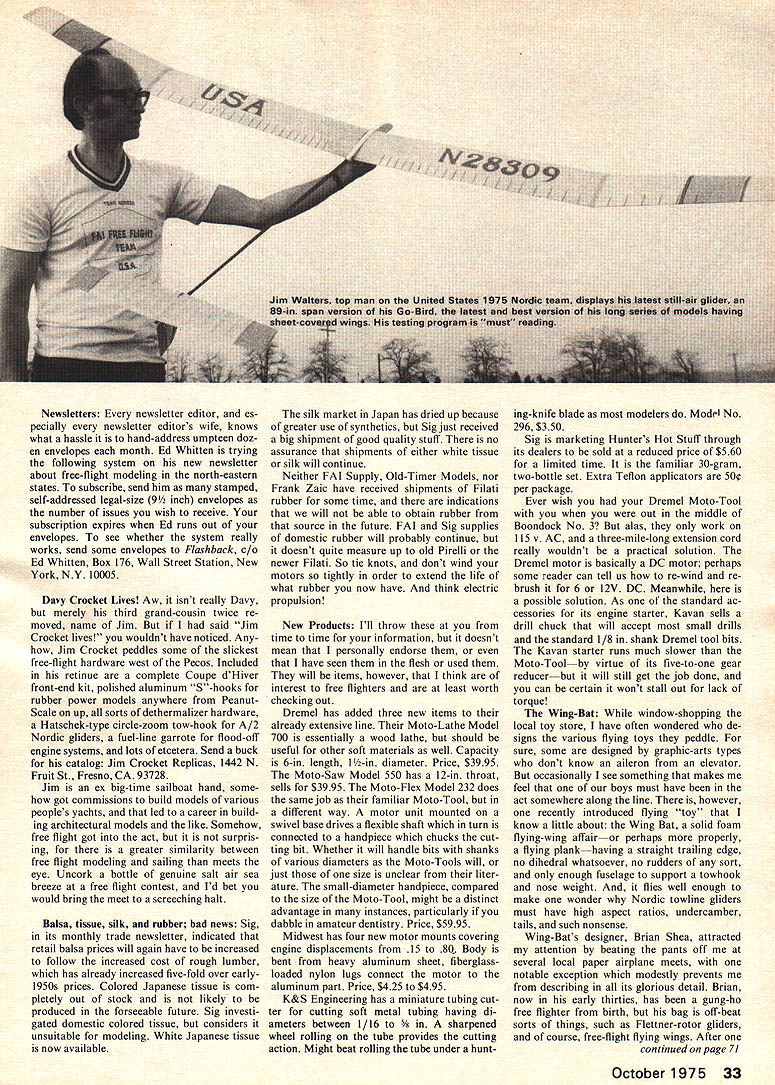
Preparing For The World Champs: Many free fighters who specialize in the international FAI events bumble through the qualifications and semi-finals with last-season's models and half-hearted preparations. Preparation for the Finals is usually taken more seriously: new models, new engines for the power-models, new gadgetry and techniques for the towline glider flyers, scrounging and testing rubber for Wakefield motors, and lots of test flying. But when, after the Finals, one suddenly discovers that he is on the team that is to defend the reputation of U.S. free-flight model aviation at the World Championships, the work really starts. I have had some correspondence with Jim Walters recently concerning his preparations for the World Champs, where he will fly Nordic towline glider. I rather imagine his level of effort is somewhat representative of what the other eight team members (three in each event) are going through about now.
Few FAI flyers would be caught dead flying a model designed by someone else, and Jim Walters is no exception. His "Bird" series—Go-Bird, Sno-Bird, Super-Bird—has included eight models having sheet balsa covered wings plus stick-and-tissue versions as well. In the Finals last fall at Taft, Jim took first place on the Nordic team flying his sheet-covered Sno-Bird in the first two rounds where still-air time was most important, and his stick-and-tissue Go-Bird for the following rounds. Two new models have been built since Taft. The first was a new Sno-Bird with an 89-inch span—an increase of 4 inches over the version he flew at Taft—intended for maximum still-air performance. Jim lives in the Seattle area, and the model was first tested when there was 3 to 6 inches of snow on the ground. In February, he won the aptly named Misery Meet using the new model. Second new model is his Super-Bird, a stick-and-tissue model intended for all-weather flying. Jim now uses Hatschek-type tow hooks on all of his models (Flying Models, January 1974) and has been working hard on his circle-tow technique.
Here are some tidbits from Jim's letters:
"I classify myself as a lazy builder, so I generally strive to find shortcuts to decrease the time required to build a model without compromising its performance. It figures; you don't get 'static judging' points at the World Champs, and time spent on frills would be better spent in practice flying. I use store-bought fiberglass tailbooms, and lumber-yard plywood for the fuselage core. I believe my new Super-Bird is superior to Go-Bird in every respect except that the wing construction is slightly more difficult. I'll do all of my practice flying 'by rounds' to simulate contest conditions; I'll set up a time schedule to allow a 20-minute period in which to get off each flight, and I'll record the time no matter how bad it is. The test flight doesn't really matter; I want downers—premature releases—to hurt bad, so I won't make the same mistakes at the World Champs.
"I have tried the Russian technique of using no towline reel and 50-lb monofilament Nylon line in place of the usual braided Dacron line. The disadvantages of this scheme are storing the line after the launch, and the stretchiness of Nylon compared to Dacron. The advantages: the Nylon does not snag in the grass, but rather slides through easily and does not tend to tangle. While circle towing you sometimes have half of the line lying on the ground. You can reel in the excess line, but feeding it out from the reel is slow and jerky, and there is always the possibility of a fatal backlash. It is far more satisfactory to let the monofilament line slide out through your pinkies.
"I've found that with winds below 3 mph I can keep the model aloft for long periods with little running by reeling the line in hand-over-hand, and letting it pay out quickly at the proper moment. One of the greatest problems with circle towing is a reluctance to launch; it's just a heck of a lot of fun keeping the model on the line, and I'm sure I am guilty of passing up many acceptable thermals—call it 'rapture of the sky.'
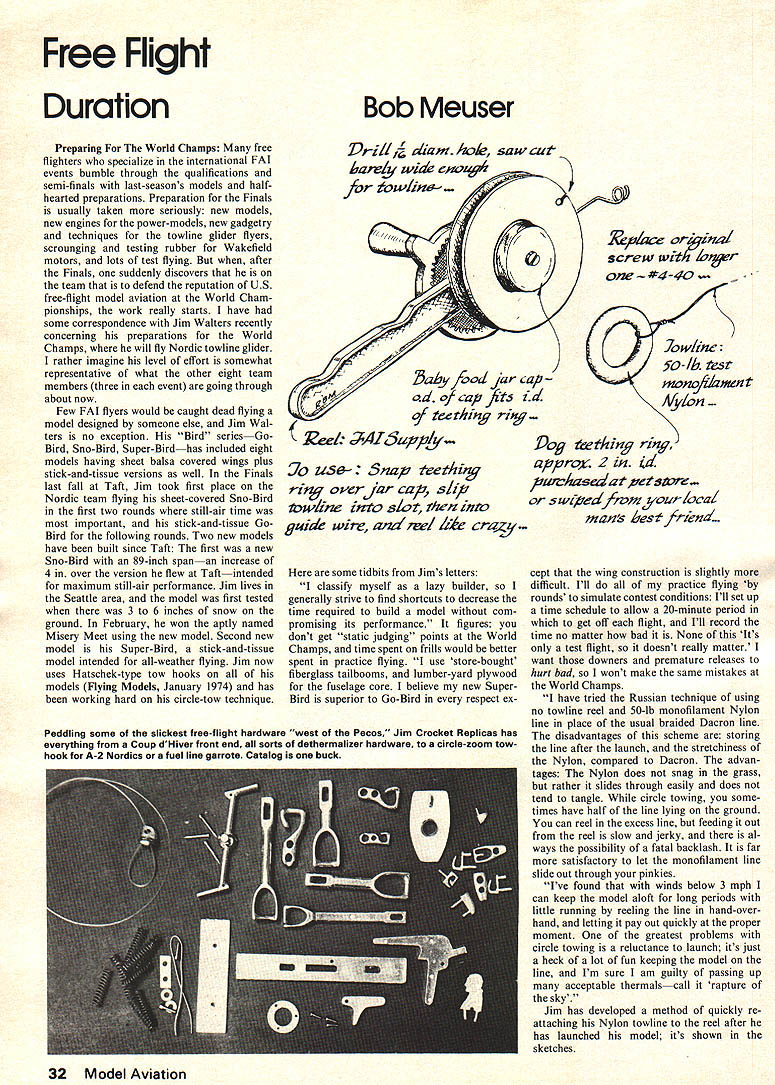
"Jim has developed a method of quickly reattaching his Nylon towline to the reel after he has launched his model; it's shown in the sketches." Newsletters: Every newsletter editor, and especially every newsletter editor's wife, knows what a hassle it is to hand-address umpteen dozen envelopes each month. Ed Whitten is trying the following system on his new newsletter about free-flight modeling in the north-eastern states. To subscribe, send him as many stamped, self-addressed legal-size (9½ in) envelopes as the number of issues you wish to receive. Your subscription expires when Ed runs out of your envelopes. So to see whether the system really works, send some envelopes to Flashback, c/o Ed Whitten, Box 176, Wall Street Station, New York, N.Y. 10005.
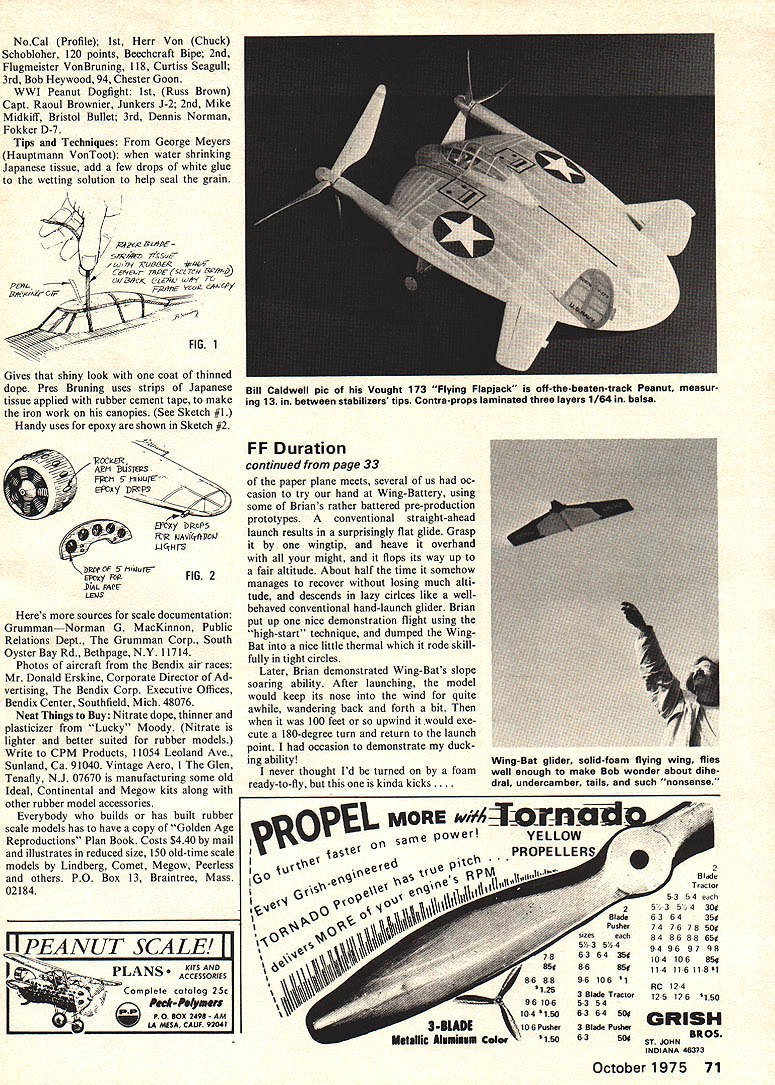
Davy Crockett Lives! Aw, it isn't really Davy, but merely his third grand-cousin twice removed, named Jim. But if I had said "Jim Crockett lives!" you wouldn't have noticed. Anyhow, Jim Crockett peddles some of the slickest free-flight hardware west of the Pecos. Included in his retinue are a complete Coupe d'Hiver front-end kit, polished aluminum 'S' hooks for rubber power models anywhere from Peanut-Scale on up, all sorts of dethermalizer hardware, a Hatschek-type circle-tow tow-hook for A/2 Nordic gliders, a fuel-line garrote for flood-off engine systems, and lots of etcetera. Send a buck for his catalog: Jim Crockett Replicas, 1442 N. Fruit St., Fresno, CA 93728.
Jim is an ex-big-time sailboat hand, somehow got commissions to build models of various people's yachts, and that led to a career in building architectural models and the like. Somehow, free flight got into the act, but it is not surprising, for there's a greater similarity between free flight modeling and sailing than meets the eye. Uncork a bottle of genuine salt-air sea breeze at a free flight contest, and I'd bet you would bring the meet to a screeching halt.
Balsa, tissue, silk, and rubber; bad news: Sig, in its monthly trade newsletter, indicated that retail balsa prices will again have to be increased to follow the increased cost of rough lumber, which has already increased five-fold over early-1950s prices. Colored Japanese tissue is completely out of stock and is not likely to be produced in the foreseeable future. Sig investigated domestic colored tissue, but considers it unsuitable for modelers. White Japanese tissue is now available.
The silk market in Japan has dried up because of greater use of synthetics, but Sig just received a big shipment of good quality stuff. There is no assurance that shipments of either white tissue or silk will continue.
Neither FAI Supply, Old-Timer Models, nor Frank Zaic have received shipments of Filati rubber for some time, and there are indications that we will not be able to obtain rubber from that source in the future. FAI and Sig supplies of domestic rubber will probably continue, but it doesn't quite measure up to old Pirelli or the newer Filati. So be kind, and don't wind your motors so tightly in order to extend the life of that rubber you now have. And think electric propulsion!
New Products:
I'll throw these at you from time to time for your information, but it doesn't mean that I personally endorse them, or even that I have seen them in the flesh or used them. They will be items, however, that I think are of interest to free fliers and are at least worth checking out.
Dremel has added three new items to their already extensive line. Their Moto-Lathe Model 700 is essentially a wood lathe, but should be useful for other soft materials as well. Capacity is 6 in. length, 1-1/2 in. diameter. Price, $39.95. The Moto-Saw Model 550 has a 12-in. throat, sells for $39.95. The Moto-Flex Model 232 does the same job as their familiar Moto-Tool, but in a different way. A motor mounted on a swivel base drives a flexible shaft which in turn is connected to a handpiece which chucks the cutting bit. Whether it will handle bits with shanks of various diameters as the Moto-Tools will, or just those of one size is unclear from their literature. The small-diameter handpiece, compared to the size of the Moto-Tool, might be a distinct advantage in many instances, particularly if you dabble in amateur dentistry. Price, $59.95.
Midwest has four new motor mounts covering engine displacements from .15 to .80. Body is bent from heavy aluminum sheet, fiberglass-loaded nylon lugs connect the motor to the aluminum part. Price, $4.25 to $4.95.
K & S Engineering has a miniature tubing cutter for cutting soft metal tubing having diameters between 1/16 to 1/8 in. A sharpened wheel rolling on the tube provides the cutting action. Might be better than rolling the tube under a hunting-knife blade as most modelers do. Model No. 296, $3.50.
Sig is marketing Hunter's Hot Stuff through its dealers to be sold at a reduced price of $5.60 for a limited time. It is the familiar 30-grain, two-bottle set. Extra Teflon applicators are 50c per package.
Ever wish you had your Dremel Moto-Tool with you when you were out in the middle of Boondock No. 32? But alas, they only work on 115 V A C, and a three-mile-long extension cord really wouldn't be a practical solution. The Dremel motor is basically a DC motor; perhaps some reader can tell us how to re-wind and re-brush it for 12 V D C. Meanwhile, here is a possible solution. As one of the standard accessories for its engine starter, Kavan sells a drill chuck that will fit most small drills and the standard 1/8 in. shank Dremel tool bits. The Kavan starter runs much slower than the Moto-Tool by virtue of its five-to-one gear reducer—but it will still get the job done, and you can be certain it won't stall out for lack of torque!
The Wing-Bat:
While window-shopping the local toy store, I have often wondered who designs the various flying toys they peddle. For some, they are designed by graphic-arts types who don't know an aileron from an elevator. But occasionally I see something that makes me feel that one of our boys must have been in the act. There's, however, one recently introduced flying "toy" that I know a little about: the Wing-Bat, a solid foam flying-wing affair—or perhaps more properly, a flying plank—having a straight trailing edge, no dihedral whatsoever, no rudders of any sort, and only enough fuselage to support a top hook and nose weight. Designed as little fliers well enough to make one wonder why Nordic towline events must have high aspect ratios, undercamber, flaps, and such nonsense.
Wing-Bat is designed by Brian Shea, who attracted my attention by beating the pants off me at several local paper airplane meets, with one notable exception which modestly prevents me from describing him in all his glorious detail. Brian, now in his early thirties, has been a gung-ho free-flighter from birth, but his bag is off-beat sorts of things, such as Pletten-rotor gliders, and of course, free-flight flying wings. After one
Free Flight: Duration
of the paper plane meets, several of us had occasion to try our hand at Wing-Bat, using some of Brian's rather battered pre-production prototypes. A conventional straight-ahead launch results in a surprisingly flat glide. Grasp it by one wingtip, and heave it overhand with all your might, and it flops its way up to a fair altitude. About half the time it somehow manages to recover without losing much altitude, and descends in lazy circles like a well-behaved conventional hand-launched glider. Brian put up one nice demonstrational flight using the "high-start" technique, and dumped the Wing-Bat into a nice little thermal which it rode skillfully in tight circles.
Later, Brian demonstrated Wing-Bat's slope-soaring ability. After launching, the model would keep its nose into the wind for quite awhile, wandering back and forth a bit. Then when it was 100 feet or so upwind it would execute a 180-degree turn and return to the launch point. I had occasion to demonstrate my ducking ability!
I never thought I'd be turned on by a foam ready-to-fly, but this one is kinda kicks...
Transcribed from original scans by AI. Minor OCR errors may remain.

