
Free Flight: Duration
Bob Meuser
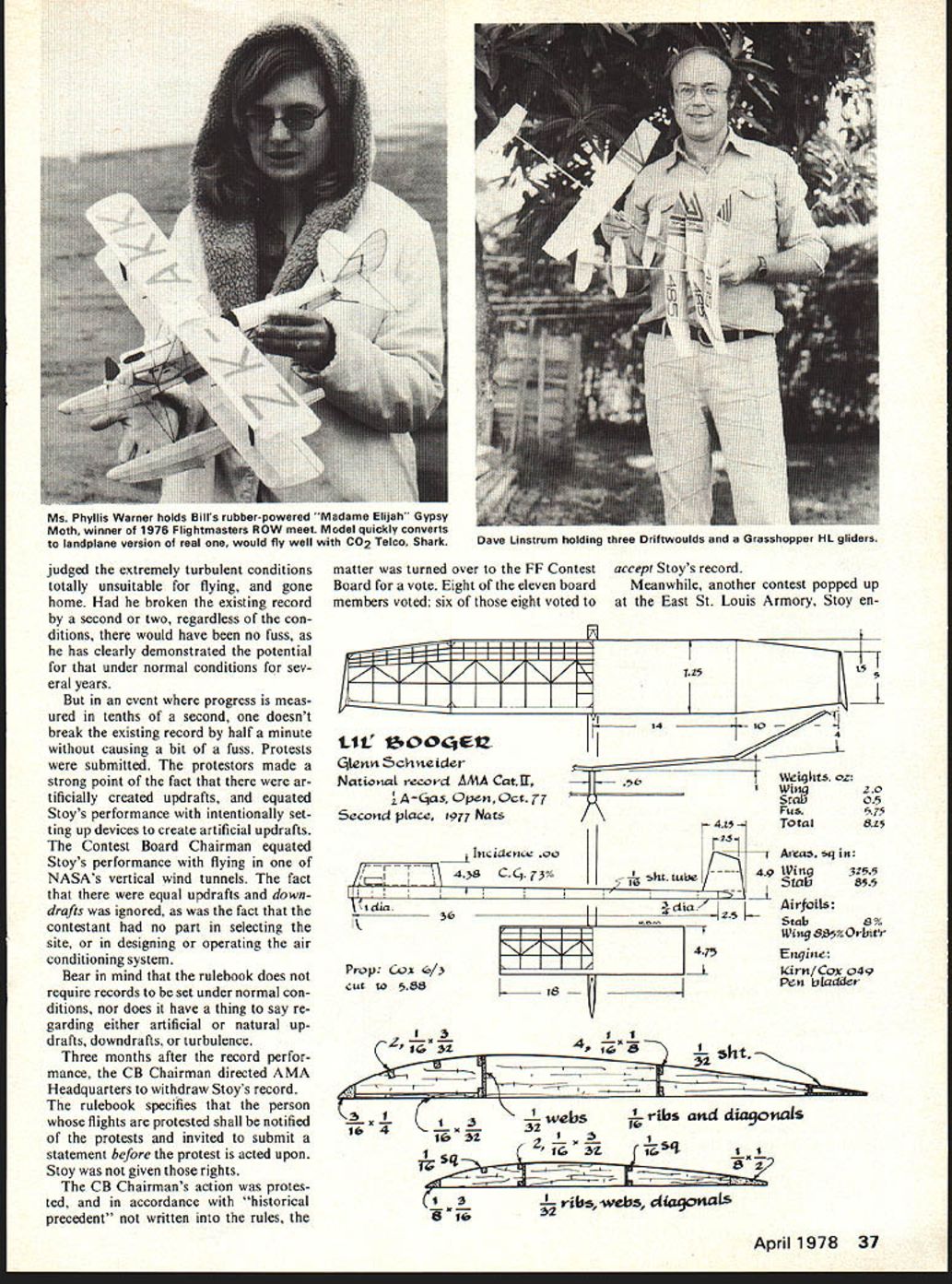
LI'L BOOGER: Although it has been entered in only a handful of contests, Glenn Schneider's Lil Booger has already stacked up a rather impressive track record: first or second place in six of the eight meets in which it has been entered, including, first at the Fresno Annual, second at the 1977 Nats, and the Category II Open 1/2A Gas record.
Although the model is not exceptionally light at 8.25 oz, careful design and construction has resulted in a structure that has the strength and rigidity greater than that of much heavier models. You don't get that kind of a strength-weight ratio by making the rudder and pylon out of solid sheet stock, for example.
The fuselage is basically a tapered 1/16-sheet balsa tube. The form is made by wrapping triangular sheets of Silkspan onto a 3/4" aluminum tube, with zero build-up at one end and a 7/8" diameter at the other. This is similar to the method used by Phil Klintworth to make a form for Nordic glider tailbooms. (See my column, April 1971 American Aircraft Modeler.) The first 7 in. is not tapered. The fuselage was designed to give maximum tail moment arms using a 3/16" sheet, hence the overhanging fin. Formers are inserted through the seam and secured with cyanoacrylate adhesive, then the seam itself is sealed with cyanoacrylate. The dethermalizer cord runs through Nylon tubing, sold by NFFS Supplies, which runs through the fuselage, so the formers are strung on the tubing like beads before they are inserted in the tube. The engine mount is made from the front section of a Competition Models tank. Fuel tank is a pen bladder slung between the landing skids.
The main structural members of the built-up pylon are plywood formers that are glued to fuselage formers before they are inserted into the fuselage tube. The only flat region on the fuselage is the pylon, so that's where the Seelig minicombo timer is installed. The area under the front stab mount is reinforced with a layer of 1/64" plywood wrapped around the tube. The entire boom is wrapped with a layer of light 0.6-oz fiberglass, then tissue is applied over that. The rudder is built up using 1/32" sheet over symmetrical ribs.
The wing and stab construction is somewhat unusual. The spars, consisting of cap strips joined by full-length webs, are joined by straight and diagonal ribs to form a torsionally rigid structure, and the leading and trailing edge sections are attached to the spars. Trailing edges are built up.
The entire model is covered with Esaki Plyspan about which Glenn is rather enthusiastic: "...all that anyone could ever hope for. It's lighter and stronger than other coverings, and takes less dope. It is nearly as strong when it is wet as when it is dry."
Although there seems to be a trend toward auto-tails in the AMA-Gas categories, especially the larger ones, Glenn's 1/2A does not use one. He says the model makes a good transition into the glide without them, and they would add weight to the tail.
Stoy Boys' Toy, Revisited:
Predictably, Stan Stoy's Cat. I Indoor H.L.G. record kicked off a bit of a fuss. (See December column.) Stan violated no rule; he flew under the conditions as he found them, as most of us would have done. Except that after one test flight most of us would have judged the extremely turbulent conditions totally unsuitable for flying, and gone home. Had he broken the existing record by a second or two, regardless of the conditions, there would have been no fuss, as he has clearly demonstrated the potential for that under normal conditions for several years.
But in an event where progress is measured in tenths of a second, one doesn't break the existing record by half a minute without causing a bit of a fuss. Protests were submitted. The protestors made a strong point of the fact that there were artificially created updrafts, and equated Stoy's performance with intentionally setting up devices to create artificial updrafts. The Contest Board Chairman equated Stoy's performance with flying in one of NASA's vertical wind tunnels. The fact that there were equal updrafts and downdrafts was ignored, as was the fact that the contestant had no part in selecting the site, or in designing or operating the air conditioning system.
Bear in mind that the rulebook does not require records to be set under normal conditions, nor does it have a thing to say regarding either artificial or natural updrafts, downdrafts, or turbulence.
Three months after the record performance, the CB Chairman directed AMA Headquarters to withdraw Stoy's record. The rulebook specifies that the person whose flights are protested shall be notified of the protests and invited to submit a statement before the protest is acted upon. Stoy was not given those rights.
The CB Chairman's action was protested, and in accordance with "historical precedent" not written into the rules, the matter was turned over to the FF Contest Board for a vote. Eight of the eleven board members voted; six of those eight voted to accept Stoy's record.
Meanwhile, another contest popped up at the East St. Louis Armory. Stoy en- tered, and beat the mark that existed previous to the one protested, by a margin of 0.8 sec. for a two-flight total of 79.6 sec. There was detectable turbulence, but not to a degree one would consider abnormal. He followed that with two additional attempts, both of which exceeded the old record of 78.8 sec. During those two latter attempts, there was no air motion that anyone could detect.
There is evidence that the full potential of the model has not yet been reached. It was a new model, not previously flown in competition, and not the one used for the protested flights. The model was only chucked to a height of about 30 ft. 5 in., less than the Cat. I limit, although on test flights, it had hit the 32 ft. 7 in. ceiling. Weather conditions were somewhat miserable outside, which seldom makes for "good air" inside.
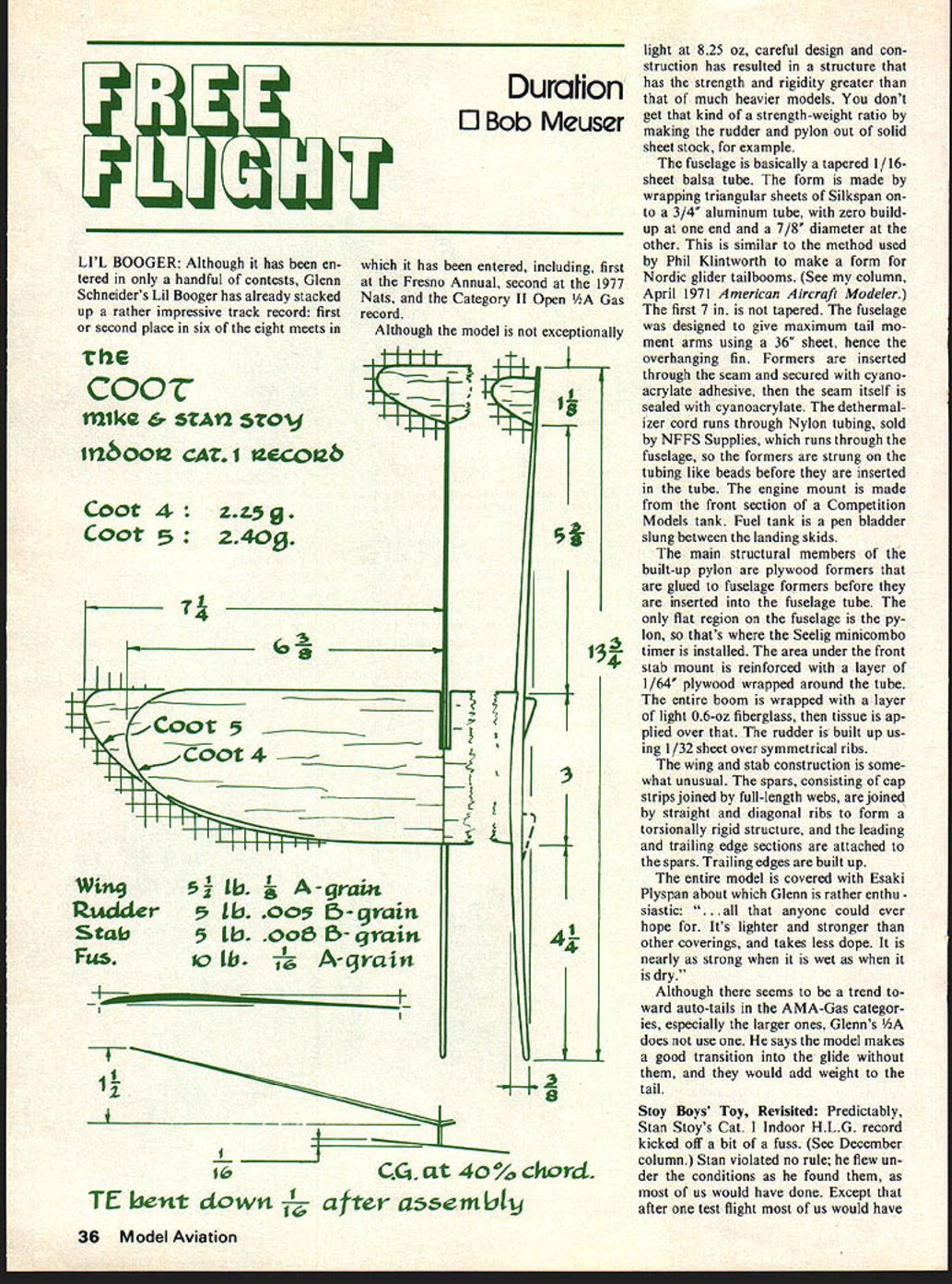
The Coots break with tradition in several important aspects. They are tiny little things; Coot 4, the one that rode turbulence for a two-flight total of 108.8 sec., has a flat span of only 12.6 in. Coot 5, the new one, is a hair larger, having a 14.5-in. span. The weights are more like those of models one would build for a 20-ft. ceiling—2.25 and 2.40 grams, respectively. The stab area is about a third the normal size: 7.5%. The flexible trailing edge, while perhaps not a new idea, has never been used more successfully. The C.G. is well forward at 40% of the root chord, and was moved even farther forward for the flights in extreme turbulence.
Stan Stoy expects to be out of competition for about a year. He is going after a Masters degree in Aeroelasticity. Then watch out! Meanwhile, we'll keep our eyes on Stan's brother Mike, and Dale Frost, both of whom have been turning in scores of around 78 sec. recently.
That the Coot can execute dynamic soaring in extreme turbulence, where most models would fall flat on their empennages, is as big a technological breakthrough as we have ever seen in model aviation. It has been predicted theoretically that aircraft of just the right sort, flying in turbulent air of just the right sort, could advantageously extract energy from the air. But that a passive aircraft, one without control mechanisms of any sort, can do so is quite unexpected. That Coot can also repeatedly execute record performances under "normal" conditions is the icing on the cake, or perhaps the salt in the wound, depending on your point of view. The 1/4A Maverick 260, winner at the U.S. Free Flight Champs, is available as a complete kit, including machine-cut parts and stripwood, for $14.50.
The Zingo is a simple, good-performing FAI Power model, designed especially for the free flighter who wants to sample this challenging event. It also is a good Class A or B model, if not built to the required weight for FAI competition. It is available as a partial kit, including all the curved parts machine-cut from high-quality balsa, but does not include stripwood, fuselage sides or plans. The plans are available from Carstens Publications for $2. The price, $12.00.
Mainstay of the RM product line is the Ultimate Dragmaster, a Nordic A-2 towline glider. This model is intended for, and has been rather successful in, serious competition since its birth in 1971. And, for an A-2, it goes together rather easily. Prices for various versions are: Complete kit, $22.50; with fiberglass boom, $27.50; partial kit, no plans or stripwood, $12.50; double kit, including all wood for two models in one box with one set of plans, $40.00.
Since the entire RM Enterprises occupies only one corner of the spare bedroom, you might not find the kits stocked on your dealer's shelves, although they are stocked by a few dealers that cater to a higher class, more discriminating, competition-oriented clientele. All the above prices are postpaid in the U.S. (U.P.S. is used where possible).
It is possible that RM will kit the Flying Burrito Brother, or perhaps a Hines or Blanchard HLG, sometime after summer, according to chief of design, T. Hutchinson. Production manager Rosemary Hutchinson states that the latest RM prototype, a 3850-gram, 51.2-cm item called Michael Patrick, will definitely not be put into production.
No Non-Cents Strikes Again: Now, this is really getting ridiculous. Mike Van Gorder, a Junior, won the combined Jr./Sr./Open Pennypalene event at the S.W.O.F.F. Indoor Meet in Cincinnati in November, and also established new official records for both Pennypalene and Novice Pennypalene, Junior, Category III. His flight time was 10:08.6. His records displace two previously held by Marnie Meuser, also made with a No Non-Cents. That makes 14 records for No Non-Cents, nine of which stand currently. (A construction article appeared in the July 1977 issue.) BMA Scholarship Contest: The Boeing Management Association has announced its ninth annual Scholarship Contest and Open Contest, to be held at the Boeing Space Center, Kent, Washington on July 8 and 9. $2500 in scholarships will be awarded to contestants 18 and under. Trophies and other prizes are to be awarded in all events. The contest is open to members of any age, but only those 18 and under may compete for scholarships.
It is not strictly a free-flight contest, and a free-flighter would have to fly in one of the following CL events to be in the running for the scholarship: Goodyear, Precision Aerobatics, Profile Navy Carrier, or Slow Combat. FF events include Outdoor HLG, Indoor HLG, Easy Bee, Towline Glider, Unlimited Rubber, Outdoor Peanut Scale, and 1/2A Gas. (It is not clear whether the Towline Glider event is for A-1 or A-2 gliders, but it has been A-2 in previous years.) In addition to the FF and CL events, a few Rocket and RC events are tossed in. All events are to be run according to AMA and NAR rules. In addition, Easy Bee models must have a solid motor stick and paper covering, and may not have wire bracing. AMA, NAR, or MAAC licenses are required, where applicable.
And if you parents are squirmy about sending your only-begotten 14-year-old off on his own for a weekend, the BMA will provide a home away from home at no cost, when required.
For more info, write to The BMA, P.O. Box 3707, Seattle, WA 98124; attention: Ted Caputo, ORGN 4-1800, Mail Stop 17-26.
Darryl Stevens Sets Five More Records. And four of them in one day, at that. On November 27, at a Record Trials at Lake Elsinore, Calif., 15-year-old Darryl set the following Junior Category I outdoor free flight records: 1/2A and A Gas ROW, Unlimited Rubber ROW, and Ornithopter. The 1/2A and A records of 10:20 and 7:53, respectively, were set using the same model and the usual Cox 049-051 switcheroo. The model is typical of the ones Darryl and his brother Gary have done so well with for quite awhile: a 300 sq. in., square-tip, slab-sided, pylon ship. Two floats were used up front, and a single one in the rear suspended from the sub-fin.
Fuel was 65% nitromethane, 20% polypropylene oxide, and 15% oil. It seems that the Stevenses have kicked the alcohol habit completely.
The Unlimited Rubber ROW model, which scored 4:46, is smallish for an Unlimited at 200 sq. in. A rolled-tube fuselage was employed. Twin fins supported a pair of foam floats at the rear; a single foam float was used up front.
The Ornithopter is a real ornithopter, not an "ornipropler," of unusual design. There is no fixed wing area; the whole works flap, all 600 sq. in. of it. It is a biplane having two 6-by-36-in. wings. The top and bottom wings come together, then separate at a 75-degree included angle. Motor run is about a minute, and there is no glide to speak of. The record three-flight score was 2:44, the best flight being 55 sec.
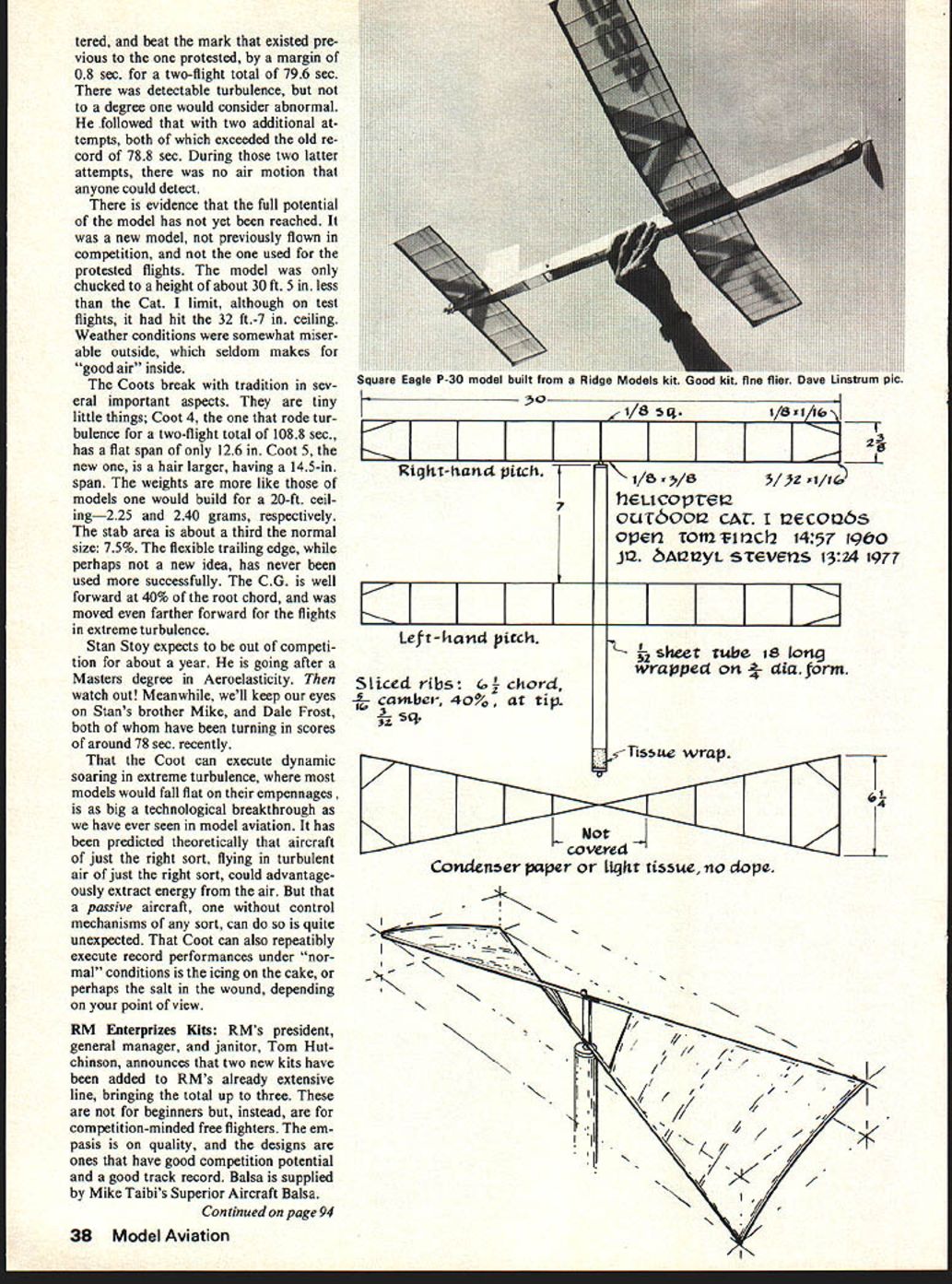
And a month earlier at the Orbiters Annual at Elsinore, Darryl demolished the Cat. I Junior Helicopter record with a three-flight total of 13:24, using Tom Finch's design. Darryl's score tops the records for all ages and categories except the mark set in 1960 by Tom Finch himself.
Sympo 78 Reminder: If you bear down, you might barely have time to crank out a paper for the 1978 NFFS Symposium Report. Completed reports should be in the hands of the Editor by April 1. If you have something in the hopper, let the Editor in on it. His name is Bob Dodds, and he lives at Box 436, Rancho Santa Fe, CA 92067.
Signs of the Times: From the minutes of the December meeting of the Willamette (Oregon) Modelers Club: "It was moved by Bob Stalick to substitute the P-30 (plastic prop, rubber power) event for Rocket at the Silents Please Meet in 1978. Seconded and passed. It was recommended that the secretary correspond with the other Northwest clubs and encourage them to include this new event." And from the minutes of the annual meeting of the Northern California F/F Council: "There was a motion by the Oakland Cloud Dusters to include the P-30 event on the schedule on a one-year provisional basis. Seconded and passed unanimously."
And again, the Southern California Free Flight Association, which includes all major free flight clubs in the area, proposes to drop Rocket and replace it with P-30. This is the outfit that runs the biggie, the U.S. Free Flight Championships annually at Taft, the country's only remaining Category I site. Incidentally, the Champs might become a four-day affair this year.
New events come and go, but the P-30 event was clearly a winner from the start. Already, there has been a national mail-in-the-model meet (the Dave Listrum "Memorial"), and unofficial events for P-30 were held at the two most prestigious meets of 1977: The Nats, and the U.S.F.F. Champs.
Plans for two Oldenkamp-designed P-30 models have appeared in the mags. The Turkey appeared in the November 1977 issue of MAN (Plan No. 301, $1.50), and the Hotbox in the July 1977 issue of MB (Plan No. 7773, $1.00). I mentioned the fine P-30 kit manufactured by Blue Ridge Models in the January issue. Blue Ridge Models, manufacturer of the Square Eagle P-30, and Coupe de Ville kits and suppliers of other free flight specialty items, has a new address: P.O. Box 429, Skyland, North Carolina 28776.
If the hassle of obtaining Jetex fuel has been too much to cope with, maybe the wing and stab of your Jetex model would serve for a P-30 model. Maybe he didn't plan it that way, but it seems to me that Wally Simmers designed a pretty good P-30 back in about 1940. He called it the Gollywock.
For more information on P-30, write to Harry Steinmetz, 4425 Samoset Ave., San Diego, CA 92117.
Manhattan Mail-In. Box up your favorite Manhattan Formula indoor cabin model for the First Annual M.I.A.M.A. Manhattan Contest. First prize is "expected to be, hopefully" a trip for two to Miami, including blimp rides, deep sea fishing, and a guest-of-honor appearance at the M.I.A.M.A. annual banquet. Models must arrive in Miami no later than April 14, 1977, so you had better hustle. For further information, write to Dr. John Martin, 3227 Darwin St., Miami, FL 33133.
Briefly, the rules are: Wing, 20" max projected span, 4" chord; stab, 8 x 3½" max; length not including prop, 20"; weight less motor, 4 gm min; fuselage-type models only, fuse must enclose "box" 2 x 2½ x 4 in.; windshield 2 sq. in., and side windows 1 sq. in. each; two 1"-diam. wheels; covering tissue or condenser paper; wood prop.
Bob Meuser, 4200 Gregory St., Oakland, CA 94619.
Transcribed from original scans by AI. Minor OCR errors may remain.

