
Free Flight
Duration — Bob Meuser
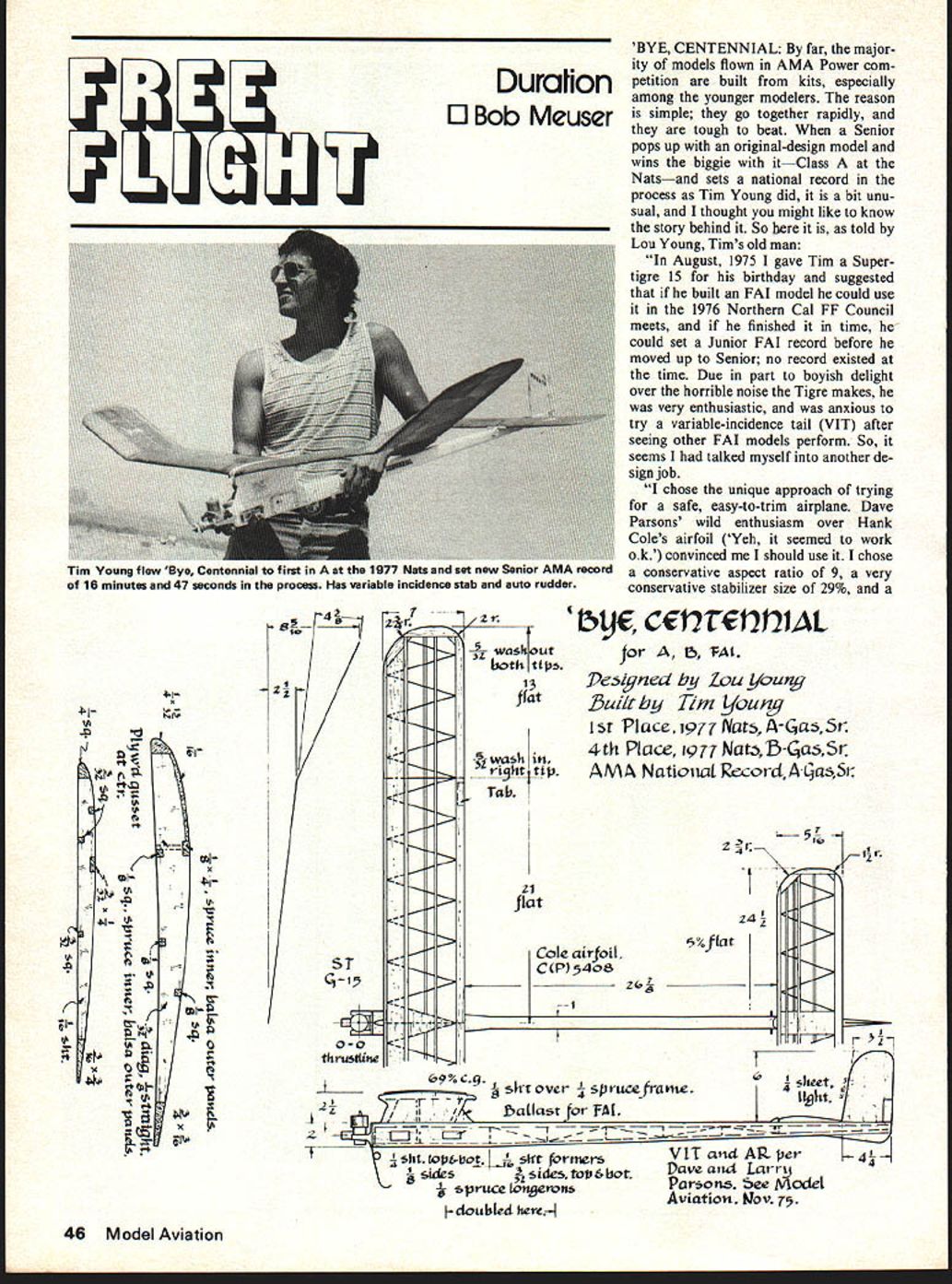
'BYE, CENTENNIAL: By far, the majority of models flown in AMA Power competition are built from kits, especially among the younger modelers. The reason is simple; they go together rapidly, and they are tough to beat. When a Senior pops up with an original-design model and wins the biggie with it—Class A at the Nats—and sets a national record in the process as Tim Young did, it is a bit unusual, and I thought you might like to know the story behind it. So here it is, as told by Lou Young, Tim's old man:
"In August, 1975 I gave Tim a Supertigre 15 for his birthday and suggested that if he built an FAI model he could use it in the 1976 Northern Cal FF Council meets, and if he finished it in time, he could set a Junior FAI record before he moved up to Senior; no record existed at the time. Due in part to boyish delight over the horrible noise the Tigre makes, he was very enthusiastic, and was anxious to try a variable-incidence tail (VIT) after seeing other FAI models perform. So, it seems I had talked myself into another design job.
"I chose the unique approach of trying for a safe, easy-to-trim airplane. Dave Parsons' wild enthusiasm over Hank Cole's airfoil ('Yeh, it seemed to work o.k.') convinced me I should use it. I chose a conservative aspect ratio of 9, a very conservative stabilizer size of 29%, and a The model was barely finished in time for the last NCFFC contest of 1975. Tim had other events to fly, and that didn't leave much time for flying the "Bye Centennial." The trim was poor on the first two flights, but by the third it was going pretty well. On the third, the time was 2 sec. short of a max on a 6.5-sec. engine run.
"Tim put in about 25 flights with the model during 1976, without noteworthy success flying against the Open fliers. The model sat around for a long time while Tim concentrated on Class C and girls. Just before the 1977 Nats we converted the Tigre to nitro fuel and removed the ballast weight.
"At the Nats we had trim problems. The model had been stored in a closet that backed up to a leaky shower, and the model may have warped because of the moisture. After the model dried out, the adjustments returned to their original settings. Tim won Class A Senior, and set a new record in the process.
"Later, during Nats week, Tim DT'd his Class B model under power, and that was the end of it. Mr. Fred Calhoun loaned Tim a Tigre 23 to put in the Bye Centennial. It took about six flights to trim the model for the larger engine, and by then Tim had to fly in the wind. If it were not for that he might have bumped one of the Calhoun boys. He was not at all disappointed with fourth place, and has had an invaluable experience in sportsmanship."
Free Flight: Duration
Unlimited Rubber models flown under sudden-death rules: one flight, with no-max time limit. As of January 1, as a result of a recent rules change, Unlimited Rubber will henceforth, and forevermore, be known as The Mulvihill Event. And a pox on those Contest Directors, magazine writers, modelers, and AMA Headquarters personnel, who ever refer to it otherwise!
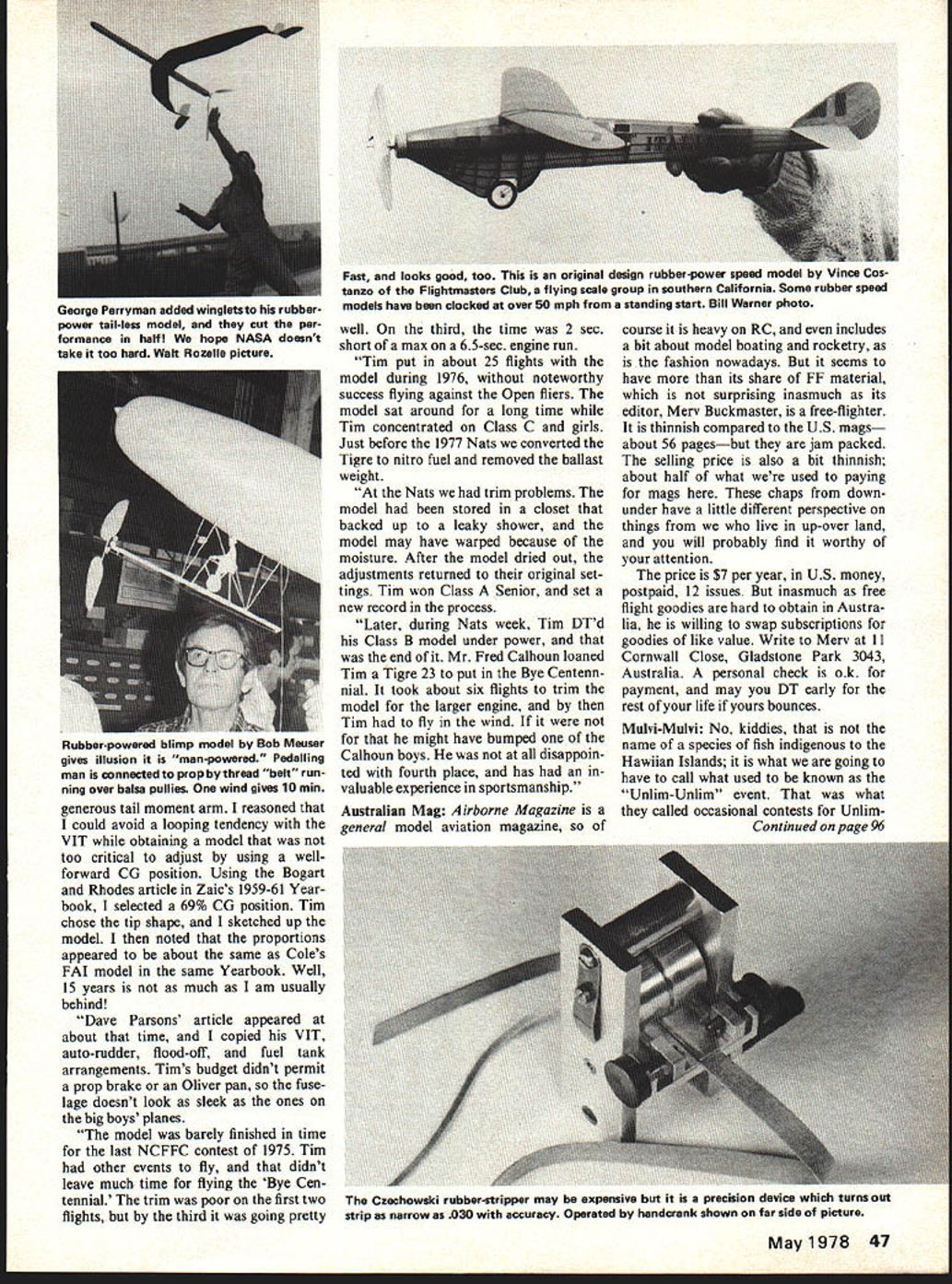
Well, that's a pretty long-winded way to lead into an announcement that George Perryman won the Mulvi-Mulvi event at the King Orange Internationals with his Mulvihill-Trophy-winning "Great Speckled Bird", shown in the December issue. It is not the first time the G.S.B. has won such a contest. It was foggy and drizzly, and George was afraid his model might climb out-of-sight into the low-lying clouds, so he wound only about 70% of maximum turns. The G.S.B. landed at 5:31 in a tree top. George's score was followed at 7-sec intervals by Jim Lewis and Phil Hartman, respectively. Phil had sponsored the event. I have other good news about George's G.S.B., but professional ethics demands that I keep it from you for awhile.
The chances are good that there will be a Mulvi-Mulvi event at the real Memorial Day Classic at Taft this year, provided I can get out of the sack early enough to run it.
George allows that he has a new design up his sleeve, but I'm not sure I want to know about it; his current designs are enough to make strong men cry. Rubber Stripper, de Luxe: If you are into Indoor modeling, you have two choices: Buy pre-stripped rubber, available only in a limited number of widths, or strip your own, using a commercially available stripper. If you elect the latter course, you have two choices: The inexpensive Jim Jones stripper mentioned in my September 1977 column, or, the Czechowski strippers, which will set you back (hold on tight!) $45.
Those who bought earlier got them for between one-half and two-thirds of the current price. But isn't that the way with just about everything nowadays?
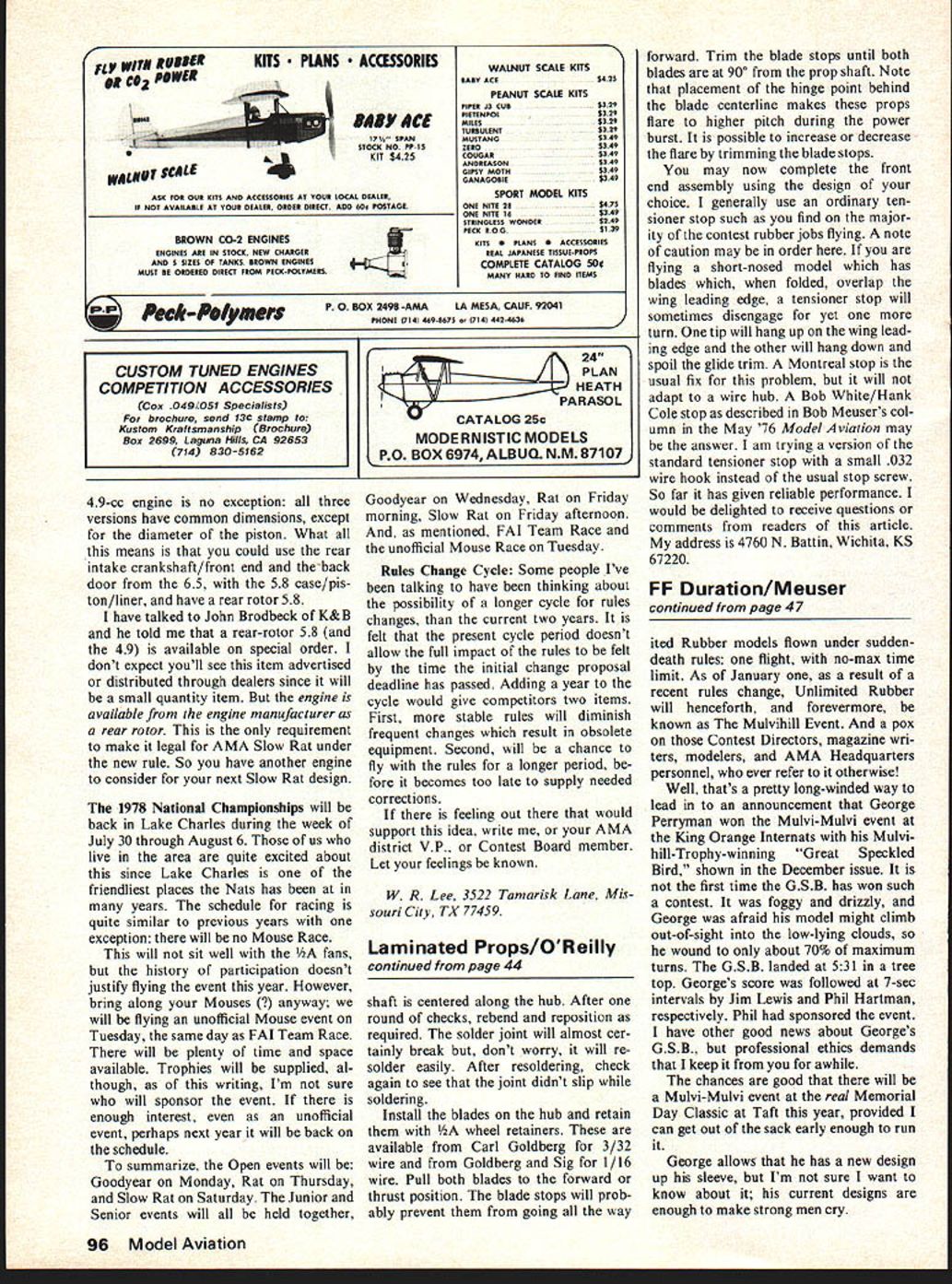
The Czechowski stripper is essentially a rotary shear with a means for accurately guiding the rubber stock into the shearing discs. A blackened brass screw on each side positions each side of the rubber guide. In principle, it would be better if one could adjust the width and position of the rubber guide independently, but the present arrangement presents no great difficulty. A hand-crank on the side, attached to the lower shear disc, couples the unit to the customer-supplied, cordless, biomechanical power source (you). Lefties will have to learn to cope; only right-hand units are available.
It works like a charm. You don't have to strip half a mile of rubber before you know whether the width is coming out correct; a few inches will do. So it is quite practical to strip stock for one motor at a time until you zero in on the size you need. Even strips as narrow as .030 inches can be produced with acceptable uniformity.
Send order to: Ryszard Czechowski, Str. Prandnicka 68A/60, 31-202 Krakow, Poland. Go to your bank, tell them the problem, and get them to write a draft payable at a cooperating bank in Poland. They'll charge you a dollar or two for the service. The price of $45 includes postage. Orders are filled within two weeks, and take about four weeks in transit.
Nobody's Perfect: Not even Mr. L. M. Cox, Inc. It is hard to imagine where Free Flight would be today if Mr. Cox had never appeared on the scene with his extensive repertoire of durable, high-performance, inexpensive engines. But it appears that the production department had the upper hand when it came to designing the outlet spigot on the fuel tank for the Tee Dee .020. In the first place, it's in the wrong place. In the second place, it is too short. In the third place, it should be barbed, or at least have a swollen end, as any self-respecting industrial hose fitting has, in the first place.
From a production point of view, it is easy to see why it is as it is; overcoming my objections would require an 18-piece die rather than a two-piece die. But, as living testimony to the infallibility of Murphy's Law—if anything can go wrong, it will go wrong—I find keeping a piece of surgical tubing stuck to the thing virtually impossible.
Not everyone seems to have this problem. If you don't, then advance to Square Eight.
One fix, which appeared in Flightplug awhile back, is to put a bit of hard plastic tubing directly onto the tank outlet spigot, and make a transition to the surgical tubing needed for the fuel-cut-off timer by means of a short length of metal tubing. That works OK, but it isn't infallible, and the position of the outlet remains awkward for many engine set-ups.
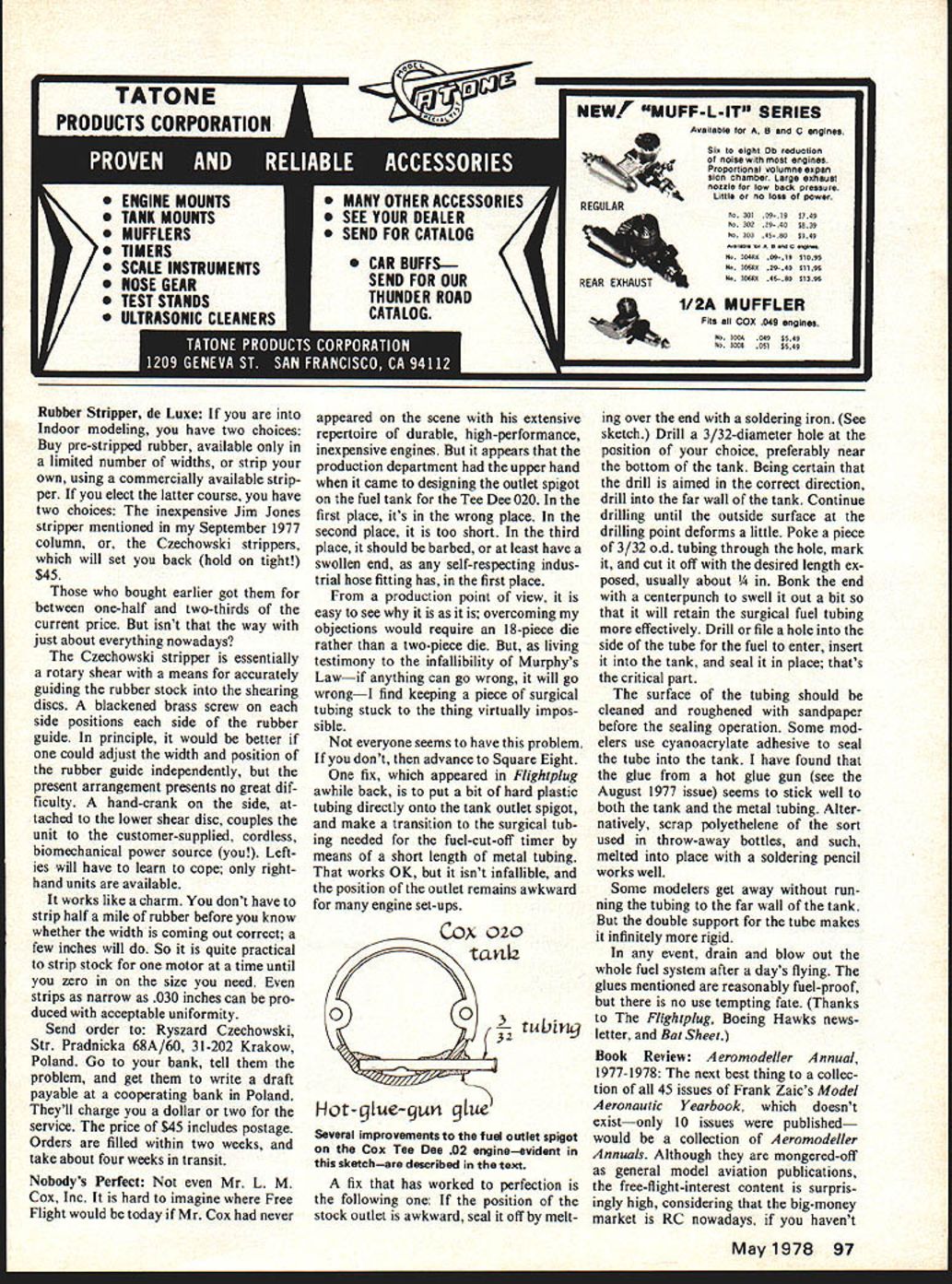
A fix that has worked to perfection is the following one: If the position of the stock outlet is awkward, seal it off by melting over the end with a soldering iron. (See sketch.) Drill a 3/32-inch-diameter hole at the position of your choice, preferably near the bottom of the tank. Being certain that the drill is aimed in the correct direction, drill into the far wall of the tank. Continue drilling until the outside surface at the drilling point deforms a little. Poke a piece of 3/32 o.d. tubing through the hole, mark it, and cut it off with the desired length exposed, usually about 1/4 in. Bonk the end with a centerpunch to swell it out a bit so that it will retain the surgical fuel tubing more effectively. Drill or file a hole into the side of the tube for the fuel to enter, insert it into the tank, and seal it in place; that's the critical part.
The surface of the tubing should be cleaned and roughened with sandpaper before the sealing operation. Some modelers use cyanoacrylate adhesive to seal the tube into the tank. I have found that the glue from a hot glue gun (see the August 1977 issue) seems to stick well to both the tank and the metal tubing. Alternatively, scrap polythene of the sort used in throw-away bottles, and such, melted into place with a soldering pencil works well.
Some modelers get away without running the tubing to the far wall of the tank. But the double support for the tube makes it infinitely more rigid.
In any event, drain and blow out the whole fuel system after a day's flying. The glues mentioned are reasonably fuel-proof, but there is no use tempting fate. (Thanks to The Flightplug, Boeing Hawks newsletter, and Bat Sheet.)
Several improvements to the fuel outlet spigot on the Cox Tee Dee .02 engine—evident in this sketch—are described in the text.
Book Review: Aeromodeller Annual 1977-1978: The next best thing to a collection of all 45 issues of Frank Zaic's Model Aeronautic Yearbook, which doesn't exist—only 10 issues were published—would be a collection of Aeromodeller Annuals. Although they are mongrel-offs as general model aviation publications, the free-flight-interest content is surprisingly high, considering that the big-money market is RC nowadays, if you haven't heard. And there is an increasing emphasis in the Annual upon RC sailplanes. But that's OK; half the free-flighters I know are closed RC soaring enthusiasts, but they don't talk about it much.
And there is a smattering of far-out stuff, such as the story of the development of people-powered aircraft at Nihon University in Japan. No, the Nihonese didn't win the first Kremer prize, but they might well win the second one, for crossing the English Channel. And Romak's "Grand Gram" '76 World Champs winner has the wrong wing-tip lengths shown. You saw the correct ones first in Model Aviation!
Knowing all the gory details of how some bloke built a working—working—that is—model of a Gnome Monosoupape rotary engine will not enhance your competition potential one iota, nor mine. I guess I feel about that in somewhat the same way I feel about the California Condor. Only a few dozen of them exist in the entire universe. I have never seen one, never expect to, and the chances are that I never will. But I once helped prevent a dam from being built which—it turned out later—would have surely flipped them from the "endangered" list to the "extinct" list, in a large hurry. And I continue to support those organizations that are interested in the survival of the Condor.
For me, it is important that the Condors still exist, despite the odds against them, even though it is improbable that one will ever cross my life in any direct way. For me it is also important that someone has built a working model of a Gnome Monosoupape, and has committed that accomplishment to printable form, and that I own, and can peruse at will, a lucid delineation of that accomplishment, although I will never accomplish that myself.
There is quite a smattering of trophy-winning, gung-ho free-flight stuff in the Annual, as usual. There is also an abundant smattering of things such as Kalina's sub-Pennyplane "Ledneck," and Perry-
Free Flight: Duration
Tim Young flew Bye Centennial at the 1977 Nats and set a new Senior AMA record — 16 minutes 47 seconds. The model has a variable-incidence stabilizer and an auto-rudder.
In August 1975 Tim's old man gave Tim a Super Tigre .15 for his birthday and suggested he build an FAI model. Tim could use the 1976 Northern California Free Flight Council meets to finish in time and possibly set the Junior FAI record before he moved up to Senior (no Junior record existed at the time). Due in part to boyish delight over the horrible noise the Tigre makes, Tim was very enthusiastic and anxious to try a variable-incidence tail (VIT) after seeing other FAI models perform. So he and I talked it over and I designed another job, choosing a unique approach trying to produce a safe, easy-to-trim airplane.
Dave Parsons' wild enthusiasm over Hank Cole's airfoil — "Yeah, seemed to work" — convinced me we should use it. I chose a conservative aspect ratio of 9 and a very conservative stabilizer size of 29%. I designed and Lou built Tim Young's Bye Centennial.
Using Bogart Rhodes' article in the 1959–61 Yearbook, we selected a 69% CG position. Tim chose the tip shape after sketching up the model and noted the proportions appeared about the same as Cole's FAI model in the same Yearbook. Fifteen years is much, much time — I am usually behind — and Dave Parsons' article appeared about that time, so we copied VIT, auto-rudder, flood-off fuel tank arrangements. Tim's budget didn't permit a prop brake. The Oliver pan fuselage doesn't look as sleek as the ones the big boys build, but the model was barely finished in time for the last NCFFC contest in 1975. Other events to fly didn't leave much time for flying Bye Centennial, and trim was poor the first two flights. The third flight was going pretty well; the third time the engine run was 2 seconds short of max (65 seconds). Tim put about 25 flights on the model during 1976, with noteworthy success flying against Open fliers. The model then sat around a long time while Tim concentrated on Class C events.
Just before the 1977 Nats Tim converted the Tigre to nitro fuel and removed ballast weight. At the Nats he had trim problems — the model had been stored in a closet behind a leaky shower and may have warped because of moisture. After the model dried out and adjustments returned to the original settings, Tim won the Senior class and set the new record in the process.
Later during Nats week Tim DT'd a Class B model under power and Mr. Fred Calhoun loaned Tim a Tigre .23. With the Bye Centennial fitted with the larger engine it took about six flights to trim. A larger engine can make the model more sensitive in wind and might have bumped the Calhoun boys down to fourth place, but Tim gained valuable experience and showed good sportsmanship.
Transcribed from original scans by AI. Minor OCR errors may remain.

