


Free Flight: Duration - Bob Meuser
COUPE DE GAS: Most of the free-flight events flown in international competition have their less-demanding "junior," "beginner," or "novice" counterparts. A-2 towline glider has A-1; Wakefield has Coupe d'Hiver; Indoor has metric Pennyplane, and FAI Power has ... nothing whatsoever. Bob Hatschek has the notion that the void should be filled, and here is how he proposes to do it.
Maximum engine displacement would be limited to 1 cc, or 0.061 cu. in. Maximum area of wing plus stab, 20 sq. dm., or 310 sq. in. Power loading, 300 g per cc, or 10.58 oz. per cc, or 173.4 oz. per cu. in., the same as the current FAI Power requirement. FAI fuel required, no nitro. Bob suggests that there be two categories: 10-sec. engine run with a 180 sec. max, and 7-sec. engine run with a 120-sec. max.
A model powered by a 0.049 cu. in. engine would be required to weigh 8.5 oz., which would permit rather rugged construction. The restriction to FAI fuel is a necessity for an international event. Those who have attempted to run Cox Tee Dee .049 engines on FAI fuel have not been too successful, but there is no fundamental reason why the problem could not be licked with minor engine modifications.
The substitution of a maximum-area rule for a wing-loading requirement is a neat touch. Since the weight is governed by the engine displacement, a model having a small engine would have a lower wing loading and therefore a better glide than one having a maximum-size engine. That would compensate for the potentially higher power-to-displacement ratio of the larger engine.
Why not simply use AMA 1/2A Gas rules for the event? Without a weight rule, AMA models tend to be lightly built, and are quite different in their overall character from FAI models. How about simply applying the FAI power-loading and wing-loading rules for the event?
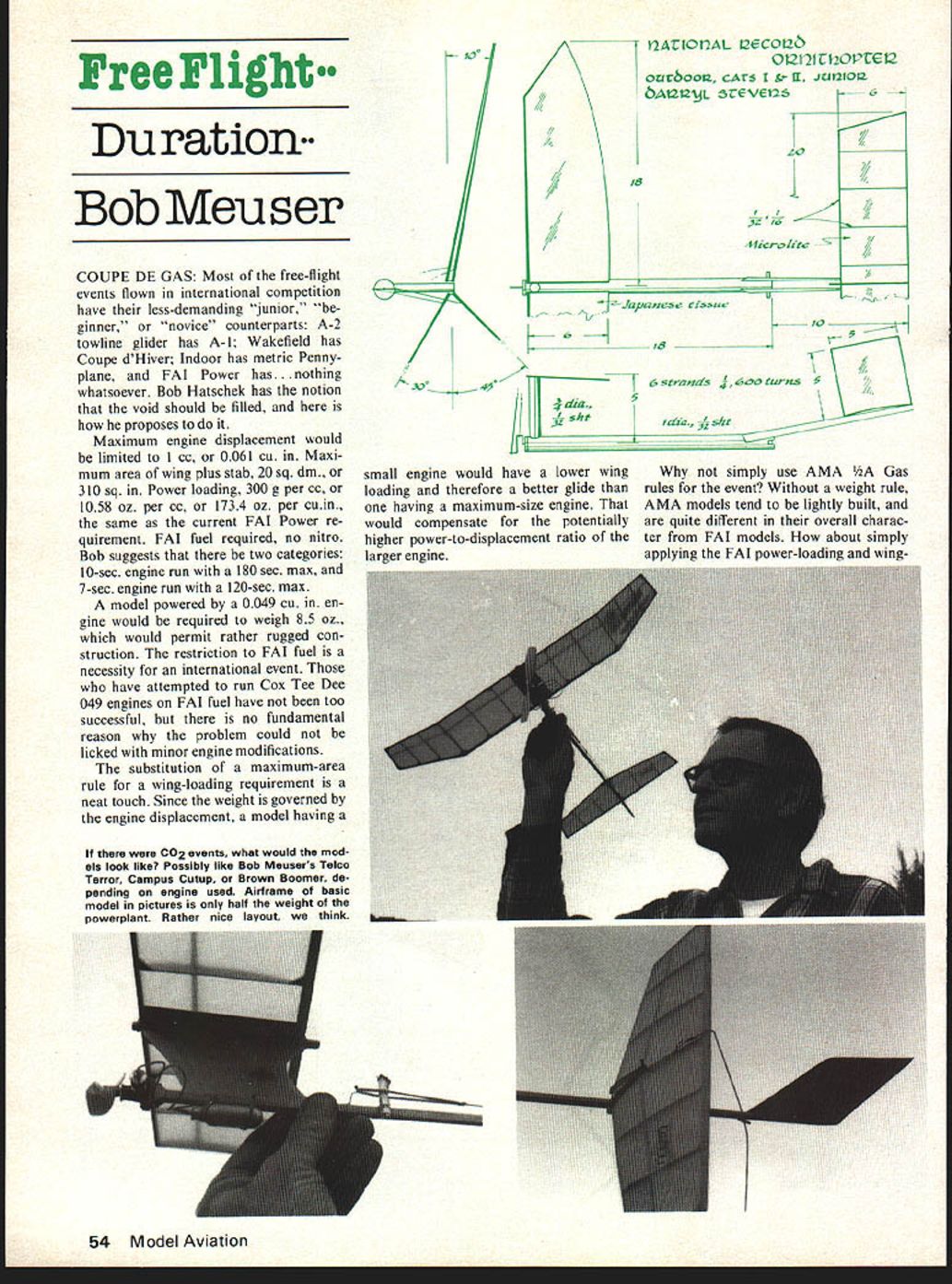
If there were CO2 events, what would the models look like? Possibly like Bob Meuser's Telco Terror, Campus Cutup, or Brown Boomer, depending on engine used. Airframe of basic model in pictures is only half the weight of the powerplant. Rather nice layout, we think. Applying loading rules to the smaller displacement engines? This has been tried many times. The resulting models are not at all like small FAI Power models. An .049 engine is allowed only 187 sq. in. if built to a minimum weight of 8.5 oz. required by the power-loading restriction. A 300 sq. in. model must be loaded up to 13.7 oz. Neither model is an appropriate stepping stone to FAI Power. The Motor-Segler class, essentially a .09 cu. in. engine powered A/2 glider, popular in Europe, being entirely different in character from an FAI Power model, also misses the mark. An entirely new class is required.
Bob's specifications are, at the moment, merely suggestions. For example, he suggests that a maximum wing area of 25 sq. dm. (387 sq. in.) might be more appropriate.
Think it over, talk it up, and tell Bob what you think of it. (Address: 316 Grosvenor St., Douglaston, NY 11363.) Also, write to our free-flight representative to the CIAM, George Xenakis, at 1288 Oak Knoll Dr., San Jose, CA 95129.
Bob expects to recommend inclusion of this event proposal on the CIAM agenda, as a U.S. item, and that is important. Usually we find ourselves in the position of reacting to proposals made by other countries, rather than leading the way.
Finder Please Notify: It took me 56 years to figure out that two pretty good ways of getting people to do things are to (a) make it so easy they can scarcely avoid it, and (b) tickle their funnybones. This applies to getting people to tell you about it when they find your lost models. In the "make it easy" category, I remember that one of the locals, possibly Joe Culver, used to strap a self-addressed postcard to his wing. All the finder of the model had to do was fill in his vital statistics, and pop it into the mailbox. It worked.
In the "tickle their funnybones" department we have the following heart-rending prose, written in "Southern" by George Perryman, and affixed to the wing of his grand-daughter Stephanie's OT/Coupe/Unlim rubber-powered model wing:
"I am a pore little country girl 8 years old. I has slopped hawgs, trapped possums, and toted well water to git enuf monie to build this little model airplane. I want to be a astronaut when I get growed up. If you find my little plane please notify...."
According to reliable sources, when Stephanie saw it she said: "Aw, Gran-paw, ah kin spell better'n that!" Ok, Steph. But maybe Gran-paw couldn't.
Ornithopter Record:
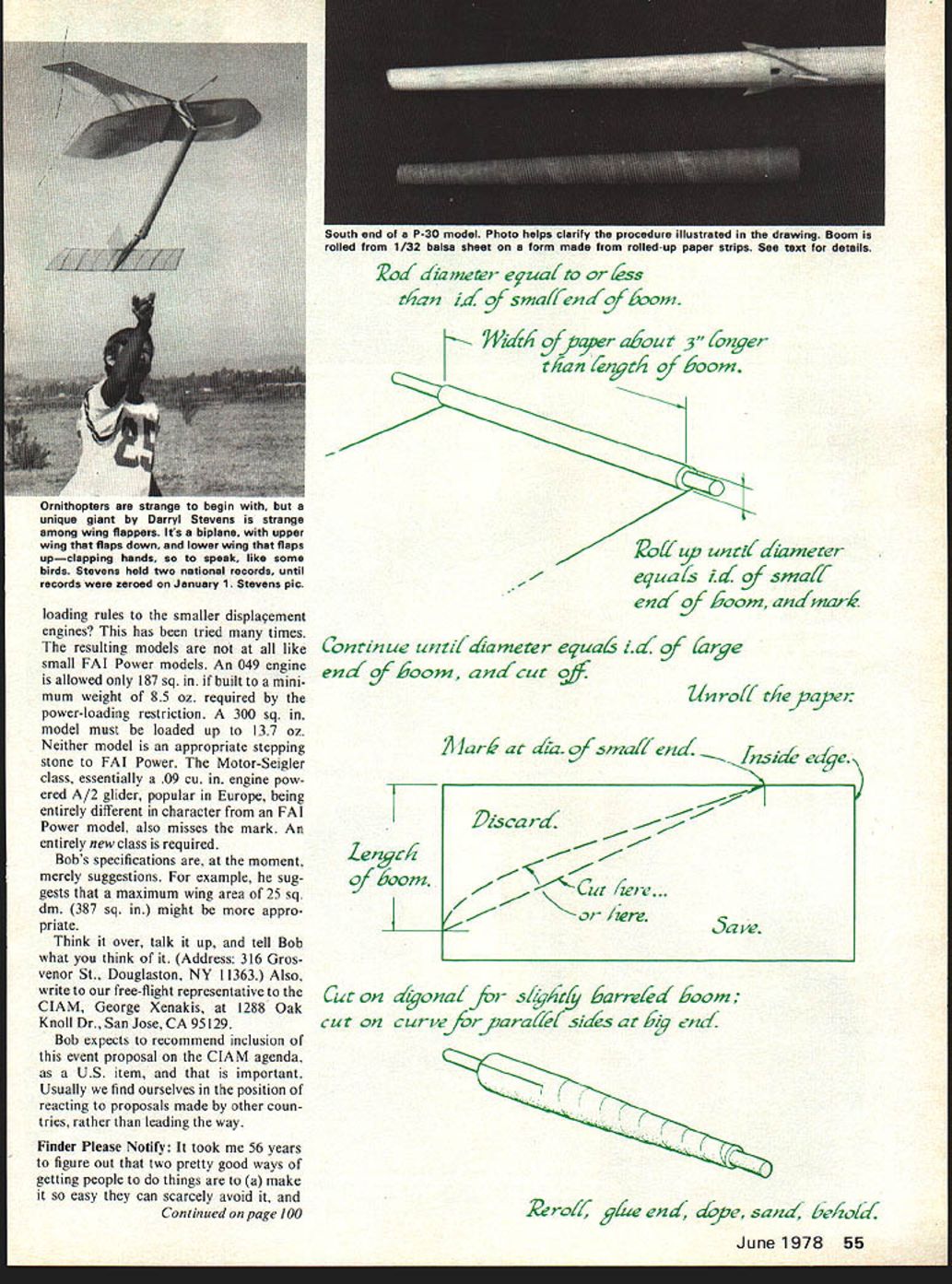
Good timing. On December 11, Darryl Stevens set a Category II Outdoor Ornithopter record, and 20 days later it got wiped out by a rules change, even though the model conforms to the new rules. It is difficult to understand the thinking behind that, but then, perhaps there was none; merely precedent. Darryl also set a Category One record with the same model two weeks earlier with a three-flight total of 2:44.
The model is strange in several aspects. It is far larger than most 'thopters, for one thing, with a total wing area of around 400 sq. in. And it is a biplane. The wings do not go up and down in unison, but rather the lower wings flap upward while the upper ones flap downward, and they clap together at the end of the stroke. Although the rules permit a large area of non-flapping wing, the whole thing flaps on Darryl's model.
Ornithopters are supposed to simulate bird flight, to some degree, and the biplane bird has yet to be evolved, let alone one that claps hands. But, they come close. Many birds clap their wings at the upper and lower extremes of the motion of their wings when taking off. There is a theory about the aerodynamics of this, and if any of you are seriously and sufficiently interested, I could probably dig out the literature on it.
Darryl's dad Curt says: "Darryl's bird has Japanese tissue on the wings. It stretches so badly that the wings must be re-covered after about six flights." Do any of you know a cure for this? "In flight, it is a sight to behold. It climbs at an angle of 70 to 80 degrees, cruises for 10 to 15 seconds, then comes down like a sick pigeon." See? Authentic bird flight simulation!
Tapered Tubular Tailbooms:
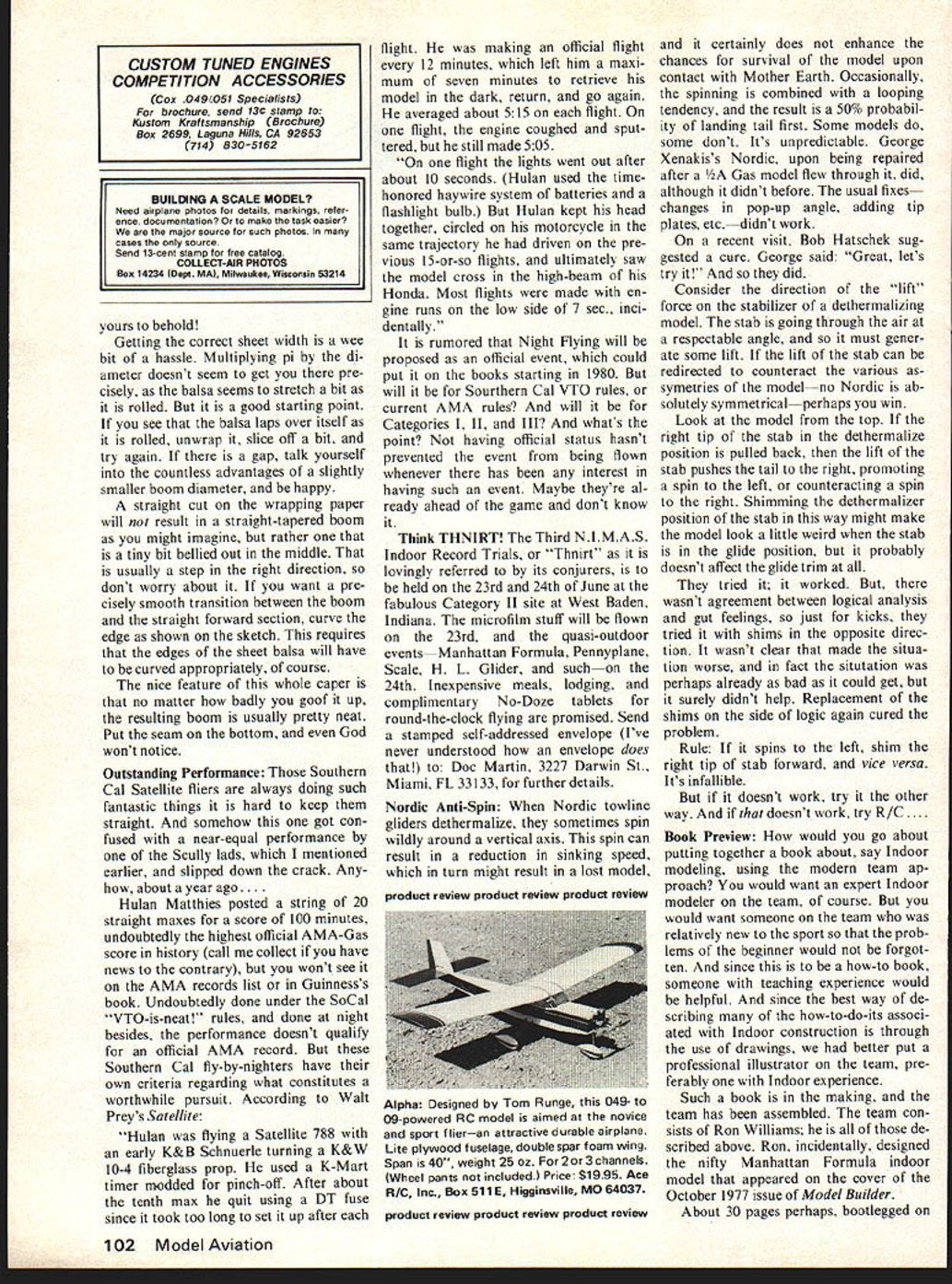
If you have decided you can't live without a tubular front end section for the fuselage of your latest AMA-Gas model, or Nordic glider, or P-30 rubber-power model, then you have a problem: How to make a tapered tubular tailboom to match? Of course, you could machine or whittle a metal or wooden form to the proper shape, and wrap a piece of sheet balsa around that. Or, you can simply bend up a balsa tube on a circular form, then harass it into a taper. But, the sketch shows an easier way.
Once you have the form, then what? The time-honored way is as follows: Soak the balsa sheet in water for at least 10 minutes per 1/32" of thickness. Longer is better, perhaps. Some say that a bit of ammonia in the water helps the water penetrate the wood, or helps to soften the resins in the wood, but I can't vouch for that; plain water works fine. Spray-dampen a piece of high-wet-strength tissue, such as Silkspan. With the tissue laying flat on the floor or a table top, stick one edge of it to the form using water as the stickum. Wrap a layer on the form, then tuck the sheet balsa between the tissue and the form, and continue wrapping. Secure the tissue in place with tape or a light spiral wrap of thread, and put it in a 150-degree oven for an hour or two. Or, simply let it sit around the house for a day or two. Remove the stuff from the form, glue up the joint, and presto!, the world's slickest tailboom is yours to behold!
Getting the correct sheet width is a wee bit of a hassle. Multiplying pi by the diameter doesn't seem to get you there precisely, as the balsa seems to stretch a bit as it is rolled. But it is a good starting point. If you see that the balsa laps over itself as it is rolled, unwrap it, slice off a bit, and try again. If there is a gap, talk yourself into the countless advantages of a slightly smaller boom diameter, and be happy.
A straight cut on the wrapping paper will not result in a straight-tapered boom as you might imagine, but rather one that is a tiny bit bellied out in the middle. That is usually a step in the right direction, so don't worry about it. If you want a precisely smooth transition between the boom and the straight forward section, curve the edge as shown on the sketch. This requires that the edges of the sheet balsa will have to be curved appropriately, of course.
The nice feature of this whole caper is that no matter how badly you goof it up, the resulting boom is usually pretty neat. Put the seam on the bottom, and even God won't notice.
Outstanding Performance: Those Southern Cal Satellite fliers are always doing such fantastic things it is hard to keep them straight. And somehow this one got confused with a near-equal performance by one of the Scully lads, which I mentioned earlier, and slipped down the crack. Anyhow, about a year ago Hulan Matthies posted a string of 20 straight maxes for a score of 100 minutes, undoubtedly the highest official AMA-Gas score in history (call me collect if you have news to the contrary), but you won't see it on the AMA records list or in Guinness's book. Undoubtedly done under the SoCal "VTO-is-neat!" rules, and done at night besides, the performance doesn't qualify for an official AMA record. But these Southern Cal fly-by-nighters have their own criteria regarding what constitutes a worthwhile pursuit. According to Walt Prey's Satellite:
"Hulan was flying a Satellite 788 with an early K & B Schnuerle turning a K & W 10-4 fiberglass prop. He used a K-Mart timer modded for pinch-off. After about ten meth max he quit using a DT fuse since it took too long to set it up after each flight. He was making an official flight every 12 minutes, which left him a maximum of seven minutes to retrieve his model in the dark, return, and go again. He averaged about 5:15 on each flight. On one flight, the engine coughed and sputtered, but he still made 5:05.
"On one flight the lights went out after about 10 seconds. (Hulan used the time-honored haywire system of batteries and a flashlight bulb.) But Hulan kept his head together, circled on his motorcycle in the same trajectory he had driven on the previous 15-or-so flights, and ultimately saw the model cross in the high-beam of his Honda. Most flights were made with engine runs on the low side of 7 sec., incidentally."
It is rumored that Night Flying will be proposed as an official event, which could put it on the books starting in 1980. But will it be for Southern Cal VTO rules, or current AMA rules? And will it be for Categories I, II, and III? And what's the point? Not having official status hasn't prevented the event from being flown whenever there has been any interest in having such an event. Maybe they're already ahead of the game and don't know it.
Think THNIRT! The Third N.I.M.A.S. Indoor Record Trials, or "Thnirt" as it is lovingly referred to by its conjurers, is to be held on the 23rd and 24th of June at the fabulous Category II site at West Baden, Indiana. The microfilm stuff will be flown on the 23rd, and the quasi-outdoor events — Manhattan Formula, Pennyplane, Scale, H. L. Glider, and such — on the 24th. Inexpensive meals, lodging, and complimentary No-Doze tablets for round-the-clock fliers are promised. Send a stamped self-addressed envelope (I've never understood how an envelope does that!) to: Doc Martin, 3227 Darwin St., Miami, FL 33133, for further details.
Nordic Anti-Spin: When Nordic towline gliders dethermalize, they sometimes spin wildly around a vertical axis. This spin can result in a reduction in sinking speed, which in turn might result in a lost model, and it certainly does not enhance the chances for survival of the model upon contact with Mother Earth. Occasionally, the spinning is combined with a looping tendency, and the result is a 50% probability of landing tail first. Some models do, some don't. It's unpredictable. George Xenakis's Nordic, upon being repaired after a 1/2A Gas model flew through it, did, although it didn't before. The usual fixes — changes in pop-up angle, adding tip plates, etc. — didn't work.
On a recent visit, Bob Hatschek suggested a cure. George said: "Great, let's try it!" And so they did.
Consider the direction of the "lift" force on the stabilizer of a dethermalizing model. The stab is going through the air at a respectable angle, and so it must generate some lift. If the lift of the stab can be redirected to counteract the various asymmetries of the model — no Nordic is absolutely symmetrical — perhaps you win.
Look at the model from the top. If the right tip of the stab in the dethermalize position is pulled back, then the lift of the stab pushes the tail to the right, promoting a spin to the left, or counteracting a spin to the right. Shimming the dethermalizer position of the stab in this way might make the model look a little weird when the stab is in the glide position, but it probably doesn't affect the glide trim at all.
They tried it; it worked. But, there wasn't agreement between logical analysis and gut feelings, so just for kicks, they tried it with shims in the opposite direction. It wasn't clear that made the situation worse, and in fact the situation was perhaps already as bad as it could get, but it surely didn't help. Replacement of the shims on the side of logic again cured the problem.
Rule: If it spins to the left, shim the right tip of stab forward, and vice versa. It's infallible.
But if it doesn't work, try it the other way. And if that doesn't work, try R/C.....
Book Preview: How would you go about putting together a book about, say, Indoor modeling, using the modern team approach? You would want an expert Indoor modeler on the team, of course. But you would want someone on the team who was relatively new to the sport so that the problems of the beginner would not be forgotten. And since this is to be a how-to book, someone with teaching experience would be helpful. And since the best way of describing many of the how-to-do-its associated with Indoor construction is through the use of drawings, we had better put a professional illustrator on the team, preferably one with Indoor experience.
Such a book is in the making, and the team has been assembled. The team consists of Ron Williams; he is all of those described above. Ron, incidentally, designed the nifty Manhattan Formula indoor model that appeared on the cover of the October 1977 issue of Model Builder.
About 30 pages perhaps, bootlegged on the company xerox machine when the boss is away, and stapled together? Not on your life! This is to be a real book, distributed through bookstores, not merely through hobby shops. Simon and Schuster—one of the biggies in the publishing business—has "retained" Ron to do the job, with a substantial retainer fee, and a contract as thick as the book itself will be, and a schedule, and such business-like appurtenances. Ron is working at it essentially full-time.
One of my spies who has seen some of the manuscript and drawings judges that it will be the best model aviation book ever written. No firm publication date has yet been established. But keep your eyes peeled for it in about a year.
Unofficial Events: It's firm! There will be an Unlimited Mulvihill event at the U.S. Free Flight Champs on Saturday—the same day as the regular Mulvihill event—from 6:30 to 7:30 am, provided the weather is suitable. One flight, unlimited max, AMA rules, except that models must weigh at least 20 grams with rubber. No Pennyplanes! Awards will be presented to the top three in Junior, Senior, and Open, and the flier having the highest time will receive the coveted Bob Meuser Memorial Trophy, to be replaced by a permanent trophy upon its return next year. Let's see what those big Mulv's will really do.
Although Cargo has been erased from the Nats menu, bring your Cargo model along anyhow. Doug Joyce will be there with his record-holding model, so you will have something to measure your performance against.
Bob Meuser, 4200 Gregory St., Oakland, CA 94619.
Transcribed from original scans by AI. Minor OCR errors may remain.

