

Free Flight: Duration
Bob Meuser
EVERYBODY knows that canards don't fly as well as conventional layouts. No World Championship in any category has ever been won by a canard. Not one Nats event has been won by a canard in at least a quarter of a century; few—perhaps one—national records are held by canards. Everybody knows that canards are bummers, therefore nobody builds canards, therefore they don't win much of anything, which confirms what everybody knows: the classic self-fulfilling prophecy.
Yet, the first man-carrying airplane to fly, the world's most advanced bomber, and the man-powered aircraft Gossamer Condor, to name a few, were all canards.
About 25 years ago, Doug Joyce decided to chuck conventional configurations and to give canards a go. He has flown canards in virtually every outdoor FF-Power class going, and has done rather well at it, as anyone who has seen his FAI Power models perform will confirm. But, if one guy is flying canards, while the other 99 are flying conventional layouts, which layout is going to make the best overall showing, regardless of the inherent advantages of one over the other?
Cargo, the ultimate small-field event. Most Cargo models will barely stagger their way to the other end of the parking lot. Motor run is 20 sec.; the "max" is 40. Unless you get real good at finding thermals that are full grown by the time they are 15 feet tall, Cargo is the ultimate test of aerodynamic efficiency and fine tuning. Being able to tote an extra ounce becomes the technological breakthrough of the century. The current record, a quantum jump over the previous one, is held by a canard, and Doug Joyce is the man that did it.
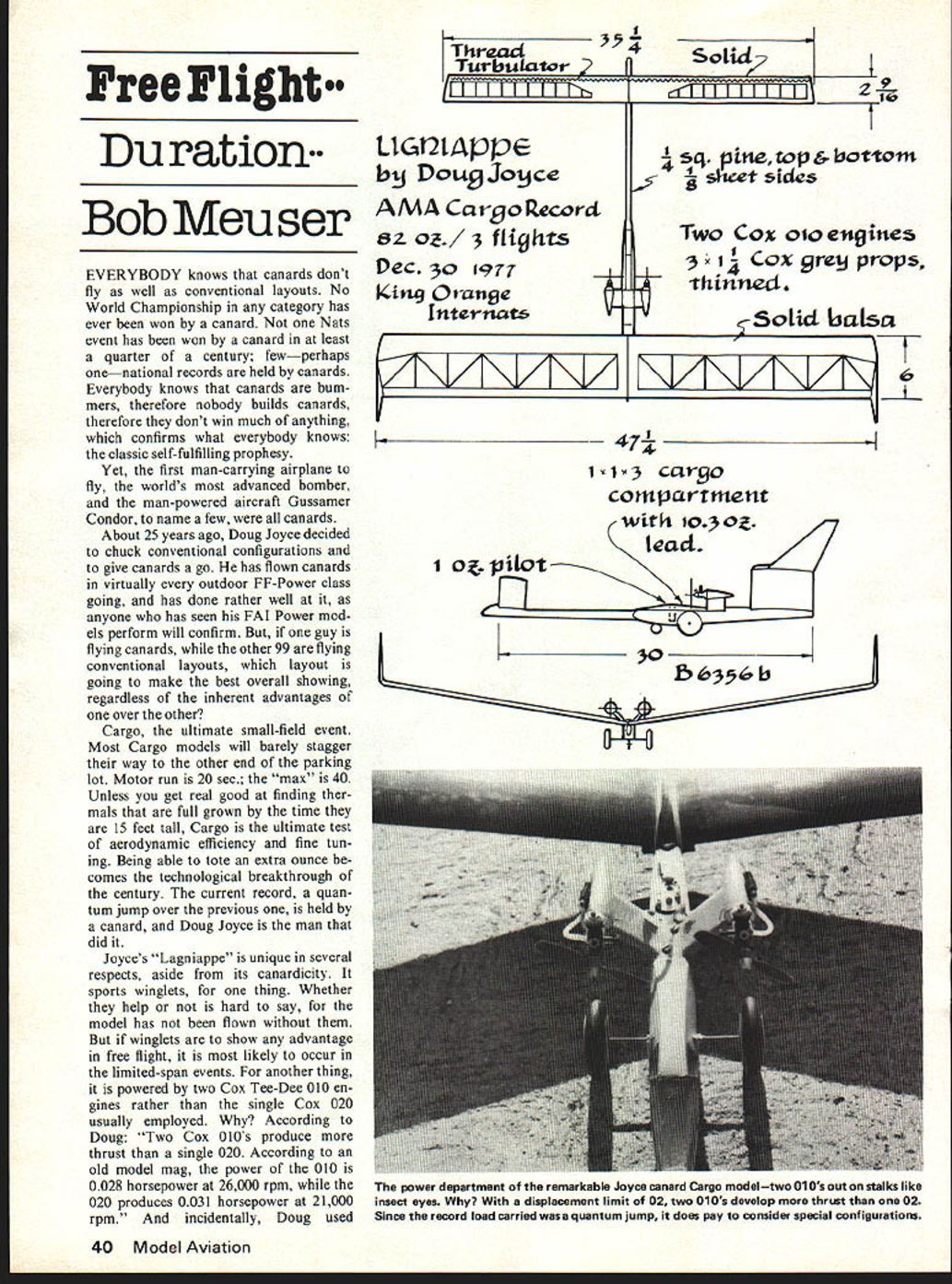
Joyce's "Lagniappe" is unique in several respects, aside from its canardicity. It sports winglets, for one thing. Whether they help or not is hard to say, for the model has not been flown without them. But if winglets are to show any advantage in free flight, it is most likely to occur in the limited-span events. For another thing, it is powered by two Cox Tee-Dee 010 engines rather than the single Cox 020 usually employed. Why? According to Doug: "Two Cox 010's produce more thrust than a single 020." According to an old model mag, the power of the 010 is 0.028 horsepower at 26,000 rpm, while the 020 produces 0.031 horsepower at 21,000 rpm.
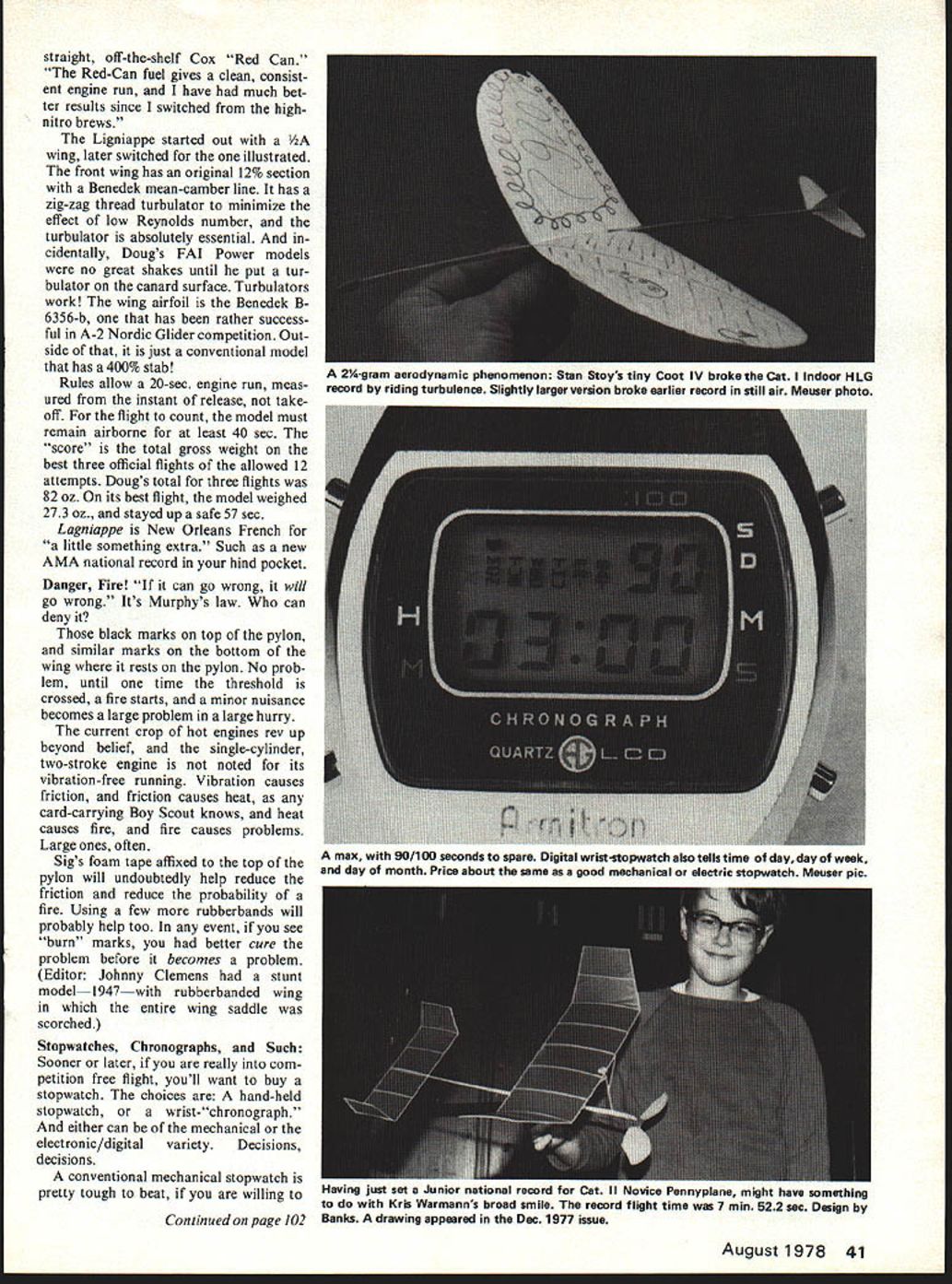
Since the record load carried was a quantum jump, it does pay to consider special configurations. Straight off-the-shelf Cox "Red Can" fuel gives a clean, consistent engine run. I've had much better results since I switched to the high-nitro brews.
Lagniappe started out with a 12% Benedek mean-camber section and uses a zig-zag thread turbulator to minimize the effect of low Reynolds numbers. A turbulator is absolutely essential. Incidentally, Doug's FAI Power models were no great shakes until he put a turbulator on the canard surface. Turbulators work the wing airfoil. The Benedek B6356-b section has been rather successful in A-2 Nordic Glider competition.
Rules allow a 20-sec engine run measured from instant-release takeoff. To count, the model must remain airborne at least 40 sec. Score is the total gross weight of the best three official flights; 12 attempts are allowed. Doug's total for three flights was 82 oz. Its best flight: the model weighed 27.3 oz and stayed up safely 57 sec.
Lagniappe — New Orleans French for "a little something extra." Such a new AMA national record is a nice hind pocket prize.
Danger: Fire. Things can go wrong — and they will go wrong. It's Murphy's law. You may deny black marks on the top pylon and similar marks where the bottom wing rests on the pylon. No problem until the time threshold is crossed and fire starts. A minor nuisance becomes a large problem in a hurry. The current crop of hot engines rev up beyond belief. Vibration causes friction; friction causes heat. A card-carrying Boy Scout knows heat causes fire; fire causes problems.
Sigs foam tape affixed to the top pylon will undoubtedly help reduce friction and reduce the probability of fire. Using a few rubber bands will probably help, too. If you see burn marks, better cure the problem before it becomes a serious one.
(Editor's note: Johnny Clemens' stunt model, 1947 — with a rubber-banded wing — had the entire wing saddle scorched.)
Stopwatches, Chronographs, and Such:
Sooner or later, if you are really into competition free flight, you'll want to buy a stopwatch. The choices are: A hand-held stopwatch, or a wrist "chronograph." And either can be of the mechanical or the electronic/digital variety. Decisions, decisions.
A conventional mechanical stopwatch is pretty tough to beat, if you are willing to plunk out fifty bucks or so for a simple one, or considerably more for one of the split-seconds variety, useful for timing both engine runs and total flight times. Cheapies, at half the price, aren't worth half what they cost. I went through three years ago that would hang up at just the wrong time. Some of the more modern cheapies I've seen are great as to the seconds and fifth-seconds, but are a little ambiguous about the minutes!
Fifteen years ago, I asked our house watchmaker what I should buy. He showed me the guts of half a dozen different brands, recommended a Minerva, and showed me why. Rugged! After 15 years of abuse, including frequent dropping on concrete, my Minerva is still accurate to better than 1/5 sec. in an hour and has never been serviced. It goes once around in a minute, so you can't make a half-minute mistake as you easily can with those that do the trip in 30 sec. And, it is impossible to inadvertently hit the wrong button; it has only one.
The digital stopwatches, now on their second or third generation, cost about the same as conventional mechanical stopwatches, are bulkier, and having many features, most of which you don't need, are a bit complicated to operate. Their accuracy and precision far exceed that of the guy punching the buttons. I have yet to see one that has the definitive click of a mechanical watch. It is virtually impossible to misread the display, if you can read it at all. Most—all, in fact, that I have seen—employ a light-emitting diode (LED) display, which is easy to see in the dark, but impossible to read in broad daylight.
So-called "chronographs" combine a regular wrist watch with a stopwatch. High-quality mechanical ones are likely to be extremely expensive, inasmuch as the demand is low. Mechanical or electronic, the pushbuttons are extremely small and easily bumbled; a disadvantage to be weighed against the convenience of having a stopwatch always with you.
There are only a few digital chronographs on the market. Most have LED displays, so you have to push a button to read the time of day. Those having a continuous liquid crystal display (LCD) are harder to find. The display is "on" continuously, works by reflected light, and consumes almost no electrical energy. In dim light, an auxiliary button lights up the display. Tritium LCD displays work as well in the dark as in broad daylight, but so far they are not available in chronographs. Some I have seen give the time only to the nearest second, useless for competition.
Most of the digital chronographs I have seen have both a "time out" mode and a "lap" mode of operation. The latter is like a split-seconds hand, but with an infinite number of splits. However, with one I saw, it was not possible to display the running time after the first split. The works were running, but would not display the time until you punched the button.
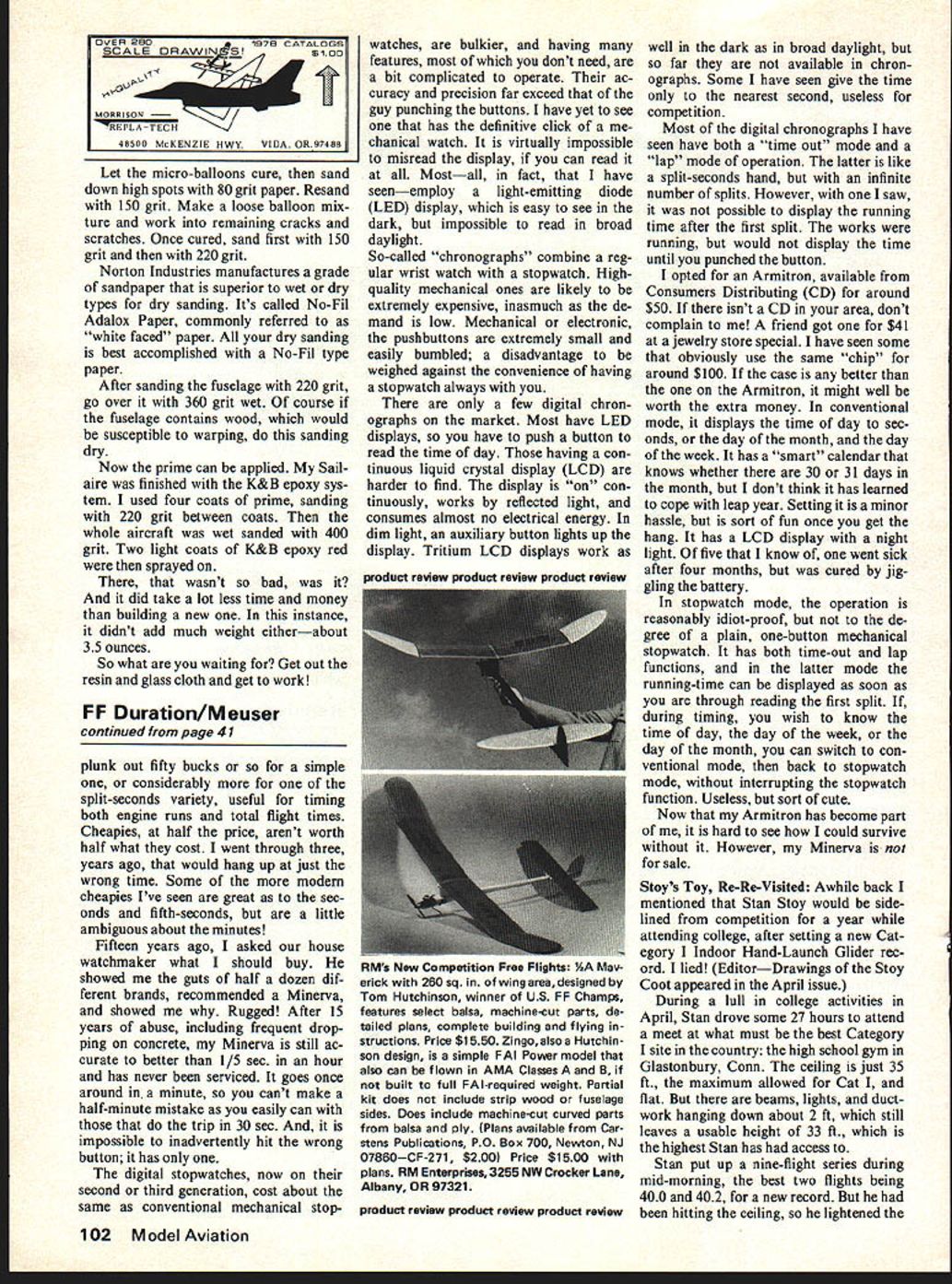
I opted for an Armitron, available from Consumers Distributing (CD) for around $50. If there isn't a CD in your area, don't complain to me! A friend got one for $41 at a jewelry store special. I have seen some that obviously use the same "chip" for around $100. If the case is any better than the one on the Armitron, it might well be worth the extra money. In conventional mode, it displays the time of day to seconds, or the day of the month, and the day of the week. It has a "smart" calendar that knows whether there are 30 or 31 days in the month, but I don't think it has learned to cope with leap year. Setting it is a minor hassle, but is sort of fun once you get the hang. It has a LCD display with a night light. Of five that I know of, one went sick after four months, but was cured by jiggling the battery.
In stopwatch mode, the operation is reasonably idiot-proof, but not to the degree of a plain, one-button mechanical stopwatch. It has both time-out and lap functions, and in the latter mode the running-time can be displayed as soon as you are through reading the first split. If, during timing, you wish to know the time of day, the day of the week, or the day of the month, you can switch to conventional mode, then back to stopwatch mode, without interrupting the stopwatch function. Useless, but sort of cute.
Now that my Armitron has become part of me, it is hard to see how I could survive without it. However, my Minerva is not for sale. EVERYBODY knows canards don't fly well. In conventional layouts no World Championship category has ever been won by a canard; no Nats event has been won by a canard in at least a quarter century; few—perhaps one—national records are held by canards. Everybody knows canards bummers; therefore nobody builds canards; therefore they don't win much of anything. That confirms what everybody knows: classic self‑fulfilling prophecy. Yet the first man‑carrying airplanes, several advanced bombers, and the man‑powered aircraft Gossamer Condor are a few canards.
About 25 years ago Doug Joyce decided to chuck conventional configurations and give canards a go. He has flown canards virtually outdoors in FF‑Power class and has done rather well. Anyone who has seen FAI Power models perform will confirm: a guy flying a canard among 99 flying conventional layouts is going to make the best overall showing regardless of inherent advantages other layouts may have in the ultimate small‑field event. Most Cargo models will barely stagger their way to the other end of the parking lot. Motor run: 20 sec, max 40. Unless you get real good finding thermals, full grown time is 15 feet tall. Cargo is the ultimate test of aerodynamic efficiency and fine tuning. Being able to tote an extra ounce can be a technological breakthrough. The current record was a quantum jump over the previous one, and that canard man was Doug Joyce.
Joyce's Lagniappe is unique in several respects aside from its canardicity: it sports winglets. Whether they help is hard to say; the model has flown without winglets and shows an advantage in free flight that is likely to occur in limited‑span events. Another thing: it's powered by two Cox Tee‑Dee .010 engines rather than the single Cox .020 usually employed. According to Doug, two Cox .010s produce the thrust of a single .020. According to old model‑mag power data, a .010 produces .0028 horsepower at 26,000 rpm; a .020 produces .0031 horsepower at 21,000 rpm. Incidentally, Doug used the Dec. 30, 1977 King Orange Internats.
Construction: solid 4‑sq pine top and bottom, sheet sides. Two Cox .010s, Cox grey props—trimmed. A 6‑A‑1 compartment. Model Aviation power department: remarkable Joyce canard Cargo model—two .010s out front like insect eyes. Within the displacement limit of .02, two .010s develop the required thrust.
Since the record load carried was a quantum jump, it does pay to consider special configurations rather than straight off‑the‑shelf. Cox "Red Can" fuel gives clean, consistent engine runs. I have had much better results since switching to high‑nitro brews.
Lagniappe started out with a rear wing; later Doug switched to the illustrated front wing. The original 12% section Benedek mean‑camber line has a zig‑zag‑tape turbulator to minimize the effect of low Reynolds numbers. A turbulator is absolutely essential. Incidentally, Doug's FAI Power models were no great shakes until he put turbulators on the canard surface. Turbulators work. The Benedek B6356‑b airfoil has been rather successful in A‑2 Nordic Glider competition.
The flexible trailing edges apparently really work. But the flight pattern indicated to Stan that the flaps were lowering too early. So to make them even more flexible, Stan drew grooves in the lower surface about an inch forward of the trailing edge, and made them progressively deeper as performance continued to improve. Neat trick!
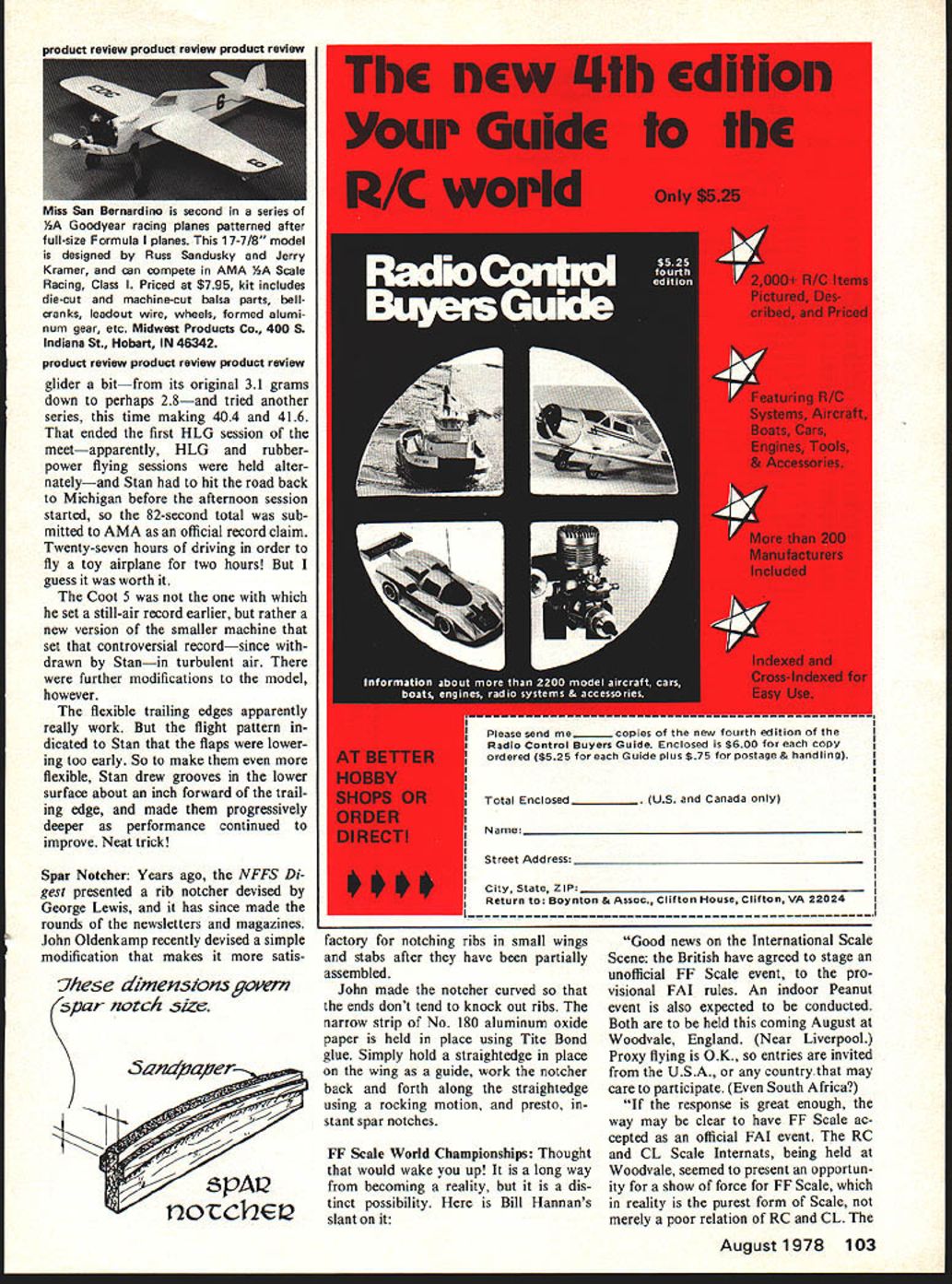
Spar Notcher: Years ago, the NFFS Digest presented a rib notcher devised by George Lewis, and it has since made the rounds of the newsletters and magazines. John Oldenkamp recently devised a simple modification that makes it more satisfactory for notching ribs in small wings and stabs after they have been partially assembled.
John made the notcher curved so that the ends don't tend to knock out ribs. The narrow strip of No. 180 aluminum oxide paper is held in place using Tite Bond glue. Simply hold a straightedge in place on the wing as a guide, work the notcher back and forth along the straightedge using a rocking motion, and presto, instant spar notches.
FF Scale World Championships: Thought that would wake you up! It is a long way from becoming a reality, but it is a distinct possibility. Here is Bill Hamann's slant on it:
"Good news on the International Scale Scene: the British have agreed to stage an unofficial FF Scale event, to the provisional FAI rules. An indoor Peanut event is also expected to be conducted. Both are to be held this coming August at Woodvale, England (near Liverpool). Proxy flying is O.K., so entries are invited from the U.S.A. or any country that may care to participate. (Even South Africa?)
"If the response is great enough, the way may be clear to have FF Scale accepted as an official FAI event. The RC and CL Scale Internats, being held at Woodvale, seemed to present an opportunity for a show of force for FF Scale, which in reality is the purest form of Scale, not merely a poor relation of RC and CL."
Free Flight: Duration
Everybody knows canards don't fly as well as conventional layouts. No World Championship entry has ever won in the canard category; no Nats event has been won by a canard in at least a quarter century; few—perhaps one—national records are held by canards. Everybody knows canards are bummers; therefore nobody builds canards; therefore they don't win much of anything. This confirms what everybody knows — a classic self-fulfilling prophecy.
Yet the first man-carrying airplane was a canard, and recent designs such as the Gossamer Condor and some advanced man-powered craft show that canards can be successful. About 25 years ago Doug Joyce decided to chuck conventional configurations and give canards a go. He has flown canards virtually outdoors in the FF-Power class and has done rather well. Anyone who has seen FAI power models perform will confirm that a guy flying a canard among 99 flying conventional layouts can make the best overall showing, regardless of inherent advantages other layouts may have.
Cargo is the ultimate small-field event. Most Cargo models will barely stagger their way to the other end of a parking lot. Motor run is 20 seconds, max 40. Unless you get real good at finding thermals, full-grown trees 15 feet tall are the rule. Cargo is the ultimate test of aerodynamic efficiency and fine tuning. Being able to tote an extra ounce can be a technological breakthrough. The current record was a quantum jump over the previous one, and the canard Doug Joyce man did it.
Joyce's Lagniappe is unique in several respects aside from its canardicity. It sports winglets — whether they help is hard to say — but the model has flown with winglets showing an advantage in free flight, likely to occur in limited-span events. Another thing: it's powered with two Cox .010 engines rather than the single Cox .020 usually employed. According to Doug, two Cox .010s produce the thrust of a single .020. According to an old model magazine, power for the .010 is .0028 horsepower at 26,000 rpm; the .020 produces .0031 horsepower at 21,000 rpm.
Incidentally, Doug used Dec. 30, 1977 King Orange Internationals. Construction is solid: 4 sq. pine top and bottom, sheet sides, two Cox .010 engines, Cox grey props — thinned. A-I compartment, solid ... Model Aviation power department called the Joyce canard Cargo model remarkable — two .010s outstalk like insect eyes. Within the displacement limit, two .010s develop the thrust of .020s.
Since the record load carried was a quantum jump, it does pay to consider special configurations rather than straight off-the-shelf Cox red-can. Red-can fuel gives a clean, consistent engine run; Doug has had much better results since he switched to higher-nitro brews.
Lagniappe started out with the wing later switched to the illustrated front wing. The original front wing had a 12% Benedek section. The mean-camber line has a zig-zag thread turbulator to minimize the effect of low Reynolds numbers. A turbulator is absolutely essential. Incidentally, Doug's FAI power models were no great shakes until he put turbulator on the canard surface. Turbulators work on the wing airfoil. The Benedek B6356-b has been rather successful in A-2 Nordic Glider competition.
Outside, just a conventional model has 400% stab.
Rules allow a 20-second engine run measured from instant release; takeoff flight counts. The model must remain airborne at least 40 seconds to score total gross weight. The best three official flights count; 12 attempts are allowed. Doug's total for three flights was 82 oz; its best flight — the model weighed ____ and stayed up a safe 57 seconds. (Lagniappe — New Orleans French: a little something extra.)
Such a new AMA national record puts a new item in your back pocket. Danger: fire can go wrong and will go wrong. It's Murphy's law. Black marks on the top pylon and similar marks on the bottom where the wing rests the pylon are no problem until a time threshold is crossed and the fire starts. A minor nuisance becomes a large problem in a big hurry. The current crop of hot engines rev up beyond belief. A single-cylinder two-stroke engine is noted for its vibration-free running; vibration causes friction, friction causes heat. A card-carrying Boy Scout knows heat causes fire; fire causes problems.
Large ones often start at the pylon. Sigs foam tape affixed to the top pylon will undoubtedly help reduce friction and reduce the probability of fire. Using a few rubber bands will probably help too. If you ever see burn marks, better cure the problem before it becomes a problem. Editor Johnny Clemens' stunt model (1947) with a rubber-banded wing had the entire wing saddle scorched.
Stopwatches, chronographs — sooner or later these become important in real competition free flight.
Transcribed from original scans by AI. Minor OCR errors may remain.

