
Free Flight — Duration — Bob Meuser
Old-Timer of the Month
After presenting two old-timer helicopter models, both of which hold current national AMA records, I couldn't resist bringing you the latest thing in old-timer hand-launch gliders, the Thermic 18, which also holds several current national records.
Between the mid-fifties and the mid-sixties, a youngster by the name of Curt Stevens developed the timeless Thermic into a formidable competition machine for both indoor and outdoor competition. During the period 1955 to 1963, Curt and his co-conspirators took four Nats firsts and two seconds, and at least nine national AMA records, among other things. After his first taste of blood — fourth place at the 1953 Plymouth Internationals — Curt never placed lower than second place in any contest, and was never beaten twice by the same person!
Since Curt's retirement from competition in about 1965, nothing much has been seen or heard of his greatly-modified Thermic glider, and the fact that no passably accurate drawings of the model were ever published, or even passed around, might have had a little something to do with that. Meanwhile Curt took unto himself a wife and begat a couple of man-kids, which became, in the normal course of events, teenagers. And it came to pass that the Nats, having nothing better to do, roosted for a spell in Southern California in 1977, a phenomenon that did not escape the notice of the Stevens family.
During the official Nats competition, clan Stevens did rather well: in the Indoor HLG competition, Darryl got first in Junior with a two-flight score of 107.8 seconds, and Gary took second place in Senior with 119.0 seconds. But that was merely the warm-up.
With the enthusiastic indulgence of the event director Bill Vanderbeek, and the help of a photographer who kept shooting off flashbulbs in their faces to keep them awake, Darryl and Gary were at it until midnight. The results: a Junior Category II record (103.4 sec.) that even exceeds the Cat III record, and would have been second only to Bill Blanchard's score in Open during the official competition; and a Senior Cat II record of 152.6 sec., which not only would have topped the best official Nats score by some 14 seconds, but which beat the existing Cat III score, and topped the Open Cat II record by some 10 seconds to boot! Not bad for a couple of kids who had never flown Indoor HLG, except for three meets in Chicago some years earlier, until that very day! Darryl also holds the current outdoor record.
The pod-and-boom fuselage is pure Thermic, and quite likely was influenced by the highly successful Joe Hervat gliders of the thirties. The major influences on the modifications and tuning came from the Oakland Cloud Dusters, who were top bananas in HLG in the early fifties:
- Robbers
- Bilgri
- Foster
- Rambo
- Andrade
- Cole
- Lenderman
- Foote
- Pete and Mike Demos
Joe Foster spent a lot of time teaching Curt how to adjust a glider before even throwing it.
For accuracy, the models are built on plate glass surfaces. The rudders are completely finished before cutting them loose from the larger sheet of wood. The stabilizer mount is trimmed for zero incidence angle only after the wing and fuselage are finished, assembled, and aged. Jigs are used to ensure getting the proper dihedral angles. Joints are made with cyanoacrylate adhesive—Eastman 910, Hot Stuff—and a skin is built up over each joint using Hobby Shack's Quick Tack glue. Since Stevens and Sal Taibi were once partners in Competition Models, it seems unlikely that the Stevenses had to make do with any second-grade balsa.
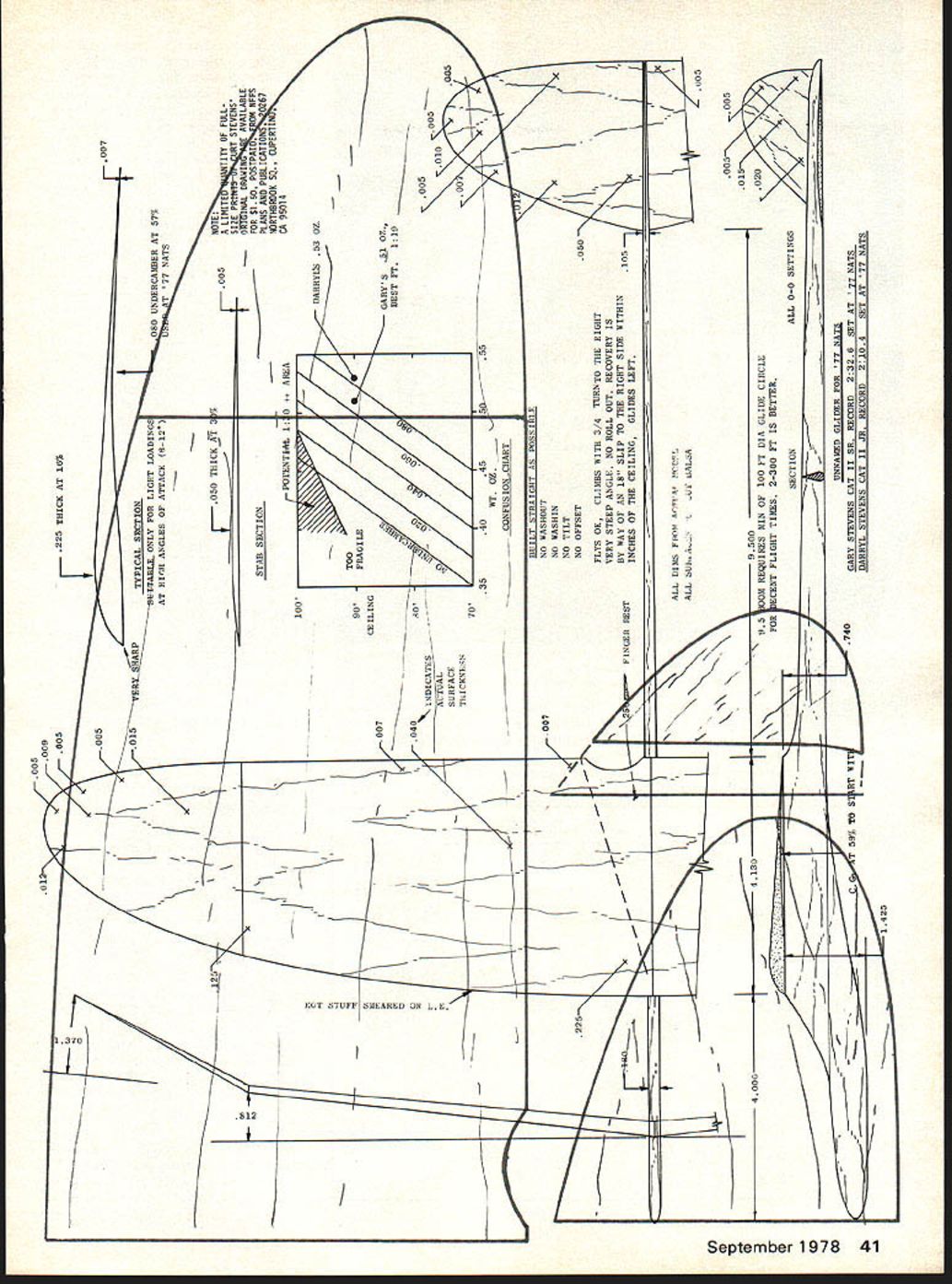
The drawing was made by Curt from measurements of the actual models, and might well serve as the standard textbook for moderate-ceiling Indoor HLG. It's all there. Nothing new; it's all been rattling around in Curt's head for 20 years. The "Confusion Chart" is especially interesting. It says that for low ceilings one needs light gliders and a bit of undercamber; everybody knows that. But it presents Curt's best guesses as to the proper combinations. For example, it says that if you are flying this design in an 84-ft. site, if you can keep the weight down to 0.4 oz. (about 11 grams), you don't need, or can't profit from, any undercamber. But, if the site is lower, you require near-perfect launches to achieve the potentially increased flight duration. Given the hazards of Nats competition, Curt opted for a more conservative design.
The record-setting models had no finish other than a smooth sanding—couldn't afford the weight. But, given his druthers, Curt would have opted for a glassy-smooth finish. Although the Stevenses started out with about a dozen models each, close encounters of the worst kind with lamp hangars and rafters dwindled it down to about one each. The record-setting models had the appearance of having spent a tough winter in a closet full of moths.
So what's for the future? With Cat II scores like that, Cat III records would seem like a cinch. The possibility of Darryl and Gary ever getting access to a Cat III site? Nil! Besides, they are all hot on RC gliders nowadays. Too bad, sort of....
(Full-size prints of Stevens's original drawing, published here half-size, are available for $1.50, postpaid, from NFFS Plans and Publications, c/o Jack Brown, 20267 Northbrook Sq., Cupertino, CA 95014.)
Copy Cat and the Scorcher
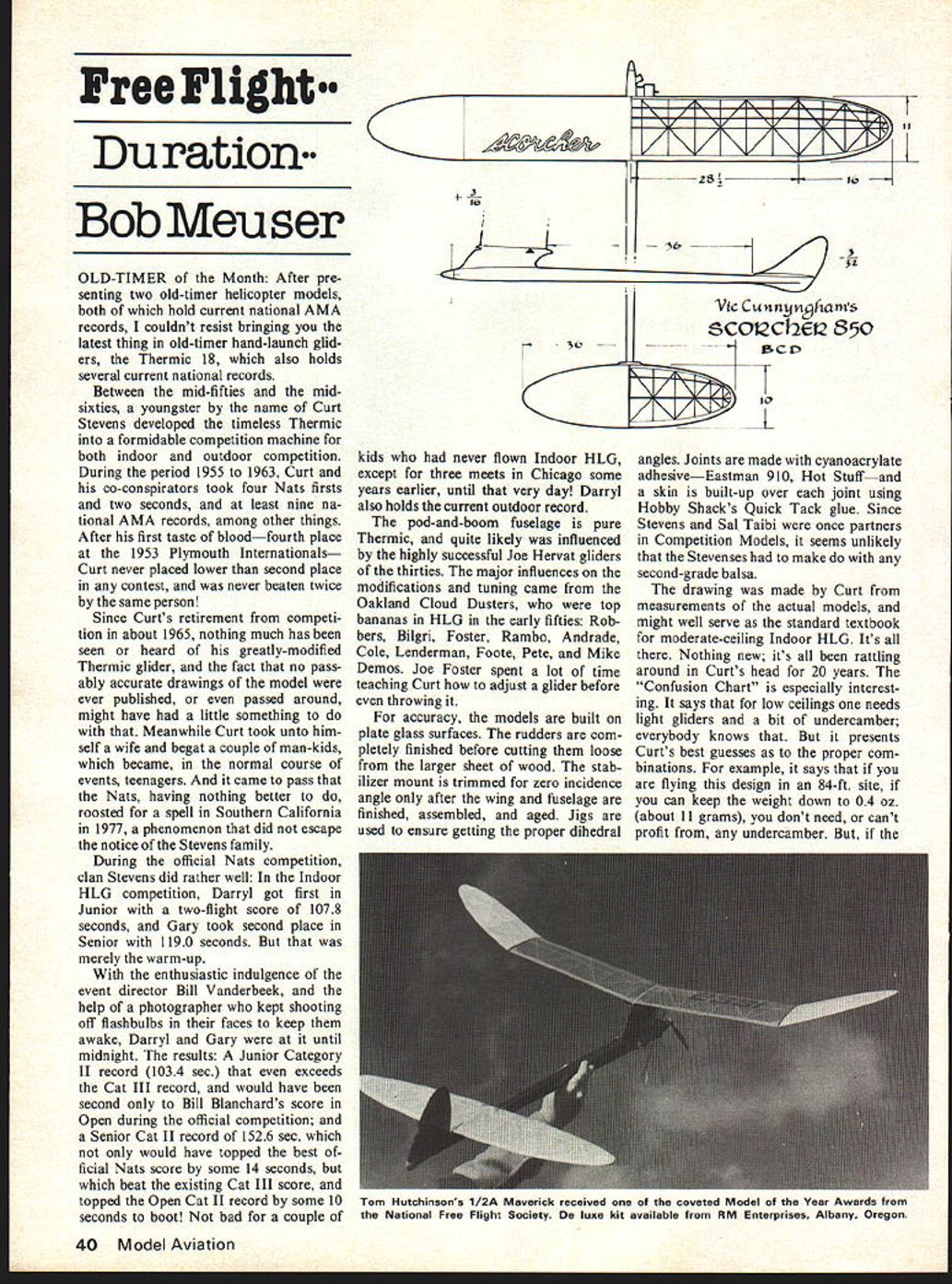
The Copy Cat was entered in every test series except the Nats, where it took second. After ten years of competition flying, including thousands of flights, the Copy Cat splattered itself against the asphalt at Buckeye, Arizona last year after Vic added auto surfaces in an attempt to improve its performance. The Scorcher has a higher aspect ratio, longer tail moment arm, and a smaller (30%) horizontal tail. More FAI-ish, you might say, but no auto-tail! Other changes are primarily cosmetic. Construction is typical of most of Vic's models, many of which have been featured in Flying Models.
Rubber Motor Turns
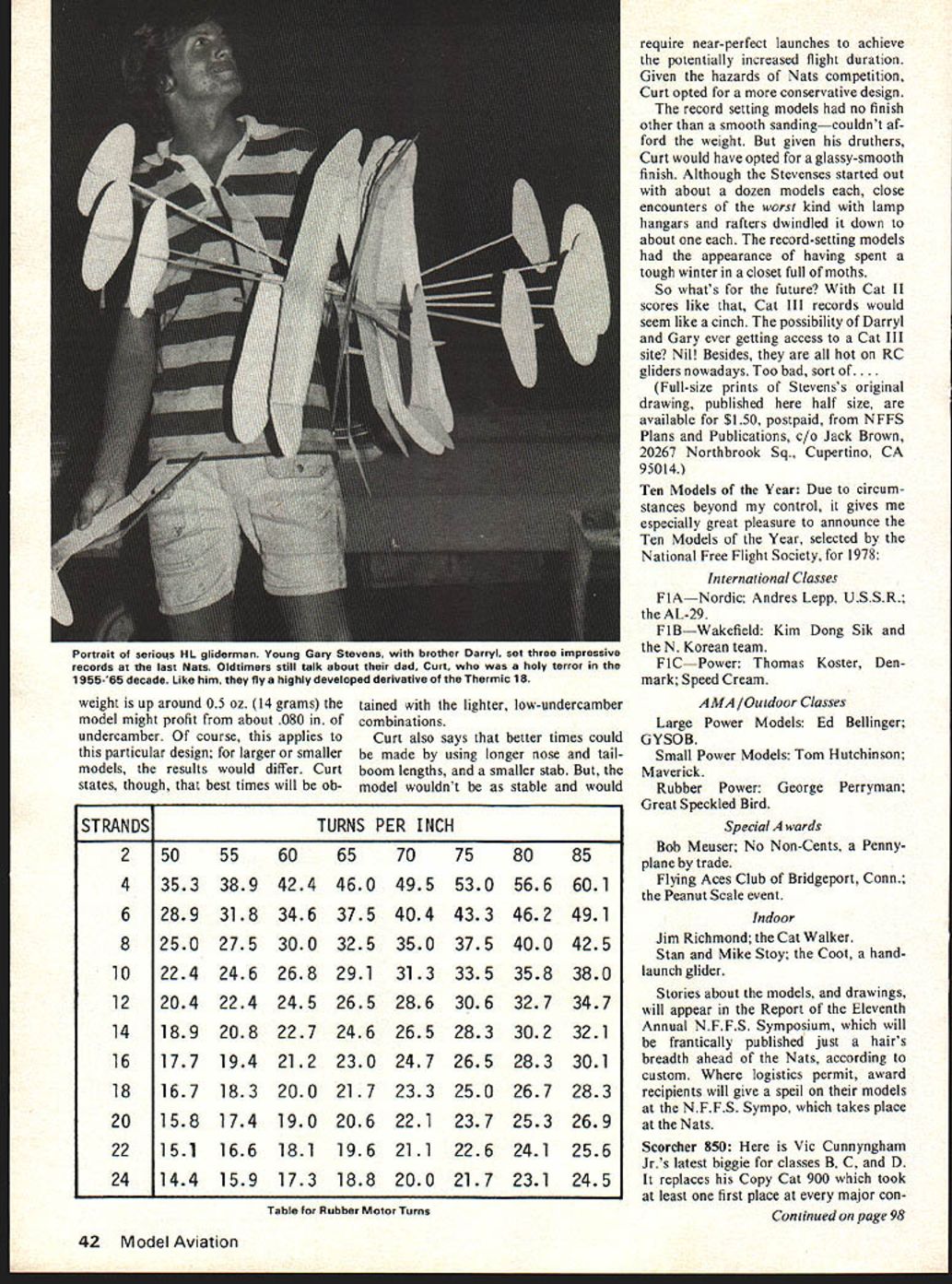
Tables giving motor turns for various numbers of strands and motor lengths pop up in the literature from time to time, but if one similar to the one presented here has been published in the last decade or two, I must have missed it. While most tables apply only to a specific kind of rubber, this one applies to all kinds. Here is how it works.
Example: You just received a new batch of 1/8" rubber, plan to make it up into 16-strand motors 42 inches long, and wonder how many turns you should expect out of such a motor. You could simply make up a few such motors and test them to destruction, but with such motors now costing $2 each, you might like to try this alternative. Make up two or three two-strand motors, say, 10 inches long, break them in, and test wind them to destruction. Say they all break at about 700 turns. If the motors were exactly 10 inches long, that would be 70 turns per inch. In the table, go across from "2" in the "Number of Strands" column to "70" in the "Turns per inch" columns. Then go down the "70" column until you are opposite "16" in the "Strands" column and read off "24.7" turns per inch. Multiply that by 42—the length the motors are to be—and you get 1,037 turns.
The table is based on the notion that the turns-per-inch is inversely proportional to the square root of the cross-sectional area. That relationship is easy to come by if you ignore the details of what happens inside a squirrelly mess of wound-up rubber. But it seems to match the experiments, which is proof of the pudding. It was first published in the thirties by J. P. Glass writing in Zajic's yearbooks, and appeared also in the later editions of Charles Hampson Grant's Model Airplane Design.
I ran some rather careful tests a few years back, covering a wide range of the variables, that confirmed the relationship within a percent or two. But there are those who hold that the number of strands, rather than merely the total cross-section, has an effect. That is, 28 strands of 1/4" rubber acts differently from 14 strands of 1/8". That might be true, but my personal opinion is that the effect is a small one under normal circumstances, and that if the effect is not small, it is because the motors are not sufficiently well lubricated. Rebuttal?
Blue Ridge Models Alive and Well
If you are one of the unfortunates who had to wait for over four months to receive your order, grumble no more; Blue Ridge is back to normal. The unexpected volume of orders, a delayed shipment of balsa, and a move to a new house put Blue Ridge a little behind.
Phil and Shirley Hartman, who run Blue Ridge Models in what used to be their "spare" time, have already sold around 500 of their fine Coupe D'Hiver kit. I find that rather amazing considering that the kit is expensive, advertising is largely by word of mouth, and the kit is sold only by direct mail. If I were to estimate the number of competition-oriented Coupe fliers in the country, I'd have to come to the conclusion that each of them already has two Blue Ridge Coupes.
Free flight is apparently much larger than what meets the eye, but it is still not big enough to entice the Big Boys in the business to market kits for some of the not-all-that-popular competition events. Meanwhile we're fortunate in being able to obtain high quality kits from cottage-industry outfits such as Blue Ridge and a handful of others we have mentioned from time to time.
Not to be overlooked are Blue Ridge's Coupe props and rib sets, which are sold separately from the kits, its kits for hand-launch gliders, sport, and P-30 models, and a vast assortment of free-flight goodies. For a catalog, send a S.A.S.E. to Blue Ridge Models, P.O. Box 429, Skyland, NC 28776. Tell them Bob sent you, and receive a DT rubber band absolutely free!
X-Acto Knife Fix
Have trouble unleashing the blade from your pet X-Acto knife after cinching it tight for a tough job? Try a wrap of Teflon tape — dope around the collet. The stuff is slippery, stretchy, and conforms to anything. It is intended for sealing pipe threads, and is available in the plumbing section of most hardware stores.
How To Make Friends and Influence Free-Flighters, People, and Everybody Else
You decide to write to a total stranger or ask him about his model, someone whose name appeared in a magazine or a contest results listing. Since you are not yet on a first-name basis, you start out "Dear Sir", or better "Dear Mr. Smith." Cautious, formal, restrained. But, feeling uncomfortable with all that formality, you sign the letter simply "Al", being sure to put your full name and address at the top, of course. Chances are, the reply will come back "Dear Al" and you are old buddies instantly. It works!
Of course you could hasten the process by starting out "Dear Fred" in the first place. But if the reply comes back, "Dear Mr. Jones", you are in trouble!
Formality has its place, I guess, but it seems best reserved for use on people you are mad at.
Outstanding Performance
If there were National Records for getting the most official AMA National Records (a) ever, (b) as a Senior, (c) in one month, or (d) in one day, all of those record-recorders would have to go to one C. Keith Martin. Keith's dad, Charlie Martin of Bellevue, Washington, must have picked up a few pointers along the way, as he wound up on the team representing the U.S.A. at the 1977 F.A.I. World Champs.
As a Junior, Keith picked up nine records during 1971. As a Senior, during the period March 1972 through December 1975 he picked up an additional 69 records, for a grand total of 78. During the month of December, 1975 he gathered 24 of the things. On the 27th of that month, he set two records in each of the three Indoor ceiling-height categories, and one in each of the two Outdoor categories, for a record one-day total of eight. The logistics boggle the mind!
Keith's indoor records were all set in the Autogiro, Ornithopter, and Helicopter events; the easy ones. Easy? ... Ok, kiddo, let's see you do six-minutes-plus with an autogiro! His Outdoor records slice a cross section through all of the Power, Rubber, and Rocket events.
Can you top any of these? Keith established nine records as a Junior, but surely someone must have topped that. Linda Randolph? Marty Thompson? Let's hear about it, eh?
Bob Meuser, 4200 Gregory St., Oakland, CA 94619.
Transcribed from original scans by AI. Minor OCR errors may remain.

