
Free Flight: Duration
Bob Meuser
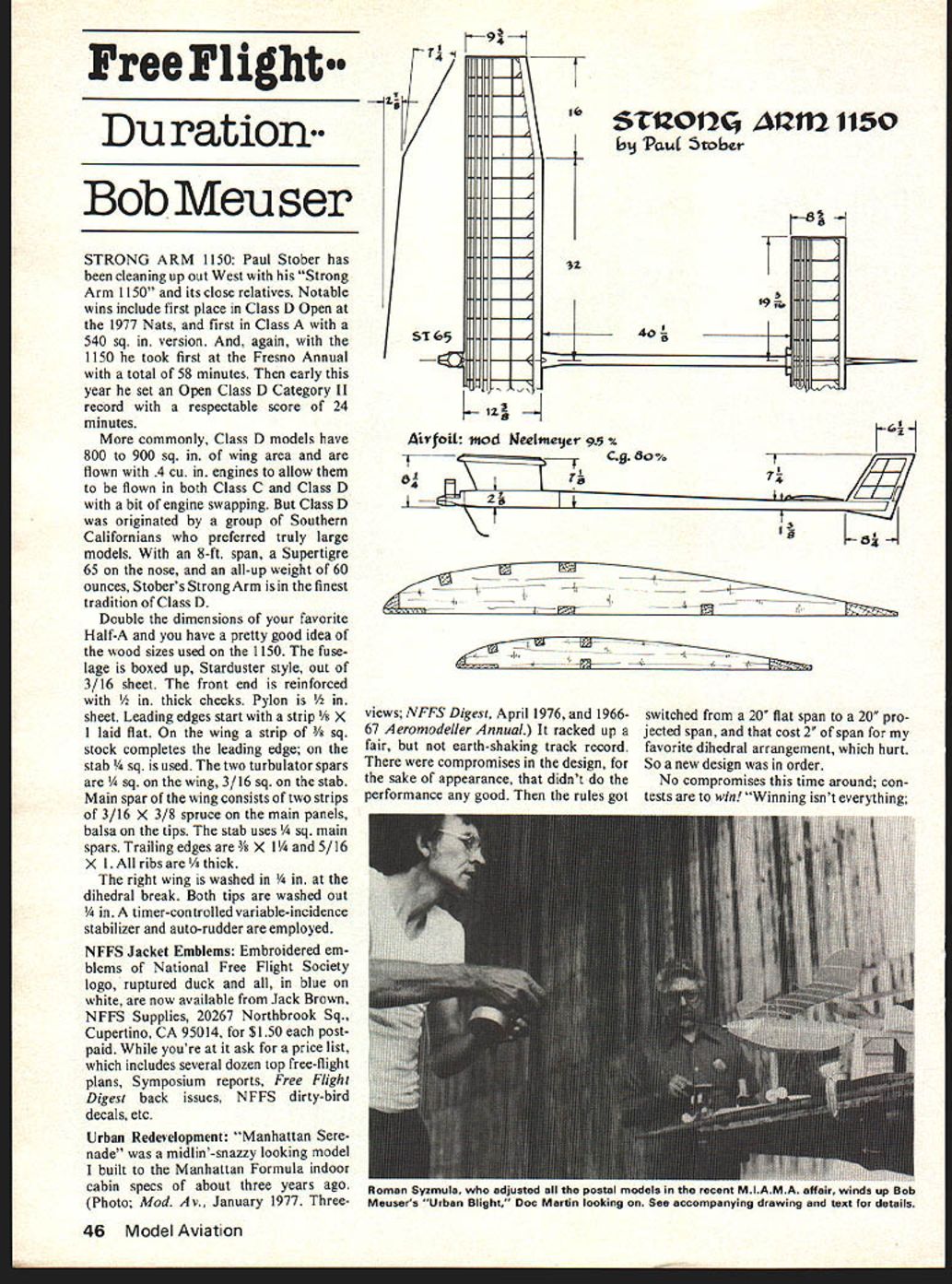
STRONG ARM 1150
Paul Stober has been cleaning up out West with his "Strong Arm 1150" and its close relatives. Notable achievements include:
- First place, Class D Open, 1977 Nats.
- First place in Class A with a 540 sq. in. version.
- First place at the Fresno Annual (total: 58 minutes).
- Early this year set an Open Class D Category II record with a 24-minute flight.
More commonly, Class D models have 800–900 sq. in. of wing area and are flown with 0.4 cu. in. engines so they can be swapped into Class C or Class D. Class D was originated by Southern Californians who preferred truly large models. With an 8-ft. span, a Supertigre 65 on the nose, and an all-up weight of about 60 oz., Stober's Strong Arm follows that large-model tradition.
Construction highlights (approximate wood sizes):
- Fuselage: boxed Starduster style from 3/16 in. sheet; front reinforced with 1/8 in. thick cheeks.
- Pylon: 1/2 in. sheet.
- Leading edges: start with a 1/8 x 1 in. strip laid flat; wing leading edge finished with 3/8 in. sq. strip; stab uses 1/4 in. sq.
- Turbulator spars: wing 1/4 in. sq., stab 3/16 in. sq.
- Main wing spar: two strips of 3/16 x 3/8 in. spruce on the main panels; balsa on the tips.
- Stab main spars: 1/4 in. sq.
- Trailing edges: 3/8 x 1-1/4 in. and 5/16 x 1 in.
- Ribs: 1/8 in. thick.
Aerodynamic/tuning notes:
- Right wing is washed in 1/4 in. at the dihedral break; both tips are washed out 1/4 in.
- Uses a timer-controlled variable-incidence stabilizer and an auto-rudder.
URBAN BLIGHT (successor to Manhattan Serenade)
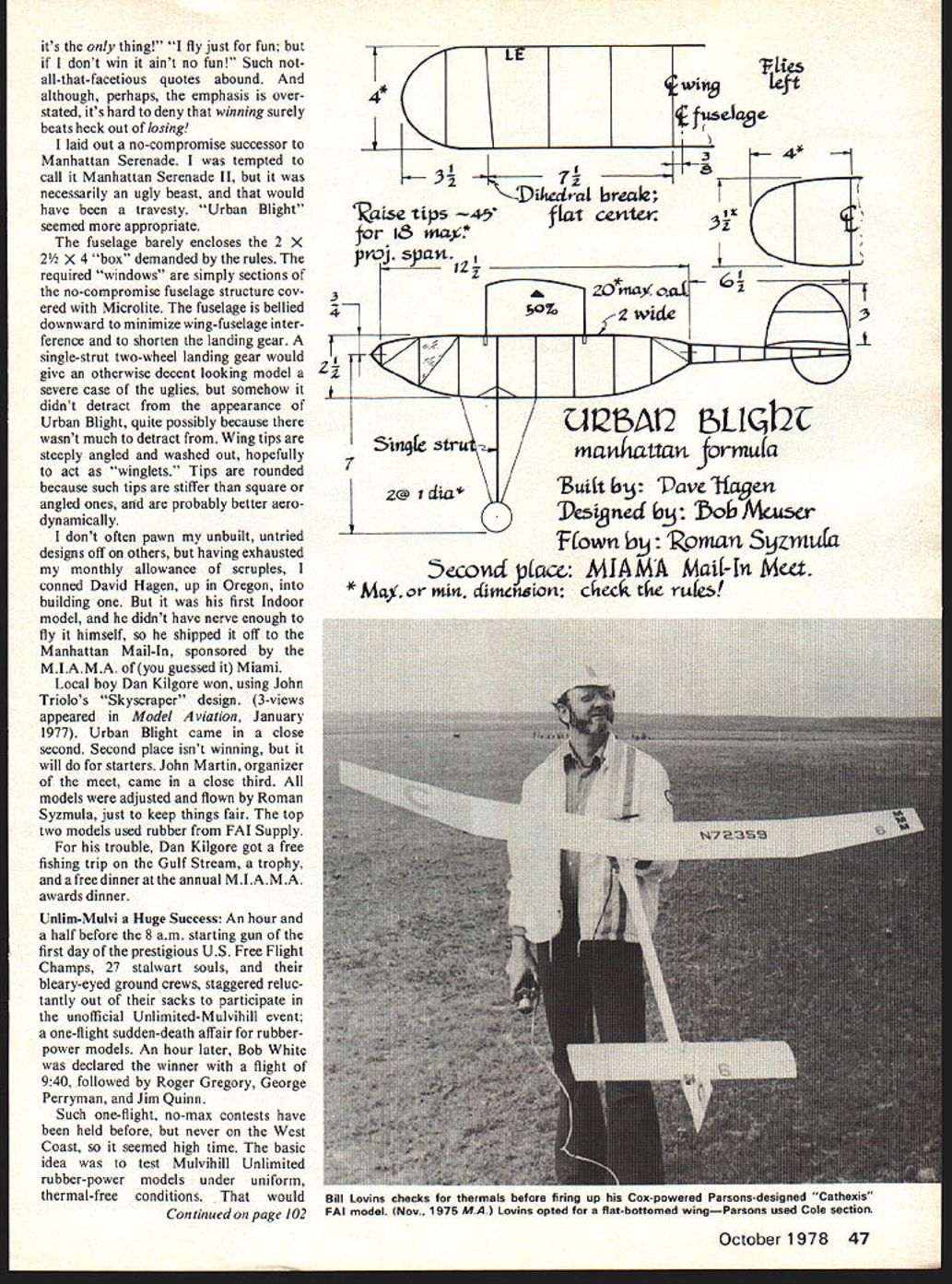
Manhattan Serenade had a fair track record but included compromises for appearance that hurt performance. When the rules changed from a 20-ft. flat span to a 20-ft. projected span (costing about 2 in. of effective span for the preferred dihedral), a new, uncompromising design was needed. I laid out a no-compromise successor. Tempted to call it Manhattan Serenade II, I instead named it "Urban Blight" because the design is intentionally ungainly.
Design and construction notes:
- Fuselage just encloses the 2 x 2-1/2 x 4 in. box required by the rules; the required "windows" are simply sections of the fuselage structure covered with Microlite.
- Fuselage belly is lowered to minimize wing–fuselage interference and to shorten the landing gear.
- A single-strut, two-wheel landing gear keeps the model compact despite its ungainly appearance.
- Wing tips are steeply angled and washed out (intended to act as winglets). Tips are rounded for stiffness and likely better aerodynamics.
Contest history:
- I persuaded David Hagen (Oregon) to build the first indoor example. He shipped it to the Manhattan Mail-In, sponsored by M.I.A.M.A., in Miami.
- Dan Kilgore won the event flying John Triolo's "Skyscraper" design (three-view appeared in Model Aviation, January 1977).
- Urban Blight placed a close second; John Martin (event organizer) was a close third.
- All models at the meet were adjusted and flown by Roman Syzmula for fairness. The top two models used rubber from FAI Supply.
- Prize for Dan Kilgore included a Gulf Stream fishing trip, a trophy, and a free dinner at the annual M.I.A.M.A. awards dinner.
Unlimited-Mulvihill — A Huge Success
An unofficial Unlimited-Mulvihill event was held one hour and a half before the 8:00 a.m. starting gun on the first day of the U.S. Free Flight Championships. This was a one-flight, sudden-death affair for rubber-powered Mulvihill models; 27 entrants and their crews participated bleary-eyed.
Results:
- Winner: Bob White — 9:40
- Runners-up: Roger Gregory, George Perryman, Jim Quinn
Event purpose and lessons learned:
- The goal was to test Mulvihill Unlimited rubber-power models under uniform, still-air conditions. While simultaneous launch at very early hours would be ideal, a compromise one-hour launching window was used; experience showed this was too wide and the window will likely be shortened to about 15 minutes next year.
- Half of the 24 who actually flew exceeded 5 minutes. A reasonably good Mulvihill design from the past 20 years can break 5 minutes in still air if well prepared.
- Some poor results were due to models not competitive against large 300-sq.-in. designs, trim problems, or insufficient preflight tuning. With only one flight allowed and limited testing, models must be sorted out ahead of time. Many Mulvihill models are tuned for thermal flying; for the still-air event, retuning for still-air performance is important (Bob White retuned successfully but then stalled during the official Mulvihill competition).
Proposed event rules (to keep the contest in the classic Mulvihill spirit):
- Require enclosed motors.
- Require double-surface or solid-sheet wing and tail surfaces.
- Consider a 70-gram minimum all-up weight to exclude impractical ultra-light designs while allowing genuine small Mulvihill types (e.g., lightly built Gollywock).
- Timers may roam on foot to keep the model in sight (the AMA rule restricting timer movement will not be invoked); if models are likely to fly out of sight under the day's conditions, postpone the event until the next morning or evening.
- Questionnaires are being circulated; suggestions are welcome.
Cottage Industry Lives
I've mentioned Jim Jones's free-flight tools previously (Aug–Sep 1977; July 1976). Recent additions include a family of high-temperature epoxy–fiberglass prop forms that can be oven-baked up to 200°F. They are ideal for molding Wakefield or Coupe prop blades and will handle prop...
A Short Amusing Fable
He flew, he won, and he thought to himself, "Winning isn't everything, but it sure beats losing." The Elders, hearing of it, were vexed and declared that the free flighter must be punished. So they banished him to AMA headquarters to serve as Technical Director, where he would frequently decide cases of alleged snookering. Of course, it's only a fable.
Bob Meuser 4200 Gregory St., Oakland, CA 94619
Transcribed from original scans by AI. Minor OCR errors may remain.

