


Free Flight: Duration
Bob Meuser
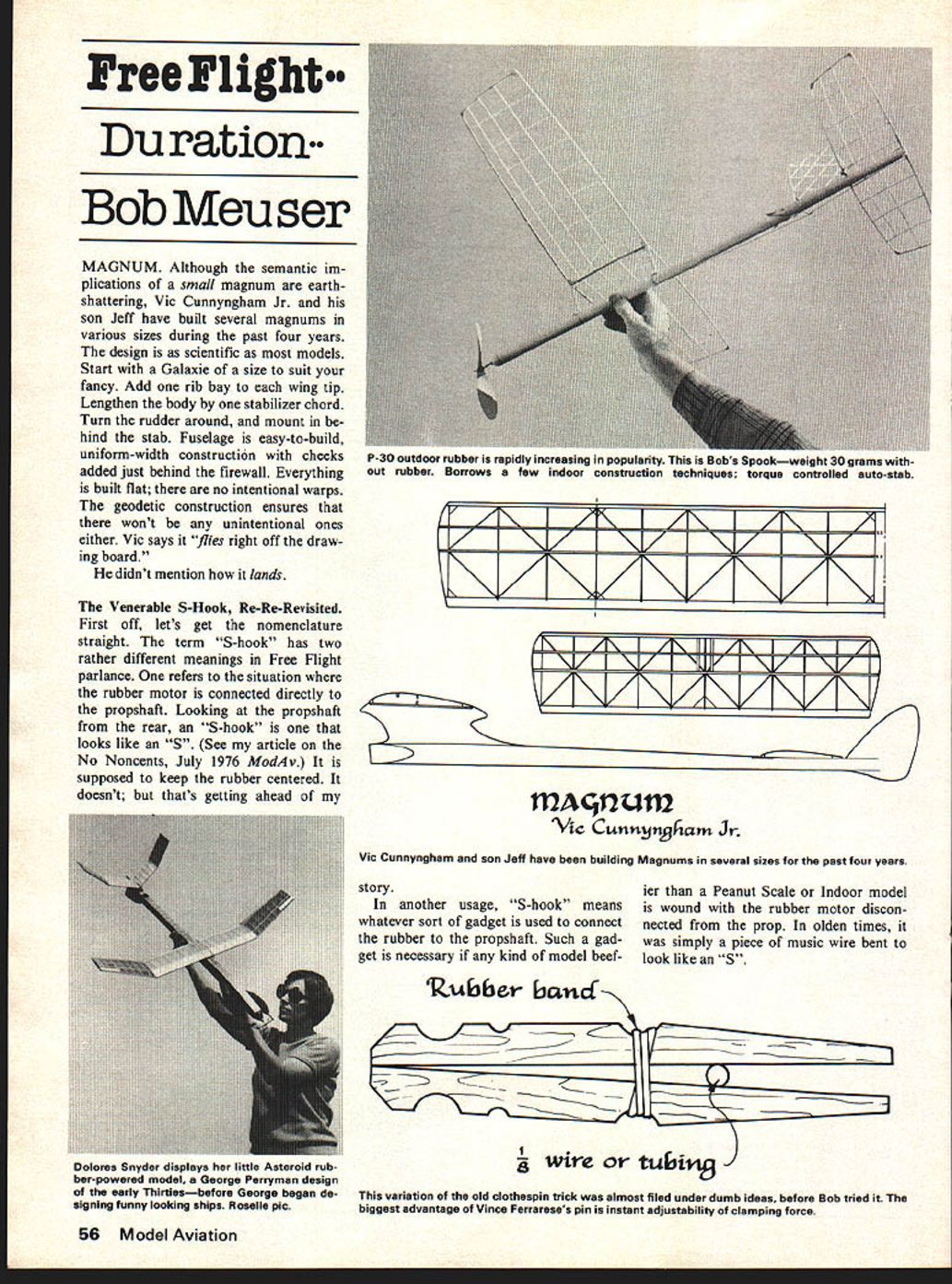
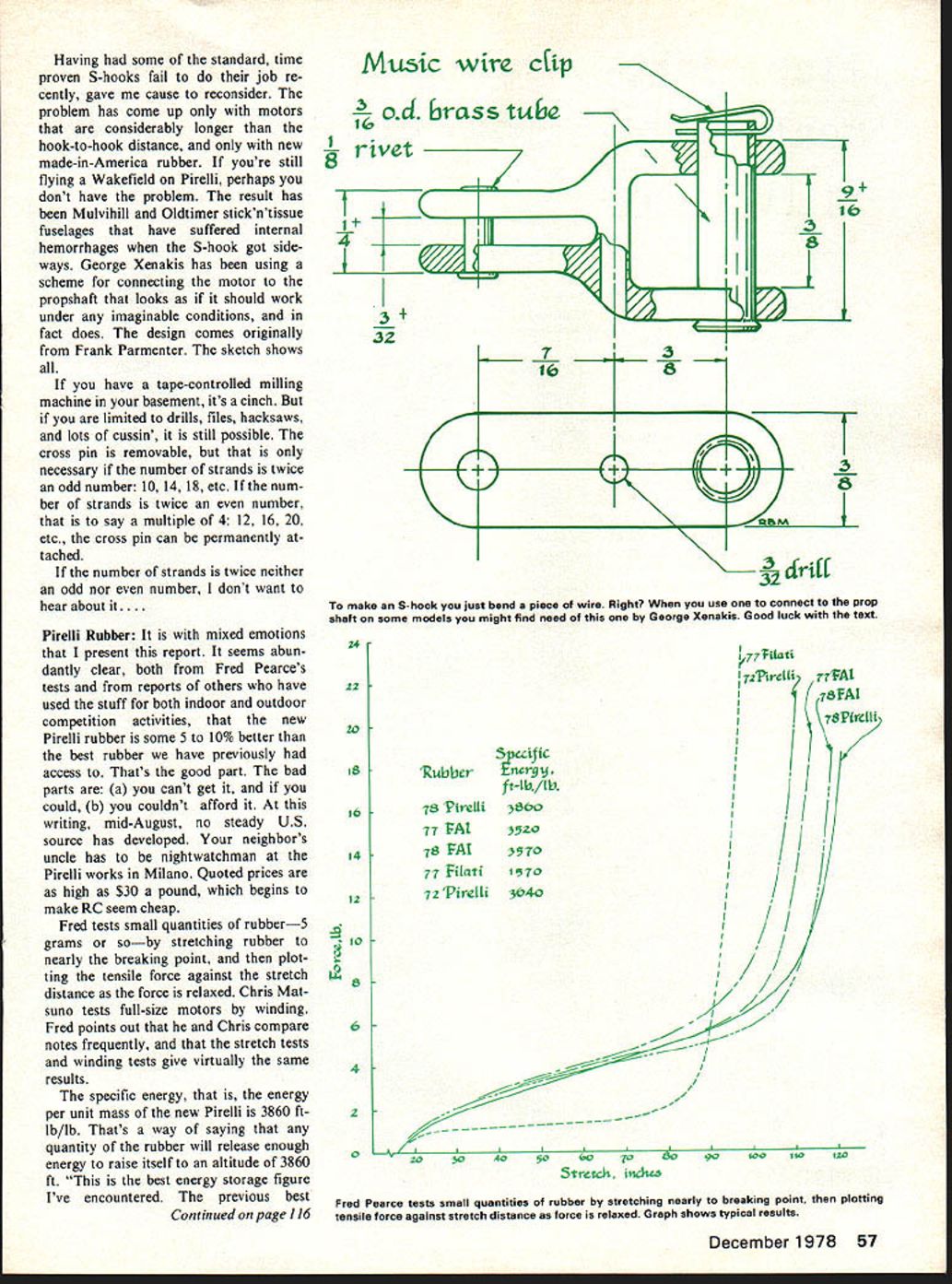
MAGNUM. Although the semantic implications of a small magnum are earth-shattering, Vic Cunnyngham Jr. and his son Jeff have built several magnums in various sizes during the past four years. The design is as scientific as most models. Start with a Galaxie of a size to suit your fancy. Add one rib bay to each wing tip. Lengthen the body by one stabilizer chord. Turn the rudder around and mount it behind the stab. The fuselage is easy-to-build, uniform-width construction with cheeks added just behind the firewall. Everything is built flat; there are no intentional warps. The geodetic construction ensures that there won't be any unintentional ones either. Vic says it "flies right off the drawing board." He didn't mention how it lands.
The Venerable S-Hook, Re-Re-Revisited
First off, let's get the nomenclature straight. The term "S-hook" has two rather different meanings in Free Flight parlance. One refers to the situation where the rubber motor is connected directly to the propshaft. Looking at the propshaft from the rear, an "S-hook" is one that looks like an "S" (see my article on the No Noncents, July 1976 ModAv). It is supposed to keep the rubber centered. It doesn't; but that's getting ahead of my story.
In another usage, "S-hook" means whatever sort of gadget is used to connect the rubber to the propshaft. Such a gadget is necessary if any kind of model beefier than a Peanut Scale or Indoor model is wound with the rubber motor disconnected from the prop. In olden times, it was simply a piece of music wire bent to look like an "S".
This variation of the old clothespin trick was almost filed under "dumb ideas" before Bob tried it. The biggest advantage of Vince Ferrarese's pin is instant adjustability of clamping force.
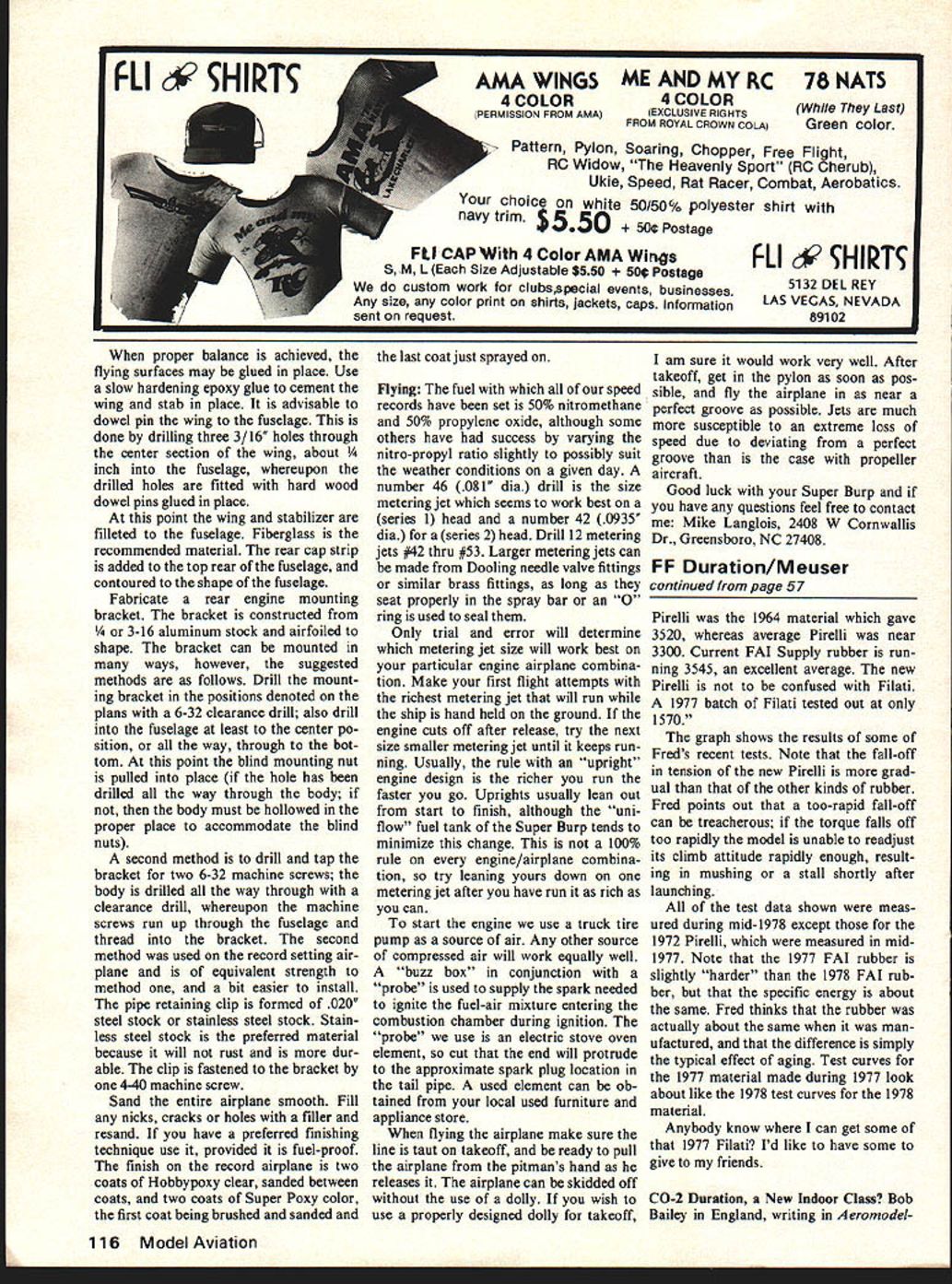
Having had some of the standard, time-proven S-hooks fail to do their job recently gave me cause to reconsider. The problem has come up only with motors that are considerably longer than the hook-to-hook distance, and only with new made-in-America rubber. If you're still flying a Wakefield on Pirelli, perhaps you don't have the problem. The result has been Mulvihill and Oldtimer stick-'n'-tissue fuselages that have suffered internal hemorrhages when the S-hook went sideways. George Xenakis has been using a scheme for connecting the motor to the propshaft that looks as if it should work under any imaginable conditions, and in fact does. The design comes originally from Frank Parmenter. The sketch shows all.
If you have a tape-controlled milling machine in your basement, it's a cinch. But if you are limited to drills, files, hacksaws, and lots of cussin', it is still possible. The cross pin is removable, but that is only necessary if the number of strands is twice an odd number: 10, 14, 18, etc. If the number of strands is twice an even number—that is to say, a multiple of 4: 12, 16, 20, etc.—the cross pin can be permanently attached.
If the number of strands is twice neither an odd nor an even number, I don't want to hear about it.
Pirelli Rubber
It is with mixed emotions that I present this report. It seems abundantly clear, both from Fred Pearce's tests and from reports of others who have used the stuff for both indoor and outdoor competition activities, that the new Pirelli rubber is some 5 to 10% better than the best rubber we have previously had access to. That's the good part. The bad parts are: (a) you can't get it, and if you could, (b) you couldn't afford it. At this writing, mid-August, no steady U.S. source has developed. Your neighbor's uncle has to be nightwatchman at the Pirelli works in Milano. Quoted prices are as high as $30 a pound, which begins to make RC seem cheap.
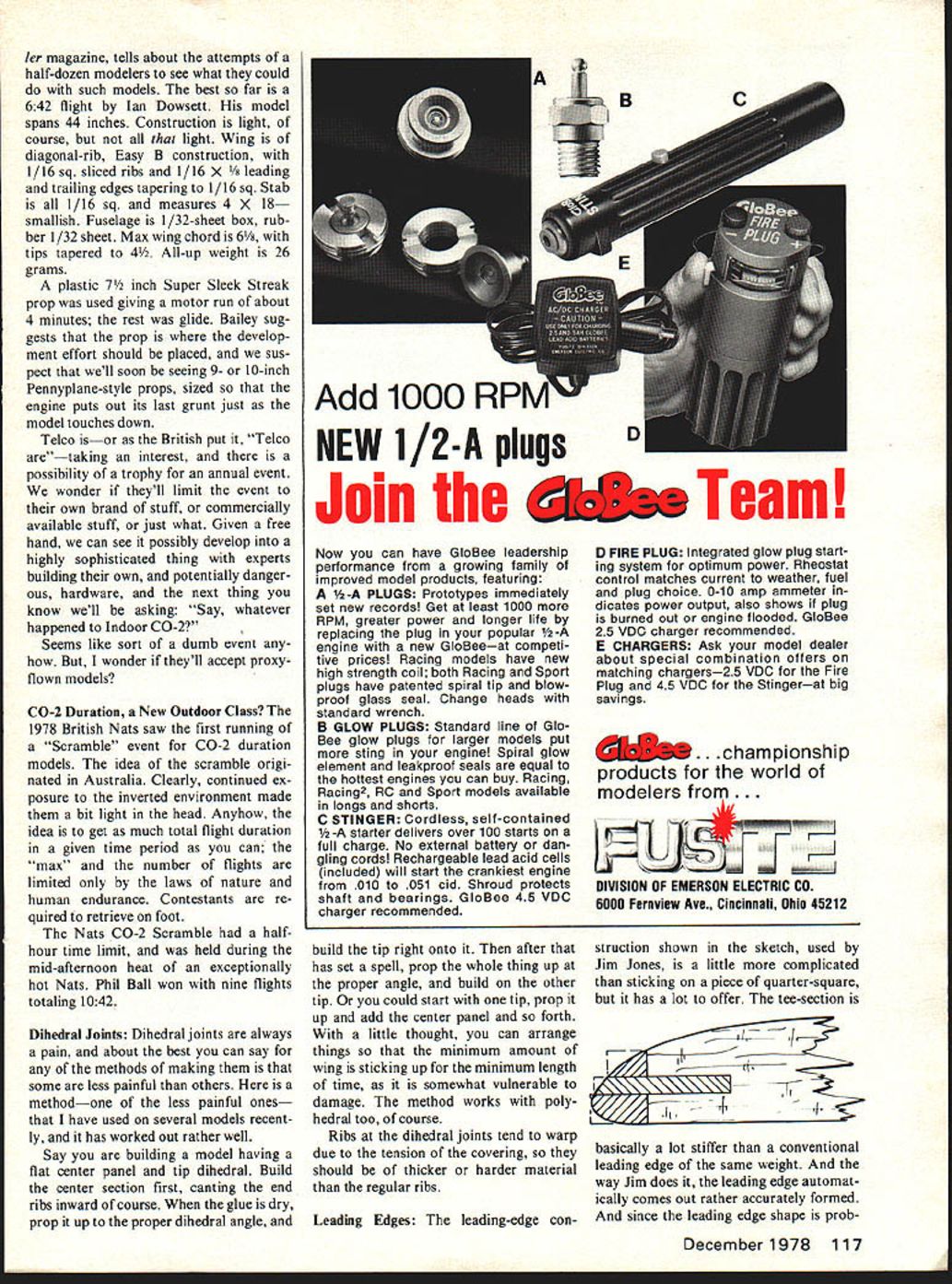
Fred tests small quantities of rubber—5 grams or so—by stretching rubber to nearly the breaking point, and then plotting the tensile force against the stretch distance as the force is relaxed. Chris Matsuno tests full-size motors by winding. Fred points out that he and Chris compare notes frequently, and that the stretch tests and winding tests give virtually the same results.
The specific energy, that is, the energy per unit mass of the new Pirelli is 3860 ft·lb/lb. That's a way of saying that any quantity of the rubber will release enough energy to raise itself to an altitude of 3860 ft. This is the best energy-storage figure I've encountered. The previous best Pirelli was the 1964 material, which gave 3520, whereas average Pirelli was near 3300. Current FAI Supply rubber is running 3545, an excellent average. The new Pirelli is not to be confused with Filati. A 1977 batch of Filati tested out at only 1570.
The graph shows the results of some of Fred's recent tests. Note that the fall-off in tension of the new Pirelli is more gradual than that of the other kinds of rubber. Fred points out that a too-rapid fall-off can be treacherous; if the torque falls off too rapidly, the model is unable to readjust its climb attitude rapidly enough, resulting in mushing or a stall shortly after launching.
All of the test data shown were measured during mid-1978 except those for the 1972 Pirelli, which were measured in mid-1977. Note that the 1977 FAI rubber is slightly "harder" than the 1978 FAI rubber, but that the specific energy is about the same. Fred thinks that the rubber was actually about the same when it was manufactured, and that the differences are simply the typical effect of aging. Test curves for the 1977 material made during 1977 look about like the 1978 test curves for the 1978 material.
Anybody know where I can get some of that 1977 Filati? I'd like to have some to give to my friends.
A recent magazine tells about the attempts of a half-dozen modelers to see what they could do with such models. The best so far is a 6:42 flight by Ian Dowsett. His model spans 44 inches. Construction is light, of course, but not ultra-light. The wing is diagonal-rib, Easy B construction, with 1/16 sq. sliced ribs and 1/16 x 1/8 leading and trailing edges tapering to 1/16 sq. The stab is all 1/16 sq. and measures 4 x 18 inches—smallish. The fuselage is 1/32-sheet box, rubber 1/32 sheet. Maximum wing chord is 6 1/8 inches, with tips tapered to 4 1/2 inches. All-up weight is 26 grams.
A plastic 7 1/2-inch Super Sleek Streak prop was used, giving a motor run of about 4 minutes; the rest was glide. Bailey suggests that the prop is where the development effort should be placed, and we suspect that we'll soon be seeing 9- or 10-inch Pennyplane-style props, sized so that the engine puts out its last grunt just as the model touches down.
Telco is—or as the British put it, "Telco are"—taking an interest, and there is a possibility of a trophy for an annual event. We wonder if they'll limit the event to their own brand of stuff, or commercially available stuff, or just what. Given a free hand, we can see it possibly developing into a highly sophisticated thing with experts building their own, and potentially dangerous, hardware, and the next thing you know we'll be asking: "Say, whatever happened to Indoor CO-2?"
Seems like sort of a dumb event anyhow. But I wonder if they'll accept proxy-flown models?
CO-2 Duration, a New Outdoor Class?
The 1978 British Nats saw the first running of a "Scramble" event for CO-2 duration models. The idea of the scramble originated in Australia. Clearly, continued exposure to the inverted environment made them a bit light in the head. Anyhow, the idea is to get as much total flight duration in a given time period as you can; the "max" and the number of flights are limited only by the laws of nature and human endurance. Contestants are required to retrieve on foot.
The Nats CO-2 Scramble had a half-hour time limit and was held during the mid-afternoon heat of an exceptionally hot Nats. Phil Ball won with nine flights totaling 10:42.
Dihedral Joints
Dihedral joints are always a pain, and about the best you can say for any of the methods of making them is that some are less painful than others. Here is a method—one of the less painful ones—that I have used on several models recently, and it has worked out rather well.
Say you are building a model having a flat center panel and tip dihedral. Build the center section first, canting the end ribs inward of course. When the glue is dry, prop it up to the proper dihedral angle, and build the tip right onto it. Then after that has set a spell, prop the whole thing up at the proper angle, and build on the other tip. Or you could start with one tip, prop it up and add the center panel and so forth. With a little thought, you can arrange things so that the minimum amount of wing is sticking up for the minimum length of time, as it is somewhat vulnerable to damage. The method works with polyhedral too.
Ribs at the dihedral joints tend to warp due to the tension of the covering, so they should be of thicker or harder material than the regular ribs.
Leading Edges
The leading-edge construction shown in the sketch, used by Jim Jones, is a little more complicated than sticking on a piece of quarter-square, but it has a lot to offer. The T-section is basically a lot stiffer than a conventional leading edge of the same weight. And the way Jim does it, the leading edge automatically comes out rather accurately formed. Since the leading edge shape is probably the most important feature of an airfoil, that's important. Furthermore, the stem of the "T" is well anchored to the ribs, so wrinkles in the covering where the ribs join the leading edge are unlikely.
The idea is that each strip is exactly the right width to begin with. Then about all that is left is sanding until the notches disappear. An accurate drawing of the leading-edge region—perhaps two or three times life size for smaller models—is the starting point. Then you design the leading edge the way you want it and cut the strips to suit, or you take the easier route of designing the leading edge to accommodate stock wood sizes.
Variation No. 437 on the Common Household Clothespin
I was about to file this one under "Dumb Ideas" until I tried it. It's really neat! The main feature of Vince Ferrarese's clothespin mod, shown in the sketch, is instant adjustability of the clamping force. Just slide the fulcrum pin. Vince used 1/8-inch music wire for the fulcrum, but other things that are more easily cut—aluminum tubing, for example—would work as well. If 1/8-inch tubing doesn't give a wide enough jaw opening, try 1/4-inch.
Sympo 78
Although it will have cooled considerably by the time this gets to you, at this writing the report of the Eleventh Annual Symposium of the National Free Flight Society is hot off the presses. And something new has been added: the Free Flight Hall of Fame. Having been one-upped by the AMA Hall of Fame appointments, for starters the NFFS chose to reaffirm the appointments made by AMA to free fliers, and to add its salutation. Future appointments will continue "to identify, celebrate, and enshrine those special individuals whose life and work has been formative in a lasting way for Free Flight Model Aviation."
Following introductions by NFFS Exec Direc Hardy Broderson and Editor Bob Dodds is the "papers" section, and that's followed by the Ten Models of the Year section.
There are 10 papers, and while I'd like to present a penetrating in-depth analysis of each, the fact is that I haven't read them all yet, so I'll just comment briefly on a few that caught my eye.
Bruce Carmichael, who has been working on airfoil selection for an RPV to be flown in the atmosphere of Mars, presents an analysis of the little-known work of Dr. Werner Pfenniger on low-Reynolds-number airfoils. Pfenniger employed a succession of "trippers" or turbulators to a thin cambered airfoil and obtained characteristics that would be hard to beat for a Nordic A-2 glider. The glide would be unusually fast, but also unusually flat; the sinking speed incredibly low.
Peter Allnut presents some wind-tunnel and flight-test results on new computer-designed airfoils. (That's sort of like referring to The Thorn Birds as a typewriter-written book.) The airfoils look a mite strange to me, but not to Mother Nature, apparently.
Earl Bailey presents some wind-tunnel-test results on a series of Top Flite wood props. It seems that model airplane props aren't as efficient as Durand's classic 1923 tests would lead us to believe.
John Worth points out that fun seems to be "the missing ingredient" in modern competition Free Flight. John points out that our high-technology, high-performance gassies tend to turn off potential participants in our sport, and indicates that flying "slow, easy, and often" is the road to increased participation. It's hard to deny that RC and FF Oldtimer, RC Soaring, and Peanut Scale are growing, while participation in AMA and FAI Power events is not. If growth is the goal, then John is probably right. But how do you put it into practice? Although there are many low-and-slow free flight events, a spectator is likely only to see the sound and the fury of the AMA Gas events, and not even know that the others exist. It wouldn't do much good to tell the sound-and-fury advocates that they should all go off and fly oldtimers and peanut scale.
The Ten Models of the Year section has the usual stories about the development of each of the models, plus exceptionally well-prepared drawings by Joe McCarthy.
The price is $8.25 including postage, which seems like a lot until you consider how much pure free flight you get for $8.25 worth of model magazines nowadays.
Bob Meuser 4200 Gregory St. Oakland, CA 94619
Transcribed from original scans by AI. Minor OCR errors may remain.

