
Free Flight: Duration
Bob Meuser
Ten‑Minute Manhattan
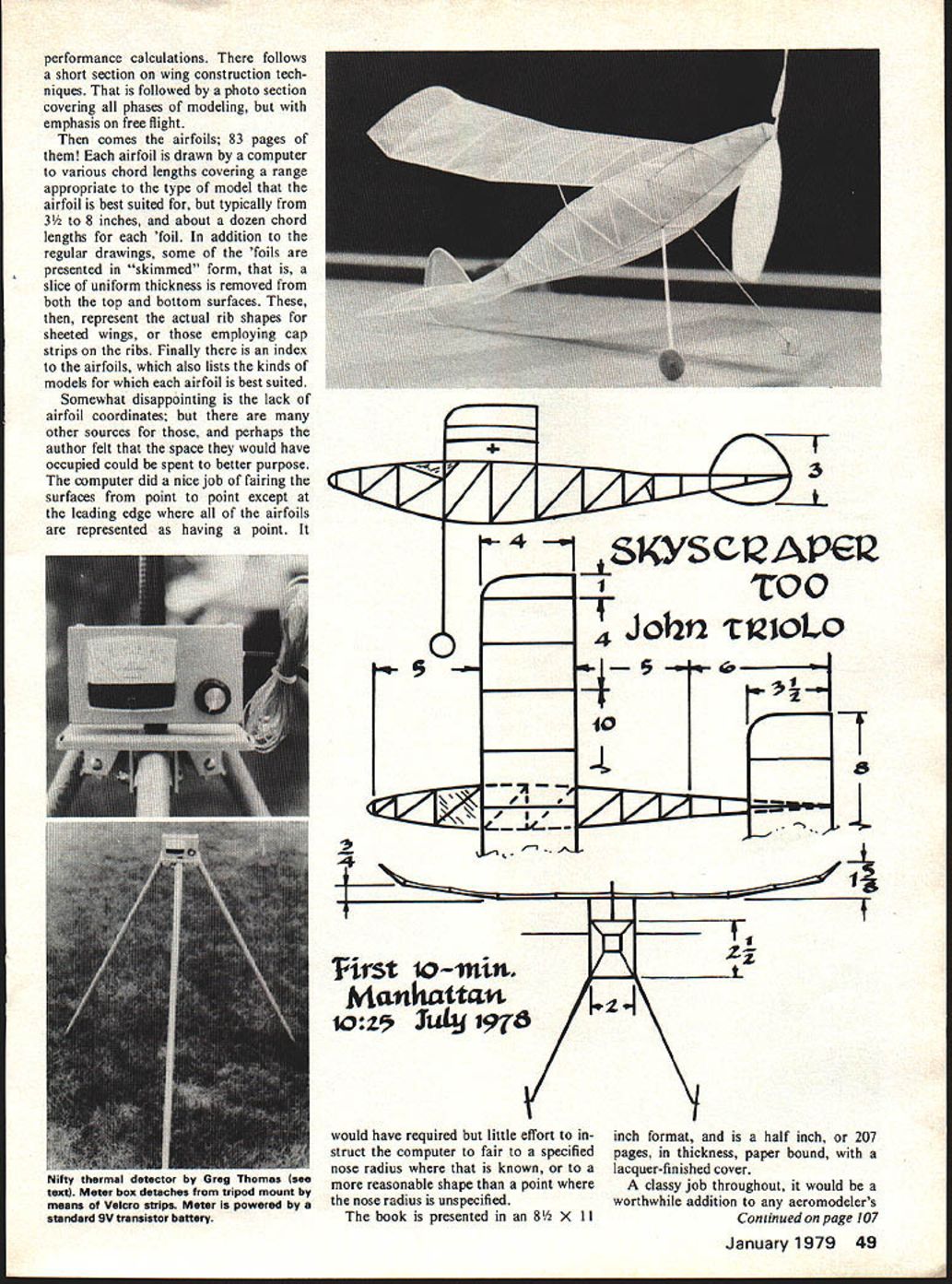
Three years after the Manhattan Formula made its big comeback following a decade of dormancy, John Triolo has made quite a name for himself in the event. In July he became the first to break the 10‑minute barrier with a practice flight of 10:25 at Lakehurst. A month later, at the first Lakehurst contest for Manhattan Formula models, John won with a flight of 10:43 — making the earlier time already obsolete.
Ten contestants entered and there were 34 flights over seven minutes — quite a change from a few years ago when a seven‑minute flight was considered about tops.
Compared with his earlier model (Model Aviation, January 1977), the appearance has improved markedly. Motor length was increased from 12 to 14 in., which got it to within a few feet of the top of the big hangar at Lakehurst. The wing position was moved back an inch and the CG is now at about 50%, giving the model better longitudinal stability. There is a slight negative incidence angle to the stabilizer, and a bit of left‑thrust and down‑thrust.
The prop diameter is 14 in., pitch 22. It is formed from .025‑inch sheet, has about 1/16‑in. camber, and the blades are a mere 1‑5/16 in. wide with squarish tips. The spar projects about 2 in. into the blades and is slightly ahead of the blade centerline, so it probably doesn't flare to a greatly higher pitch under the initial torque. A 19‑1/2‑inch loop of .090‑inch new Pirelli, wound to 1,800 turns, makes it go. Wing offset (not indicated on the sketch) is 1/4 in. to the right; the model flies to the left. Wing spars on John's earlier model were fairly hard 1/16‑sq. balsa, rounded off and tapered toward the tips; the new model is presumed similar.
The official New York rules for Manhattan Formula were presented in the June issue — read them carefully before you decide to build one. Note that wood bracing of the wing and stab is allowed.
World Championships (note)
The U.S. rode on Jim Richmond's exceptional World Champion performance to garner the second‑place team award. Defending World Champion Bud Romak placed a strong second. This was the first contest I have seen in a very long time where bad weather did not influence the outcome. Many fliers had new personal high times. The Japanese moved from tenth place in 1976 to fourth this year. The Swiss, lacking a third member to challenge for the team cup, have steadily progressed since their 1974 initiation. With three 37‑minute flights, imagine what they might have done without the pigeon bombings.
Jim Richmond last won the World Championship in 1968. Let's hope he doesn't limit it to once a decade.
This is a valuable addition to the library, and especially a free‑flighter's.
Winding Stooge, Etc.
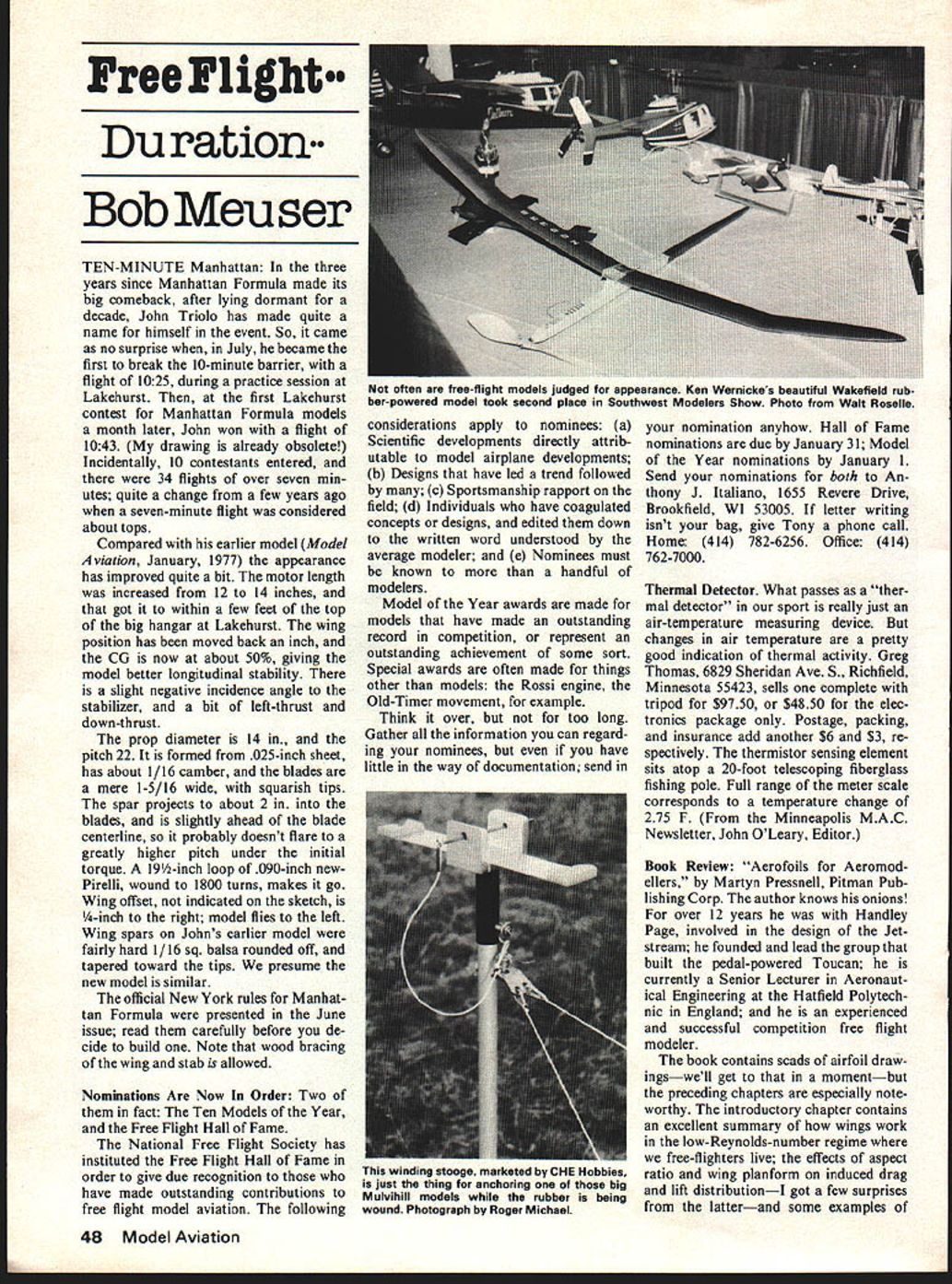
CHE Hobbies has recently introduced a stooge to hold rubber‑power models from Mulvihills and Wakefields on down. Constructed almost entirely from 6061‑T6 structural‑grade aluminum alloy, it has features such as aircraft‑type quick‑release pins to secure the back stays and head in place, and a foam‑padded model support shelf. To drive it into the ground, first remove the top end (secured by a quick‑release pin) and insert a plug that distributes the load from hammer blows.
Tom Cashman, writing in Batsheet, says it isn't quite up to contending with the rock‑studded soil of Harts Lake Prairie, so he drives a piece of 1/2‑in. steel rod into the ground and slips the stooge tube over it. The U‑shaped head will accept models having rear peg tubes as long as 2 1/4 in. Some deep‑bellied old‑timers might not fit, as the distance from the cross pin to the bottom of the channel is only 1 1/4 in. The price is $25.50 postpaid from CHE Hobbies, 10900 Eastwood Ave., Inglewood, CA 90304.
CHE has several hundred other items for free‑flighters, including:
- torquemeters
- rubber
- winders
- nitrate dope
- circle‑two hooks
- 1/64‑sq. and 1/32‑sq. turbulator stock
- Japanese tissue
- Seelig timers
- Cox engines customized by Kustom Kraftsmanship
- Bartels props
- and about every free‑flight competition kit in the business, including old‑timers
A stamped, self‑addressed envelope will bring you a complete list.
Anyone for Free Flight?
Want to get started in free flight? Keep it simple and inexpensive — go rubber power. Wakefield is the class to start with.
Better count on two models, just in case. Typical costs:
- two chem‑milled motor tubes: $15
- two ball‑bearing front‑end units: $18
- a pair of prop hubs: $4
- balsa, tissue, dope, wire, and miscellaneous: about $25
- about 3 lb. of rubber (S26)
- one Bob Piserchio winder: $100
- torquemeter: $20
- winding stooge: $25
- thermal detector: $100
- binoculars (good enough to avoid eyestrain): $35
- good compass: $13
- used trail motorcycle (for retrieval): about $250
- DT timers (for flying where fuses are unsafe): $17
Total (approx.): $648.
What's that? Can't afford it? Going to look into something less expensive, like R/C? OK — but you just blew your excuse for needing a motorcycle.
Bob Meuser 4200 Gregory St., Oakland, CA 94619
Transcribed from original scans by AI. Minor OCR errors may remain.

