
Free Flight: Duration
Jerry Barnette
(Editor's Note: Bob Meuser is taking a well-deserved break from the column for the next two months. He will return in the April issue.)
Sandlot Free Flight Tournament
Have you ever been out flying, just trimming or practicing, and wished you could have a contest? A full contest may be impractical because:
- you only have a few other guys in the field who would compete, or
- there is not enough time left to hold a complete contest.
Why not try the tournament approach for a spur-of-the-moment pickup contest? Basically, the tournament would be set up as an elimination system (see figure 1). Competition should follow flyoff-type rules with both competitors launching within a given, but short, number of minutes. The criteria for winning a round can be chosen according to how much time is available: best one flight (fly again if both max), best total of two flights, etc.
One attractive feature of the tournament system is that only a maximum of two timers are required at any one time, which would logically be two fliers from another round. Try it — a little flyoff practice wouldn't hurt.
Fad Followers Please Ignore
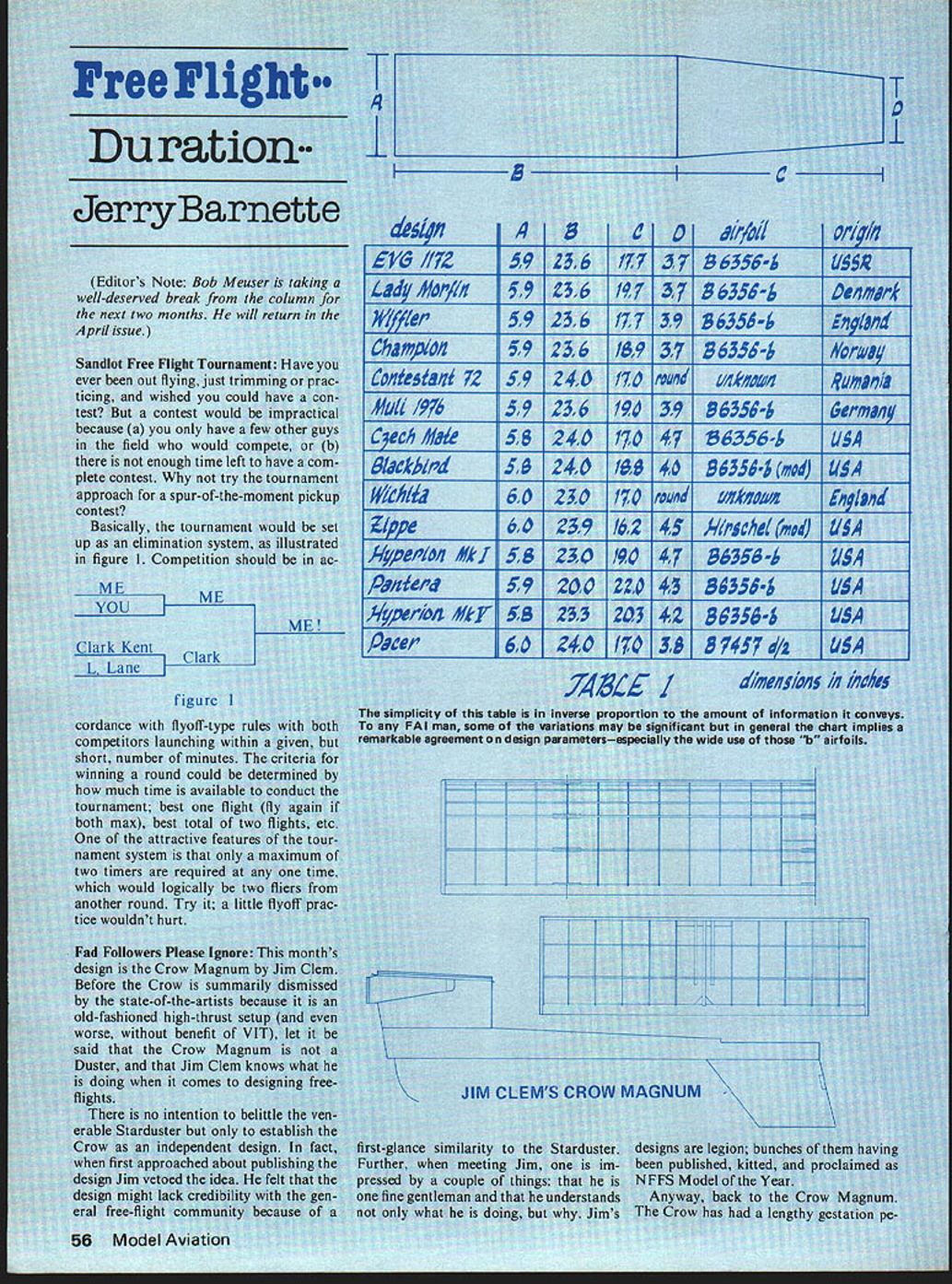
This month's design is the Crow Magnum by Jim Clem. Before the Crow is summarily dismissed by the state-of-the-artists because it is an old-fashioned high-thrust setup (and even worse, without benefit of VIT), let it be said that the Crow Magnum is not a Starduster, and that Jim Clem knows what he is doing when it comes to designing free-flights.
There is no intention to belittle the venerable Starduster; only to establish the Crow as an independent design. In fact, when first approached about publishing the design Jim vetoed the idea. He felt that the design might lack credibility with the general free-flight community because of a first-glance similarity to the Starduster. Further, when meeting Jim one is impressed by a couple of things: that he is one fine gentleman and that he understands not only what he is doing, but why. Jim's designs are legion; many have been published, kitted, and proclaimed as NFFS Model of the Year.
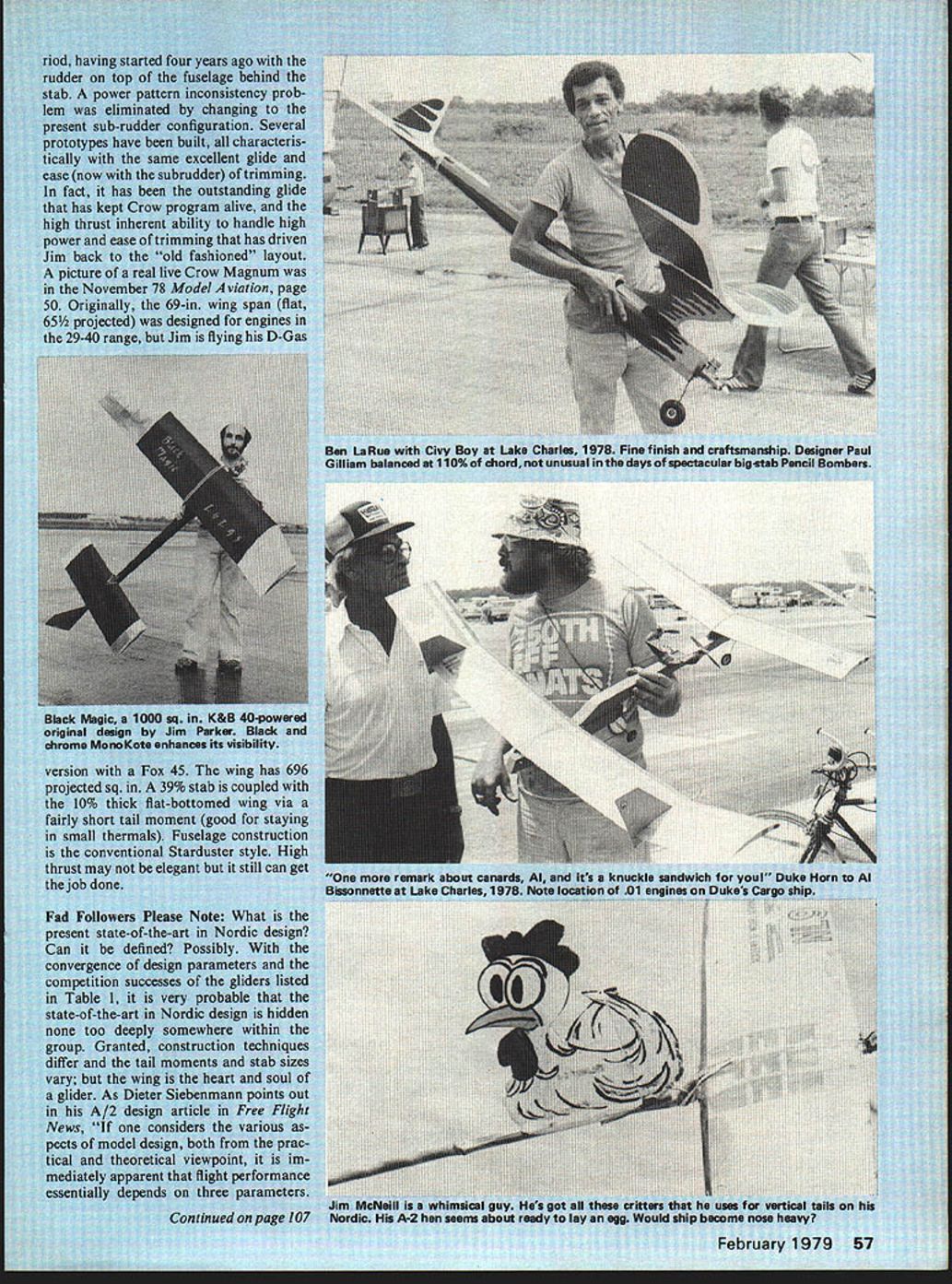
The Crow has had a lengthy gestation period, having started four years ago with the rudder on top of the fuselage behind the stab. A power-pattern inconsistency problem was eliminated by changing to the present sub-rudder configuration. Several prototypes have been built, all characteristically showing the same excellent glide and ease (now with the sub-rudder) of trimming. In fact, it has been the outstanding glide that has kept the Crow program alive, and the high-thrust inherent ability to handle high power and ease of trimming that has driven Jim back to the "old-fashioned" layout. A picture of a real live Crow Magnum appeared in the November 1978 Model Aviation, page 50.
Originally, the 69-inch wing span (flat, 65% projected) was designed for engines in the .29–.40 range, but Jim is flying his D-Gas version with a Fox .45. The wing has 696 projected sq. in. A 39% stab is coupled with the 10% thick flat-bottomed wing via a fairly short tail moment (good for staying in small thermals). Fuselage construction is the conventional Starduster style. High thrust may not be elegant but it still can get the job done.
Fad Followers Please Note
What is the present state-of-the-art in Nordic design? Can it be defined? Possibly. With the convergence of design parameters and the competition successes of the gliders listed in Table 1, it is very probable that the state-of-the-art in Nordic design lies somewhere within that group. Granted, construction techniques differ and the tail moments and stab sizes vary; but the wing is the heart and soul of a glider.
As Dieter Siebenmann points out in his A/2 design article in Free Flight News, "If one considers the various aspects of model design, both from the practical and theoretical viewpoint, it is immediately apparent that flight performance essentially depends on three parameters."
FF Duration continued from page 57
These are the aspect ratio, the curvature of the airfoil section, and the thickness of the airfoil section of the wing. Or, restated: wing layout and airfoil — which is what Table 1 essentially documents — are the real secrets of glider performance. At any rate, Table 1 may be used as an interim Great And Wonderful Nordic Design Oracle & State-Of-The-Art Determiner until the next design trend comes along.
Speaking of Which
Speaking of the state-of-the-"art" in Nordics, District V Vice-President Jim McNeill has a delightfully arty collection of decorative tails — chickens, hippos, etc. (see photo, also noting the bamboo tail boom). Jim enjoys his flying and this is reflected in his artful approach to tails. And if the chicken doesn't work out Jim can always change to an eagle, condor, or peacock for more performance.
NFFS 'Nouncement
The National Free Flight Society gears are already in motion for '79. One of the Society's most looked-forward-to efforts is the annual (12th annual this year) NFFS Symposium. The National Free Flight Society is now soliciting papers for the 1979 NFFS Symposium to be held at the 1979 Nats. Papers will be published in the 1979 Symposium volume whether or not the author is able to present his paper personally at the Nats.
Papers should cover some aspect of the science or art of free flight models, including technical studies, practical design and engineering as applied to models, new or unusual model aircraft developments, or historical items. Both indoor and outdoor free-flight modeling developments are to be included. Please send proposed papers to Mr. Robert P. Dodds, Box 436, Rancho Santa Fe, CA 92067. Send the title of the proposed paper together with an abstract of 200 words or more, or a complete paper if it is available. Abstracts should be submitted as soon as possible.
NFFS 'Nouncement No. 2
Another of the Society's annual efforts is associated with the Nats — sponsoring/conducting the Nats Unofficial Events.
Although the Unofficial Events program has become somewhat traditional at the Nats, planning and/or announcement of some of the events in the past have sometimes been late, loose, or non-existent. Terry Rimert, the NFFS 1979 Nats Unofficial Events Director volunteer, is attempting to prevent past mistakes by, as Terry puts it, "trying to get some events lined up in time to let people know we are going to have them so they can prepare for them. I'm looking for people to sponsor events and people to run the events at the Nats. The sooner we find out what we can do the better. So far, John Pond has told me he is going to have Old Time FF on Friday and the Old Time Banquet on Friday night."
"I will try to schedule NFFS events to not conflict with this. Rubber Speed will again offer a prize of a buck per mph to the winner. Tentatively, Rubber Speed will be on Tuesday. All we need is someone to sponsor/run Helicopter, Autogiro, Ornithopter, Jumbo Scale, Thompson Trophy Races, Embryo Endurance, ROW, P-30, Cargo, and a few others."
Volunteers interested in aiding Terry as an event sponsor, event director, event worker, or whatever should contact him at 367 Orange Avenue, Baldwin, FL 32234. If you can't be a helper, at least consider flying the events. While "Unofficial," some are really neat, challenging, unique, fun, and even "official."
North By Northwest
It definitely is no fun to lose an airplane or wander around aimlessly in the woods looking for one. A compass can be an excellent aid in searching for a "lost" model, if properly used. However, a compass doesn't do much good if you don't know how to use one.
As it might be somewhat embarrassing to ask a competitor for instructions on compass use (some people would rather eat worms than ask for help), a how-to book would be nice. There is a book which explains very simply some compass techniques useful to free flighters — oversimplified, in fact: See the dog, see the cat, see the dog and cat techniques. The book is Be Expert With Map And Compass: The Orienteering Handbook, by Bjorn Kjellstrom (Stackpole Books).
Bob Meuser 4200 Gregory St. Oakland, CA 94619
Transcribed from original scans by AI. Minor OCR errors may remain.

