
Free Flight: Duration
installation. The timer is set deep into the fuselage, and covered by a thin celluloid window, glued or taped in place. The window has a hole large enough to accept the business end of the mini-wrench, and a slot wide enough to clear the release-arm when the timer cuts it loose.
The advantage over a conventional surface mount? There are two. First, there is less drag; totally unimportant on a D-Gas job, but perhaps important on a Nordic glider, Wakefield rubber-powered model, or small gas model. Second, the window presents an additional obstacle to be overcome by dirt particles intent on finding their way into the vital organs of the timer.
Tissue Tantrums: We've been hearing for some time that colored Japanese tissue will no longer be produced. Then out of the blue we receive a flier from Sig regarding its new Plyspan "super-tough laminated Japanese tissue manufactured specifically for covering model airplanes," and available in colors! In response to my "What the heck?" letter, Glen Sigalose explained that Plyspan is currently available in colors, but is no longer produced in colors; when present stocks are gone, that is. Plyspan comes in three weight grades: Lite-Flite, Medium-Flite (white only), and Super-Flite. Lite-Flite would pass for good old-fashioned Japanese tissue. Its weight is about the same, and if anything it is more uniform and closer grained than some; might take less dope to seal the pores. Super-Flite is about twice the weight of regular tissue, seems a little more porous than the Lite-Flite but less porous than some other heavy paper covering materials. It might well serve as a substitute for expensive and time consuming double-tissue coverings used on the larger gas models. Medium-Flite, would you believe, lies in between, but comes in white only.
Here are some other sources of tissue. Peck-Polymers, which puts out those neat Peanut Scale kits, and is now combined with W.C. Hannegan Graphics plans, and such. Peck carries Super-Lite Japanese tissue in five colors plus white, at 20¢ per 20 X 18 in. sheet; very nice stuff indeed. In addition they continue to sell their older P-P Tissue, also in colors, at the old price of 15¢ per sheet. Address: P.O. Box 2498, La Mesa, Calif. 92041.
Jim Noonan, who runs the office up at Old-Timer Models, peddles ten different paper coverings, some in colors. P.O. Box 18002, Milwaukee, Wisc. 53218. Micro-X Products, P.O. Box 1063, Lorain, Ohio 44055, carries Japanese tissue in several colors. Marlow Engineering sells Featherlite Tissue in 14 colors, including such oddities as aluminum and olive drab; 20¢ each for 20 X 30 in. sheets. Write to 6850 Vineland, North Hollywood, Calif. 91605. It is about 50% heavier than the average Japanese tissue.
For a dime and a stamped envelope, Bill Wilton, P.O. Drawer Y, Kountze, Texas 77625, will send you a book of samples of the 19 colors of domestic tissue, so you can see what you get before you buy. Blue Ridge Models, P.O. Box 9188, Asheville, N.C. 28805 has an ample supply of the same fine tissue it puts in its Coupe kits. If you are either an individual free-flighter or a cottage-industry kit manufacturer, you might check it out. Colors are yellow, orange, and white. Minimum order 20 sheets, at 20¢ per 18 X 20 sheet plus $1 postage and handling.
The Rocket Racket
Rocket-power free-flight models, in various forms, have been in the official AMA rulebook for some time. Despite some of the less pleasant aspects of this mode of propulsion—fuse that won't light, or won't stay lit, or gaskets that simply won't—the event remains rather popular, and development of the class continues. Rumors regarding the availability of motors, fuel, and such run rampant. So every year or two, it seems, I check with Nathan Polk, head man down at Polk's Model-Craft Hobbies, to see what's happenin'. Polk's is the sole source of Jetex-brand stuff, if you didn't know. Nathan and his brother Irwin are the ones primarily responsible for popularizing rocket-power F/F modeling in the U.S., and later throughout the world, incidentally. Unfortunately, the production of the stuff got into the hands of foreign interests who apparently had their corporate minds on other things.
So here is the latest from Nathan Polk: "At this stage the production company has given up completely, and we are working with the designers and tooling that are available to us to re-establish the line completely. We have finally licked the problem of producing the wick. We are now on schedule for delivery of the wicks and fuel units within the next few months.
Currently, the following stuff is available: EN2 Rocket HT 50 engines, fuel and wicks; fuel and wicks for the EN3 engine—the one most popular for F/F Rocket events—but no engines; and the classic book on Jetex, 'Building/Designing, Maintenance and Care of Jetex,' which still lists at a paltry buck.
As evidence that the event is a long ways from dead, Don Chaney received a 1975 Model of the Year award from the National Free Flight Society for his Canned Heat rocket model. A construction article appeared in the August 1975 issue of Model Airplane News; plans are available from both MAN and the NFFS. An electric ignition system for Jetex, developed by Dave and Larry Parsons, appeared in my column in the January 1975 issue of American Aircraft Modeler, and their system is being put into commercial form by Jim Crocket Replicas. Jim also pedals a slick mounting plate for the Jetex 150 engine, plus gaskets!
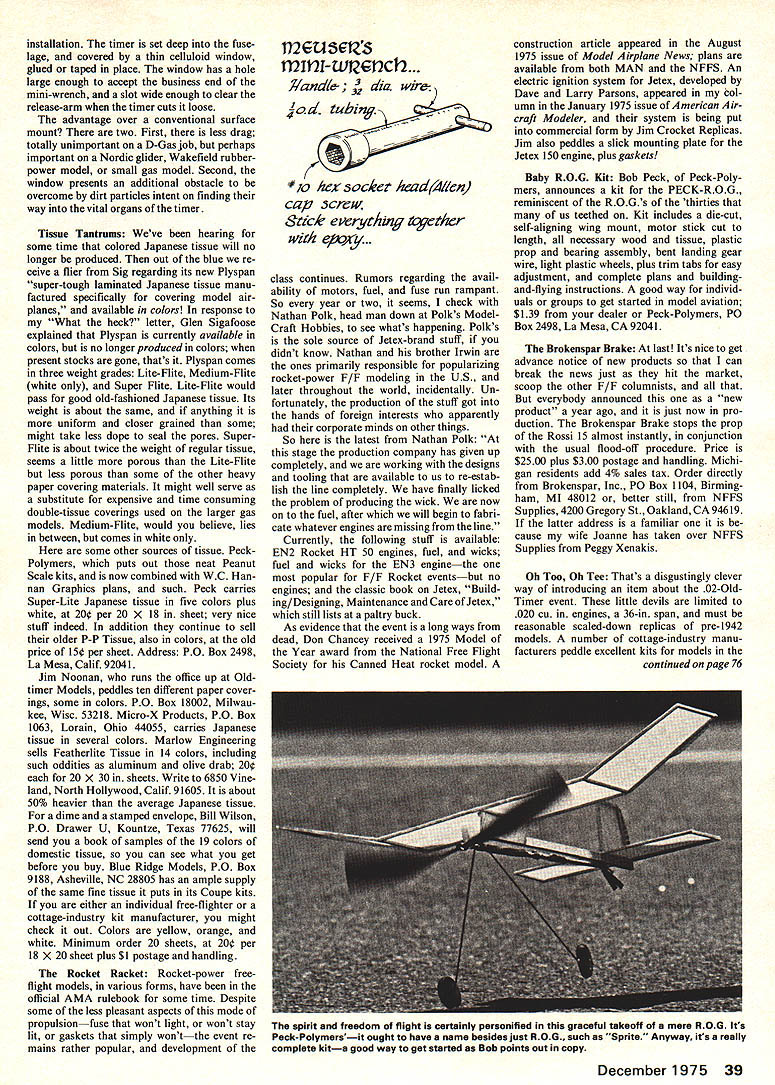
By R.O.G. Kit: Bob Peck, of Peck-Polymers, announces a kit for the PECK-R-O-G, reminiscent of the R.O.G.'s of the 'thirties that many of us teethed on. Kit includes a die-cut, self-aligning wing mount, motor stick cut to length, all necessary wood and tissue, plastic prop and bearing assembly, bent landing gear wire, light plastic wheels, plus trim tabs for easy adjustment, and complete plans and building-and-flying instructions. A good way for individuals or groups to get started in model aviation; in fact, it ought to be in your dealer or Peck-Polymers, P.O. Box 2498, La Mesa, CA 92041.
The Brokenspar Brake: At last! It's nice to get advance notice of new products so that I can break the news just as they hit the market, scoop the other F/F columnists, and all that. But everybody announced this one as a "new product" a year ago, and it is just now in production. The Brokenspar Brake stops the prop of the Rossi 15 almost instantly, in conjunction with the usual flood-off procedure. Price is $20.00 plus $3.00 postage and handling. Michigan residents add 4% sales tax. Order directly from Brokenspar, Inc., Box 1014, Birmingham, MI 48012, or better still, from NFFS Supplies, 4200 Gregory St., Oakland, CA 94619. If the latter address is a familiar one it is because my wife Joanne has taken over NFFS Supplies from Peggy Xenakis.
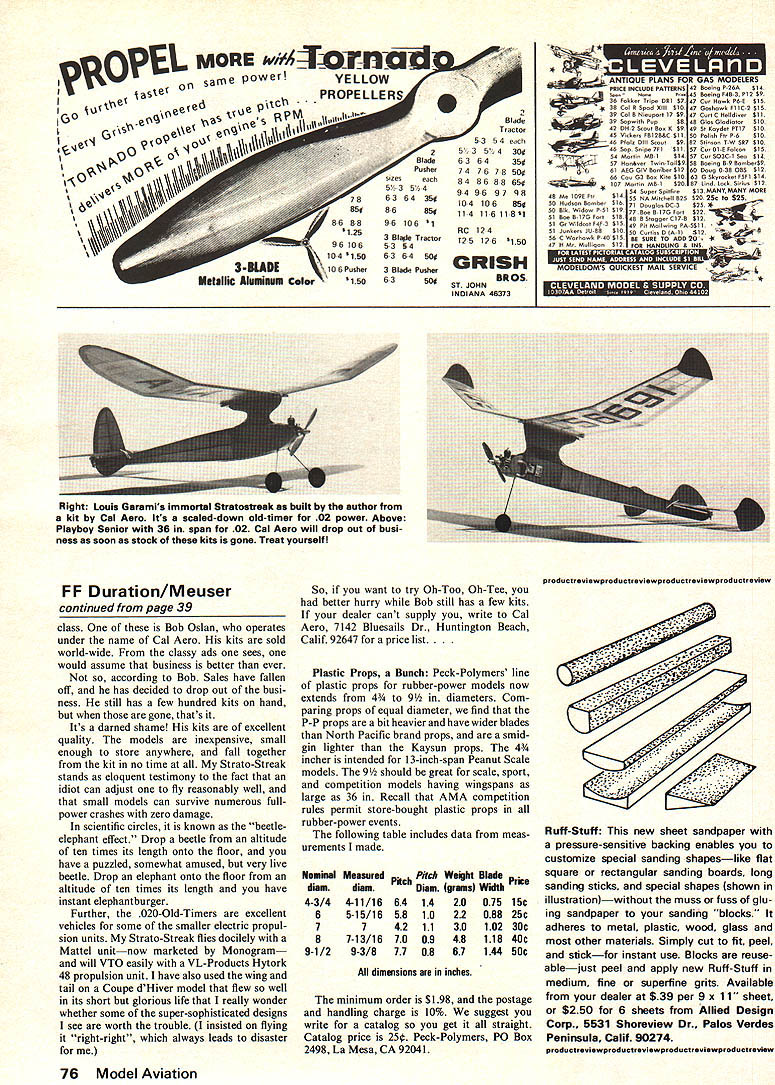
Oh Too, Oh Tree: That's a disgustingly clever way of introducing an item about the .020-OL Timer event. These little devils are limited to .020 cu. in. engines, a 36-in. span, and must be reasonable scaled-down replicas of pre-1942 models. A number of cottage-industry manufacturers peddle excellent kits for models in the... class. One of these is Bob Oslan, who operates under the name of Cal Aero. His kits are sold world-wide. From the classy ads one sees, one would assume that business is better than ever.
Not so, according to Bob. Sales have fallen off, and he has decided to drop out of the business. He still has a few hundred kits on hand, but when those are gone, that's it.
It's a darned shame! His kits are of excellent quality. The models are inexpensive, small enough to store anywhere, and fall together from the kit in no time at all. My Strato-Streak stands as eloquent testimony to the fact that an idiot can adjust one to fly reasonably well, and that small models can survive numerous full-power crashes with zero damage.
In scientific circles, it is known as the "beetle-elephant effect." Drop a beetle from an altitude of ten times its length onto the floor, and you have a puzzled, somewhat amused, but very live beetle. Drop an elephant onto the floor from an altitude of ten times its length and you have instant elephantburger.
Further, the .020-Old-Timers are excellent vehicles for some of the smaller electric propulsion units. My Strato-Streak flies docilely with a Nittol unit—now marketed by Monogram—and will VTO easily with a V-L Products Hytor 48 propulsion unit. I have also used the wing on a Coupe d'Hiver model that flew so well in its short but glorious life that I really wonder whether some of the super-sophisticated designs are worth the trouble. (I insisted on flying it "right-right", which always leads to disaster for me.)
So, if you want to try Oh-Too, Oh-Tee, you had better hurry while Bob still has a few kits. If your dealer can't supply you, write to Cal Aero, 7142 Blue Sail Dr., Huntington Beach, Calif. 92647 for a price list.
Transcribed from original scans by AI. Minor OCR errors may remain.

