
Free Flight: Duration
Bob Meuser
Coupe Kit
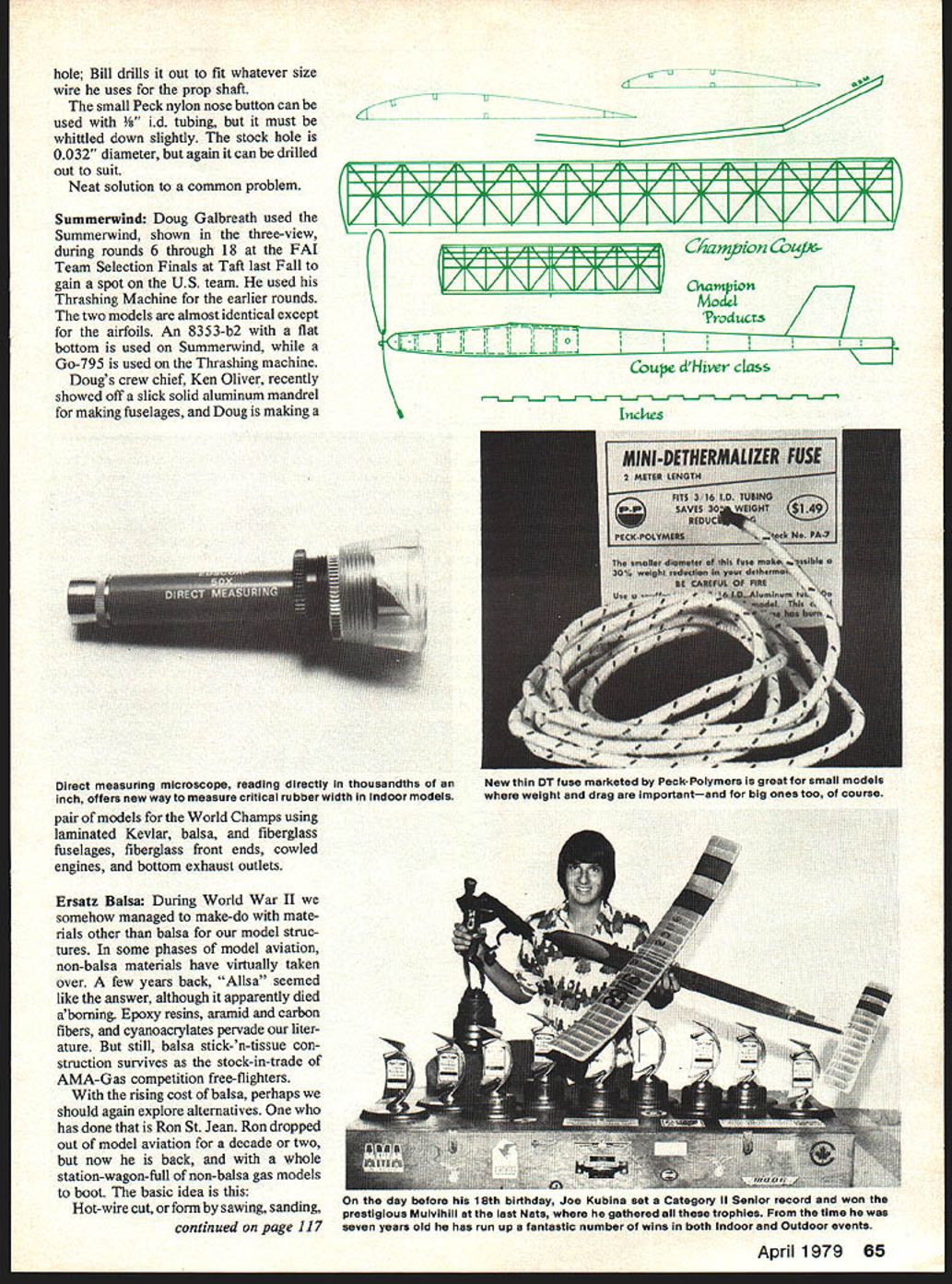
Competition rubber-power kits are few and far between, so we give a hearty three cheers when a new one appears. The "Champion Coupe" isn't all that new — it has seen ten years of competition — but it has only recently been kitted. So far about 50 kits have been sold, mostly in Southern California. Marketed by Champion Model Products — which is a corner in George Schroedter's garage, 880 Carmen Court, La Verne, CA 91750 — its price tag is a whopping $13.95, plus $1.70 for postage and handling. But look what you get for your money!
Wing and stab are full-geodetic Union Jack construction, which means that there are nearly 40 pieces in the stab alone. All ribs, including the diagonal half-ribs, are cut to shape and notched. Both wing and stab trailing edges are furnished tapered and notched for the ribs. The sides, top, and bottom sheets for the sheet-box fuselage are accurately cut to shape and marked for the formers. The blade for the single-blade prop is laminated — four thicknesses of 1/16" sheet at the hub, tapering to two at the tip — and ready to sand to final shape; undercamber is built in.
A goodie package includes bits of wire all bent to shape, tubing cut to length, metal and Teflon washers, springs, and all the little odds and ends needed for such a model. In addition to the excellent plans furnished, there are eight pages of instructions, which should be about enough. The one-blade prop gives a fast climb and short motor run, by intention, to get it up into the thermals in a hurry. Competition track record is excellent. If your time is worth more than about 37 cents an hour, the ribs alone are worth the price of the kit.
Henn/Peck
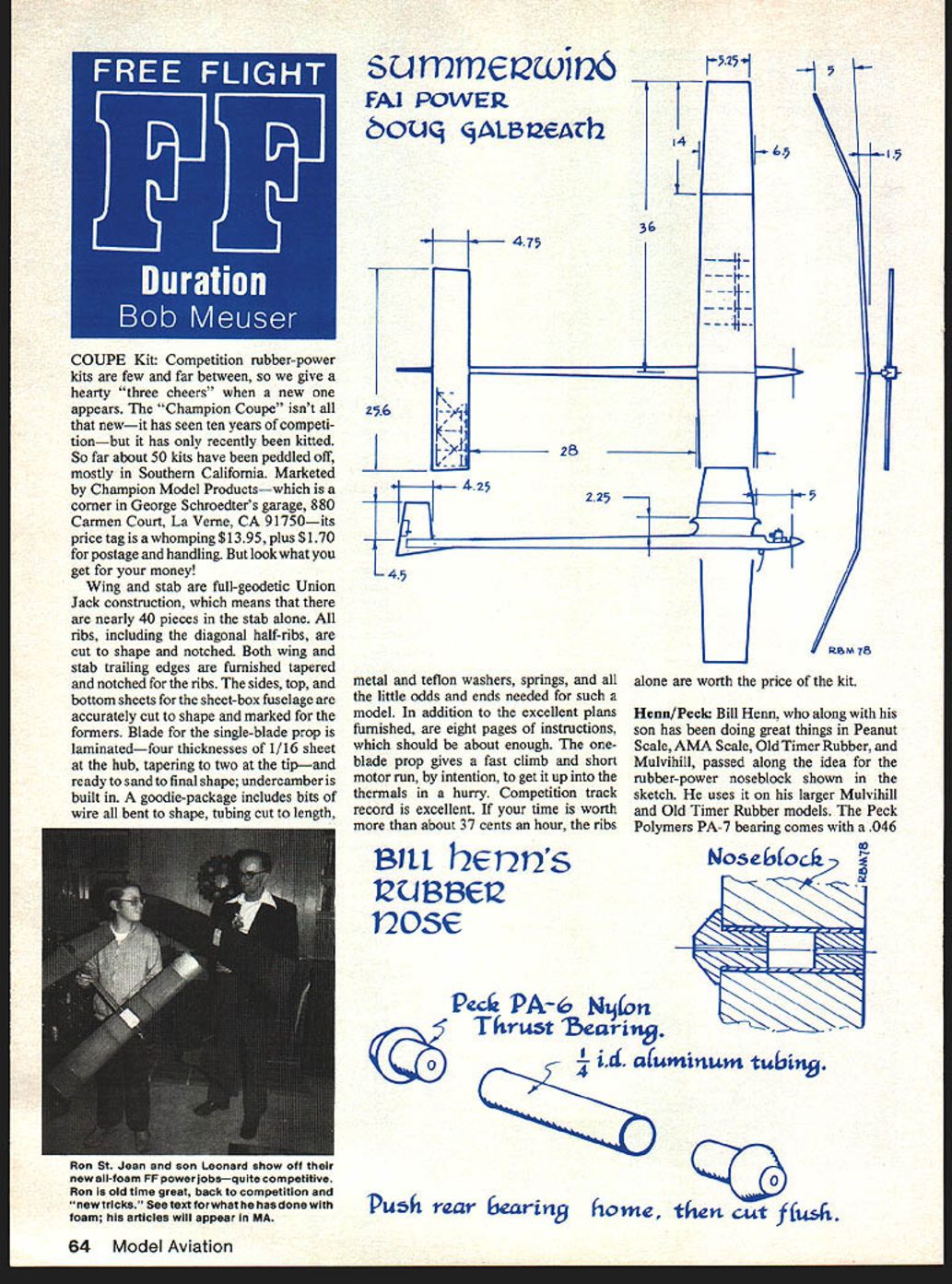
Bill Henn, who along with his son has been doing great things in Peanut Scale, AMA Scale, Old Timer Rubber, and Mulvihill, passed along the idea for the rubber-power noseblock shown in the sketch. He uses it on his larger Mulvihill and Old Timer Rubber models. Bill drills it out to fit whatever size wire he uses for the prop shaft.
The small Peck nylon nose button can be used with 1/8" i.d. tubing, but it must be whittled down slightly. The stock hole is 0.032" diameter, but it can be drilled out to suit.
Neat solution to a common problem.
Summerwind
Doug Galbreath used the Summerwind, shown in the three-view, during rounds 6 through 18 at the FAI Team Selection Finals at Taft last fall to gain a spot on the U.S. team. He used his Thrashing Machine for the earlier rounds. The two models are almost identical except for the airfoils. An 8353-b2 with a flat bottom is used on Summerwind, while a Go-795 is used on the Thrashing Machine.
Doug's crew chief, Ken Oliver, recently showed off a slick solid aluminum mandrel for making fuselages, and Doug is making a...
Ersatz Balsa
During World War II we somehow managed to make do with materials other than balsa for our model structures. In some phases of model aviation, non-balsa materials have virtually taken over. A few years back, "Allsa" seemed like the answer, although it apparently died aborning. Epoxy resins, aramid and carbon fibers, and cyanoacrylates pervade our literature. But still, balsa stick-and-tissue construction survives as the stock-in-trade of AMA-Gas competition free-flighters.
With the rising cost of balsa, perhaps we should again explore alternatives. One who has done that is Ron St. Jean. Ron dropped out of model aviation for a decade or two, but now he is back, and with a whole station-wagon-full of non-balsa gas models to boot. The basic idea is this:
Hot-wire cut, or form by sawing, sanding, or by whatever method suits your plane or fancy, the appropriate shapes of foam plastic to represent the wing, tail surfaces, and fuselage of your intended super-model. Cover the surfaces with a grade and number of layers of Silkspan appropriate to the task, using dilute white glue. Reinforce high-stress points with a bit of plywood here and there, and finish off the whole shebang with Pactra Formula-U, or perhaps some other space-age hardening and fuel-proofing coating, and you have a model plane ready to fly.
The only thing I had at hand to compare with Ron's Ramrod-derived models were a Starduster 600, an ultralight B-C model typical of a trend in Northern California a year or two ago, a Viking, and a few unmentionables. Ron's foamies were heavier, by far, than the lightest of the bunch, but were lighter than some of the state-of-the-art stick-and-tissue parts. The stiffness, in torsion and in bending, seemed about equivalent to those of stick-and-tissue models of the same size and weight. I have some reservations about crashworthiness and repairability; but time will tell. Building time? Far longer than a conventional model if you are building your first foamie, I suspect, but far shorter once you get tooled up. And the tooling isn't all that much, if you follow Ron's lead.
You'll be hearing more about it soon. Meanwhile, experiment!
(Editor's Note: Ron is preparing a series of articles for Model Aviation to appear in early issues.)
Measuring Rubber Width
I've never been totally successful measuring rubber motor stock with either a micrometer or a dial-indicator-type thickness gauge; I never get the same reading twice. If the rubber has a slightly beveled edge it becomes a total disaster. A microscope with a micrometer stage always seemed like the answer, but the cost is the better part of $1,000, and they are a bit bulky. I seem to have bumbled into a solution. At least it seems like a solution; time will tell.
The potential solution is a 50-power direct-measuring microscope, marketed by Edmund Scientific Co. Basically, it is a small 50-power microscope. Beneath the eyepiece is a reticle consisting of a scale graduated in thousandths of an inch, with the five-mil marks accented and the 10-mil marks numbered. Total scale length corresponds to 100 mils (1/10 inch). The actual size of the reticle scale is several times that, so it appears crisp and clear. The bottom end has a slanted, concave, chrome-plated cap that reflects light onto the object being viewed. A clear-plastic spacer on the bottom holds the thing at the correct distance from the specimen.
For a cheapie, the optical and mechanical quality are surprisingly good. The image appears sharp and clear over the entire field of view. The accuracy depends on the adjustment of the clear-plastic spacer with respect to the scope body, and is pre-set by the factory. As received, mine was off by 1 mil over the whole 100-mil range. One percent of full scale is pretty darned good for such a thing, I'd say. I readjusted it to put it "right on," and that made all of the intermediate markings right on also, but it fuzzed up the image slightly.
Skinny DT Fuse
If you remember the thin stuff with the red spiral stripe that we used to get our friends in England to send us, that's what I'm talking about. The Mini-Dethermalizer Fuse recently introduced by Peck-Polymers is apparently the same stuff, and also the same as that peddled by Blue Ridge Models. It is packaged in 2-ft. lengths that sell for $1.49, complete with instructions showing how to install it on top of the fuselage so that it is less likely to cause fires, and since it is far forward of the tail it won't change the trim much as it burns away. Being small in diameter — it fits nicely into a 3/16" i.d. snuffer tube — both the snuffer and the fuse weigh about half as much as the regular Sig 1/4" stuff, and the drag is less too, making it ideal for small models and certainly adequate for even the largest. Burning rate in moving air is 1:42 minutes per stripe in moving air. The stripes are more widely spaced than they are on Sig's, but it turns out that the burning rate per inch is still a bit faster than Sig's. And it is reliable.
Pirelli Available... Maybe
Two sources for the new Pirelli have opened up in the U.S.: Oldtimer Models, Box 18002, Milwaukee, WI 53218 and CHE Hobbies, 10900 Eastwood Ave., Inglewood, CA 90304.
Oldtimer Models has been selling a lot to the indoor crowd, and notes that an Easy B record of 18:45 and a Paper Stick record of over 28 minutes, among others, have been set using its rubber. Sizes and prices (postpaid and subject to change) are:
- 2 mm: $3.75 per 100 ft.
- 3 mm: $4.20 per 100 ft. or $9.50 per 245 ft. (1.75 oz.)
- 6 mm: $8.40 per 100 ft. and $19.00 per 245 ft. (15 oz.)
Eventually, Oldtimer will have other sizes including 1.5 mm (1/16 in.).
CHE expected a large shipment which should have arrived by the time you read this. Size isn't stated, but is presumed to be 6 mm (1/4 in.). Price is $15 per pound.
That's the good news... except for the price. The bad news is that some batches of the new Pirelli exhibit a characteristic common to some batches of the old Pirelli we knew and hated: brittleness. That is, it often breaks at half-turns. And even if you get it wound up, the energy output may be far less than that reported for certain batches. So nothing's new: you pay your money and you take your chances.
Third Sierra Cup International
This meet, sponsored by the Sierra Eagles of Northern California, will take place on October 13 and 14 at Sacramento immediately following the World Championships at Taft. Patterned after the Pierre Trebod contest held in France following European world-champs contests, it should draw many of the World Champs competitors and their supporters, plus a large number of other American modelers who attend the World Champs as observers and helpers.
It appears that this will be the first actual international contest — FAI sanctioned, and all that — ever held in the U.S. for Nordic Glider (F1A), Wakefield Rubber Power (F1B), and FAI Power (F1C) events. By any measure, this should be the biggie of the decade for FAI-event competition in the U.S. The details will appear in due course, and previous FAI program participants will receive announcements. But if you have any questions, check with Roger Simpson, 2625 Queenwood Dr., Rancho Cordova, CA 95670.
Model Aviation Plan Service
I wonder how many of you have taken advantage of the little announcement accompanying the monthly list of full-size plans, the one that says that by sending a stamped, self-addressed business-size envelope to Model Aviation you can obtain a complete listing of all of the available plans free for the asking. Only a random sampling is listed each month in the magazine. As of December 1978, 143 plans are listed, 37 of which — or 25.9% — are for free-flight models. That doesn't include the hybrid RC-assisted old-timers. Plans for many models that have appeared as full-size plans in the magazine are not available, so you had better check your back-issues file if you are planning something like a Peanut scale or Penneyplane model. Average price of a plan is around $3, postpaid.
It's well worth a pair of postage stamps and five minutes of your time, I'd say.
Bob Meuser 4206 Gregory St., Oakland, CA 94619
Transcribed from original scans by AI. Minor OCR errors may remain.

