
Free Flight: Duration
Bob Meuser
Nostalgia Event
The official name is "Nostalgia Event," conceived by the San Valeers. According to the official rules, its purpose is to "re-live those moments of history in the development of the AMA gas free flight model airplane from the close of WWII to the mid-fifties, prior to the advent of one-point VTO." It is already scheduled for some of the country's major free-flight meets for 1979.
Eligibility and construction
- Applicable designs: Those kitted or published from the end of World War II through December 1956.
- Construction: No changes to basic construction or airfoils are permitted, though minor substitutions of materials are allowed (e.g., plywood for balsa, silk for tissue) and minor structural modifications to accommodate specific engines are acceptable.
- Scaling: Models may be scaled larger or smaller.
- Dethermalizers: May be added.
- Auto-tails: Not permitted.
- Landing gear: A two-wheel landing gear may be substituted for a single-wheel one, but not vice versa. Fat wheels may be replaced by streamlined ones.
- VTO: One-point VTOs are not permitted. Three-point VTOs are allowed only if the original design used them and the model will stand on three points by itself.
- Engines: Engines manufactured during the stated period are allowed. Later engines are allowed provided they:
- Use plain sleeve bearings for the crankshaft,
- Do not employ Schnuerle or other advanced porting,
- Do not use ABC piston-sleeve materials.
- Example: Current Cox .010 to .051 engines are eligible.
Classes, times, and governing rules
- Classes: 1/2 A, combined A–B, and combined C–D.
- Engine run times: 15 sec hand launch, 20 sec ROG, 25 sec ROW.
- Maximum flight time: 6 minutes for all flights, including flyoffs.
- Records: No official records will be established for the event.
- Entries: Two models permitted per entrant.
- Otherwise: AMA rules apply.
- Governing body: San Valeers Model Airplane Club (SVMAC). Changes will be published in the Satellite, SVMAC’s newsletter.
- Plans: The San Valeers will make available a number of plans for eligible models.
- Spirit: The "spirit" of the rules is the governing criterion. The rules invite constructive suggestions but are not intended to be continually changed to prevent circumventions.
Clearly, six-minute maximums are practical only at certain sites (Taft, CA is mentioned), so local options will likely be needed if the event expands beyond a local affair. For constructive suggestions or more information, contact Ralph Prey, long-time Editor-in-Chief of the Satellite.
Maxaid Winder (product note)
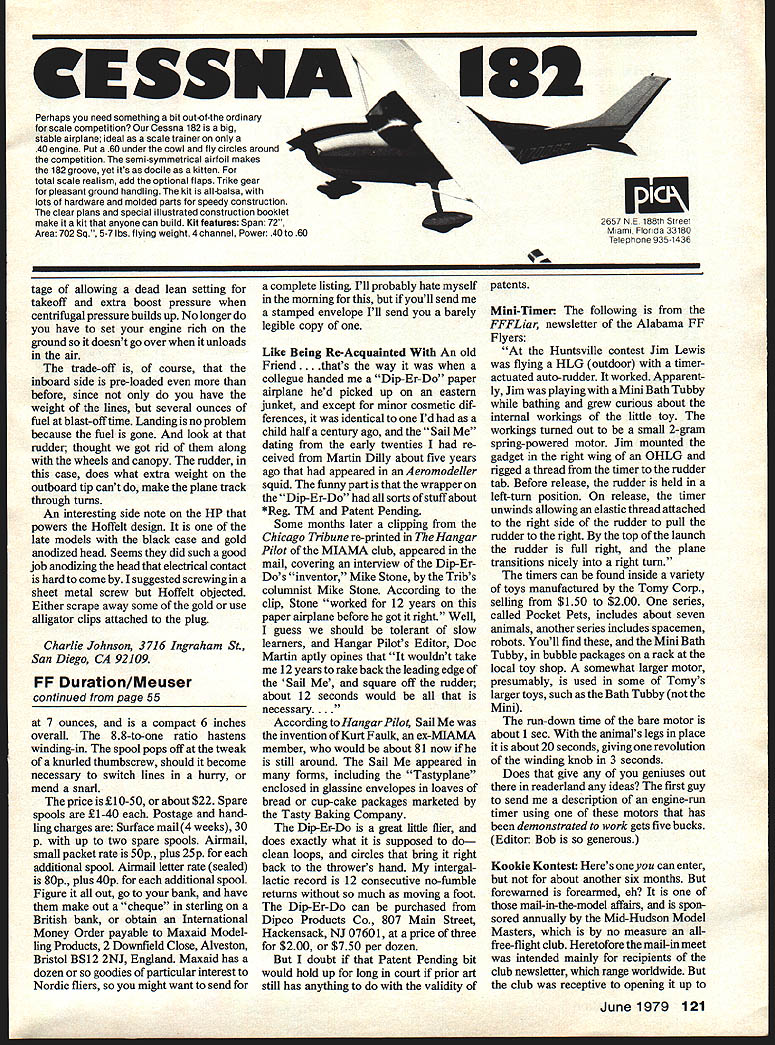
A compact winder is available from Maxaid Modelling Products. It weighs about 7 ounces and is approximately 6 inches overall. An 8:1 gear ratio speeds winding. The spool pops off quickly via a knurled thumbscrew for fast line changes or to remove snarls.
Pricing and ordering
- Price: £10.50 (about $22).
- Spare spools: £1.40 each.
- Postage and handling:
- Surface mail (about 4 weeks): 30p (includes up to two spare spools).
- Airmail, small packet rate: 50p plus 25p for each additional spool.
- Airmail letter rate (sealed): 80p plus 40p for each additional spool.
- Payment: Send a British cheque drawn on a British bank or an International Money Order payable to:
Maxaid Modelling Products 2 Downfield Close, Alveston, Bristol BS12 2NS, England
Maxaid offers a dozen or so items of interest to Nordic fliers; request a complete listing. The author will send a copy of Maxaid’s listing if you send a stamped envelope (copy may be difficult to read).
Dip-Er-Do and Sail Me (paper airplane nostalgia)
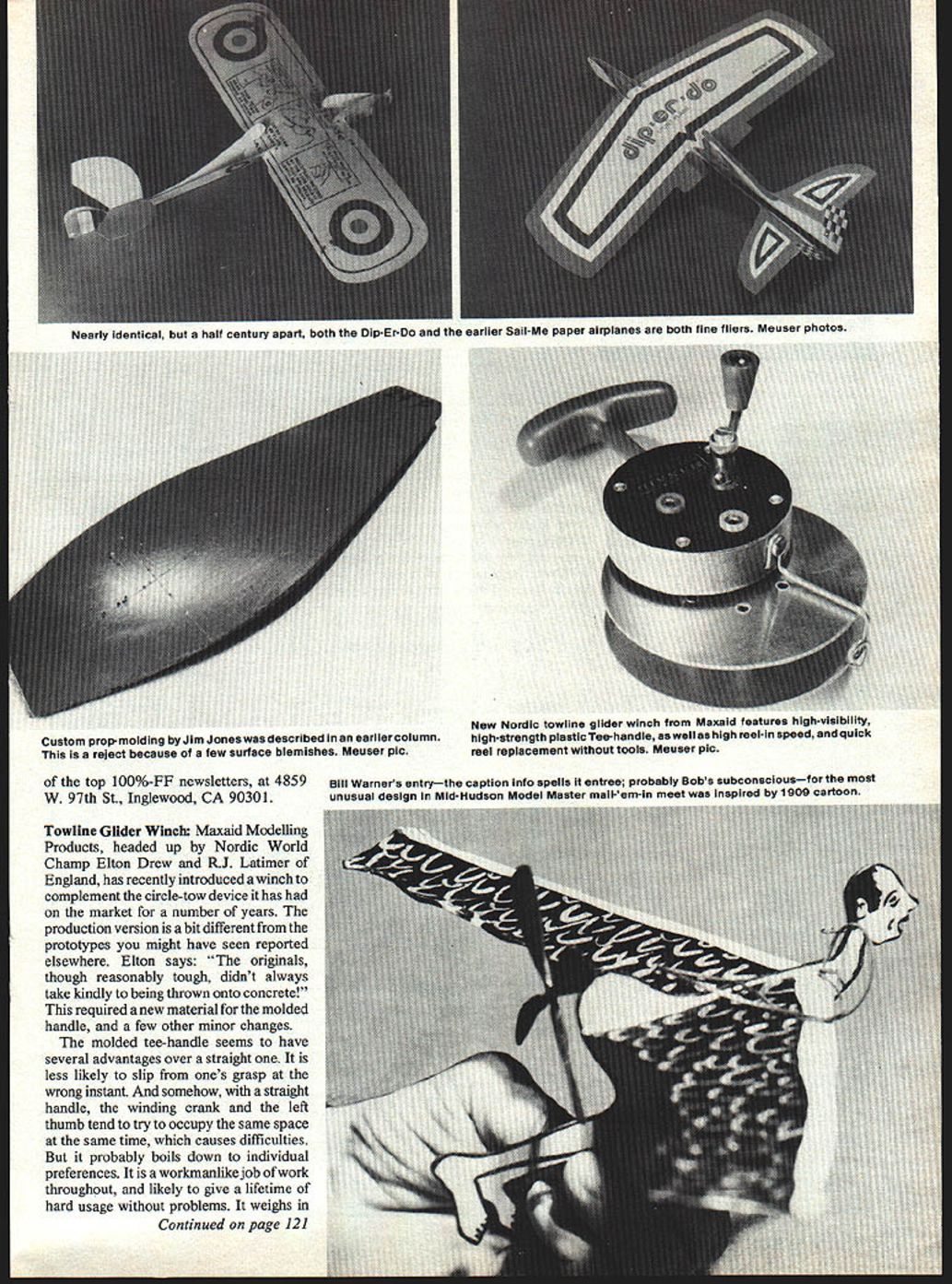
Being re-acquainted with simple classic paper airplanes is sentimental. A colleague handed me a "Dip-Er-Do" he picked up on an eastern trip, which, except for minor cosmetic differences, was identical to one I had as a child. Another example, the "Sail Me," dates from the early 1920s and was shared by Martin Dilly.
The Dip-Er-Do's wrapper claimed "Reg. TM and Patent Pending." A Chicago Tribune clipping reprinted in the Hangar Pilot of the MIAMA club covered an interview with the Dip-Er-Do's "inventor," Mike Stone, who claimed he "worked for 12 years on the paper airplane before he got it right." Hangar Pilot’s editor, Doc Martin, wryly observed that it would take much less time to trim an old "Sail Me" to fly well.
Sail Me was reportedly invented by Kurt Faulk, an ex-MIAMA member, and appeared in many forms, including the "Tastypane" enclosed in glassine envelopes in loaves of bread or cupcake packages marketed by the Tasty Baking Company.
The Dip-Er-Do is an excellent small flier that does clean loops and circles that return to the thrower's hand. My no-fumble record is 12 consecutive returns without so much as moving a foot. The Dip-Er-Do can be purchased from: Dipco Products Co. 807 Main Street, Hackensack, NJ 07601 Price: 3 for $2.00, or $7.50 per dozen.
I doubt the "Patent Pending" claim would stand up if prior art were considered.
Mini-Timer (Tomy spring-motor timers)
From the FFFliar (newsletter of the Alabama FF Flyers):
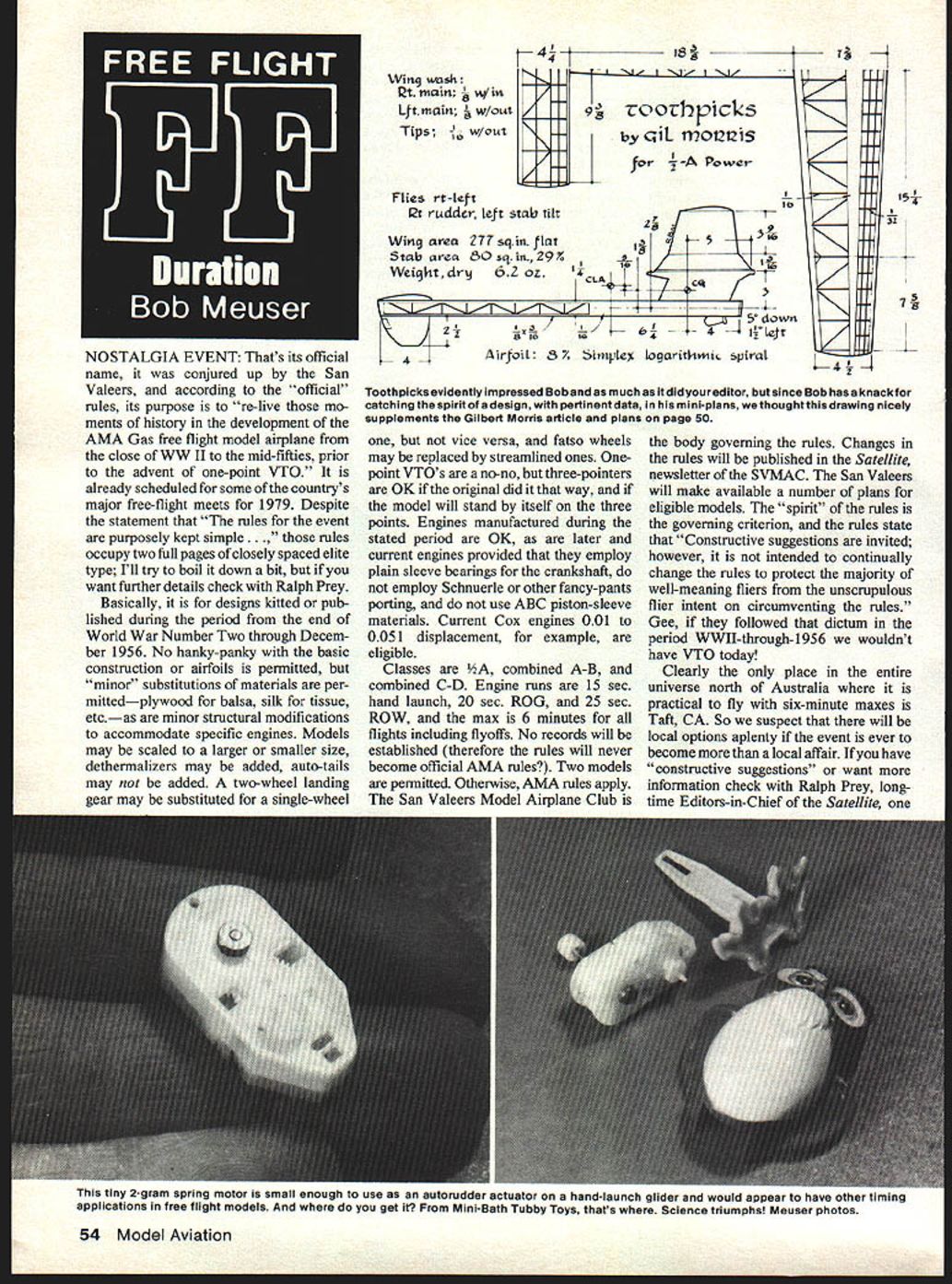
At a Huntsville contest, Jim Lewis flew a hand-launched glider (HLG/outdoor) with a timer-actuated auto-rudder successfully. Jim discovered the internals of a small toy ("Mini Bath Tubby") contained a 2-gram spring-powered motor. He mounted the motor in the right wing of an OHLG and rigged a thread from the timer to the rudder tab. Before launch, the rudder was held in a left-turn position. On release, the timer unwound, allowing an elastic thread attached to the right side of the rudder to pull it to the right. By the top of the launch the rudder was full right, and the plane transitioned into a right turn.
Sources and characteristics
- These timer units are found inside various toys made by the Tomy Corp., selling for roughly $1.50–$2.00.
- One series, Pocket Pets, includes small animals; other series include spacecraft and robots. These and the Mini Bath Tubby are sold in bubble packages at toy shops.
- A larger motor is used in some of Tomy's bigger toys (e.g., Bath Tubby).
- Run-down time of the bare motor: about 1 second.
- With the toy’s legs in place: about 20 seconds (one revolution of the winding knob ≈ 3 seconds).
Does this inspire ideas? The first reader who sends a description of an engine-turn timer using one of these motors that has been demonstrated to work will receive five dollars (author’s offer).
Timer conversion and construction notes
Some conversion steps may require welding or brazing; these services should be available at a local fix-it shop. Aim for a finished diameter close to a standard drill size to simplify making the timer body.
Making the timer body
- The timer body can be hand-produced in an evening of drilling, sawing, filing, and tapping threads.
- Suitable stock: aluminum bar, part of an old automotive distributor housing, or an old flywheel housing.
- Start by drilling a hole to fit the crankcase; this forms the basis for further work.
- Add a slot and clamp screw to provide adjustable friction for the timer body.
- Components required: spark advance lever, point pivot, spring support, and stationary point mount.
- Point pivot: can be a brass tube pressed into a hole.
- Spark advance lever: can be a long screw.
- Spring support and stationary point mount: can be attached with screws but are best made integral to the timer body (more cutting and filing).
- Electrical points: the stationary point is grounded; the spring-mounted point must be insulated (use fiber washers or similar).
Cam
- The required cam can usually be made by modifying the original prop-drive washer.
- The cam is essentially a round surface with a tapered prong or a lowered portion occupying roughly 1/4 to 1/2 of the circumference, corresponding to the desired point gap.
Transcribed from original scans by AI. Minor OCR errors may remain.

