
Free Flight: Duration
Bob Meuser
Bob White Does It Again
Bob White does it again: Bob won the Wakefield event held on the first day of the two-day California Eagles Annual at Taft in March, but Bob's winning yet another Wakefield contest—ho hum—is scarcely news. The big-news event happened on the following day.
The Mulvihill event started at 7:15, and Bob got his three 5-minute maxes over with early and decided to take a crack at the 10-year-old record set by George Batiuck: 68 min. 54 sec.—or 11 progressively increasing max flights, the last being the 11-minute flight, plus a 12th flight of 2 min. 54 sec. Weather was hazy and partly cloudy, with very little drift. Bob wasn't quite prepared, having brought only five motors, and well-worn ones at that, so tying broken strands became a hassle.
Well, Bob just went on flight after flight, maxed on the tenth, or 12-minute flight, passing the old record, and followed that with a flight of 10 min. 24 sec. for a new record of 88 min. 24 sec!
I tell you, this White lad is a comer!
Record Autogiro
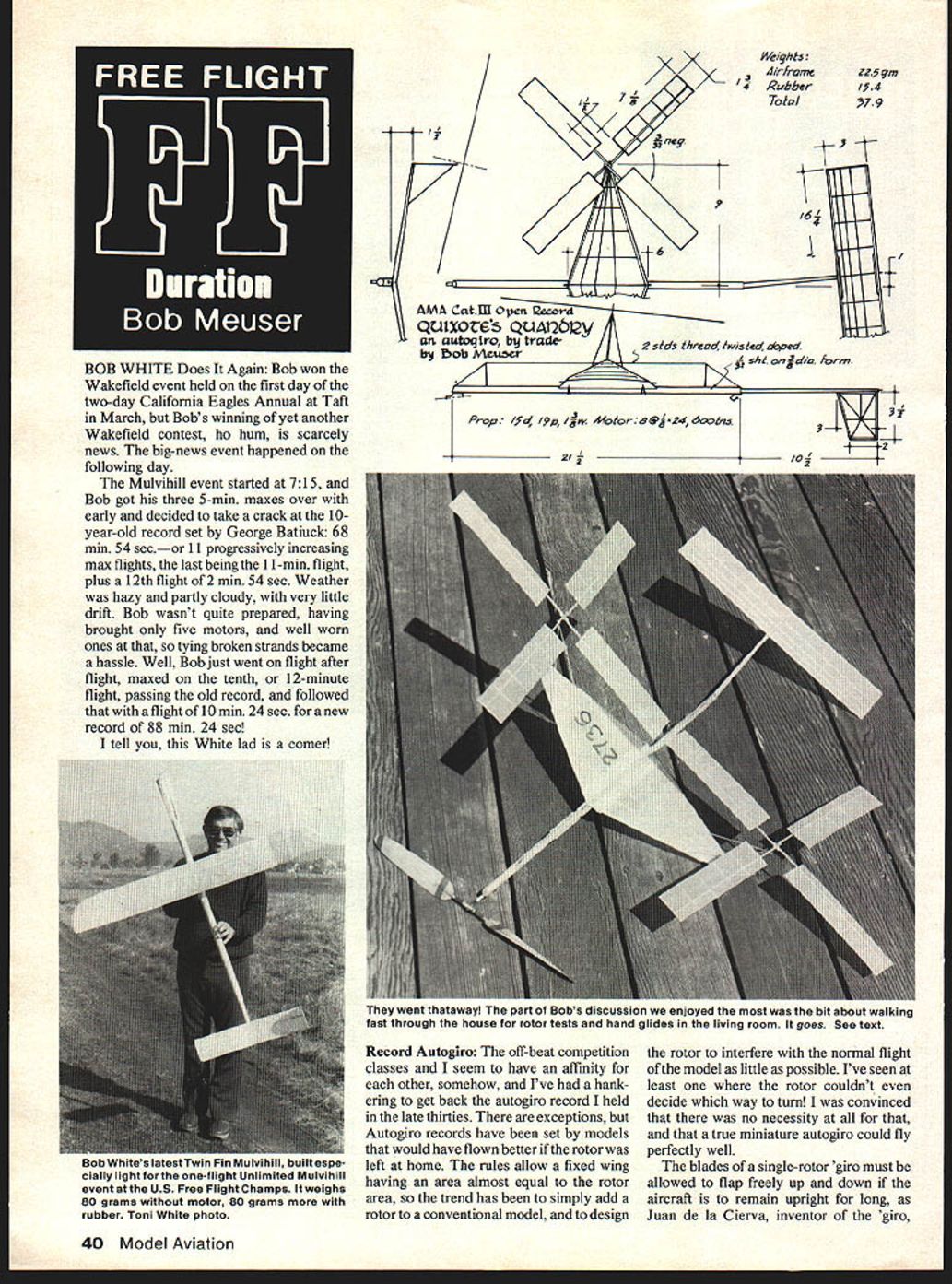
The off-beat competition classes and I seem to have an affinity for each other somehow, and I've had a hankering to get back the autogiro record I held in the late thirties. There are exceptions, but autogiro records have often been set by models that would have flown better if the rotor was left at home. The rules allow a fixed wing having an area almost equal to the rotor area, so the trend has been to simply add a rotor to a conventional model and to design the rotor to interfere with the normal flight of the model as little as possible. I've seen at least one where the rotor couldn't even decide which way to turn! I was convinced that there was no necessity at all for that, and that a true miniature autogiro could fly perfectly well.
The blades of a single-rotor giro must be allowed to flap freely up and down if the aircraft is to remain upright for long, as Juan de la Cierva, inventor of the giro, discovered the hard way. Successful flapping-blade, single-rotor giros have been built, but they seem to require careful tuning—my experience with them hasn't been happy. Twin-rotor giros, model and man-carrying, have been built before. The only twin-rotor model I know of, reported in a Zaic Yearbook, of course, used flapping blades and was reported to be tricky. I figured flapping blades on a twin would be more efficient, but that rigid rotors would be easier for starters; efficiency could come later.
The model was built sort of middle-size for convenience in making changes. Too small or too large would have been a hassle. It was built very light, but using outdoor-style construction. All surfaces—the rotors included—are tissue-covered on both sides and doped. The fuselage is indoor-style simply because I had an appropriate, unused balsa tube kicking around the shop. A small wing, of half the area allowed by the rules, was used to support the rotors, simply because conventional wing construction is a rather efficient sort of structure.
A few fast walks through the house with the assembled model convinced me that the rotors were doing what they were supposed to do rather well. Glide tests in the living room got the CG position and incidence angles about right. Yep, giros glide, and surprisingly flat at that!
Limited flight testing indicates that the model is the most docile, forgiving model I've ever built. Stalls, in the conventional sense, don't happen. If the model comes to a dead stop, either under power or in the glide, it simply drops its nose a bit and keeps going. Lateral stability is absolute—immediate recovery, no overshoot or oscillations.
Best flight so far was 1:22, about half of what one would expect from an equivalent conventional model under similar conditions. Autogiros aren't noted for their efficiency. A 1:22 flight time isn't all that great, but it isn't too bad for starters.
French Half-A
Free Flight, French style, is apparently not at all like Free Flight, American style. Of course they are strong on the Big Three FAI events and Coupe d'Hiver, which they originated. The French magazines feature Peanut Scale and other rubber-power scale models as well. But curiously enough, our most popular competition event, 1/2A Gas, has been slow to catch on and was labeled "a new classification" in a recent magazine.
France's current big name in 1/2A, Georges Matherat, curiously enough, is best known internationally as a Coupe d'Hiver modeler. He didn't become a big-time 1/2A flier by copying American-style 1/2A machines, but rather went his own way—an interesting and strange route.
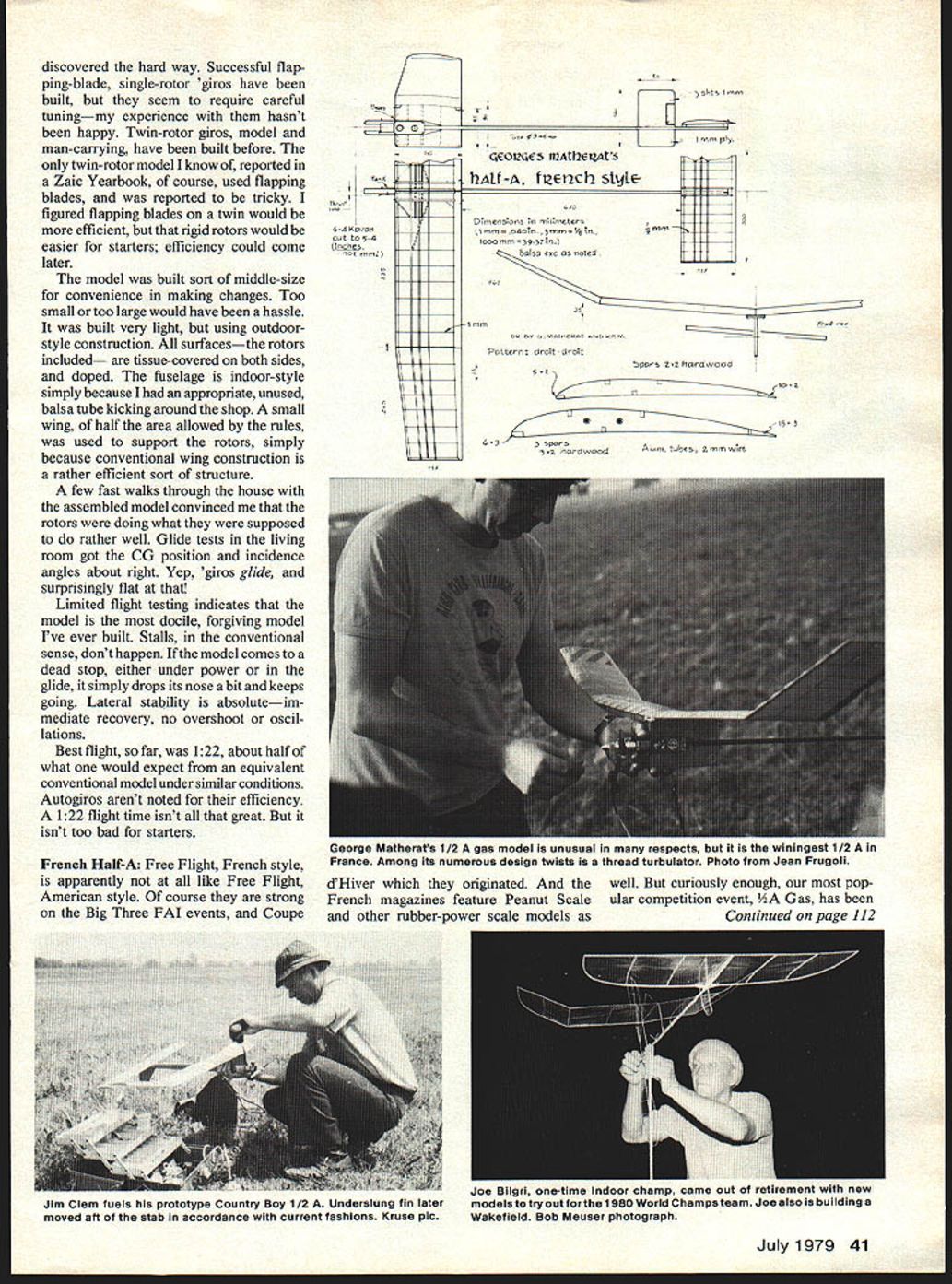
The fuselage of his model is built up around a fiberglass boom. The bones of the forward section consist of a vertical "crutch" for mounting the engine, tank, and the two timers; the boom is imbedded in the aft end of the crutch. The pylon, or forward-fin—whatever you choose to call it—makes no concessions to mere esthetics! Ordinary, solid, American-style pylons weigh more than they have a right to and are often the first thing to go in a mild crash. Regarding its size, I doubt if any American-style FF Gas model has suffered from too much lateral area up front.
The stabilizer aspect ratio is a mere 2.6, which is about as mere as you can get. I doubt if that is a winner. A higher AR gives a greater change in stab lift for a given change in angle-of-attack. So a small, high-AR stab can be as effective as a large low-AR one.
The model sports a timer-actuated auto-rudder, but with a new twist: a trick mechanism starts the DT timer (Graupner) when the engine and auto-rudder timer actuates, making it 100% foolproof in avoiding the possibility of a launch with the auto-rudder in the glide position.
The model is built like the traditional "chiotte de brique," and employs copious quantities of "hardwood," which I take to be pine or spruce. Plywood is used for the auto-rudder and the core of the pylon. All-up weight is over 8 oz., and the wing area is 243 square inches measured flat. The Cox Tee Dee 051 (French 1/4A rules sensibly include 051s) turns 25,000 RPM on a 5-inch Kavan prop of heaven knows what pitch. The French fly 7-sec engine runs and 2-min maxes, so it would seem that one would have to find a rather large downer in order not to max.
Georges has recently added a thread turbulator about 1/2 inch behind the leading edge, and has added the MRA Cup to his list of wins with the model. We thank Georges for the fine original three-view drawing presented here, and for additional information from Jean Frugoli and Guillaume Warner, le Comte de Pisana.
Rebuttal
I'm glad to see that someone was paying attention when I tallied up the cost of getting into Wakefield competition at some $648 in the January issue. If you think that's high, you should see the bill for FAI Power! But don't forget, I throw in a motorcycle.
Writing in The Turbulator, Bob Klipp points out that "for around four bucks you've got the makings of two outdoor hand-launch gliders." Of the whole spectrum of competition free flight classes, HL Glider undoubtedly has the most to offer in terms of reward-per-buck of any aero-modeling sport going.
And I received the following note from a French-speaking scale modeler, which I translate word for word to ensure absolute accuracy: "To the subject from the Pirelli: At $30 per book, one may to supply one dozen from Peanuts on account of 300 years? Not very clear, no is it not?" Well, we ordinarily wouldn't take seriously anything said by someone who talks as goofy as that. But the point—that you can buy enough materials to build a dozen Peanut-Scale models a year for 300 years for the price of a pound of Pirelli, while a bit exaggerated—has a lot of truth in it. There are many competition events that can be pursued competitively for a very small cash outlay: Peanut Scale, Pennyplane, Easy B, P-30, Embryo Endurance. Even thrown in the cost of a winder and a two-year supply of rubber, it doesn't add up to a whole lot.
Step over to the Towline glider events, and you almost push HL Glider into second place. In the A/1 event, which by no means is limited to the kiddies, circle-tow and zoom launches haven't caught on really, so you don't have to lay out $15 for one of those trick towhooks. There are few A/1 kits on the market, but even with today's high costs, it is difficult to see how you could spend more than $10 for sticks and a set of plans. An FAI Model Supply winch plus towline will run a bit over $10. Use a fuse for the dethermalizer, and save close to $15.
Join the big kids and go the A/2 route, and you'll need the trick towhook and a clockwork timer. One of Hutchinson's Dragmaster kits will set you back a whopping $30. But you can't possibly build and crash or lose more than about one A/2 Nordic a year, and it isn't unusual to see a five-year-old model in top place.
But AMA Gas, the most popular of all, is really a rich-man's sport. Half a dozen engines at $60 a throw, $30 per airplane for a set of timers, $100 worth of kits for starters, batteries, an electric starter, fuel ... but a Cox Tee Dee 049, plus kit, plus timer, and a bit of fuel and things you need will get you into the business for about $60. Not too much for an adult, perhaps, but it represents a lot of lawn mowing for a youngster if he indeed is even able to find such work.
There is hope even for AMA Gas. We mentioned all-foam construction in the April issue. It is certainly inexpensive, but as yet it doesn't seem like the thing for a beginning free flighter—time will tell. There was a proposal for a low-cost beginners' event, designated FF-B0-27, authored by Dave Benepe, which might have helped matters, but it got clobbered by the FF Contest Board on the Initial Vote, where a negative vote by a mere one-third of the members condemns a proposal to no further consideration whatsoever—no possibility of modification via the Cross Proposal, Interim Vote procedure, no possibility of it reaching the Final Ballot where it could still be killed by a one-third majority negative vote. The next round will make it 1982 before it could possibly get into the rulebook, even as a "provisional" or "supplemental" event.
Benepe's proposed event is aimed to encourage beginners of any age to try AMA Gas free flight. The event would be limited to stock reed-valve engines. Expensive clockwork timers—selling now for half again the price of a reed-valve engine—are prohibited; fuel-limiting engine timing is required. That destroys the incentive for anyone developing a really inexpensive clockwork timer, but that's another story. A person entering this event would not be permitted to enter another Power event at a specific contest. Kits specifically geared to such an event are simply not available, nor are magazine plans. Of course there are plenty of other 1/2A kits on the market, but they are more refined and more expensive than a model would have to be for this event.
But the idea is far from dead. Dave isn't off in a corner somewhere sulking. He has been in contact with some of the Contest Board members to find out why they clobbered his proposal, and getting suggestions from them for changes that might be incorporated in a future proposal. There is considerable interest in the event, and several clubs will be running it as an unofficial event.
Free flight isn't dead by a long shot. The number of participants is stable, but still fewer than we'd like; it warrants mention on the Endangered Species list. The discouraging thing is that the average age of free flighters is increasing at a rate of almost one year per year, and that can't lead to much. Little new blood is being pumped into the system. One free flighter—a Contest Board member at that—told me that it would be of no great concern to him if free flight did die in 10 or 15 years. I suspect that many hold that point of view, for if they didn't we'd see more action aimed at turning the tide, and the mere wringing of the hands in agony won't hack it. It is encouraging to see guys like Dave Benepe trying to do something about it. Too bad there aren't more of him.
Book Coverage
The book covers the World Champs and the models flown in that sort of competition. There is considerable material on the Indoor World Champs and Coupe d'Hiver, and even a smattering of Old-Timer modeling and Free Flight, U.S.-style as exemplified by the U.S. Free Flight Champs. There are sections about the developments and techniques associated with each model class written by some of the most knowledgeable fliers in the business. There are blow-by-blow accounts of all of the major international and World Champ competitions in the period covered, and complete listings of the results.
The full-page plans occupy about half of the book. Each is accompanied with a story about the history and development of the model in the modeler's own words. About 90% of the plans have appeared in publications available to U.S. FAI fliers—Scatter, Free Flight News, the NFFS Digest, Indoor News and Views, and so forth—but it is nice having them all under one cover. Most of the color photos are truly excellent, although I could have been perfectly happy without the postcard shots of l'Arc de Triomphe and the Tour Eiffel and some of the family-album type snapshots. Nevertheless, on the whole the photos document the spirit of international free flight competition—its triumphs and tragedies, glories and defeats, and the pure fun of it—in addition to its technology.
It is a book any red-blooded American FAI-oriented free flighter would be proud to own.
Announcement: Fresno Annual
The September 29–30 weekend will see the fortieth consecutive annual contest put on by the Fresno Gas Model Airplane Club. Events will include:
- The three FAI events
- 1/2A, A, B, C, and D Gas
- Coupe
- P-30
- Mulvihill
- A-1 Glider
- Hand Launch Glider
- And perhaps a few others
The Stockton club's Old-timer Meet will be held simultaneously at the same site. Last year's annual drew 155 contestants, and there was more than $2,200 worth of prizes, including engraved silver-plate bowls for the sweepstakes winners; this year's meet promises to be bigger and better in every respect.
The site is on sheep-grazing land, 1 x 1/2 miles, and criss-crossed with paved roads at quarter-mile intervals. Motorcycles are OK. Contact man is Russ James, 4840 E. Leisure, Fresno, CA 93727. Call (209) 255-2422 anytime.
Also new for the Fresno club will be a series of indoor meets, the first of which will be on June 23. Check with Russ for details.
Bob Meuser 4200 Gregory St. Oakland, CA 94619
Transcribed from original scans by AI. Minor OCR errors may remain.

