
Free Flight: Duration
Bob Meuser
Of swingers — flappers, folders, and other wondrous things
Variable-Configuration Model Aircraft (VCMA)
What in the world are "Variable-Configuration Model Aircraft"? (We'll refer to them as VCMA from here on.) Basically, they are any model aircraft that change shape during flight. Some call them "Variable-Geometry" aircraft, but I prefer the term VCMA. I should also distinguish VCMA from Automatic-Control Model Aircraft — pendulum control, gyro-stabilized models, auto-stabs, auto-rudders, and the like — but I'm not going to worry a lot about precise definitions here.
The folder concept
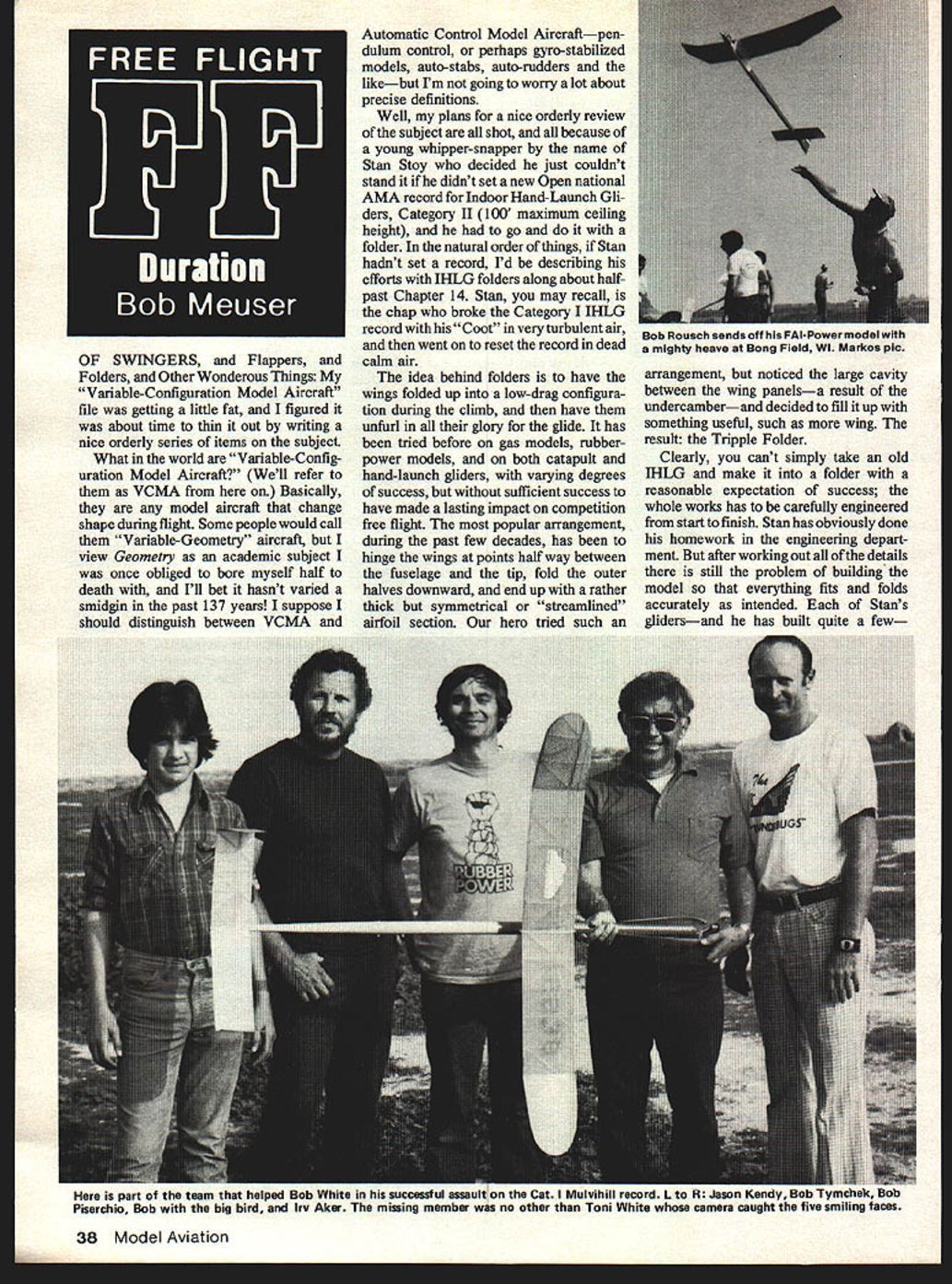
The idea behind folders is simple: have the wings folded into a low-drag configuration during the climb, then have them unfurl for the glide. This concept has been tried on gas models, rubber-powered models, catapult gliders, and hand-launch gliders, with varying degrees of success. The most popular arrangement in recent decades has been to hinge the wing roughly halfway between fuselage and tip, fold the outer halves downward, and end up with a rather thick, symmetrical or "streamlined" airfoil section.
One problem with that arrangement is the large cavity between wing panels produced by undercamber. One solution is to fill the cavity with additional wing area — the result being the so-called Triple Folder.
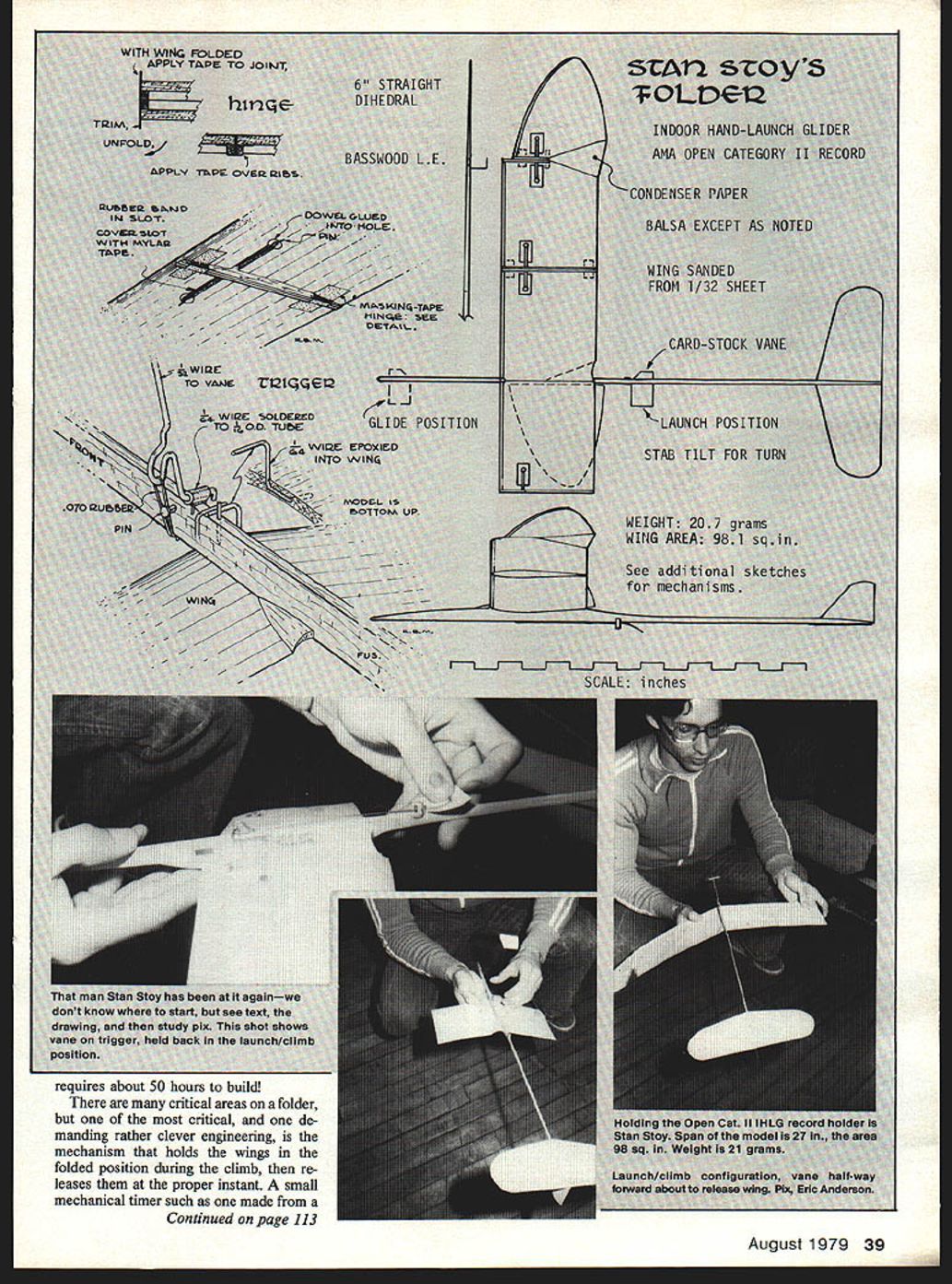
Clearly, you can't simply convert an old IHLG into a successful folder; the entire airplane must be engineered from start to finish. Stan Stoy, whose work prompted this discussion, has clearly done his homework. After engineering the details, there remains the difficult task of building the model so everything fits and folds accurately — each of Stan's gliders requires about 50 hours to build.
Stan Stoy — record flights and mechanism
Stan Stoy recently set a new Open national AMA record for Indoor Hand-Launch Gliders (IHLG), Category II (100-ft maximum ceiling height), using a folder. He came very close several times and on April 22 posted flights of 71.2 and 75.6 seconds. The previous Open Category II record had been set by Bucky Servaites nine years earlier at a 95-ft-ceiling site in Cleveland. Stoy's record flights were made in Chicago's Madison Street Armory, which has a reduced 75-ft ceiling since the floor was raised a few years ago.
The critical mechanism on a folder is what holds the wings in the folded position during the climb and releases them at the proper time. A small mechanical timer could be used, but Stan elected to use dynamic pressure to hold a trigger in the locked position. Key points of his release system:
- A thread on the trigger is held between the fuselage and the thumb before and during launch.
- When the model is launched at high velocity, lift on a small vane produces the force to keep the mechanism latched.
- As speed drops (Stan verified in a wind tunnel that this occurs below about 20 mph), the vane arm flips from its rearward latched position to a fully forward position and releases the wings.
- Rubber bands stretched across the hinges then deploy the wings.
Competitive and rule implications
Stan's success raises questions for the sport. Historically, HLG has been one of the easiest free-flight events to enter, and a competitive hand-launch glider could be built in a fraction of the time it takes to build one of Stan's folders. If competitive HLG now effectively requires 50 hours of building time, the event's popularity could suffer.
Should the rules be changed? Possible approaches include:
- Permit folders in one set of HLG events and outlaw them in another, at least for a transition period (for example, setting a cut-off year such as 1985).
- Allow both types of events to be flown for records; contest directors or sponsors could choose which format to run.
Any rule change will be contentious because many builders will have invested significant time and effort in folders by the time changes are considered.
Ornithopter rule reminder
Read the rulebook. I have noticed three competition ornithopter models in the literature and correspondence that do not meet current official AMA rules for the event. Two of them have been awarded official National Records despite the violation. The problematic feature is a fixed wing in addition to the flapping wing, which violates this rule excerpt:
"If part of a wing is fixed, the projected area of the flapping part shall be not less than that of the fixed part . . . . If the model has more than one wing, these restrictions apply independently to each wing, and the wings shall be substantially identical..."
Builders and contest officials should ensure designs conform to this and other applicable rules.
Free-Flight Hall of Fame Awards
The National Free Flight Society (NFFS) recognizes individuals who have made outstanding contributions to the development and continuity of free-flight model aviation worldwide through their annual Free-Flight Hall of Fame awards. The recipients for 1975 have been selected and are listed by the Society.
Transcribed from original scans by AI. Minor OCR errors may remain.

