

Free Flight: Duration
Bob Meuser
WAKEFIELD Junior Record Falls
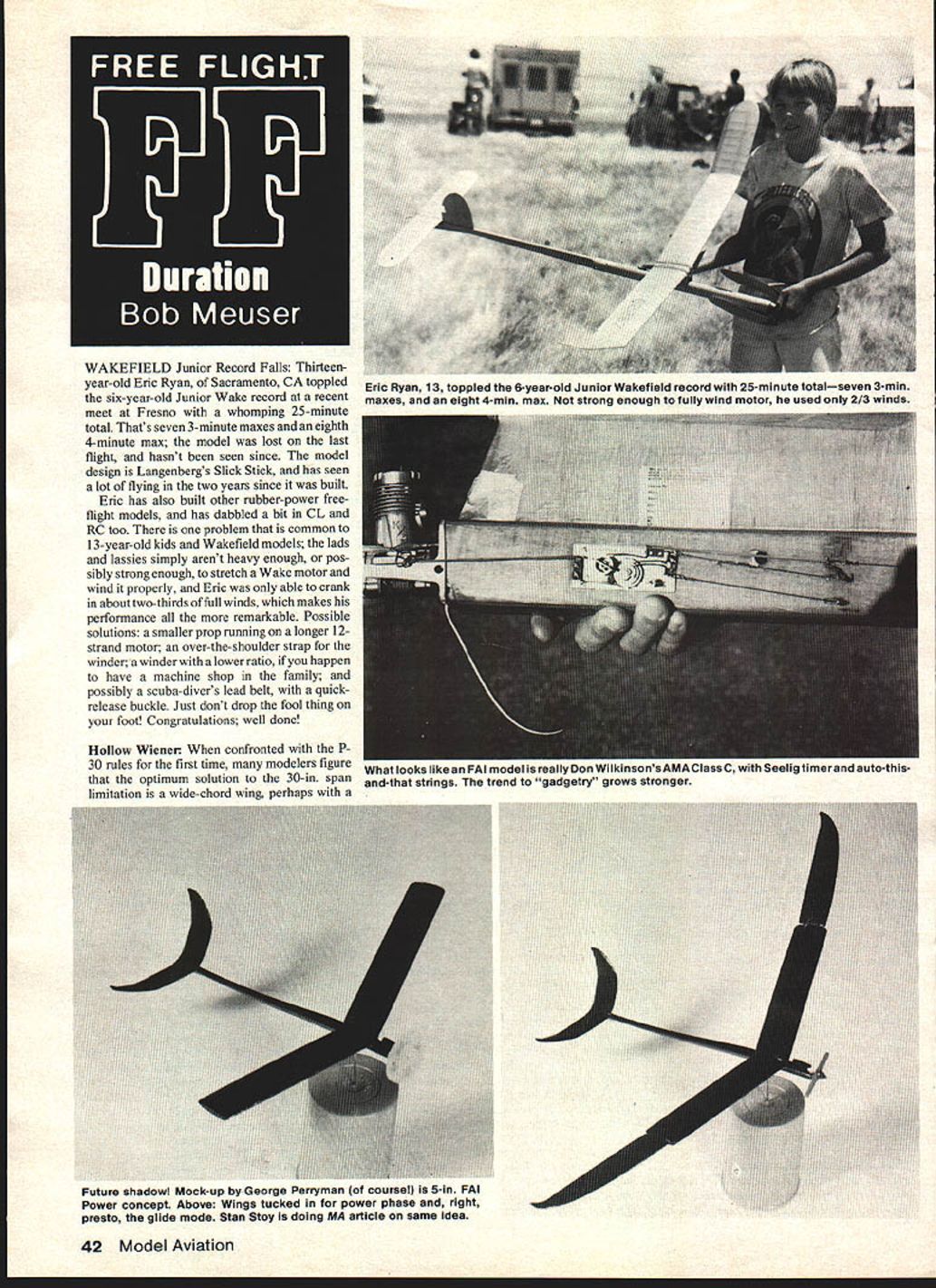
Thirteen-year-old Eric Ryan, of Sacramento, CA, toppled the six-year-old Junior Wakefield record at a recent meet in Fresno with a whomping 25-minute total. That's seven 3-minute maxes and an eighth 4-minute max; the model was lost on the last flight and hasn't been seen since. The design was Langenberg's Slick Stick, which has seen a lot of flying in the two years since it was built.
Eric has also built other rubber-power free-flight models and has dabbled a bit in CL and RC too. There is one problem common to 13-year-olds and Wakefield models: the lads and lassies simply aren't heavy enough, or possibly strong enough, to stretch a Wake motor and wind it properly. Eric was only able to crank in about two-thirds of full winds, which makes his performance all the more remarkable.
Possible solutions:
- Use a smaller prop running on a longer 12-strand motor.
- Fit an over-the-shoulder strap for the winder.
- Use a winder with a lower ratio (if you happen to have a machine shop in the family).
- Consider a scuba diver's lead belt with a quick-release buckle — just be careful not to drop the thing on your foot!
Congratulations; well done!
Hollow Wiener
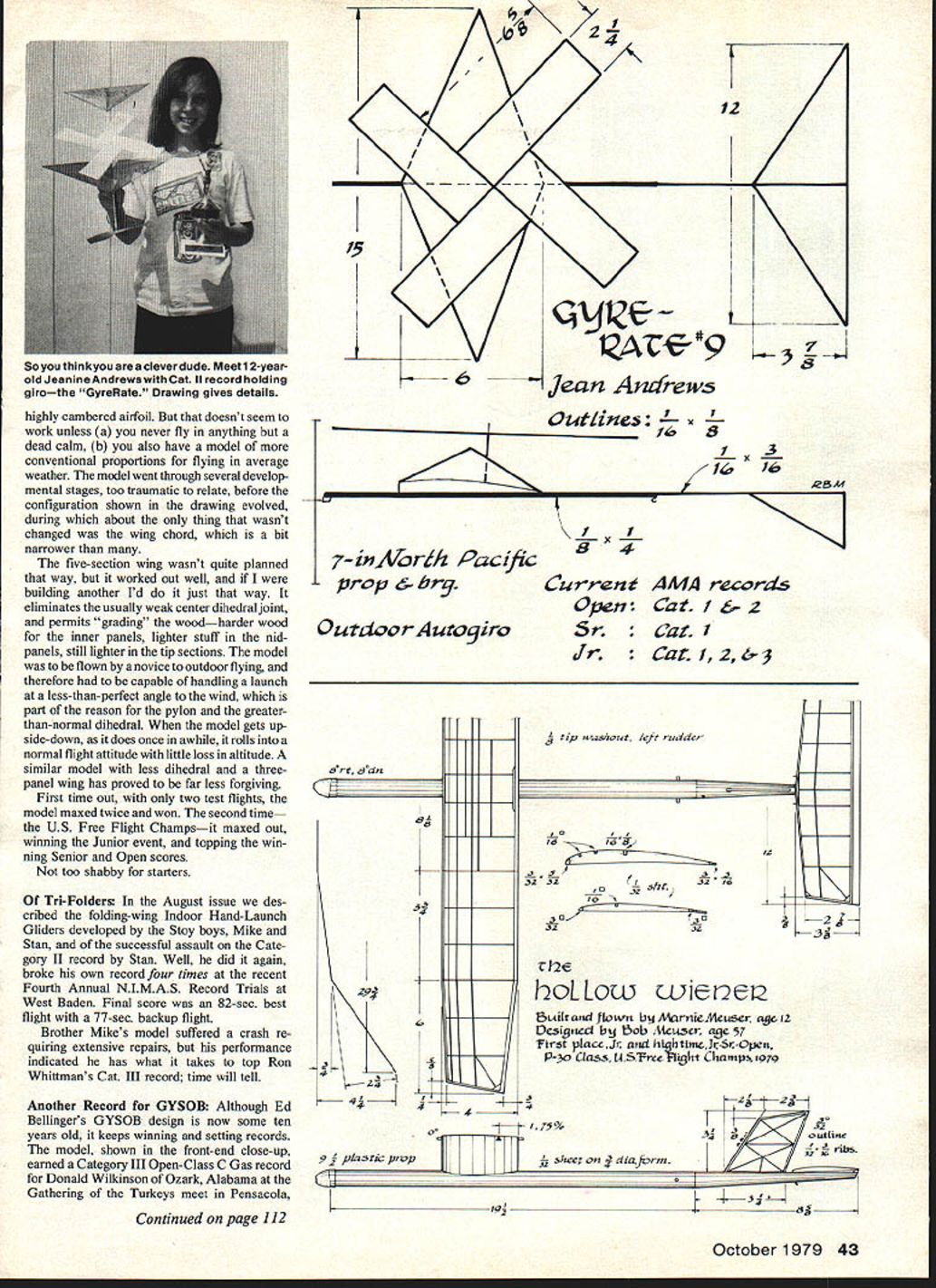
When confronted with the P-30 rules for the first time, many modelers assume the optimum solution to the 30-inch span limitation is a wide-chord wing, perhaps with a highly cambered airfoil. That doesn't seem to work unless you never fly in anything but dead calm. I also have a model of conventional proportions flying in average weather.
The model went through several developmental stages before the configuration shown in the drawing evolved. During that time nothing important was changed; wing chord was cut a bit. The now five-section wing wasn't quite planned the way it worked out, but building another I'd do it just that way. It eliminates the usually weak center dihedral joint and permits grading wood—harder wood for inner panels, lighter wood for mid panels, and still lighter for tip sections.
The model is flown by novices outdoors and therefore is capable of handling launches at a less-than-perfect angle to the wind. Part of the reason is that the pylon has greater-than-normal dihedral. The model gets up side-down once in a while, then rolls to normal flight attitude with little loss of altitude. A similar model with less dihedral and a three-panel wing has proved far less forgiving.
First time out, two test flights maxed twice and won. The second time, at the U.S. Free Flight Champs, it maxed out, winning the Junior event and topping the Senior Open scores too—not too shabby for a starter.
Of Tri-Folders
In the August issue we described the folding-wing Indoor Hand-Launch Gliders developed by the Stoy boys, Mike and Stan, and Stan's successful assault on the Category II record. Well, he did it again—he broke his own record four times at the recent Fourth Annual N.I.M.A.S. Record Trials at West Baden. Final score was an 82-second best flight with a 77-second backup flight.
Brother Mike's model suffered a crash requiring extensive repairs, but his performance indicated he has what it takes to top Ron Whittman's Cat. III record; time will tell.
Another Record for GYSOB
Although Ed Bellinger's GYSOB design is now some ten years old, it keeps winning and setting records. The model, shown in the front-end close-up, earned a Category III Open-Class C Gas record for Donald Wilkinson of Ozark, Alabama, at the Gathering of the Turkeys meet in Pensacola.
"Some would have us believe that the price is not worth Free Flight. Could it be that it takes a special kind of man to do all of the things that need to be done before Free Flight can become a reality?
Yet, who else but those who are willing to pay the price will know in their hearts the glory of the skies; watching their own creation fly free."
And that, free flighters, somehow says it all!
Clarence Haught, Rt. 5, Box 16, Coeur d'Alene, ID 83814
After almost getting its tailfeathers clipped off by a wayward FAI-power model, the replica is powered by the traditional K&B 6.5 post‑rotor engine and a Simpson 10-4 fiberglass prop. The model is equipped with an auto-rudder and auto-stab, as was the original. It is covered with red and white silk doped with clear butyrate, runs on 25% nitro, and weighs in at 45 oz.
Sympo '79 Report
Bob Dodds, editor of the 1979 N.F.F.S. Report, reports that the Report is off to the printer, just in the nick of time to be ready for sale at the Nats. In addition to the usual array of papers and the sections covering NFFS Models of the Year and NFFS Hall of Fame awards, there will be a new section listing all winners of the Mulvihill, Dick Black, Tulsa (?), Dobbers, Wakefield, Chuck Broadhurst, Stout, and McNeil trophies.
Of the tech papers, four are theoretical and six are very practical (I detest that kind of pigeonholing, but I can't think of a better nomenclature). Included are:
- A 12-page in-depth interview with the Monrovia Rubber Man, Bob White, in which he reviews everything he has tried for Wakefield—what he likes and what he has discarded.
- Jim O'Reilly's review of the state of the art in Mulvihill model development, including his projected design philosophy for a new model.
- Two papers by Andy Bauer; in one he "flies" Thomas Koster's Speed Cream world championship model on a computer for some 15 flights. Bob Dodds calls it a "milestone contribution to free flight."
- Chris Matsuno's description of his latest refinements in rubber motor testing.
- Articles on the P-30 event, a proposed Novice Power event, Dieter Siebenman's highly successful Swiss Indoor model design, and the frustrations of an adult beginner trying to build her first model.
The Ten Models section includes descriptions of model development plus detailed three-views.
Price:
- $7.50 for members of both the AMA and the NFFS, and for non-residents of the U.S.
- $8.50 for others.
- For Fourth Class mailing in the U.S., Canada, and Mexico, add $0.75.
- For Air Mail to Canada and Mexico, add $2.25; to Europe add $3.35; to the Far East add $4.65.
Make checks payable to the NFFS. Order from Fred Terzian, 4858 Moorepark Ave., San Jose, CA 95129.
OHLG DT
Many forms of dethermalizers have been used for Outdoor Hand-Launch Gliders, including drag brakes, fold-down rudders, drop-off nose weight, and the pop-up stab popularized by Bill Blanchard (see "Polly" article, May issue). Bill's scheme, employed by him and others for most of a decade, works great. But some fliers prefer to mount the stabilizer on the bottom of the fuselage, and for such designs the pop-up stab won't work.
Orbiter Gerry Giles comes to the rescue with a pop-down stab, reported in Torbellino. The sketch shows the basic tail-end hardware; the front end can be any fuse burner, such as that on "Polly." Gerry reports: "The prototype works very well, and does not appear to be as vulnerable to damage as I had feared. Addition of 1/16 sq. spruce leading edge will help. The only drawback as compared to a pop-up is the lack of adjusting screw for trim. However, I find that once adjustments are warped in, there is little need to ever change them."
(Note: Blanchard's version of the pop-up DT employs shims rather than an adjusting screw.)
Of Swingers, Flappers, Folders, and Other Wondrous Things
Three sub-categories for my "Variable-Configuration Aircraft" file weren't enough; when this one came along, we had to add a fourth: "Stretchers." Anyone who has been paying attention should be able to identify the inventor of this scheme from the photos in about three seconds flat. For the slow thinkers, a clue: his name is George Perryman.
In George's scheme, which he applies specifically to FAI Power, the inner wing panels are devoid of such conventional nuisances as spars, ribs, and other concessions to convention. With the recent introduction of metal covering for FAI-model wings, perhaps that isn't so far out as it might first seem. Hidden within the inner wing panels are the outer wing panels; at the propitious moment—at the instant the engine cuts—the inner panels pop out to their glide positions, surprising any passing seagulls.
Well, preliminary design has done its job; now we'll just turn it over to engineering.
Record 'Giro'
The three-view shows what currently is the record-setting model in the autogiro business, the most recent of a long sequence of 'giros flown to many national records by Gene Andrews and his offspring. Gene tried various wing outlines, two-, three-, and four-blade rotors, and dihedraled rotors before settling on this design.
The model is built as lightly as possible. The rotor is built flat, but the trailing edges are unsupported. The leading edge twists as a result of the lift on the rotor, and this gives a sufficient amount of negative incidence to the vanes to make them spin at the proper speed.
Bob Meuser, 4200 Gregory St., Oakland, CA 94619.
Transcribed from original scans by AI. Minor OCR errors may remain.

