
Free Flight: Duration
Bob Meuser
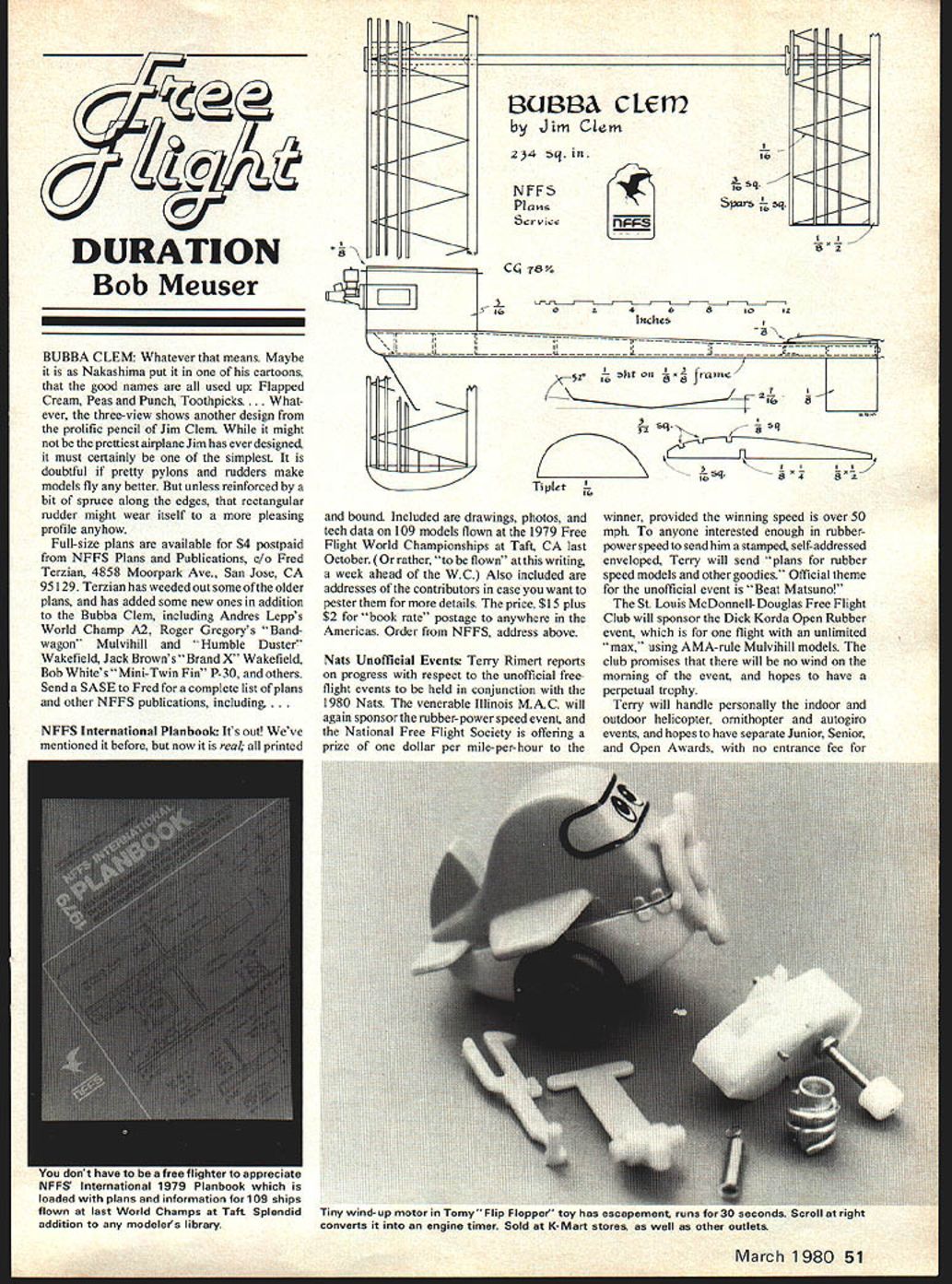
BUBBA CLEM: Whatever that means. Maybe it is as Nakashima put it in one of his cartoons — that the good names are all used up: Flapped Cream, Peas and Punch, Toothpicks... Whatever, the three-view shows another design from the prolific pencil of Jim Clem. While it might not be the prettiest airplane Jim has ever designed, it must certainly be one of the simplest. It is doubtful if pretty pylons and rudders make models fly any better. But unless reinforced by a bit of spruce along the edges, that rectangular rudder might wear itself to a more pleasing profile anyhow.
NFFS Plans and Publications
Full-size plans are available for $4 postpaid from NFFS Plans and Publications, c/o Fred Terzian, 4858 Moorpark Ave., San Jose, CA 95129. Terzian has weeded out some of the older plans and has added some new ones in addition to the Bubba Clem, including:
- Andres Lepp's World Champ A2
- Roger Gregory's "Bandwagon"
- Mulvihill "Humble Duster"
- Wakefield designs
- Jack Brown's "Brand X" Wakefield
- Bob White's "Mini-Twin Fin" P-30
- and others
Send a SASE to Fred for a complete list of plans and other NFFS publications.
NFFS International Planbook
It's out! We've mentioned it before, but now it is real — all printed and bound. Included are drawings, photos, and technical data on 109 models flown at the 1979 Free Flight World Championships at Taft, CA last October (or rather, "to be flown" at this writing — we are a week ahead of the W.C.). Also included are addresses of the contributors in case you want to pester them for more details. The price is $15 plus $2 for book-rate postage to anywhere in the Americas. Order from NFFS at the address above.
Nats Unofficial Events
Terry Rimmert reports progress on the unofficial free flight events to be held in conjunction with the 1980 Nats. Highlights:
- The venerable Illinois M.A.C. will again sponsor the rubber-power speed event. The National Free Flight Society is offering a prize of $1 per mile-per-hour to the winner, provided the winning speed is over 50 mph. Terry will send plans for rubber speed models and other goodies to anyone who sends a stamped, self-addressed envelope. Official theme for the unofficial event is "Beat Matsuno!"
- The St. Louis McDonnell-Douglas Free Flight Club will sponsor the Dick Korda Open Rubber event, which is for one flight with an unlimited "max," using AMA-rule Mulvihill models. The club promises that there will be no wind on the morning of the event and hopes to have a perpetual trophy.
- Terry will personally handle the indoor and outdoor helicopter, ornithopter, and autogiro events and hopes to have separate Junior, Senior, and Open awards, with no entrance fee for juniors.
- The Minneapolis Model Aero Club will run the Cargo event.
The Nats unofficial FF events have deserved a better break than they have given themselves in the past and have suffered from a lack of coordination, but it appears the unofficial events coordinator, Terry Rimmert, is well on the way to fixing that. If your club has an unofficial event up its collective sleeve, contact Terry at 367 Orange Avenue, Baldwin, FL 32234.
Models of Models, Re-Visited
In my December column I described how small, simplified models of models can be used to check out the quirks of a design with only a small expenditure of time before committing a new design to hardware. Ken Simpson pointed out that an article in the same vein, by Paul Gilliam, appeared in the May 1954 issue of Model Airplane News. Paul stated he had been using the model-of-model trick since 1946. In 1954 Jose Tellez and other members of the San Valeers Model Club built miniatures of the Sandy Hogan, Fubar, Civy Boy, Zekes, Zipper, and others; the flight characteristics of these tiny 7- to 9-inch models duplicated the prototypes rather well. The San Valeer lads did it with a flair for fun as much as for science: their models were color-doped and lettered appropriately and even had dummy engines whittled from the nozzle ends of old glue tubes.
This supports my theory that given any problem and a smidgin of encouragement, model builders will somehow carry the solution to the ridiculous extreme and have a ball doing it. Witness quarter-scale R/C!
Design / Construction Tips
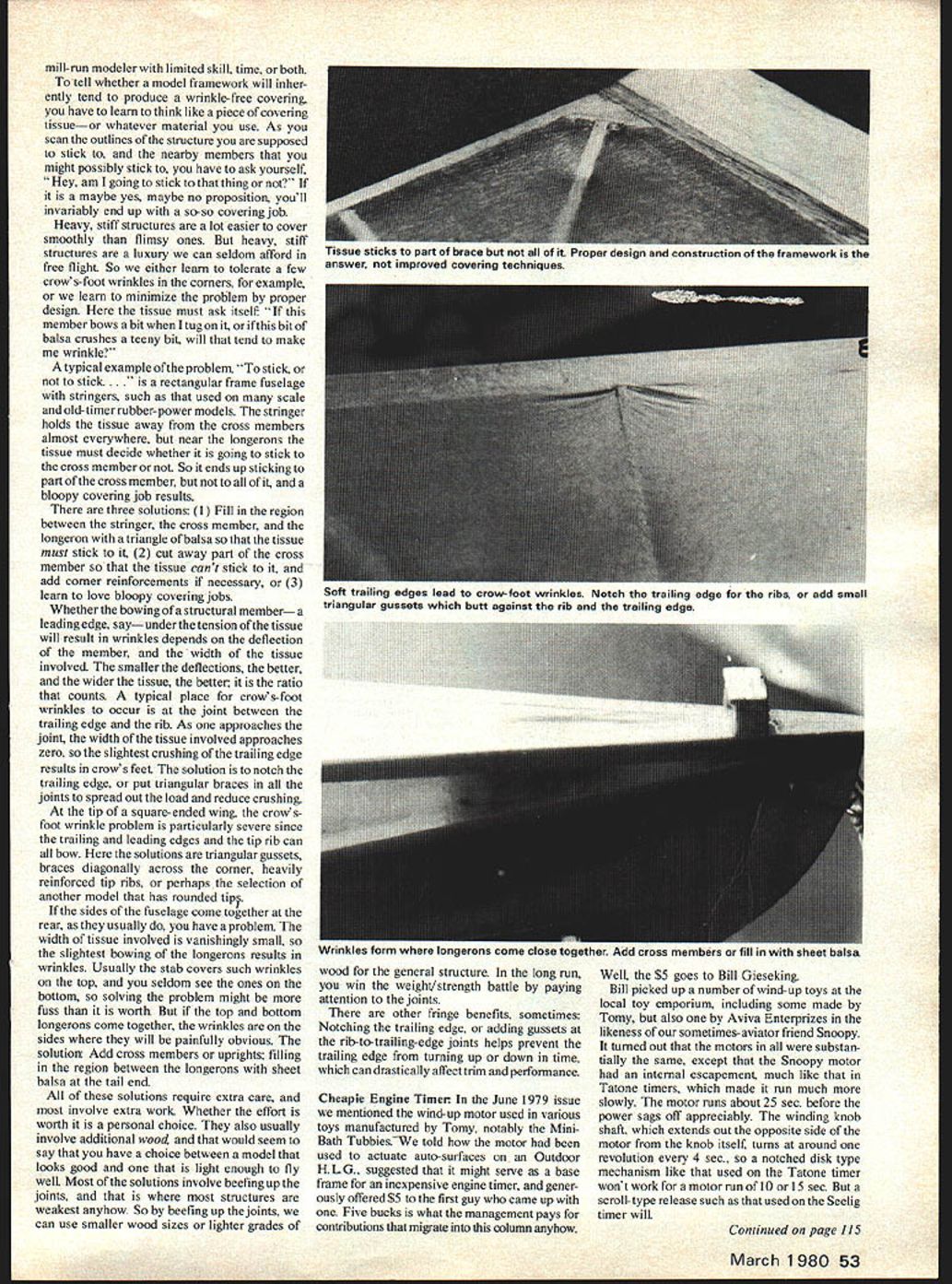
A super-craftsman can get a perfect, wrinkle-free covering job on almost any model. But some model design features are more likely to result in a smooth covering than others in the hands of a mill-run modeler with limited skill or time. To tell whether a model framework will inherently tend to produce a wrinkle-free covering, you have to learn to think like a piece of covering tissue — ask yourself, "Am I going to stick to that thing or not?" If it is a maybe-yes, maybe-no proposition, you'll invariably end up with a so-so covering job.
Heavy, stiff structures are a lot easier to cover smoothly than flimsy ones, but heavy, stiff structures are a luxury seldom afforded in free flight. So either learn to tolerate a few crow's-foot wrinkles in the corners or minimize the problem by proper design. The tissue must ask itself: "If this member bows a bit when I tug on it, or if this bit of balsa crushes a teeny bit, will that tend to make me wrinkle?"
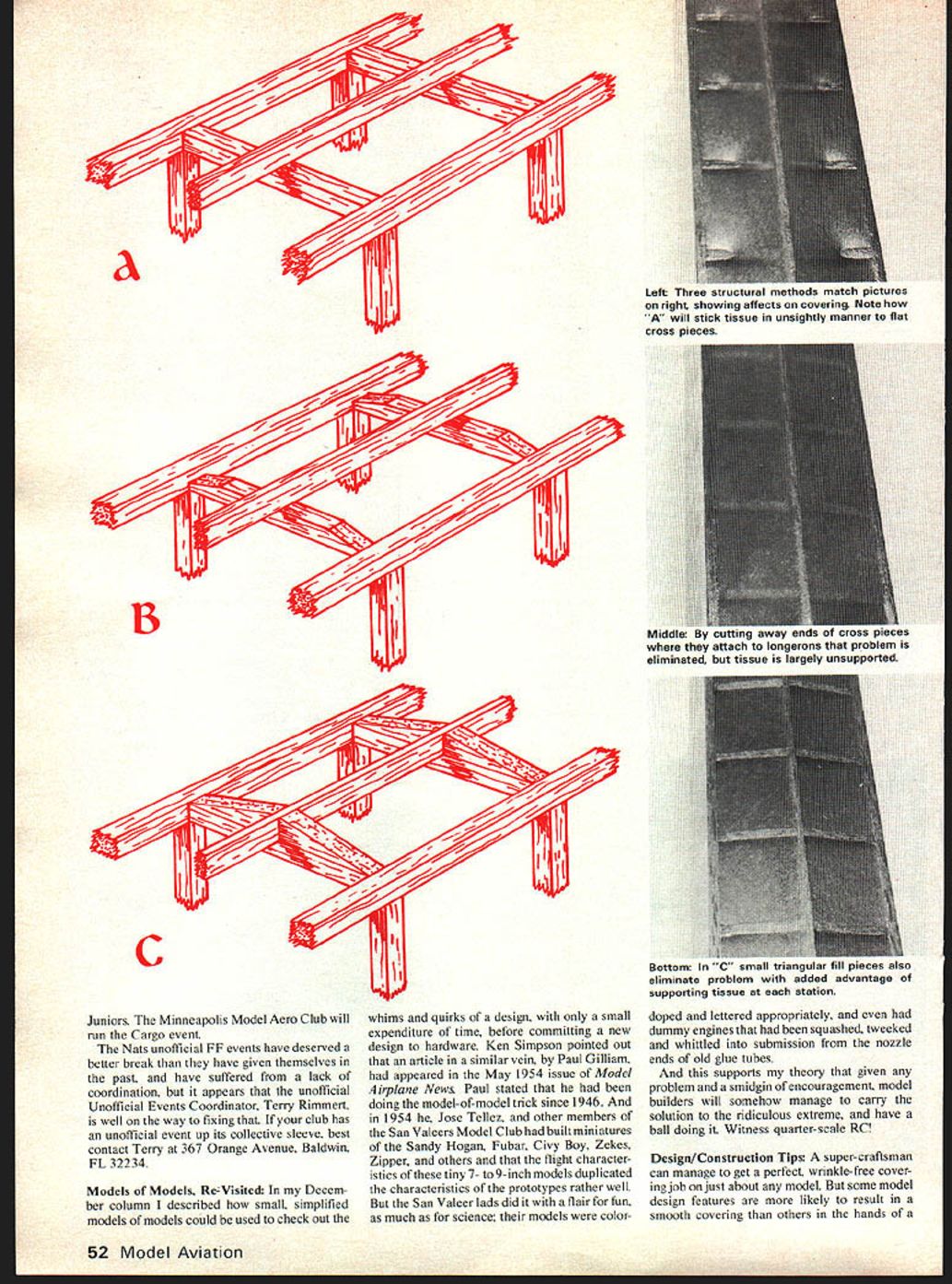
A typical example is a rectangular frame fuselage with stringers, as used on many scale and old-timer rubber-power models. The stringer holds the tissue away from the cross members almost everywhere, but near the longerons the tissue must decide whether it will stick to the cross member or not. It often ends up sticking to part of the cross member but not all of it, and a bloopy covering job results.
There are three solutions:
- Fill in the region between the stringer, the cross member, and the longeron with a triangle of balsa so that the tissue must stick to it.
- Cut away part of the cross member so the tissue can't stick to it, and add corner reinforcements if necessary.
- Learn to love bloopy covering jobs.
Whether the bowing of a structural member (a leading edge, say) under the tension of the tissue will result in wrinkles depends on the deflection of the member and the width of the tissue involved. The smaller the deflections and the wider the tissue, the better — it is the ratio that counts. A typical place for crow's-foot wrinkles is at the joint between the trailing edge and the rib. As one approaches the joint, the width of tissue involved approaches zero, so the slightest crushing of the trailing edge results in crow's feet. Solutions include notching the trailing edge or putting triangular braces in the joints to spread the load and reduce crushing.
At the tip of a square-ended wing, the crow's-foot wrinkle problem is particularly severe since the trailing and leading edges and the tip rib can all bow. Solutions: triangular gussets, braces diagonally across the corner, heavily reinforced tip ribs, or selecting another model with rounded tips.
If the sides of the fuselage come together at the rear, you have a problem: the width of tissue involved is vanishingly small, so the slightest bowing of the longerons results in wrinkles. Usually the stab covers such wrinkles on the top and you seldom see the ones on the bottom, so solving the problem might be more fuss than it is worth. But if the top and bottom longerons come together, the wrinkles are on the sides where they will be painfully obvious. Solution: add cross members or uprights, filling in the region between the longerons with sheet balsa at the tail end.
All of these solutions require extra care and usually extra work and wood. That seems to imply a choice between a model that looks good and one that is light enough to fly well. Most solutions involve beefing up the joints, and that is where most structures are weakest anyhow. By beefing up the joints, you can use smaller wood sizes or lighter grades for the general structure. In the long run you win the weight/strength battle by paying attention to the joints.
There are other fringe benefits: notching the trailing edge or adding gussets at rib-to-trailing-edge joints helps prevent the trailing edge from turning up or down over time, which can drastically affect trim and performance.
Cheapie Engine Timer
In the June 1979 issue we mentioned the wind-up motor used in various toys manufactured by Tomy, notably the Mini-Bath Tubbies. We described how the motor had been used to actuate auto-surfaces on an outdoor H.L.G., suggested it might serve as a base for an inexpensive engine timer, and offered $5 to the first person who came up with one. The $5 goes to Bill Gieseking.
Bill picked up a number of wind-up toys at the local toy emporium, including some made by Tomy and one by Aviva Enterprises in the likeness of Snoopy. The motors in all were substantially the same, except the Snoopy motor had an internal escapement (much like that in Tatone timers), which made it run much more slowly. The motor runs about 25 seconds before the power sags off appreciably. The winding knob that sits outside the motor on the motor shaft (which extends out the opposite side from the knob) turns around one revolution every 4 seconds, so a notched-disk mechanism like that used on the Tatone timer won't work for a motor run of 10 or 15 seconds. But a scroll-type release such as that used on the Selsig timer will.
The Seelig scroll would be rather expensive to duplicate, but in essence it is simply a screw thread. Rather than use a little wire flipper as used by both Seelig and Tatone, Bill used an idea he got from Hardy Brodersen: attach string to the fuel cut-off or flood-off mechanism of your choice, tie a loop in the end of it, and place the loop over the timer scroll. When the timer unwinds, the loop simply screws itself off the end of the scroll.
Bill made the scroll by wrapping a spiral of soft wire around a music-wire mandrel, then slipping it over a piece of 1/8" O.D. aluminum tubing that he attached to the timer shaft. You can manufacture your own aluminum tubing of almost any I.D. and O.D. by gluing appropriate sizes of telescoping aluminum tubing together with cyanoacrylate or epoxy glue, if that helps.
After hearing this from Bill, ol' Meuser went off to his local toy emporium, and of course there wasn't a wind-up walking Snoopy within miles. But hanging on the hook in all their bubbly-packaged elegance was a series of Tomy items called Flip Floppers. They come in various forms — including one that might have been inspired by the embryo of an airplane — and inside the wee beastie is a motor like the one described by Gieseking, with internal escapement and all. Bill conjectured the basic motor, which has lots of extra holes in the case for a variety of applications, is made by some Hong Kong manufacturer who peddles it to various toy makers for incorporation into their products. Or perhaps products under a variety of trade names come out different back doors of the same factory.
Bonuses (Boni?): Included in the Flip-Flops is a very soft tension spring you might find use for.
Transcribed from original scans by AI. Minor OCR errors may remain.

