
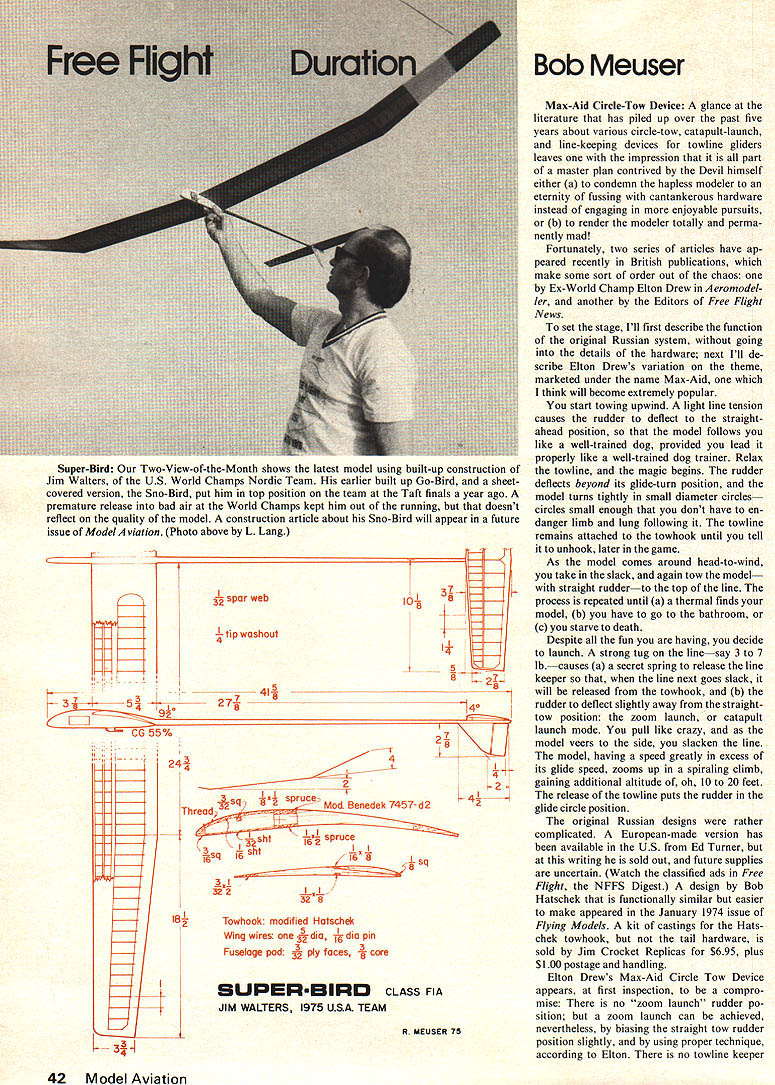
Free Flight: Duration
Bob Meuser
Max-Aid Circle-Tow Device: A glance at the literature that has piled up over the past five years about various circle-tow, catapult-launch, and line-keeping devices for towline gliders leaves one with the impression that it is all part of a master plan contrived by the Devil himself either (a) to condemn the hapless modeler to an eternity of fussing with cantankerous hardware instead of engaging in more enjoyable pursuits, or (b) to render the modeler totally and permanently mad!
Fortunately, two series of articles have appeared recently in British publications, which make some sort of order out of the chaos: one by Ex-World Champ Elton Drew in Aeromodeller, and another by the Editors of Free Flight News.
To set the stage, I'll first describe the function of the original Russian system, without going into the details of the hardware; next I'll describe Elton Drew's variation on the theme, marketed under the name Max-Aid, one which I think will become extremely popular.
You start towing upwind. A light line tension causes the rudder to deflect to the straight-ahead position, so that the model follows you like a well-trained dog, provided you lead it properly like a well-trained dog trainer. Relax the towline, and the magic begins. The rudder deflects beyond its glide-turn position, and the model turns tightly in small-diameter circles—circles small enough that you don't have to endanger limb and lung following it. The towline remains attached to the towhook until you tell it to unhook, later in the game.
As the model comes around head-to-wind, you take in the slack, and again tow the model—with straight rudder—to the top of the line. The process is repeated until (a) a thermal finds your model, (b) you have to go to the bathroom, or (c) you starve to death.
Despite all the fun you are having, you decide to launch. A strong tug on the line—say 3 to 7 lb.—causes (a) a secret spring to release the line keeper so that, when the line next goes slack, it will be released from the towhook, and (b) the rudder to deflect slightly away from the straight-tow position: the zoom-launch, or catapult-launch mode. You pull like crazy, and as the model veers to the side, you slacken the line. The model, having a speed greatly in excess of its glide speed, zooms up in a spiraling climb, gaining additional altitude of, oh, 10 to 20 feet. The release of the towline puts the rudder in the glide-circle position.
The original Russian designs were rather complicated. A European-made version has been available in the U.S. from Ed Turner, but at this writing he is sold out, and future supplies are uncertain. (Watch the classified ads in Free Flight, the NFFS Digest.) A design by Bob Hatschek that is functionally similar but easier to make appeared in the January 1974 issue of Flying Models. A kit of castings for the Hatschek towhook, but not the tail hardware, is sold by Jim Crocket Replicas for $6.95, plus $1.00 postage and handling.
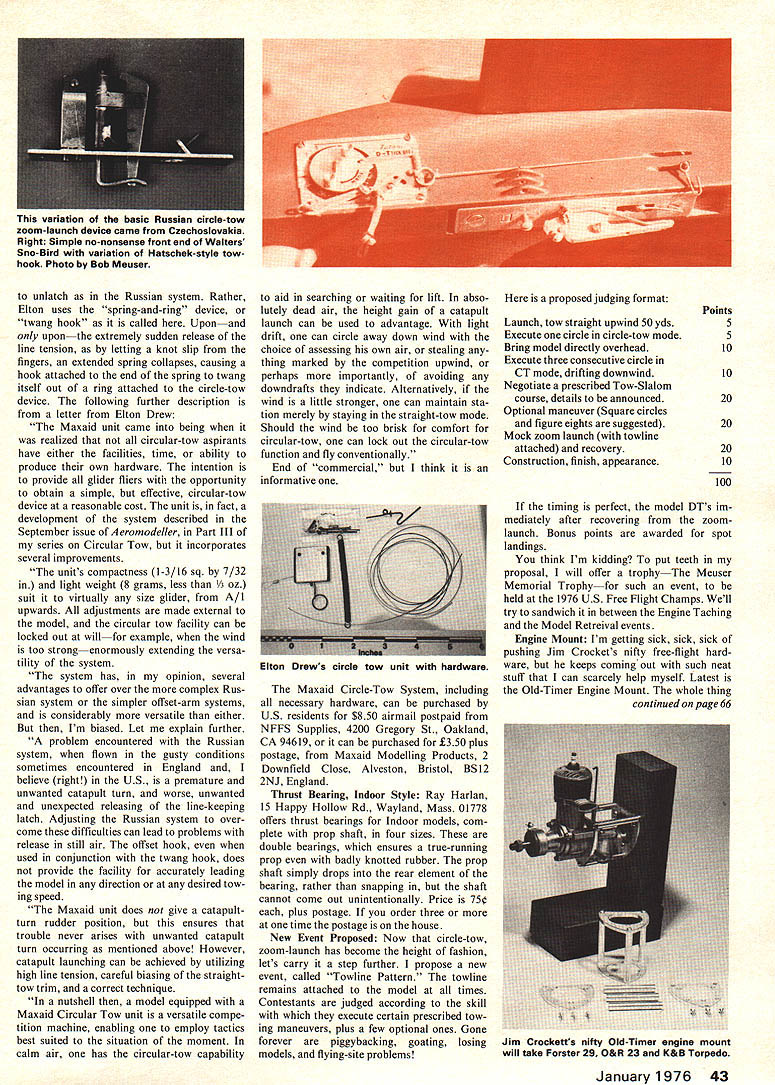
Elton Drew's Max-Aid Circle-Tow Device appears, at first inspection, to be a compromise: there is no "zoom-launch" rudder position; but a zoom launch can be achieved, nevertheless, by biasing the straight-tow rudder position slightly, and by using proper technique, according to Elton. There is no towline keeper in the Max-Aid; rather Elton uses a spring-and-ring device (a "twang-hook") which, upon the extremely sudden release of line tension, lets the knot slip from the fingers. The extended spring collapses, causing the hook attached to the end of the spring to twang itself out of the ring attached to the circle-tow device.
Following a further description in Aeromodeller, the Max-Aid unit came into being to provide circular-tow aspirants who do not have the facilities, time or ability to produce their own hardware with an opportunity to obtain a simple, effective circular-tow device at reasonable cost. In fact, the development of the system described in the September issue of Aeromodeller (Part III of the Circular Tow series) incorporates several improvements: units are compact (1-3/16" sq.), light weight (8 grams, less than 1/3 oz.), and suited to virtually any size glider A/1 upwards. Adjustments are made externally. The model circular-tow facility can be locked out, will, for example, wind t to unlatch as in the Russian system. Rather, Elton uses the "spring-and-ring" device, or "twang-hook" as it is called here. Upon—and only upon—the extremely sudden release of the line tension, as by letting a knot slip from the fingers, an extended spring collapses, causing a hook attached to the end of the spring to twang itself out of a ring attached to the circle-tow device. The following further description is from a letter from Elton Drew:
"The Maxaid unit came into being when it was realized that not all circular-tow aspirants have either the facilities, time, or ability to produce their own hardware. The intention is to provide all glider fliers with the opportunity to obtain a simple, but effective, circular-tow device at a reasonable cost. The unit is, in fact, a development of the system described in the September issue of Aeromodeller, in Part III of my series on Circular Tow, but it incorporates several improvements.
"The unit's compactness (1-3/16" sq. by 7/32" in.) and light weight (8 grams, less than 1/3 oz.) suit it to virtually any size glider, from A/1 upwards. All adjustments are made external to the model, and the circular-tow facility can be locked out at will—for example, when the wind is too strong—or enormously extend the versatility of the system.
"The system has, in my opinion, several advantages to offer over the more complex Russian system or the simpler offset-arm systems, and it is considerably more versatile than either. But then, I'm biased. Let me explain further.
"A problem encountered with the Russian system, when flown in the gusty conditions sometimes encountered in England and, I believe (right!) in the U.S., is a premature and unwanted catapult turn, and worse, unwanted and unexpected releasing of the line-keeping latch. Adjusting the Russian system to overcome these difficulties can lead to problems with release in still air. The offset hook, even when used in conjunction with the twang-hook, does not provide the facility for accurately leading the model in any direction or at any desired towing speed.
"The Maxaid unit does not give a catapult-turn rudder position, but this ensures that trouble never arises with unwanted catapult turns occurring as mentioned above! However, catapult launching can be achieved by utilizing high-line tension, careful biasing of the straight-tow trim, and a correct technique.
"In a nutshell then, a model equipped with a Maxaid Circular Tow unit is a versatile competition machine, enabling one to employ tactics best suited to the situation of the moment. In calm air, one has the circular-tow capability to aid in searching or waiting for lift. In absolute dead air, the height gain of a catapult launch can be used to advantage. With light drift, one can circle away downwind with the choice of assessing his own air, or stealing any lift marked by the competition wind, or perhaps more importantly, of avoiding any downdrafts they indicate. Alternatively, if the wind is a little stronger, one can maintain station merely by staying in the straight-tow mode. Should the wind be too brisk for comfort for circular-tow, one can lock out the circular-tow function and fly conventionally.
"If 'commercial'—but I think it is an informative one.
"The Maxaid Circle-Tow System, including all necessary hardware, can be purchased by U.S. residents for $8.50 airmail postage from NFFS Supplies, 4200 Gregory St., Oakland, CA 94619, or it can be purchased for £3.50 plus postage, from Maxaid Modelling Products, 2 Downfield Close, Alveston, Bristol, BS12 2NJ, England.
"Thrust Bearing, Indoor Style: Ray Harlan, 15 Happy Hollow Rd., Wayland, Mass. 01778 offers thrust bearings for indoor models, complete with prop shaft, in four sizes. These are double bearings, which ensure a true-running prop even with badly knotted rubber. The prop shaft simply drops into the rear element of the bearing, rather than snapping in; but the shaft cannot come out unintentionally. Price is 75¢ each, plus postage. If you order three or more at one time the postage is on the house.
"New Event Proposed: Now that circle-tow, zoom-launch has become the height of fashion, let's carry it a step further. I propose a new event, called 'Towline Pattern.' The towline remains attached to the model at all times. Contestants are judged according to the skills with which they execute certain prescribed towline maneuvers, plus a few optional ones. Gone forever are piggybacking, goating, losing models, and flying-site problems!
Here is a proposed judging format:
- Launch, two straight upwind 50 yds.: 5 points
- Execute one circle in circle-tow mode: 5 points
- Bring model directly overhead: 10 points
- Execute three consecutive circles in CT mode, drifting downwind: 10 points
- Negotiate a prescribed Tow-Slalom course, details to be announced: 20 points
- Optional maneuvers (square circles and figure eights are suggested): 20 points
- Mock zoom launch (with towline attached) and recovery: 10 points
- Construction, finish, appearance: 20 points
Total: 100 points
If the timing is perfect, the model DT's immediately after recovering from the zoom-launch. Bonus points are awarded for spot landings.
You think I'm kidding? To put teeth in my proposal, I will offer a trophy—the Meuser Memorial Trophy—for such an event, to be held at the 1976 U.S. Free Flight Champs. We'll try to sandwich it in between the Engine Tacking and the Model Retrieval events.
Engine Mount: I'm getting sick, sick, sick of pushing Jim Crockett's nifty free-flight hardware, but he keeps coming out with such neat stuff that I can scarcely help myself. Latest is the Old-Timer Engine Mount. The whole thing continued on page 66.
FF Duration/Meuser
continued from page 43
can be purchased for $6.95, or you can buy the individual parts. The unit accommodates the Forster 29, O&R 23 and K&B Torpedo. While primarily for flying, parts are nicely polished, so the unit makes an attractive display too. Weight is 29.4 grams — a thin hair over an ounce — and overall length is 2 in. For more info, write to Jim at 1442 N. Fruit Ave., Fresno, CA 93728.
Call for Papers: The National Free Flight Society is soliciting papers for the 1976 NFFS Symposium to be held at the 1976 Nats. Papers will be published in the 1976 Symposium volume whether or not the author is able to present his paper personally at the Nats. Papers should cover some aspect of science or art of free-flight modeling, including technical studies, practical design and engineering as applied to models, new or unusual model aircraft developments, or historical items. Both indoor and outdoor free-flight modeling developments are to be included. Please send proposed papers to: Ray Harlan, 15 Happy Hollow Rd., Wayland, Mass. 01778. Send title of proposed paper together with an abstract of 200 words, or more, or a complete paper if it is available. To be considered, abstracts should be submitted by Feb. 15, 1976.
Book Review: Aero-Modeller Annual, 1975-76. Why a review of a general model aviation book in a free-flight column? Well, I'll skip the R/C and C/L stuff, and judge it solely on its free-flight content.
A sign of the times perhaps: in the first Annual I've seen as a paperback, and the price has doubled in two years. The U.K. price translates into $4.50, but what the actual U.S.A. price will be remains to be seen. Compared to what you get for your money when you buy, say, $6.00 worth of magazines, I imagine many of you will judge it worth the money.
For the last few weeks I have been testing a new product called Power/Charge from S.P. Systems in Marietta, Ga. It is a combined nickel-cadmium battery discharge-charger and field tester. While I haven't made a comprehensive test of the unit, it seems to do all that it is advertised to do. I have used it with the batteries in my two radio systems, and an old, questionable, airborne pack. In all cases the Power/Charge progressively increased the discharge time (indicating increased capacity). Especially striking was the capacity increase of the old battery pack. After an initial charge, the old 475-ma pack should have discharged for at least 2 hours 10 minutes. The first discharge only lasted 1 hour 40 minutes, the second discharge was 2 hours 4 minutes and a third discharge lasted 2 hours 20 minutes. Subsequent discharges of the pack hovered around 2 hours 30 minutes. Similar, but less startling, capacity increases occurred for the other battery packs which were tested. In the future a more comprehensive review will be published.
Have you seen the new book for beginners called "Basics of Radio Control Modeling?" Fred Marks co-authors the book with Model Aviation editor Bill Winter. Fred was in town a couple of weeks ago on business and presented me with a copy for review. It is a remarkably well done piece of work. The book includes chapters on tools, materials, radio equipment, engines, airplanes, boats, cars, and other models. I like the way it's written, and the photography has a quality not often seen in model publications.
My address is: 12 Connie Dr., Shalimar, Fla. 32579.
Transcribed from original scans by AI. Minor OCR errors may remain.

