
Free Flight: DURATION
Bob Meuser
Chicago Aeronuts Banquet
I seldom announce club banquets—mainly because I am seldom asked to—and I'd be in big trouble if I announced every banquet given by every club in the country, so I don't want to start a trend. But this banquet is something special, especially since it has been five years since the last similar shindig and because the club running it is perhaps the most prestigious and venerable one in the country (second only to one which modesty prevents me from mentioning).
The Big Deal is to take place on Saturday, April 19. Cocktails and such at 6:00 p.m., Heck's, 5149 N. Milwaukee Ave., Chicago. Prime rib with all the trimmings goes for $11 a head. Maximum is 140 persons. Contact man is Rudy Schuh, 267 E. County Line Road, Barrington, IL 60010.
Attendees include:
- Pete Vacco and Carl Goldberg (coming from California)
- Jim Richmond (from the East)
- Ed Lidgard (from the South)
Top Indoor HLG: Wasp III
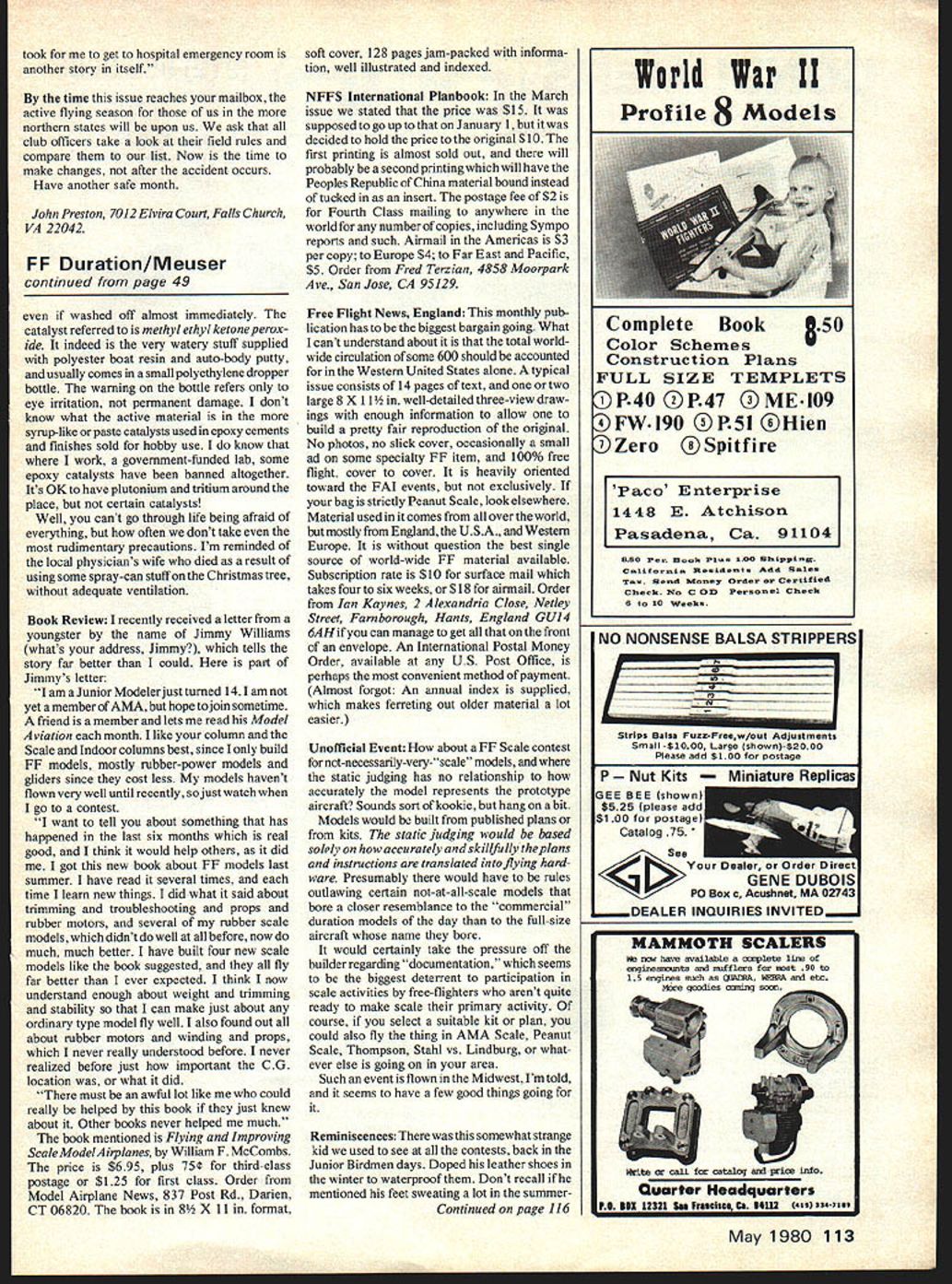
Wasp III is the medium-ceiling hand-launched glider (HLG) that got its designer, Mike Stoy, second place and the first-place award for his brother, Stan, at the 1979 Nats. If you have been paying attention to this column, you already know about their Coot and Folder designs, both of which have set many records. Here is the story of Wasp III, as told by Stan.
The Wasp III design is all Mike's; I made a few small changes, the most notable being smaller tail feathers and the use of spars in the softer wings. Wasp III was drawn up in the spring of 1974 and evolved from a long line of progressively larger HLGs dating back to 1971. Mike first flew it at the 1974 Midwestern Indoor Champs and won first place, beating Bob Hayes, who had recently set the senior record. At the 1974 Nats, Mike again won first in Senior and was topped only by Open flier Rudy Kluiber. (At the 1974 Nats there were two indoor competitions at different sites.) The model was lightened and flown to second place two days later at Lake Charles. The only other contest Mike failed to win was as a Senior (second place at the Nats isn't exactly losing). Mike was at the Nats the following year, where he again took second place. Arnie Schmidt, another Senior, took fourth using Wasp III at the 1975 Nats; it was his first IHLG contest.
In 1975 I started flying in medium- and high-ceiling contests. Since then the Wasp has won or placed high at numerous Midwestern contests. The most notable was when Mike and I tied for first at the 1979 contest at Anderson, IN, which drew the best competition in the central states, including four Nats HLG winners. The model had been finely tuned for 40- to 60-foot ceilings. In 1976 Mike clocked 48.4 seconds at Anderson (43 ft.), and I did 59.8 seconds with it in Detroit (47 ft.).
At the 1979 Nats both Mike and I had new models including some light folders; however, time was too short to sort them out, so we used our four-year-old Wasps. While I was able to transition within about a foot of the ceiling, Mike's lighter 9-gram model never got within four feet. No question that model had the lowest sink rate of any there.
Construction details:
- All joints and seams are really tight. Glue everything together.
- Hot Stuff is used for most joints (except tail and finger rest).
- Tail and finger rest are assembled using Ambroid so the tail can be removed—soften Ambroid with thinner to remove, then re-set if necessary.
- Finger rest attached with Titebond.
- Wing is nearly 1/8 in. thick, with almost 1/16 in. of undercamber—sanded in using Mike's reflex method (the upside-down wing is bent over a curved form, and the bottom is then sanded flat).
- Finish is two coats of thinned Litecoat.
- Leading-edge radius is very small.
Gliders are launched at angles between 70° and 90°. Models having flexible stabs going up steeply convinced me that chord-wise flexibility of the stab affects transition. High undercamber thickness reflects the desire to minimize sinking speed at the expense of high drag during launch. Structural strength rather than throwing ability limits height; medium-ceiling models can be thrown. Under certain conditions, thick undercamber wings come out on top. I am foolish enough to think that the Wasp III is the best IHLG design around; certainly it can go head-to-head with the best fixed-geometry gliders.
Better Mousetrap
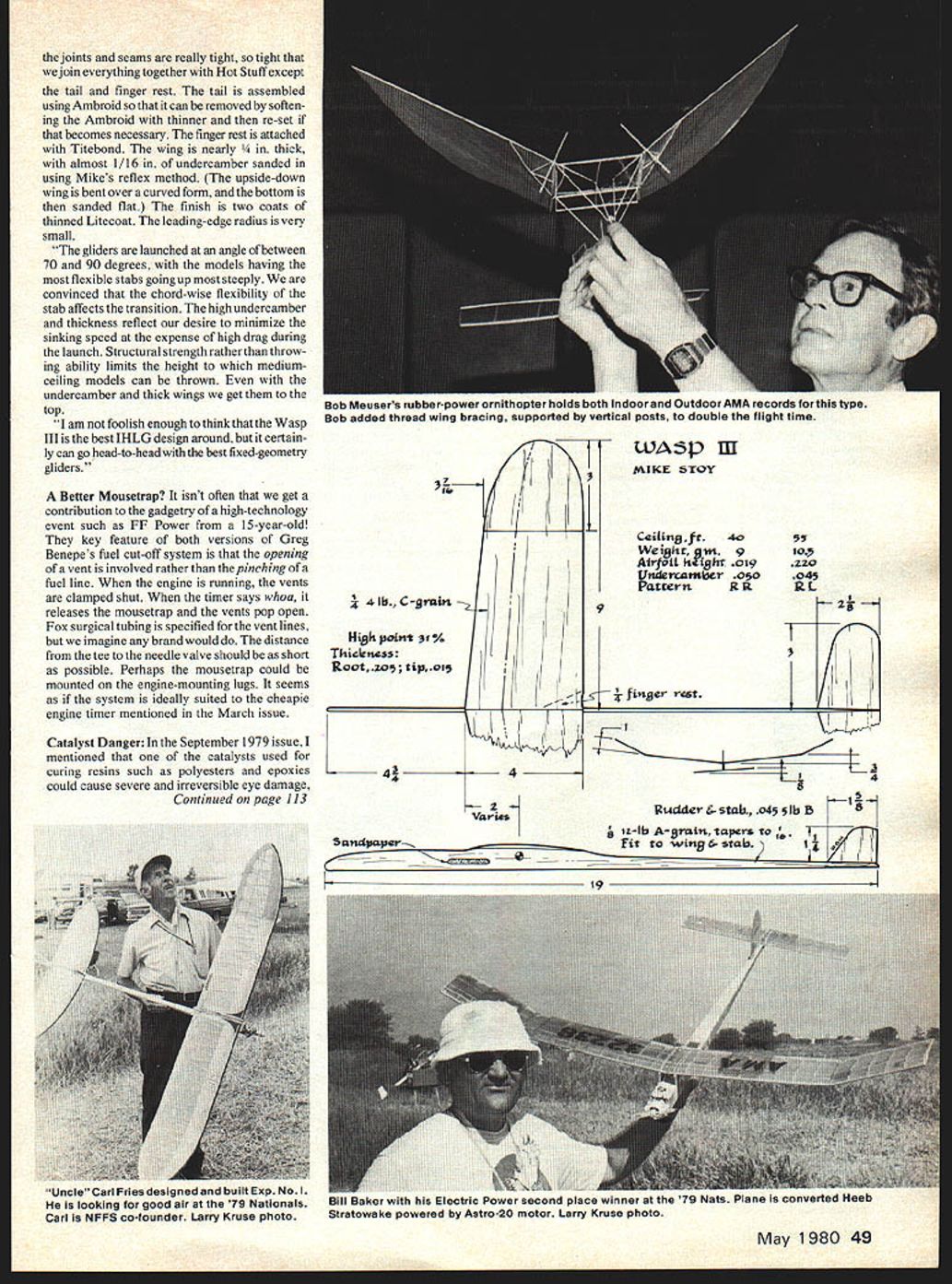
Better Mousetrap isn't often the recipient of gadgetry and high technology, but a key feature in both versions discussed here is Greg Benepe's fuel cut-off system. It uses an opening vent rather than pinching a fuel line. With the engine running, vents are clamped shut; when the timer says "whoa," the releases cause the mousetrap vents to pop open.
Details and recommendations:
- Use Fox surgical tubing for vent lines (any brand would do).
- Keep the distance from the tee to the needle valve as short as possible.
- The mousetrap could perhaps be mounted on engine-mounting lugs.
- The system seems ideally suited to cheap engine timers mentioned in the March issue.
Catalyst Danger
In the September 1979 issue I mentioned that catalysts used in curing resins such as polyesters and epoxies could cause severe irreversible eye damage. Even if washed off almost immediately, the catalyst I referred to is methyl ethyl ketone peroxide (MEKP). It is the watery stuff supplied with polyester boat resin and auto-body putty and usually comes in a small polyethylene dropper bottle. The warning on the bottle refers only to eye irritation, not permanent damage.
I don't know what the active material is in the more syrup-like or paste catalysts used in epoxy cements and finishes sold for hobby use. I do know that where I work, a government-funded lab, some epoxy catalysts have been banned altogether. It's OK to have plutonium and tritium around the place, but not certain catalysts!
Well, you can't go through life being afraid of everything, but how often do we not take even the most rudimentary precautions. I'm reminded of the local physician's wife who died as a result of using some spray-can stuff on the Christmas tree without adequate ventilation.
Book Review
I recently received a letter from a youngster by the name of Jimmy Williams (what's your address, Jimmy?), which tells the story far better than I could. Here is part of Jimmy's letter:
"I am a Junior Modeler just turned 14. I am not yet a member of AMA, but hope to join sometime. A friend is a member and lets me read his Model Aviation each month. I like your column and the Scale and Indoor columns best, since I only build free flight models, mostly rubber-power models and gliders since they cost less. My models haven't flown very well until recently, so just wait 'til I go to a contest.
"I want to tell you about something that has happened in the last six months which is real good, and I think it would help others, as it did me. I got this new book about FF models last summer. I have read it several times, and each time I learn new things. I did what it said about trimming and troubleshooting and props and rubber motors, and several of my rubber scale models, which didn't do well at all before, now do much, much better. I have built four new scale models like the book suggested, and they all fly far better than I ever expected. I think I now understand enough about weight and trimming and stability so that I can make just about any ordinary type model fly well. I also found out all about rubber motors and winding and about props, which I never really understood before. I never realized before just how important the C.G. location was, or what it did.
"There must be an awful lot like me who could really be helped by this book if they just knew about it. Other books never helped me as much."
The book mentioned is Flying and Improving Scale Model Airplanes by William F. McCombs. Price is $6.95, plus 75¢ for third-class postage or $1.25 for first class. Order from Model Airplane News, Box 37, Post Rd., Roxbury, CT 06820. The book is 8½ x 11 in., soft cover, 128 pages jam-packed with information, well illustrated and indexed.
NFFS International Planbook
In the March issue we stated that the price was $15. It was supposed to go up to that on January 1, but it was decided to hold the price at the original $10. The first printing is almost sold out, and there will probably be a second printing which will have the People's Republic of China material bound instead of tucked in as an insert.
Postage: $2 for Fourth Class mailing to anywhere in the world for any number of copies, including Symposia reports. Airmail: $3 per copy in the Americas; $4 to Europe; $5 to Far East and Pacific. Order from Fred Terzian, 4858 Moorpark Ave., San Jose, CA 95129.
Free Flight News, England
This monthly publication has to be the biggest bargain going. What I can't understand about it is that the total worldwide circulation of some 600 should be accounted for in the Western United States alone. A typical issue consists of 14 pages of text and one or two large 8 x 11½ in. well-detailed three-view drawings, with enough information to allow one to build a pretty fair reproduction of the original. No photos, no slick cover, occasionally a small ad on some specialty FF item, and 100% free flight, cover to cover.
It is heavily oriented toward the FAI events, but not exclusively. Material used in it comes from all over the world, but mostly from England, the U.S.A., and Western Europe. It is without question the best single source of world-wide FF material available. Subscription rate is $10 for surface mail (takes four to six weeks), or $18 for airmail. Order from Ian Kaynes, 2 Alexandria Close, Netley Street, Farnborough, Hants, England GU14 6AH. If you can manage to get all that on the front of an envelope, an International Postal Money Order, available at any U.S. Post Office, is perhaps the most convenient method of payment. An annual index is supplied, which makes ferreting out older material a lot easier.
Unofficial Event
How about a FF Scale contest for not-necessarily-very-"scale" models, and where static judging has no relationship to how accurately the model represents the prototype aircraft? Sounds sort of kooky, but hang on a bit. Models would be built from published plans or from kits. The static judging would be based solely on how accurately and skillfully the plans and instructions are translated into flying hardware. Presumably there would have to be rules outlawing certain not-at-all-scale models that bore a closer resemblance to the "commercial" duration models of the day than to the full-size aircraft whose name they bore.
It would certainly take the pressure off the builder regarding "documentation," which seems to be the biggest deterrent to participation in scale activities by free-flighters who aren't quite ready to make scale their primary activity. Of course, if you select a suitable kit or plan, one could also fly the thing in AMA Scale, Peanut Scale, Thompson, Stahls vs. Lindburg, or whatever else is going on in your area.
Such an event is flown in the Midwest, I'm told, and it seems to have a few good things going for it.
Reminiscences
There was this somewhat strange kid we used to see at all the contests, back in the Junior Birdmen days. He doped his leather shoes in the winter to waterproof them. I don't recall if he mentioned his feet sweating a lot in the summer.
He sandpapered his tissue to make it lighter. I don't know whether it saved much weight, but it sure fuzzied it up a lot, and it had tremendous psychological value—how could I ever hope to beat a guy who sandpapered his tissue paper?
At the California State Fair model plane meets, we got regular official state medals—gold, silver, bronze—the same as the winemakers, beet growers, and cattle ranchers. For the winemakers and such it was money in the pocket in advertising value; for us it was important, but in a different way. Anyhow, this guy wins a gold or silver medal, whatever, and immediately sends it somewhere to have it assayed. It comes back with a big notch sawed out of the side, the answer: "Nope, it's plated zinc-base alloy (pot-metal)," and with an invoice for $5. That was in the days when you could get a Buick Century or a Packard 180 for $1,200.
Bob Meuser 4200 Gregory St., Oakland, CA 94619
Transcribed from original scans by AI. Minor OCR errors may remain.

