
Free Flight: Duration
Bob Meuser
Correction
In the caption to the photo of the AD-15 engine in the April issue I said "production is not planned." At the FF World Champs I was told that only 20–30 engines per year were being manufactured, which scarcely qualifies as "production." Whether that remains true, or whether the production rate has been increased as a result of Mario Rocca's winning the World Champs, is not clear. Nevertheless, the engine is available in two versions, according to Rocca:
- Normal AD-15
- Supplier: Alberto Dall'Oglio
- Address: Via Gagliardotti 13, 36100 Vicenza, Italy
- Price: $130 plus $5 postage
- Free-Flight Tuned AD-15
- Supplier: Mario Rocca
- Address: 44040 Rovereto Ferrarese, Italy
- Price: $170 plus $5 postage
- Includes: testing, spinner, pressure fitting, large-section flood-off fitting, enlarged venturi
Payment: International Postal Money Order is the simplest method. Delivery: about 30 days.
Ribs — Italian Style
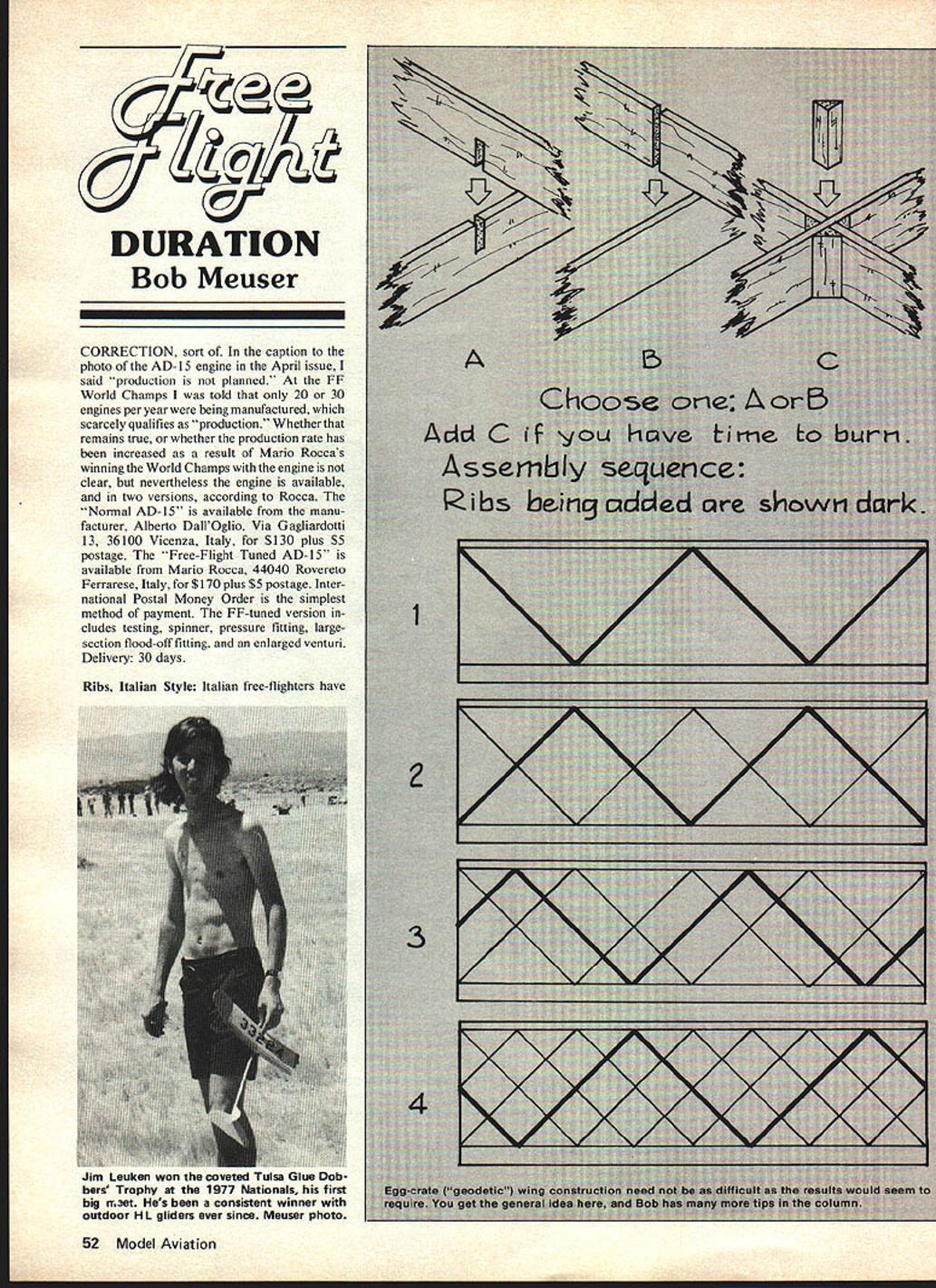
Italian free-flighters have long favored what is commonly called "egg-crate" or "geodetic" construction for wing and tail surfaces in some competition classes. Alberto Dall'Oglio won the 1963 Power World Champs with a model using diagonal ribs on 2-cm (0.78 in.) centers. Since then, FAI Power fliers have tended toward sheet-balsa-covered surfaces as engines have become more powerful and builders have sought greater rigidity. Mario Rocca's 1979 World Championship win with an egg-crate model might renew interest in this effective form of construction.
The term "geodetic construction" is something of a misnomer. In the 1930s the phrase was applied — or misapplied — to describe a diagonal construction quite different from true geodetic structures used in full-scale aircraft. The "egg-crate" name comes from the way ribs are sometimes notched halfway through, like old-fashioned cardboard egg-crate dividers.
There are two popular ways to handle ribs where they cross:
- Notch each rib halfway through (egg-crate style).
- Leave one rib intact and cut the other rib through its full depth. This minimizes warpage from glue shrinkage, but the full-depth-cut ribs may end up slightly wiggly.
Construction looks difficult or time-consuming, but Rocca says he can pop all the ribs into place in an evening — with practice.
Assembly tips:
- Lay ribs slanting one way first, then lay ribs slanting the other way. Glue shrinkage and humidity changes will almost certainly warp a wing if all ribs are laid the same way.
- The proper method is to lay a symmetrical zigzag: ribs alternating displaced right and left until you run out. This balances left- and right-handed glue joints and reduces warping.
- Ribs can be pre-notched, but bookkeeping (keeping track which ribs are notched on top or bottom) can be tedious. An alternative is to notch as you go; an omitted notch is usually obvious and easy to fix.
- Spar notching can be done after the ribs are in place to simplify bookkeeping.
- Ribs can be shaped to final profiles before assembly, but it is often simpler to install them as balsa rectangles and sand to shape afterward. A shaped sanding block with glued sandpaper and a template or two is a worthwhile investment.
Ribless construction, revisited
Dave Gibson proposed an interesting variation on the "Look, Ma, no ribs!" idea. The key concept is to use standard-size strip-wood for all spanwise members: leading edge, trailing edge, and spars. If a top-surface spar doesn't stick up far enough, prop it up to obtain the desired airfoil section.
Torsional rigidity concerns:
- Unless you build a geodetic structure, about 90% of a wing's torsional rigidity comes from the covering; the framework's torsional resistance is essentially negligible.
- Ribless construction should be neither better nor worse than conventional construction in torsional rigidity terms.
- Geodetic (cross-rib) construction greatly increases torsional rigidity if the ribs are full depth of the airfoil. Trying to increase torsional stiffness in ribless construction by angling non-ribs relative to the chord is ineffective, because the non-ribs lack vertical bending rigidity required for geodetic action.
- Torsional resistance is often correlated with warp resistance. If the covering is applied uniformly and doped adequately (but not excessively), warpage is usually not a major problem. Ed Lidgard reports some 40-year-old wings as straight as the day they were built.
Anecdote: I might report on 40-year-old wings of my own, too, if cats hadn't found them comfortable as beds some 38.6 years ago.
India Nats
Many of us know little about India beyond stereotypes: "backward countries" or, more politely, "developing nations." Despite economic and resource challenges, India has an active aeromodelling community.
- Organization: All India Aeromodellers Association (roughly equivalent to our AMA).
- President: Bijay Manzil, who holds the title MaharajaBhadurjah Bahadur of Burdwan.
- Coverage: Prasanta Banerjee, a Nordic flier and editor of The Calcutta (a sometimes-occasional newsletter), provided information; he served as joint secretary and joint treasurer of their recent nationals.
- Their 1979 Nats: a 32-page slick-cover souvenir program — their 33rd Nats — with perpetual trophies comparable in heritage and prestige to our Mullin trophies.
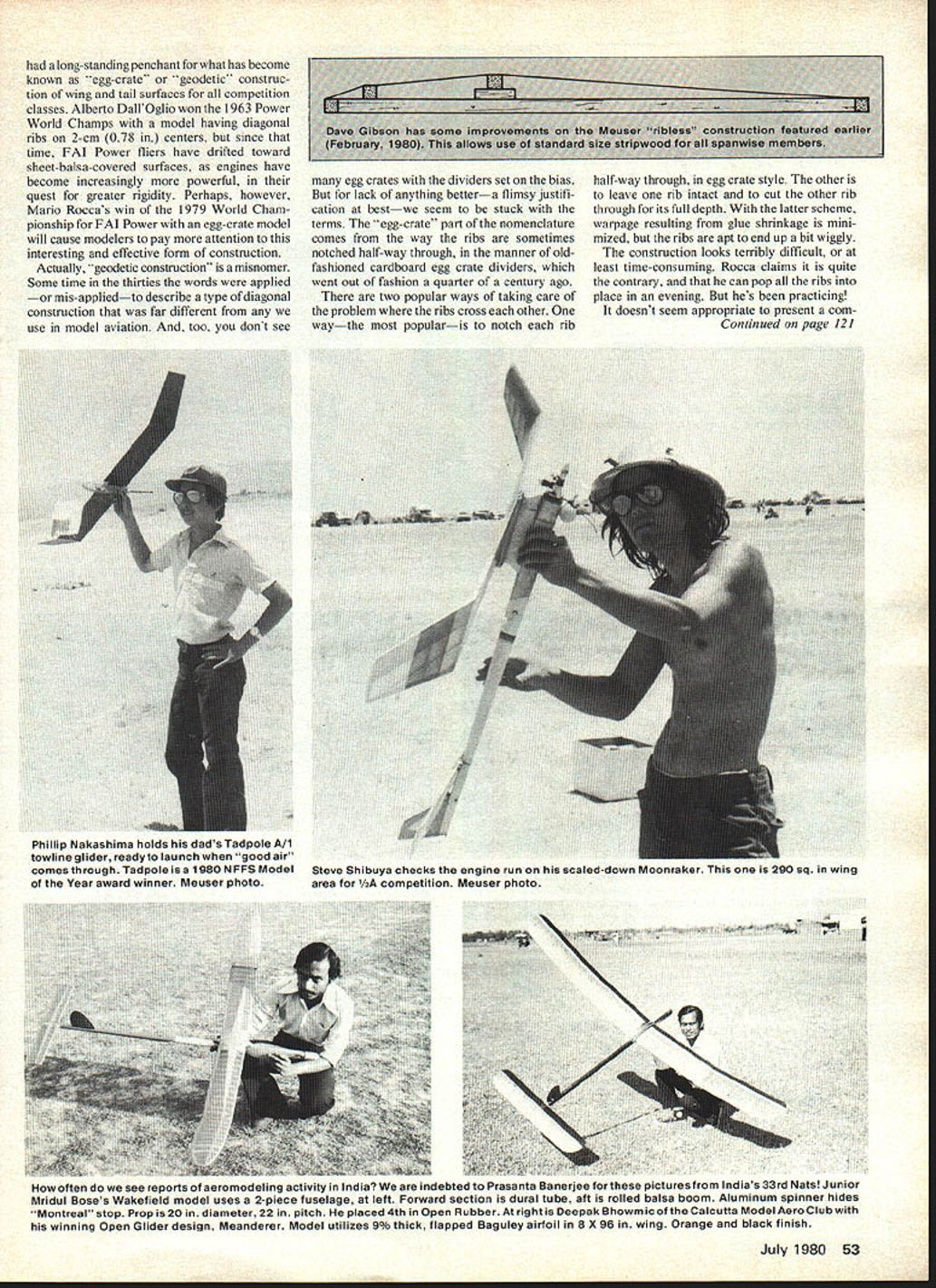
We are pleased to present photos of some of their models and hardware. If India strikes oil, watch out for these fellows at the next World Champs!
FIC fliers, arise
I like using acronyms such as "FIC" that few people understand — it makes me sound important. A friend who had flown Wakefield (F1B) for five years asked me what "VIT" meant. Not knowing for sure, I said it meant "Very Important Thing" and he seemed satisfied. (The editor believes it might be "variable incidence tail" — RBM.)
The current World Champ in F1C (FAI Power) used a fiberglass "pool cue" for a tailboom. At about the time these went out of fashion here, the NFFS ordered a supply of excellent booms; only a few have been sold. They are inexpensive relative to their purchase price from some years ago and make good RC sailplane booms as well.
Boom specifications and ordering:
- Length: 42 in.
- Diameter: 0.52 in. at the small end, 0.8 in. at the big end
- Weight: 59 grams
- Price: $7 each
- Postage: $0.50 extra for Parcel Post or $1.50 for First Class per order
- Order from: Karen Thompson, 2012 Landon Lane, Sacramento, CA 95825
Note: You could encounter vibration problems with fiberglass booms, but these are unlikely if tailfeathers are kept light.
NFFS Model of the Year awards (1980)
- A/2 Towline Glider: Mike Fanfam (England)
- Wakefield: Itzhak Ben-Itzhak (Israel)
- FAI Power: Doug Galbraith
- F1A Power: Gil Morris for Toothpicks
- Large Power Models: Mark Woodley
- Outdoor Rubber: Chan Leano for the historic (but still winning) Lanzar Stick
- Outdoor HLG: Zingaroo — Paul Lagan, Mike Elmore, and Gary Bowden (New Zealand)
- A/I Glider: George Xenakis for the Tadpole
- Indoor Rubber: Jim Richmond for his world-record Starlwalker
- Indoor Hand-Launch Glider: John Taitono for Tim-Bird
- Special awards: Bob Tunstall and Carl Goldberg for the invention of the pop-up stabilizer dethermalizer
New Wakefield Record
Bill Bogart's nine-year-old national record for outdoor rubber Wakefield models has been broken by — you'd never guess — Bob White. Although Bob dropped only two max flights out of 80 in competition, ...
Transcribed from original scans by AI. Minor OCR errors may remain.

