
DURATION
Bob Meuser
The venerable S-hook, re-revisited
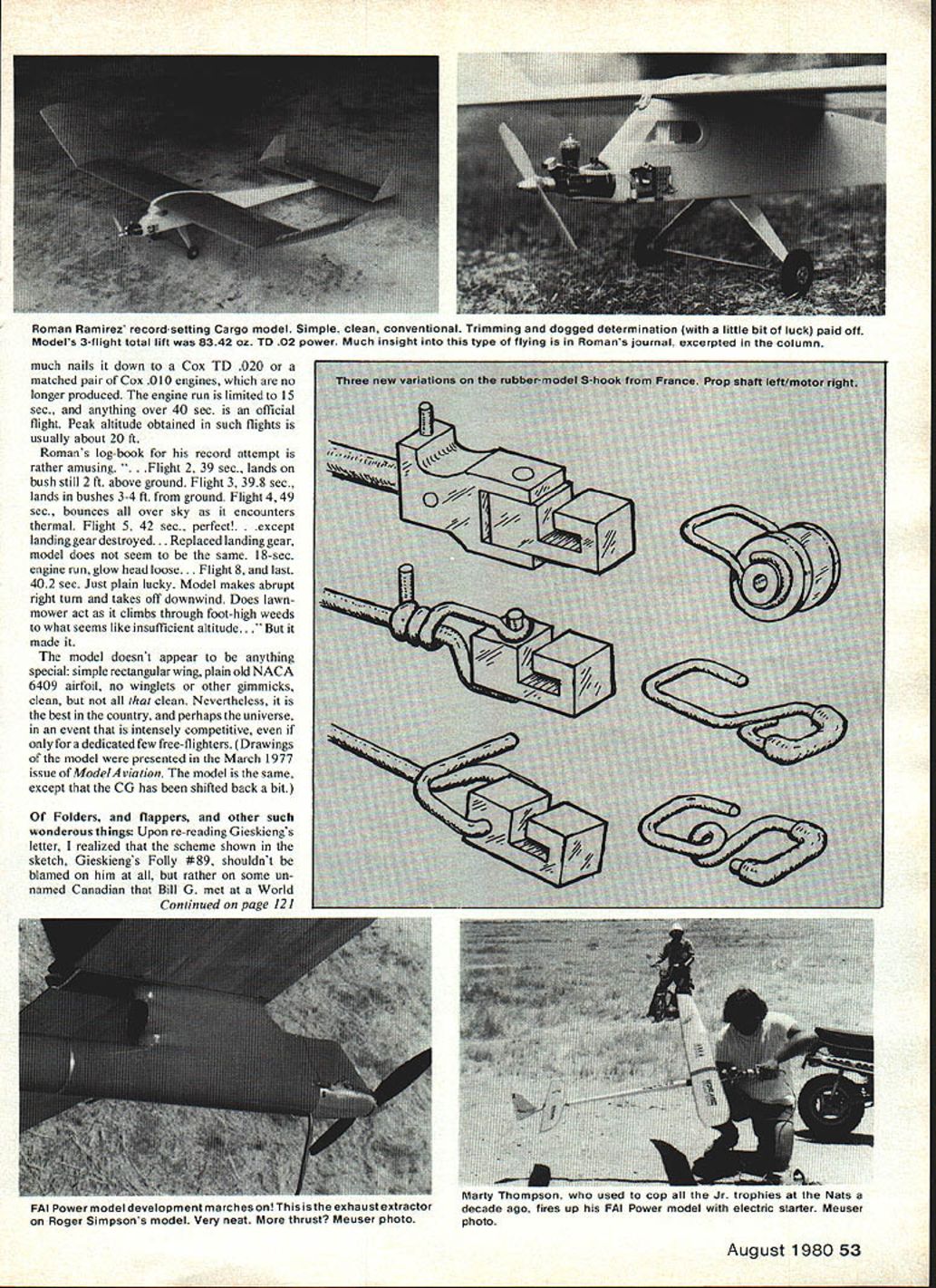
In days of yore, an S-hook was an S-hook: simply a piece of music wire bent to the shape of an S. It served adequately as a link between the rubber motor and either the prop-shaft or the rear hook. But it had its problems. Invariably, the thing would crawl around and end up where it wasn't supposed to be. Hundreds of solutions have been developed over the past half century, but new ones keep popping up. There is no single "best" solution, because what is best for one person may not be best for someone with a different set of skills, tools, or goals.
The three variations shown in the sketch come from the French magazine Modèle Réduit d'Avion. They all involve a block whittled and cussed into shape with a jeweler's saw and a file, or perhaps a milling machine. All three have some sort of universal-joint action. In the lower sketch, however, a better effect would be obtained by drilling the hole for the prop-shaft wire at 90 degrees from the direction shown.
Any of the three hooks on the right will couple with any of the three prop-shaft fitments on the left. The upper one incorporates a single bobbin, which is pretty tough to beat, but it is hard to make one without a lathe. The bottom bent-wire affair incorporates an extra loop for a wire pin, useful for transferring the rubber motor from the winder to the prop after the motor is wound. The bobbin has a central hole to do the same job. The device in the middle has no provision for a holding pin, but perhaps one could be stuck through the loop just forward of the motor. For Coupes and smaller models, you won't have to bother with a holding pin if you have reasonably strong hands and can manage to avoid getting rubber lube all over them.
Ornithopter
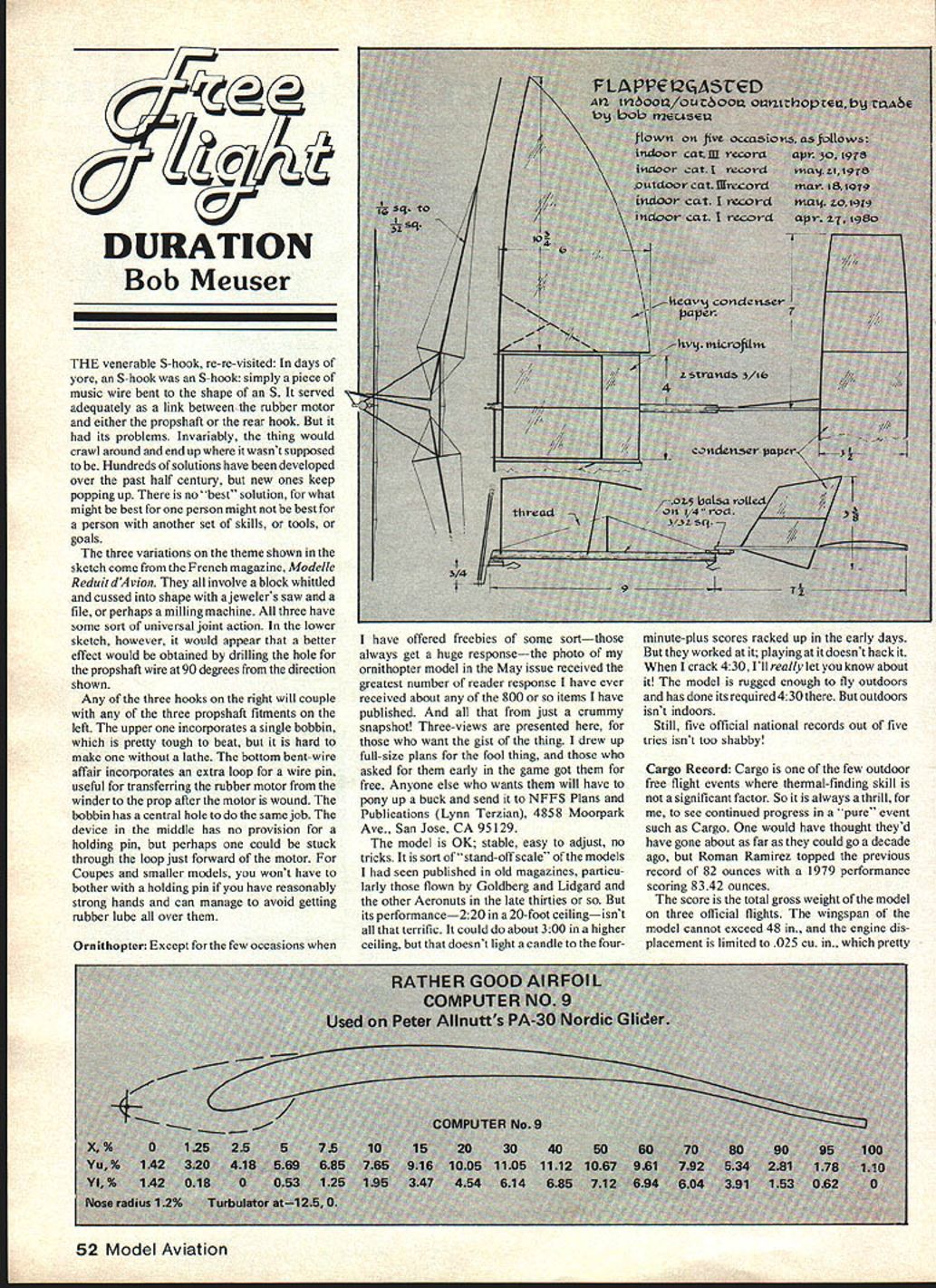
Except for the few occasions when I have offered freebies—those always get a huge response—the photo of my ornithopter model in the May issue received the greatest number of reader responses I have ever received about any of the 800 or so items I have published. And all that from just a crummy snapshot! Three views are presented here, for those who want the gist of the thing. I drew up full-size plans for the whole thing, and those who asked for them early in the game got them for free. Anyone else who wants them will have to pony up a buck and send it to NFFS Plans and Publications (Lynn Terzian), 4858 Moorpark Ave., San Jose, CA 95129.
The model is OK: stable, easy to adjust, no tricks. It is sort of "stand-off scale" compared to models I had seen published in old magazines, particularly those flown by Goldberg, Lidgard, and the other Aeronuts in the late thirties. But its performance—2:20 in a 20-foot ceiling—isn't all that terrific. It could do about 3:00 in a higher ceiling, but that doesn't hold a candle to the four-minute-plus scores racked up in the early days. They worked at it; playing at it doesn't hack it. When I crack 4:30, I'll really let you know about it! The model is rugged enough to fly outdoors and has done its required 4:30 there. But outdoors isn't indoors.
Still, five official national records out of five tries isn't too shabby!
Cargo record
Cargo is one of the few outdoor free-flight events where thermal-finding skill is not a significant factor. So it is always a thrill to see continued progress in a "pure" event such as Cargo. One would have thought they'd have gone as far as they could a decade ago, but Roman Ramirez topped the previous record of 82 ounces with a 1979 performance scoring 83.42 ounces.
The score is the total gross weight of the model on three official flights. The wingspan of the model cannot exceed 48 in., and the engine displacement is limited to .025 cu. in.—which pretty much nails it down to a Cox TD .020 or a matched pair of Cox .010 engines, which are no longer produced. The engine run is limited to 15 sec., and anything over 40 sec. is an official flight. Peak altitude obtained in such flights is usually about 20 ft.
Roman's logbook for his record attempt is rather amusing: "...Flight 2, 39 sec., lands on bush still 2 ft. above ground. Flight 3, 39.8 sec., lands in bushes 3–4 ft. from ground. Flight 4, 49 sec., bounces all over sky as it encounters thermal. Flight 5, 42 sec., perfect!... except landing gear destroyed. Replaced landing gear. Model does not seem to be the same. 18-sec. engine run, glow head loose... Flight 8, and last, 40.2 sec. Just plain lucky. Model makes abrupt right turn and takes off downwind. Does lawnmower act as it climbs through foot-high weeds—what seemed like insufficient altitude... " But it made it.
The model doesn't appear to be anything special: simple rectangular wing, plain old NACA 6409 airfoil, no winglets or other gimmicks, clean but not exceptionally so. Nevertheless, it is the best in the country, and perhaps the universe, in an event that is intensely competitive, even if only for a dedicated few free-flighters. (Drawings of the model were presented in the March 1977 issue of Model Aviation. The model is the same, except that the CG has been shifted back a bit.)
Of folders, flappers, and other wondrous things
Upon re-reading Gieskieng's letter, I realized that the scheme shown in the sketch—Gieskieng's Folly #89—shouldn't be blamed on him at all, but rather on some unnamed Canadian that Bill G. met at a World Champs. The real Gieskieng's Folly #89 is as follows: the wings are hollow moldings of silicone rubber. During the climb the wings are rolled up like those New Year's Eve things. Then, just before the engine cuts, the exhaust is directed into the wing cavities and brr-ap!... out they go into the glide position.
Not all of the practical details of either of these schemes have been totally solved; I felt I should warn you. OK, Perryman, your move!
Stan Stoy, watch out! Bill Gieskieng has two new folder/flapper-type concepts. This is one of them; the other is in the column.
Rather good airfoil
Having already presented what the editor referred to as the "World's Best Low Speed Airfoil" in the April issue, what am I supposed to do for an encore? A tough act to follow! In the item about the Lissaman airfoil used on the Gossamer Albatross, I mentioned that I'd present one of Peter Allnutt's airfoils "next month." But Peter's material got buried 'twixt the pages of an old NFFS Symposium report and floated to the surface again only recently.
The airfoil shown is one of a series representing the combined efforts of Brian Egglestone of de Havilland Canada, Dr. David Surry of the University of Western Ontario, and members of the Toronto FAI Group. Earlier work appeared in the 1978 NFFS Symposium Report (A New Family of High-Lift Airfoils for Low Reynolds Number, by Peter J. Allnutt). The Computer #9 airfoil, used on Peter's PA30, "...has a uniform 'roof-top' pressure region followed by a concave, separation-free, pressure recovery region having fully turbulent flow." This section, along with all the previous sections with the reflexed trailing edge, showed very good performance. However, they had two very unusual characteristics: the pull exerted by the model while being towed was incredibly high—ideal for calm air though—and the models required very large decalage. Some had 7 to 8 degrees. Maybe this isn't surprising, as the wing doesn't stall until around 12 to 15 degrees!
Peter uses a "shirring thread" turbulator, consisting of a fine strip of rubber encased in a spiral wrapping of fine thread. The material is available in stores selling cloth yardage and sewing materials. The thread vibrates in the wind, leaving a swath of turbulent air behind it. I set the drawing of Peter's foil at its stalling angle and sketched in what I thought were realistic streamlines. It appeared that the streamline passing through the turbulator would pass far above the wing, so I asked Peter about that. Peter replied: "You may have a good point. However, we have not as yet had time to try a variety of locations for the turb. We put it where it is shown in the article by Max Hacklinger in the May 1954 Aero Modeller... we figured he knew what he was doing. He states: 'A failing with our former models was the low mounting of the turbulator... flight measurements showed that at 5° angle of attack the turbulator only creates drag, but at 9° the turbulator improves performance substantially.' It is possible that with much more work on turbs, higher performances will be obtained, but it will take a while to do the work."
The vertical positioning of the turbulator is critical. I recall once watching Hank Cole testing an old model. Hank's model used a full-span nylon monofilament turb, not the shirring thread. The turning characteristics of the model had changed severely; it simply didn't want to turn in the direction Hank wanted it to. Hank thought it best to let it have its own way, and was about to re-rig the autorudder for the opposite turn, when he noticed that one of the wire supports for the turb had gotten bent a little, putting the turb in the wrong position. After the turb support wire was straightened, the model circled nicely.
Hank also had a model with a turbulator on only one wing half, making that wing stall later than the other. This gave the model a nice recovery when Hank zoomed it off the towline into a thermal, with little chance for a disastrous complete stall.
Incidentally, the dashed lines on the airfoil drawing represent plywood supports for the turb; less likely to become bent than wire ones.
Next month we'll present another of Peter's airfoils that is even better in some respects than the Computer #9.
Aeromodeller Annual bites the dust
First published in the late forties, this fine, free-flight–intensive, book-type annual is to be no more, joining the ranks of other annuals that have ceased publication: Air Trails Annual, Model Airplane News Annual, and, alas, Frank Zaic's Model Aeronautic Yearbooks. The intolerably high production costs for small books, even in paperback form as the Annual has been for the past four years, made continued publication impractical.
But another annual publication will take its place. Published in magazine format, the same size as the Aeromodeller magazine, the new publication is to be called Model Planes Review. The price in the USA will be $3, and the scheduled on-sale date is June 20—perhaps a bit later here in the Colonies.
Bob Meuser 4200 Gregory St., Oakland, CA 94619.
Transcribed from original scans by AI. Minor OCR errors may remain.

