
DURATION
Bob Meuser
Here's a new Cat. II HL glider record. In the early sixties Ron Wittman and Lee Hines swapped the record back and forth a few times. In those days the best single flight was scored and the record stood at 37 seconds at the time Hines and Wittman quit flying the event. There was no further Cat. record-quality flying west of the Continental Divide for the 18 years that followed.
Scoring has since been changed so that the total of the best two flights counts as the score. In 1969 Dan Belieff (Washington, D.C.) set a record of 788 seconds that stood for nearly nine years. The Stoy brothers, Mike and Stan, developed the flexible flapped trailing-edge idea in their series of Coots. Stan set a record of 1,088.8 seconds (see columns Dec. ’75, Dec. ’77, Apr. ’78 and Aug. ’78) in extremely turbulent air—the sort of conditions most HL/IG fliers try to avoid. By a not-completely-understood but plausible process, the glider was able to “rectify” the equal upward and downward gusts and thereby extract energy from the air’s motion.
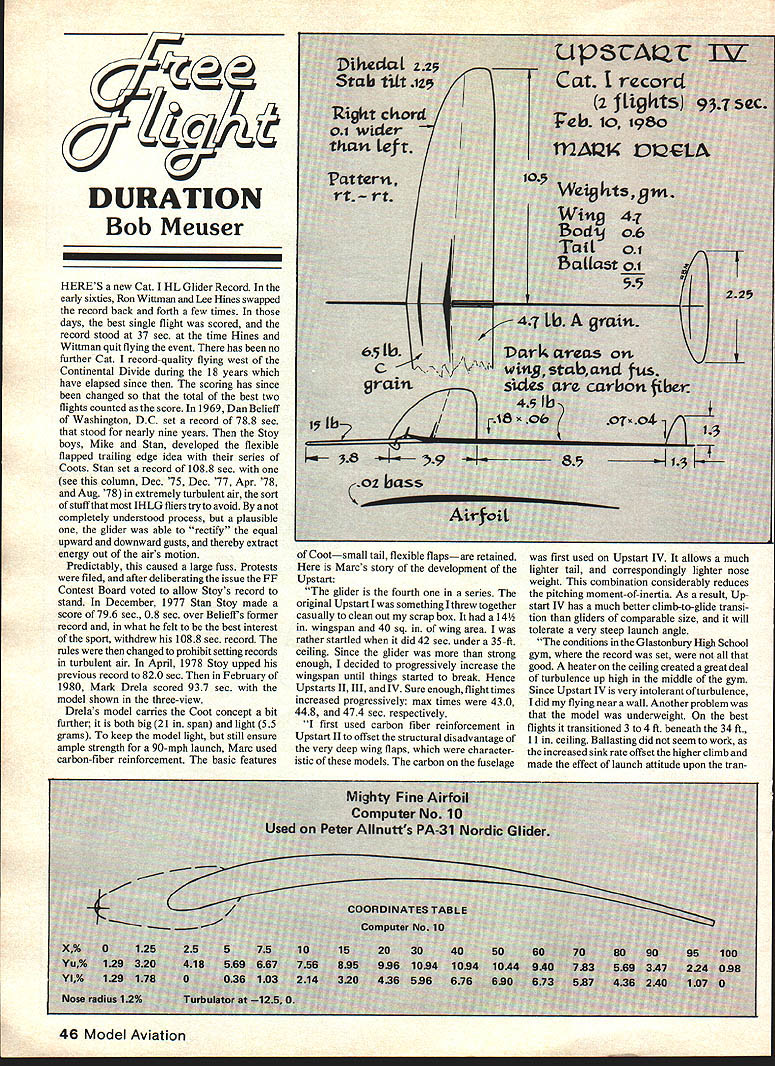
Predictably, this caused a large fuss. Protests were filed, and after deliberation the Free Flight Contest Board voted to allow Stoy’s record to stand. In December 1977 Stan Stoy made a score of 796.6 seconds (8.0 seconds over Belieff’s former record) and, in what he felt was best for the sport, withdrew his 1,088.8-second claim. The rules were then changed to prohibit setting records in turbulent air. In April 1978 Stoy increased his record to 820 seconds. Then, in February 1980, Mark Drela scored 937.3 seconds with the model shown in the three-view.
Drela’s model carries the Coot concept a bit further: it is both relatively large and light. To keep the model light yet still ensure ample strength for a 90-mph launch, Mark used carbon-fiber reinforcement. The basic Coot features—a small tail and flexible flaps—are retained.
Mark Drela — development of the Upstart
"The glider is the fourth one in a series. The original Upstart I was something I threw together casually to clean out my scrap box. It had a 14-1/2 in. wingspan and 40 sq. in. of wing area. I was rather startled when it did 42 sec. under a 35-ft ceiling. Since the glider was strong enough, I decided to progressively increase the wingspan until things started to break. Hence Upstarts II, III and IV. Sure enough, flight times increased progressively; max times were 430, 444.8, and 474 seconds respectively.
"I first used carbon-fiber reinforcement in Upstart II to offset the structural disadvantage of the very deep wing flaps, which were characteristic of these models. The carbon on the fuselage was first used on Upstart IV. It allows a much lighter tail, and correspondingly lighter nose weight. This combination considerably reduces the pitching moment of inertia. As a result, Upstart IV has much better climb-to-glide transition than gliders of comparable size; it will tolerate a very steep launch angle.
"In the conditions in the Glastonbury High School gym, where the record was set, things were not all that good. A heater on the ceiling created a great deal of turbulence up high in the middle of the gym. Since Upstart IV is very intolerant of turbulence, I did my flying near a wall. Another problem was that the model was underweight. On the best flights it transitioned 3 to 4 ft beneath the 34 ft. 11 in. ceiling. Ballasting did seem to work: it increased sink rate but offset the higher climb and made the effect of launch attitude upon the transition less critical.
"Getting up the courage to throw a favorite glider as hard as possible can be difficult—at least my vision is of shredded balsa falling slowly to the floor. Having backup models (Upstarts II and III), knowing they can also do the job, is a tremendous help. Together with judicious prodding, Ray Harlan and Leon Nault made it possible to let loose 100% of my arm. My arm tingled all the way home.
"The recent glider has a 26 in. wingspan, 76 sq. in. wing area, carbon fiber along nearly the entire span, carbon oriented to resist torsion as well as bending. It has a lot of potential; I haven't tried it under Cat. I ceiling yet."
Airfoils — Computer #9 and #10
Mighty fine airfoil. Last month I presented the airfoil section used on models Peter Allnutt flew at the 1979 World Champs. Another Peter described Computer #9 as the best airfoil developed so far, although he felt things could still be improved. The Computer #10 airfoil was then designed to have the same sort of pressure distribution near the front as Computer #9, while the rear part was designed to have a pressure distribution like the Schmitz–Wortmann–Hacklinger GO-803 section. It seems the best airfoil I have used to date—super stable, can be flown in a breeze and has very good still-air performance too.
Some observers judged Peter to have the slowest-flying model at the World Champs. Peter then continues: "I finished model #31, which employed the new Computer #10 airfoil, just a short time before the World Champs, intending to use it only for the rounds when the air was 'flat.' However, after flying the model extensively on the practice days, I realized that it was my best model, so I flew it throughout the contest."
I obtained the coordinates of both the Computer #9 and Computer #10 foils by carefully measuring the drawing furnished by Peter. The coordinates are therefore not as accurate as the usual ones presented (but more accurate than some!). The 0.01% figures are not accurate to 0.01% as might be inferred, but they are more precise than you can achieve when making a template and slicing ribs, which is plenty good enough.
On binoculars, eyeballs, and ticklish noses
Although the 1978–79 AMA rulebook is a bit confusing in spots—saying in one place you can and in another you can’t use binoculars—the fact is binoculars can be used by the timekeepers for all Outdoor AMA and FAI free flight events. In the hands of the modeler, binoculars serve as a useful model-retrieval aid. Increasing numbers of free-flighters are using them, so perhaps it is time we paid a little attention to their selection and use.
My job would be easy if I could simply recommend a particular brand and model as "best" for free flight applications, or spout a simplistic statement such as "you get what you pay for." It doesn't work that way; what is best for Person A is not necessarily best for Person B, and simply throwing money at the binocular salesperson won't necessarily get you better glass.
The first step is to define the problem. What do you want to use the binoculars for? Are they for you to use, or for the timekeeper? Do you expect to use them for activities other than model aviation, such as birdwatching or general viewing? Whatever the use, selection of the best binoculars will be a set of compromises.
Consider these questions:
- Do you wear glasses, and if so, do you require a correction for astigmatism or prism?
- Do you expect to use the binoculars with or without your eyeglasses?
- Will others (timekeepers) use them?
- Are size and weight important?
- Do you expect them to be useful under low-light conditions?
- Is price a consideration?
The March 1980 issue of Consumer Reports (limited in scope—it doesn't cover individual-focus or zoom models) has an excellent article on the subject.
Before going further, it's necessary to define some technical terms used for binoculars. You will see specifications such as "6x30." The "6" is the magnification (power), and the "30" is the diameter of the objective lenses (the ones away from you) in millimeters. A 6-power magnification will make objects appear about one-sixth of their real distance away. Field of view tells you the width of the subject you can see at any one time; it is often expressed as, for example, "622 ft. at 1000 yds." Sometimes it's expressed in degrees, which is preferable if available.
Exit-pupil diameter (often called simply "exit pupil") is the diameter in millimeters of the bundle of light exiting the eyepieces onto your eyeballs. It is simply the objective diameter divided by the magnification. A 7x35 glass has an exit pupil of 35/7 = 5 mm. Note that this is the diameter of the light beam hitting your eyeball; if your eye's pupil is smaller than the exit pupil, not all the light will pass through your iris.
If your pupil diameter is greater than the exit pupil, all the light will hit your retina and a larger exit pupil would produce a brighter image. In daylight, even small compact binoculars produce images that are bright enough. At dawn or dusk, a 6x30 (exit pupil 5 mm) will often suffice. Under extremely low-light conditions your pupils may dilate to about 7 mm; hence the 7x50 "night glasses" (exit pupil ≈ 7.1 mm) provide a brighter image in near-darkness. In principle, larger objectives can give a sharper image, but they also cost more and add weight.
Greater magnification makes the image appear to jiggle more when held in hand. A power of 7 is generally regarded as the practical upper limit for hand-held binoculars; many people are happier with 6x. The field of view increases as power decreases, and that can be important when trying to find a model in the sky: a 6-power glass typically has a wider field of view than a 7-power, which translates into a noticeably larger area seen.
If you want a wide field of view, you might consider wide-angle or super-wide-angle binoculars. Be aware they usually mean greater bulk and either a fuzzier image at equal price or a much higher price for equivalent quality. There is no way a manufacturer can give you the same image quality in a wide-angle class as in a standard class for the same price. If you must use eyeglasses, you may not be able to see clearly to the edges of the field anyway, reducing the advantage of a wide-angle design.
Choose binoculars to fit your needs: power, field, size, weight, eyeglass compatibility, low-light performance and budget. There is no single "best" binocular for all free flight purposes—only the best compromise for you.
Transcribed from original scans by AI. Minor OCR errors may remain.

