
Free Flight: Duration
Bob Meuser
Sport Free Flight
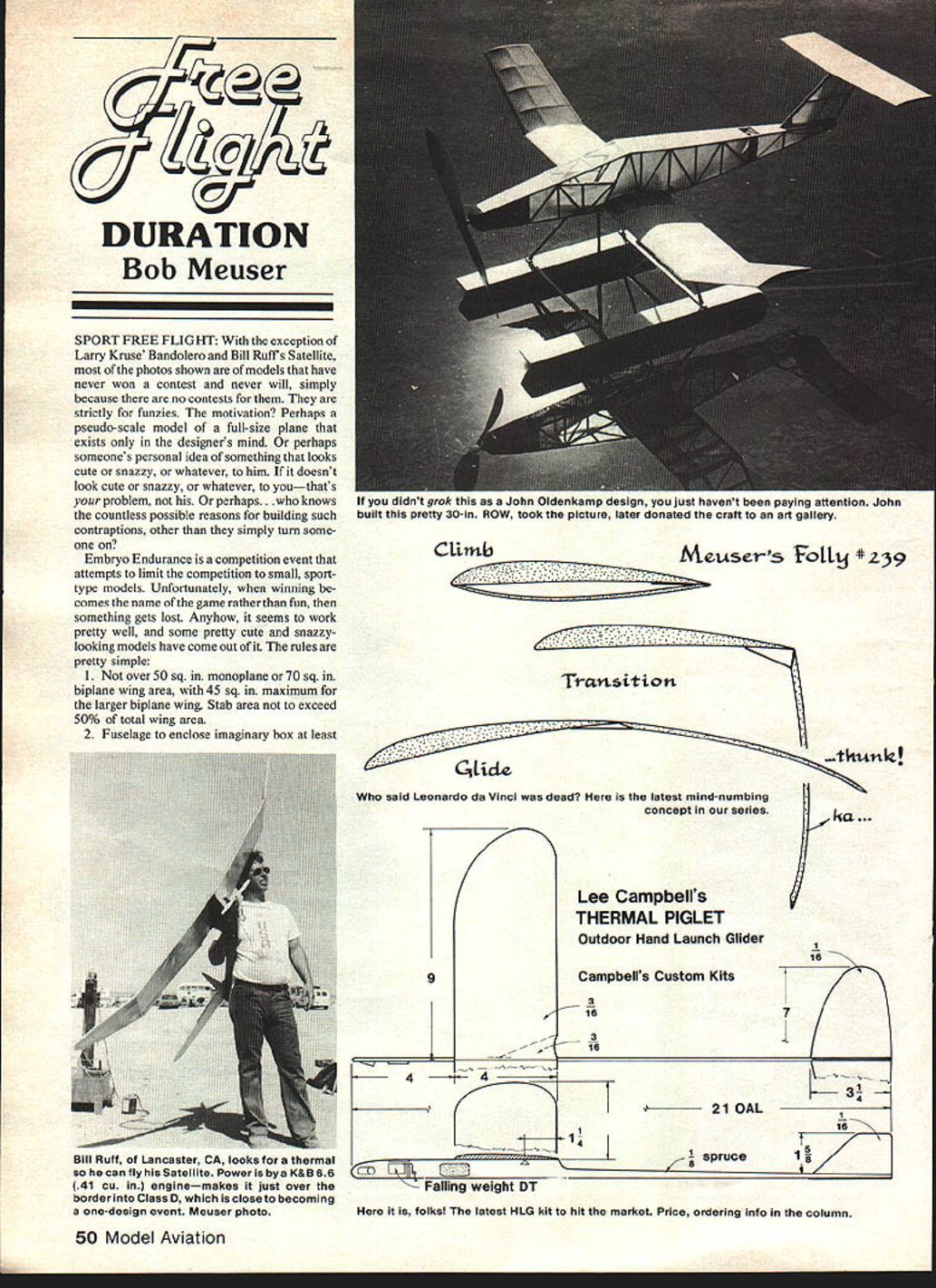
With the exception of Larry Kruse's Bandolero and Bill Ruff's Satellite, most of the photos shown are of models that have never won a contest and never will, simply because there are no contests for them. They are strictly for funzies. The motivation? Perhaps a pseudo-scale model of a full-size plane that exists only in the designer's mind. Or perhaps someone's personal idea of something that looks cute or snazzy, or whatever, to him. If it doesn't look cute or snazzy, or whatever, to you — that's your problem, not his. Or perhaps... who knows the countless possible reasons for building such contraptions, other than they simply turn someone on?
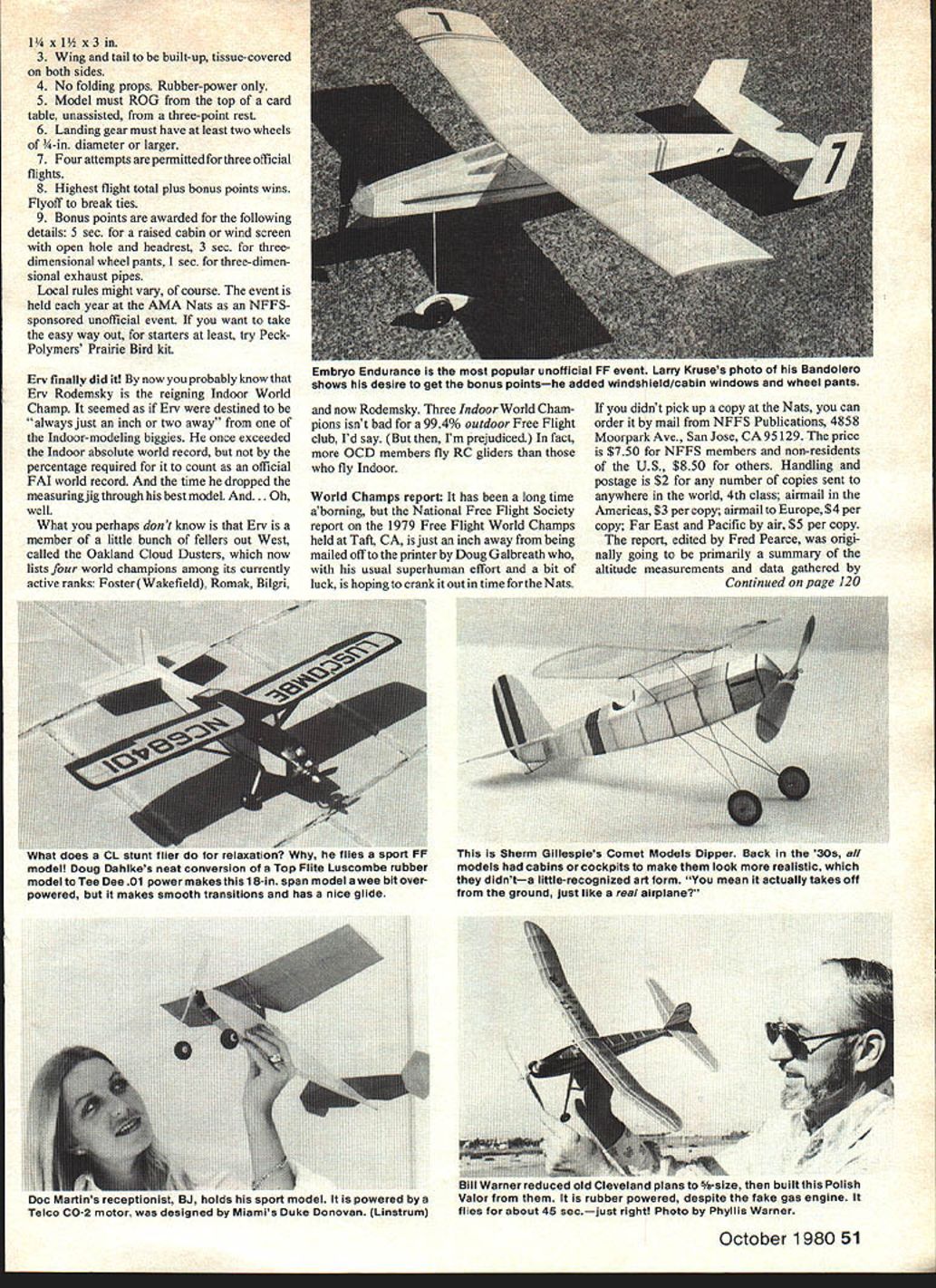
Embryo Endurance is a competition event that attempts to limit the competition to small, sport-type models. Unfortunately, when winning becomes the name of the game rather than fun, then something gets lost. Anyhow, it seems to work pretty well, and some pretty cute and snazzy-looking models have come out of it. The rules are pretty simple:
- Not over 50 sq. in. monoplane or 70 sq. in. biplane wing area, with 45 sq. in. maximum for the larger biplane wing. Stab area not to exceed 50% of total wing area.
- Fuselage to enclose imaginary box at least 1¼ x 1½ x 3 in.
- Wing and tail to be built-up, tissue-covered on both sides.
- No folding props. Rubber-power only.
- Model must ROG from the top of a card table, unassisted, from a three-point rest.
- Landing gear must have at least two wheels of 3/4-in. diameter or larger.
- Four attempts are permitted for three official flights.
- Highest flight total plus bonus points wins. Flyoff to break ties.
- Bonus points are awarded for the following details:
- 5 sec. for a raised cabin or wind screen with open hole and headrest
- 3 sec. for three-dimensional wheel pants
- 1 sec. for three-dimensional exhaust pipes
Local rules might vary, of course. The event is held each year at the AMA Nats as an NFFS-sponsored unofficial event. If you want to take the easy way out, for starters at least, try Peck-Polymers' Prairie Bird kit.
Erv Rodemsky and the Oakland Cloud Dusters
Erv finally did it! By now you probably know that Erv Rodemsky is the reigning Indoor World Champ. It seemed as if Erv were destined to be "always just an inch or two away" from one of the Indoor-modeling biggies. He once exceeded the Indoor absolute world record, but not by the percentage required for it to count as an official FAI world record. And the time he dropped the measuring jig through his best model. And... Oh, well.
What you perhaps don't know is that Erv is a member of a little bunch of fellers out West called the Oakland Cloud Dusters, which now lists four world champions among its currently active ranks: Foster (Wakefield), Romak, Bilgri, and now Rodemsky. Three Indoor World Champions isn't bad for a 99.4% outdoor Free Flight club, I'd say. (But then, I'm prejudiced.) In fact, more OCD members fly RC gliders than those who fly Indoor.
World Champs report (NFFS)
It has been a long time a'borning, but the National Free Flight Society report on the 1979 Free Flight World Champs held at Taft, CA, is just an inch away from being mailed off to the printer by Doug Galbreath who, with his usual superhuman effort and a bit of luck, is hoping to crank it out in time for the Nats.
If you didn't pick up a copy at the Nats, you can order it by mail from: NFFS Publications, 4858 Moorpark Ave., San Jose, CA 95129.
Prices and postage:
- Price: $7.50 for NFFS members and non-residents of the U.S.; $8.50 for others.
- Handling and postage: $2 for any number of copies sent anywhere in the world (4th class).
- Airmail: Americas $3 per copy; Europe $4 per copy; Far East and Pacific $5 per copy.
Report contents
The report, edited by Fred Pearce, was originally intended primarily as a summary of altitude measurements and data gathered by Fred's Technical Task Force, but it has expanded considerably.
Contents include:
- Fred Pearce's results of the technically difficult job of measuring altitude gained by Wakefield rubber-power and FAI power models during climb, and altitude gained by towline gliders as a result of zoom launching, along with descriptions of the methods used.
- Contest Director Bill Hartill's description of how his end of the show was organized and operated.
- Bob Hartsche describing problems associated with checking approximately 500 models during a 10-hour period in the face of Murphy's Law.
- New Zealand's Paul Lagan (fourth place in Wakefield) providing a personal account of his experience and observations on technical and tactical aspects of the meet.
- Deborah Beron reporting on the team from the People's Republic of China, including procedures, materials, personalities, lifestyles, and the team's observations of our lifestyles.
- Fred Pearce presenting results of tests on recent kinds of rubber, especially those used by World Champs teams and including home-brew types used by the Chinese.
- Reports by many authors, edited by Dennis Mihora (Nordic) and Chris Matsuno (Wakefield), covering teams and individuals in action, technical aspects of models and equipment, interviews with competitors, and other topics.
- FAI Power competition coverage round-by-round by Fred Pearce; analysis of climb patterns by Andrews Bauer; observations by Ralph O'Pry (a greatly expanded version of his story which appeared in Free Flight).
- Dozens of photographs and around 30 drawings of the top models, including some of their features.
Hand-Launched Glider (HLG) kit and resources
The HLG kit includes parts, including those for a swinging-weight dethermalizer. Typically, no liquids (such as glues or solvents) are included in the kit.
Instructions are adequate for anyone who has built a HLG before but might be frustratingly inadequate for a beginner. We take this opportunity to recommend John Kaufmann's book, Flying Hand-Launched Gliders (William Morrow and Co., New York, 1974). The book is required reading for anyone interested in any phase of Free Flight, regardless of level of proficiency. Your local hobby shop has no legitimate excuse for not carrying it. The paperback version is available through AMA for $1.75.
Meanwhile, back at the Campbell Kit Works: inasmuch as both the kit and its manufacturer are new, it is unlikely that your local hobby shop will have it in stock—but asking doesn't cost anything. You can get the kit by mail for $4.98 each, plus $2 shipping per order.
Additional kits to be offered soon will be the Tiny Piglet (for young arms) and Chuck Weiss' Merlin, a U.S. record-holder and Canadian Nationals-winning outdoor HLG.
Of Flappers, and Such
At this point, it doesn't seem fair to continue to deprive my readers of Meuser's Folly #239. I concede, reluctantly, that it is a variation of the Fowler flap. In fact, it is the foulest variation of the flap ever conceived. Airliners require mechanisms that operate in the continuous-variation, or whirr-n-r mode, and so they are stuck with things like Fowler flaps. But Free Flight models can tolerate mechanisms that operate in the step-function, or ka-thunk, mode. Refer to the sketch. During the climb, the flaps are reefed so as to present a wing of small area with a symmetrical airfoil section. But when the engine cuts, ka-thunk! The flaps unfurl, and suddenly the model has double the wing area and a high-lift, undercambered section to boot! The competitive advantages are obvious.
If you work out the mere mechanical details of the scheme and achieve any degree of success with it, please let me know. I might even bother to mention your name when I receive a NFFS Model of the Year award for the concept.
Bob Meuser 4200 Gregory St., Oakland, CA 94619
Transcribed from original scans by AI. Minor OCR errors may remain.

