
Free Flight: Duration
Bob Meuser
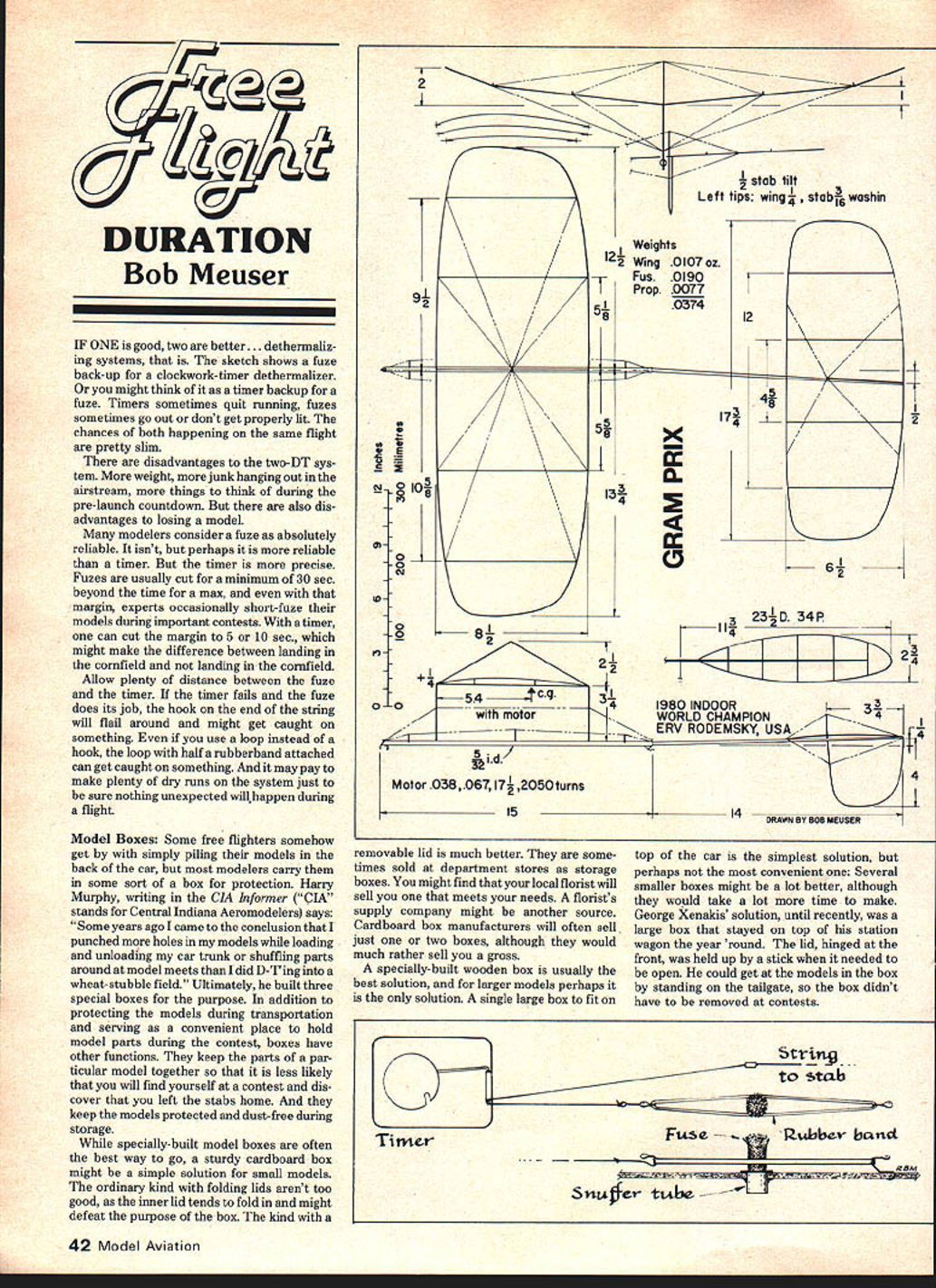
If one is good, two are better—dethermalizing systems, that is. The sketch shows a fuze backup for a clockwork-timer dethermalizer. Or you might think of it as a timer backup for a fuze. Timers sometimes quit running; fuzes sometimes go out or aren't properly lit. The chances of both failing on the same flight are pretty slim.
There are disadvantages to the two-DT system: more weight, more junk hanging in the airstream, and more things to think about during the pre-launch countdown. But there are also disadvantages to losing a model.
Many modelers consider a fuze absolutely reliable. It isn't, although it may be more reliable than a timer. The timer is more precise. Fuzes are usually cut for a minimum of about 30 seconds beyond the time for a max, and even with that margin experts occasionally short-fuze their models during important contests. With a timer, you can cut the margin to 5–10 seconds, which might make the difference between landing in a cornfield and not landing in a cornfield.
Allow plenty of distance between the fuze and the timer. If the timer fails and the fuze does its job, the hook on the end of the string will flail around and might get caught on something. Even a loop instead of a hook, or a loop with half a rubber band attached, can get snagged. It pays to make plenty of dry runs on the system to be sure nothing unexpected will happen during a flight.
Model Boxes
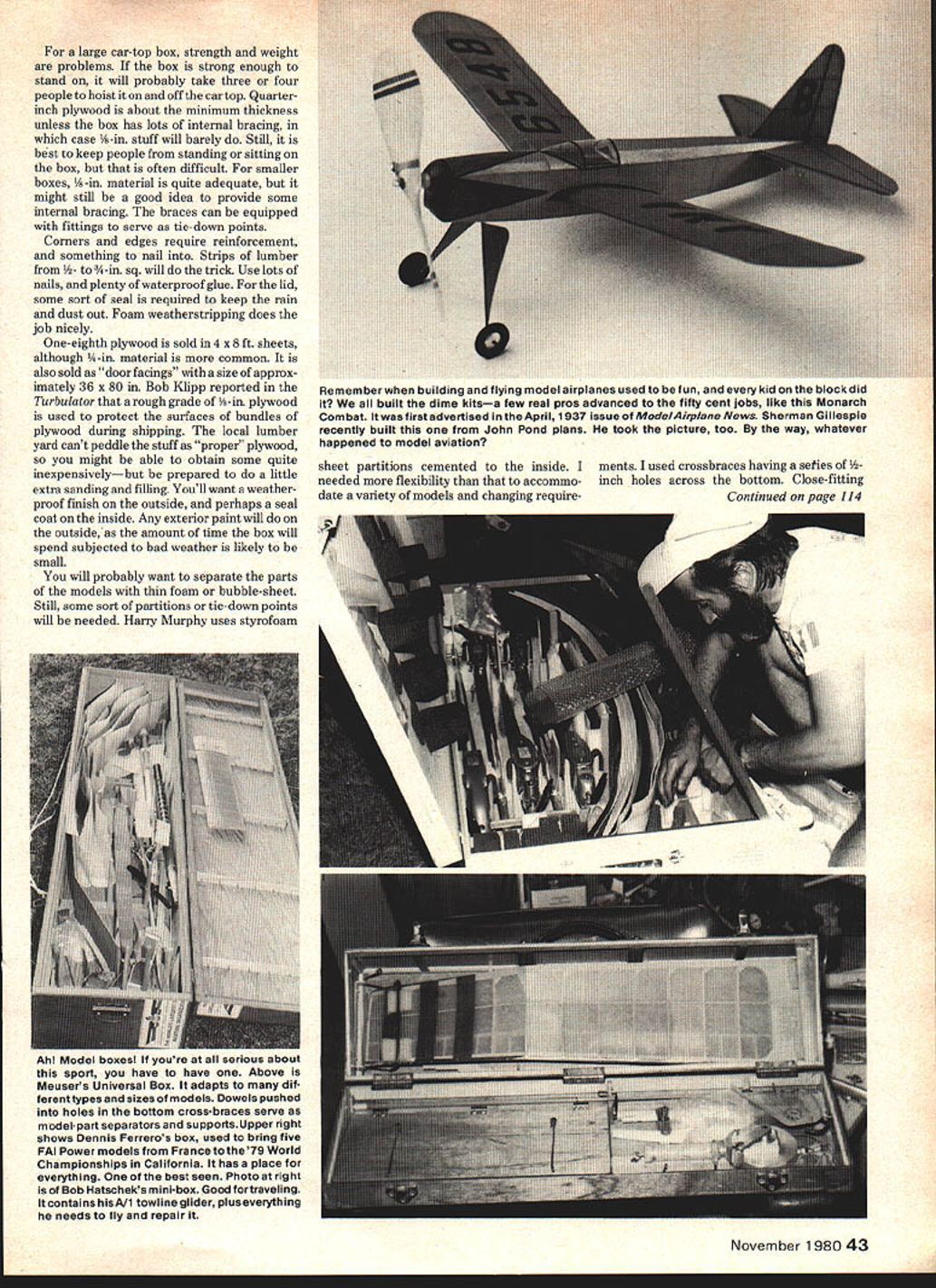
Some free flighters somehow get by by simply piling models in the back of the car, but most carry them in some sort of box for protection. Harry Murphy, writing in the CIA Informer (CIA = Central Indiana Aeromodelers), said: "Some years ago I came to the conclusion that I punched more holes in my models while loading and unloading my car trunk or shuffling parts around at model meets than I did by D-Ting into a wheat-stubble field." Ultimately he built three special boxes for the purpose.
Boxes protect models during transportation, serve as a convenient place to hold parts during a contest, keep parts for a particular model together (so you don't arrive and discover you left the stabs at home), and keep models dust-free during storage.
- For small models a sturdy cardboard box can be a simple solution. Ordinary boxes with folding lids aren't ideal because the inner lid tends to fold in; a removable lid is much better. Department stores sell storage boxes; local florists or florist supply companies can also be sources. Cardboard manufacturers will sometimes sell single boxes, though they'd rather sell in bulk.
- For larger models, a specially built wooden box is usually the best solution. A single large car-top box is simple but may not be the most convenient; several smaller boxes can be better though more work to make.
- George Xenakis kept a large box on top of his station wagon year-round. The lid was hinged at the front and held up with a stick so he could reach models while standing on the tailgate; the box didn't have to be removed at contests.
Large car-top boxes present strength and weight problems. The box must be strong enough to stand on and will often take three or four people to hoist off the car. Quarter-inch plywood is about the minimum thickness unless the box has lots of internal bracing; 3/8-inch is better. Smaller boxes of 1/8-inch material are often adequate but should have internal bracing. Braces can carry fittings to serve as tie-down points.
Corners and edges require reinforcement—nail strips or small lumber strips work well. Use plenty of nails and waterproof glue. The lid needs a seal to keep rain and dust out; foam weatherstripping does the job nicely. One-eighth-inch plywood commonly comes in 4 x 8 ft sheets; 1/4-in. material and door facings (about 36 x 80 in) are also available. Bob Klipp reported that rough-grade 1/8-in. plywood used to protect bundles during shipping can sometimes be obtained inexpensively—be prepared for extra sanding and filling.
You'll want a weatherproof finish outside and perhaps a seal coat inside. Separate model parts with thin foam or bubble sheet, and provide partitions or tie-down points. One practical system uses crossbraces with a series of 1/2-inch holes across the bottom; dowels are pushed into the holes as needed and heavy parts (engines, etc.) are lashed to the dowels with rubber bands. Lighter parts float loose, protected by foam. Stabs are often lashed to the inside of the lid.
You might not really need a model box, but it surely makes a nice place to display all those club decals you've been collecting.
World Champ Indoor Model
The three-view shows Erv Rodemsky's Grand Prix, which in a sudden-death last flight clinched the World Champs for both Erv and the U.S. team. Tracings of the building templates and measurements from photographs were used to make the drawing.
Some notable features:
- Vertical sheet-balsa reinforcements of the motor stick go through slots in the stick and are glued on the outside where the rear hook and thrust bearing attach.
- The thrust bearing is in two pieces. The forward part is glued to the front of the motor stick and ends in a tiny hook for the upper bracing wire. That wire passes over balsa hooks in the sides of the wing posts, then to a loop on the upper extension of the rear hook. Changing wing incidence is a bit more work, but manageable: to change incidence by 1/4 in., cut 1/16 in. off the bottom of one post and glue it to the bottom of the other.
- Tissue tubes that accept the posts are capped on the bottom, and the posts seat in the tubes; with the wire holding the posts down there's little chance of an accidental change in wing incidence.
- The prop spar does not go all the way to the tip as many do, yet Erv has never had a tip break.
- Wing rib camber decreases in a straight-line fashion from root to tip, and all ribs (including stab ribs) are cut from a single long sheet-metal template.
- Tapering the thickness toward the tips is an effective way to decrease loading toward the tips, reducing induced drag or tip losses. The wing is rigged nearly flat with a bit of left-tip wash-in; because the center has greater camber, it effectively has a greater zero-lift angle, which produces a desirable lift distribution without the drag penalty of highly cambered tips.
- The prop has relatively low pitch and wide blades to keep rpm low; the model flies slowly. During the early part of the flight the model is nearly in a full stall, so it climbs very little and does less rafter banging than it might otherwise. It still suffered a dozen or so hits but survived, showing a well-proportioned, rugged structure.
- Wing bracing goes to the ends of all the ribs, and all are compression ribs—now a common practice.
Free Flight Hall of Fame
Nominations are now in order for 1981. The National Free Flight Society has instituted the Free Flight Hall of Fame to recognize individuals who have contributed to the development and furtherance of free flight model aviation.
Nominations should be received by December 31, 1980. They must include a detailed narrative of the individual's accomplishments over the years. Considerations include:
- Scientific developments directly attributable to model aviation.
- Designs that have formed a trend copied by many.
- Sportsmanship on the field.
- Individuals who have catalogued concepts or designs and edited them into written material understandable by the average modeler.
Transcribed from original scans by AI. Minor OCR errors may remain.

