
Free Flight: Duration
Bob Meuser
WILL THE REAL Peter Allnutt please stand up. Remember that terrific movie "African Queen"? With Humphrey and Katherine What's-Their-Names? And what was the name of the hero? Peter Allnutt! Well, kiddies, today we're going to talk about the real Peter Allnutt, the one from north of the border up Canada way, who flies F1A (Nordic towline glider) and Unlimited Rubber and all that, and who won the F1A event at the U.S. Nats twice in a row just to warm up for the World Champs, where he took second place last year in the F1A event. Here is how Peter describes the occasion:
"Fantastic! The organization, the weather, the flying field, the food and drink, the fellowship among the competitors ... it will take some topping.
"In the competition, many 'big guns' blew it. The thermals were there as they are on any hot summer day, but if you didn't watch the Mylar streamers and the 'thermistors' closely your model was likely to find itself in a big 'downer.' The F1A event was very much a wait-and-piggy-back game, and that is what I tried to do. The idea of circle-towing among 30 guys with their lines strung out just didn't appeal to me. The variable wind direction caused a bit of a problem; sometimes the flier and his assistant had to change positions quickly to allow going after a model that was in lift.
"There were 42 in the fly-off, surprisingly. Luckily I drew a spot at the end of the line, and downwind of the parked cars. The team figured that the only heat source remaining that late in the day would be the parked cars. Brian Eggle stations check the parking area with a thermistor confirmed the guess. When the starting gun went off, I headed for the cars, and found lift right away.
"When the stopwatch hit the 4-minute mark, the team went mad, for it appeared that all the others fell short. Well, all but one had, it turned out; the young Russian, Niktoz Tchop also made it. Again the team went into a huddle. We decided that we would let Tchop go first, then follow him and launch into the same air he did. And that is what I started to do. But when I had gone only a short distance I felt light lift. A decision had to be made: continue after Tchop, or let the model go in what seemed like fairly good air.
"I decided to release the model. For the first few turns it looked good, but the lift soon died out. Tchop ran until he found a great chunk of air into which he blasted off in a steep climbing turn, and he made his 5 minutes. In fact he got about 12 minutes; his timer must have stuck.
"I can't say enough how proud I am to be part of it. We have always sent good individual fliers to the World Champs, but this time we sent a team. Previously we seemed to lack that certain something that the Russians, East Germans, Danes, and some of the others had, but this time we had it! Individual second place in F1A and third in F1B (Wakefield), plus third place in F1B for the team shows that it wasn't just luck."
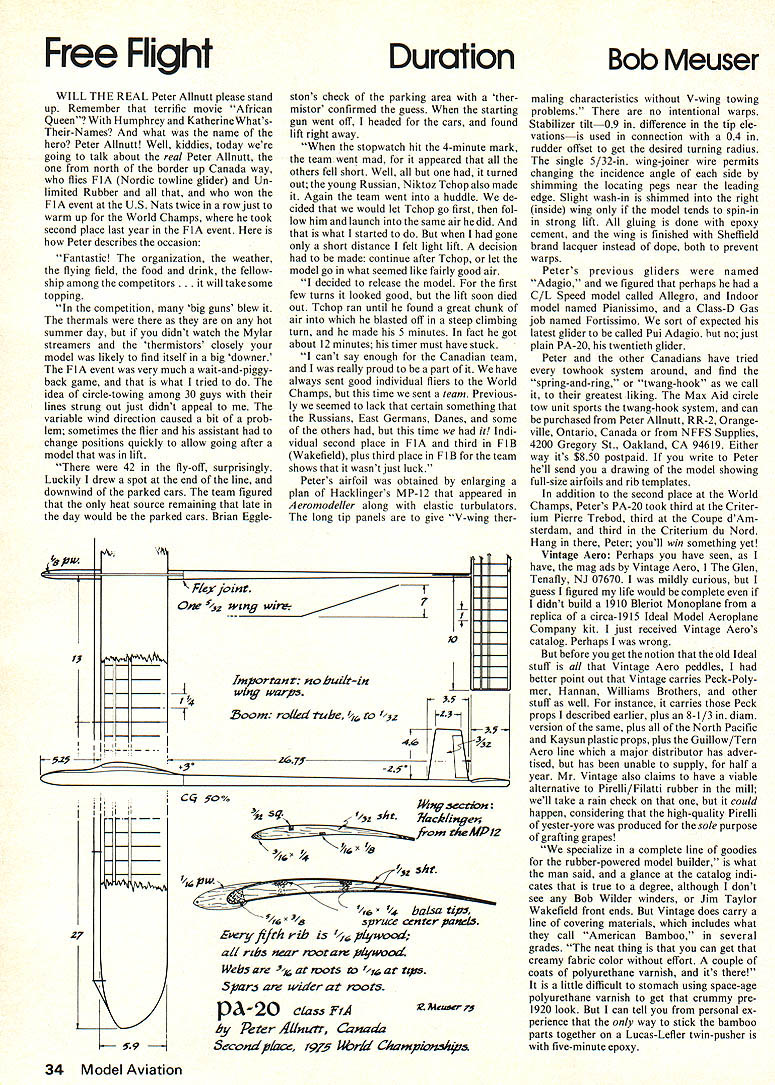
Peter's airfoil was obtained by enlarging a plan of Hacklinger's MP-12 that appeared in Aeromodeller along with elastic turbulators. The long tip panels are to give V-wing turning characteristics without V-wing towing problems — no intentional warps. Stabilizer tilt —0.9, the difference in the tip elevations used in connection with a 0.4 in. rudder offset get the desired turning radius. The single 5/32-in. wing-joiner wire permits changing the incidence angle of each side by shimming; the locating pegs near the leading edge. Slight wash-in is shimmed into the right (inside) wing only if the model tends to spin-in in strong lift. All gluing is done with epoxy cement, and the wing is finished with Sheffield brand lacquer instead of dope, both to prevent warps.
Peter's previous gliders were named "Adagio," and we figured that perhaps he had a C/L Speed model called Allegro, an Indoor model named Pianissimo, and a Class-D Gas job named Fortissimo. We sort of expected his latest glider to be called Paul Adagio, no just plain PA-20 — twentieth glider. Peter and the other Canadians have tried tow-hook systems around to find the spring-and-ring twang-hook the greatest liking. Max Aid circle tow unit sports the twang-hook system, can be purchased from Peter Allnutt, RR-2, Orangeville, Ontario, Canada or from NFFS Supplies, 4200 Gregory St., Oakland, CA 94619. Either way, it's $8.50 postpaid. If you write to Peter he'll send drawings of the model showing full-size airfoils, rib templates, in addition.
Second place, 1975 World Championships. Peter's PA-20 took third at the Criterium Pierre Trebod, third at the Coupe d'Amsterdam, and third in the Criterium du Nord. Hang in there, Peter; you'll win something yet!
Vintage Aero: Perhaps you have seen, as I have, the mag ads by Vintage Aero, The Glen, Tenafly, NJ 07670. I was mildly curious, guess I figured my life would be complete even if I didn't build a 1910 Bleriot Monoplane replica of a circa-1915 Ideal Model Aeroplane Company kit. I just received Vintage Aero's catalog. Perhaps I was wrong.
But before you get the notion that the old Ideal stuff is all that Vintage Aero peddles, I had better point out that Vintage carries Peck-Polymer, Hannan, Williams Brothers, and other stuff as well. For instance, it carries those Peck props I described earlier, plus an 8-1/3 in. dia. version of the same, plus all of the North Pacific and Kayson plastic props, plus the Guillows/Tern Aero line which a major distributor has advertised, but has been unable to supply, for half a year. Mr. Vintage also claims to have a viable alternative to Pirelli/Filat rubber in the mill; we'll take a rain check on that one, but it could happen, considering that the high-quality Pirelli of yesteryear was produced for the purpose of grafting grapes!
"We specialize in a complete line of goodies for the rubber-powered model builder," is what the man said, and a glance at the catalog indicates that is true to a degree, although I don't see any Bob Wilder winders, or Jim Taylor Wakefield front ends. But Vintage does carry a line of covering materials, which includes what they call "American Bamboo," in several grades. "The neat thing is that you can get that creamy fabric color without effort. A couple of coats of polyurethane varnish, and it's there!" It is a little difficult to stomach using space-age polyurethane varnish to get that crummy pre-1920 look. But I can tell you from personal experience that the only way to stick the bamboo parts together on a Lucas-Teller twin-pusher is with five-minute epoxy.
Free Flight: Duration
Bob Meuser
WILL THE REAL Peter Allnutt please stand up? Remember that terrific movie African Queen — Humphrey, Katharine — what's‑their‑names — what was the hero's name? Peter Allnutt? Well, kiddies, today I'm going to talk about the real Peter Allnutt up on the north border, up Canada way. He flies F1A (Nordic towline) and Unlimited Rubber. He won the F1A event at the U.S. Nats twice; the World Champs he took second place last year in the F1A event.
Peter describes the occasion: "Fantastic organization, weather, flying field, food, drink, fellowship among competitors. I'll take some topping competition; the big guns blew thermals on a hot summer day. We didn't watch Mylar streamers or thermistors closely — a model was likely to find itself a big downer. F1A event is very much a wait‑and‑piggyback game. What we tried was circle‑towing among 30 guys, lines strung out — it just didn't appeal. Variable wind direction caused a bit of a problem; sometimes the flier or assistant had to change positions quickly to allow going after model lift.
"At the 42 fly‑off we, surprisingly, drew a spot at the end of the line, downwind of the parked cars. The team figured the heat source remaining late in the day would be the parked cars. We checked the parking area; the thermistor confirmed our guess. The starting gun went off; we headed for the cars and found lift right away. The stopwatch hit the 4‑minute mark; the team went mad — it appeared others fell short. Well, it turned out young Russian Nikita Tchop also made it. Again the team huddled and decided we'd let Tchop go first. I followed him and launched in the same air. What he started went a short distance and felt light lift; the decision was made to continue. After Tchop let his model go, what seemed like fairly good air soon died out after the first few turns. Tchop ran until he found a great chunk of air, blasted off in a steep climbing turn and made 5 minutes — in fact he got about 12 minutes; the timer must have stuck. I can't say enough — the Canadian team is really proud. We have always sent good individual fliers to the World Champs; this time we sent a team.
"Previously it seemed we lacked a certain something — the Russians, East Germans, Danes and some others have been strong. An individual second place in F1A, third F1B Wakefield plus third place F1B team shows it wasn't just luck."
Peter's airfoil was obtained by enlarging the plan of Hacklinger's MP‑12 (appeared in Aeromodeller). Along with elastic turbulators and long tip panels to give a V‑wing, the construction is: 1/16 in. K?, 5? hi 3.1 ??? [plan details as on drawing]. Spruce center stands, etc. (full-size airfoils and rib templates available from Peter — see below).
PA‑20 (class F1A) — Peter Allnutt, second place (1975 World Championship) — molding characteristics: V‑wing towing problems — no intentional warps. Stabilizer tilt: -0.9°; difference in tip elevations used; connection: 0.4° rudder offset to get desired turning radius. A single 5/32‑in. wing‑joiner wire permits changing incidence angle by side shimming. Locating pegs near the leading edge. Slight wash‑in shimmed right; inside wing model tends to spin‑in in strong lift. Gluing done with epoxy cement. Wing finished with Sheffield brand lacquer instead of dope to prevent warps.
Peter's previous gliders were named Adagio (I figured perhaps a C/L speed model called Allegro), an indoor model named Pianissimo, a Class‑D gas job named Fortissimo — so one might have expected the latest glider to be called Puiri Adagio — no, it's just plain PA‑20, the twentieth glider Peter has built.
Other Canadians have tried tow‑book systems but have found spring‑and‑ring twang‑hook the greatest liking. Max‑Aid circle tow unit sports a twang‑hook system and can be purchased. Peter Allnutt, RR‑2, Orangeville, Ontario, Canada. NFFS Supplies, 4200 Gregory St., Oakland, CA 94619. Either way it's $8.50 postpaid — write Peter and he'll send drawings showing full‑size airfoils and rib templates.
In addition to second place at the World Champs, Peter's PA‑20 took third at the Criterium; Pierre Trebod third Coupe d'Amsterdam; third Criterium du Nord. Hang in there, Peter — you'll win something yet.
Free Flight: Duration
Bob Meuser
That activity apparently died. A few years later Lee's friend Chuck Furiani called Lee to ask if he knew where they could do some indoor flying. After checking around, Lee found that the recreation hall in Wilmington was available. The years of competition at Wilmington that followed produced many design trends that are still prevalent, as well as some high flight times. Lee and Ron Wittmann did most of the winning. The culmination of that activity was Lee's Category I record of 37 sec., made with his Sweeperlite 16 Mk. III, shown in the 1964-65 Model Aeronautics Yearbook.
Later Lee applied what he had learned in low-ceiling flying to high-ceiling flying, and the record shows that it worked. (Lee cautions that what one learns in high-ceiling flying is not very helpful under low-ceiling conditions, however.) Lee soon became the first guy in the solar system to exceed 1 min. 20 sec., and later, the first to pass 1 min. 25 sec.
Lee told of getting his 20-gram record setter even with the first catwalk at the Santa Ana Marine blimp hangar — a height of 130 ft. — and of seeing Curt Stevens hit the center catwalk — 160 ft. up — with a 35-gram machine. Curt had the best throwing arm Lee has ever seen. But Lee also said build better control and was more consistent, which made the difference in the long run. Ron Wittmann wasn't exactly sitting on his hands all this time, and he has a couple of first-place Nats trophies to prove it. And recently, after being away from Indoor HLG flying for five years, Ron became the first to break the 1 min. 30 sec. barrier using his pointed-tip Super-Sweeper design.
The hangars at Santa Ana are no longer available for model flying, so perhaps the history of high-ceiling Indoor HLG modeling has been already written. Or will someone in another part of the country write another chapter?
If there is a point to this story it is certain that Lee and Ron are some sort of super humans. They have good throwing arms to be sure, more by training than from a God-given gift. In body type, they are as different as Lauda and Hardy, Ferrari and Peterbilt. But what counts is the best throwing arm, or the best construction, or the best adjusting technique, or the best control, or the best design doesn't automatically ensure continued first place. As in any sport — and anyone who would deny that Indoor HLG is a true sport simply hasn't been paying attention — it is the right combination that wins. Dedication is a name of the game; a goal, and the guts to keep working toward it no matter what.
I certainly don't mean to detract from what Ron and Lee have achieved. But I venture there are lots of young fellows who, by working together and learning from each other's triumphs and mistakes, as well as from their own, could do as well or better if they were equally dedicated to a goal.
Transcribed from original scans by AI. Minor OCR errors may remain.

