
Free Flight: Duration
Bob Meuser
Musings
A lot has been said in both the visible and the underground model aviation press concerning the new 1980–81 Easy B rules, affectionately called "Botched B," "Bungled B," etc., the event that "nobody" wanted. It would have been nice if the AMA rules for Easy B reflected what everyone wanted (wishful thinking at best, as there has been controversy over Easy B rules since the event was invented). It would also be helpful if modelers paid more attention to rules proposals and informed their Free Flight Contest Boards of their opinions. But a key point seems to have been missed.
People seem to assume that because there is an official Easy B event in the rule book, they must fly Easy B according to those rules. That is not true. Any rules can be specified by contest organizers at an official AMA-sanctioned meet, provided safety is not compromised. At any meet there could be an event for the "old" Easy B, the "new" Easy B, or both. Nothing has been taken away by the 1980–81 rules; there wasn't an official "traditional" Easy B event before, and there isn't one now. What has been added is a totally new official AMA indoor event which, unfortunately perhaps, is called Easy B. Since the indoor community enjoys having all sorts of events and categories for official records, one would think they would be pleased rather than distressed.
There is ample evidence some contest organizers understand this point. At the annual U.S. Free Flight Championships, the AMA gas events are often held under the old VTO rules, not the official AMA rules. Few clubs fly Indoor or Outdoor Flying Scale or Peanut events entirely according to AMA rules. Even the AMA Nats holds non-AMA-rule events as official Nats events, despite that being specifically prohibited by the AMA rule book—and despite my annual complaining to the AMA Nats Planning Committee, via AMA Headquarters, about AMA ignoring its own rules. (Ed. note: Bob refers to a case where, at the 1977 Nats, Easy B was flown to a different set of rules than the Provisional rules in the AMA rule book. — RMcM.) Based on precedent, I see no reason why the traditional Easy B event could not be held at future Nats as an official Nats event instead of the rule-book Easy B, provided the right people press the right people.
So do your own thing. And quit bellyaching, Easy-B types; you're ahead, and you don't even seem to know it!
Boeing Management Association Contest
Scholarship prizes worth $3,500, plus trophies and recognition, are offered if you are under 19 years of age on July 11, 1981. There is a wide range of events for Free Flight, Control Line, and Rocket, in addition to two specialty events: RC Sailplane and Design Craftsmanship. The contest is structured so that you don't stand much of a chance of winning a scholarship if you enter only one category; entering two categories improves your odds. Historically, Free Flighters have done rather well. Usually, special arrangements are made for lodging contestants whose parents cannot accompany them. Open-class fliers will also receive awards (though not scholarship money).
- Contact:
- The Boeing Management Assoc., Attn. Ted Caputo
- Org. 4-1800, Mail Stop 63-10
- PO Box 3707, Seattle, WA 98124
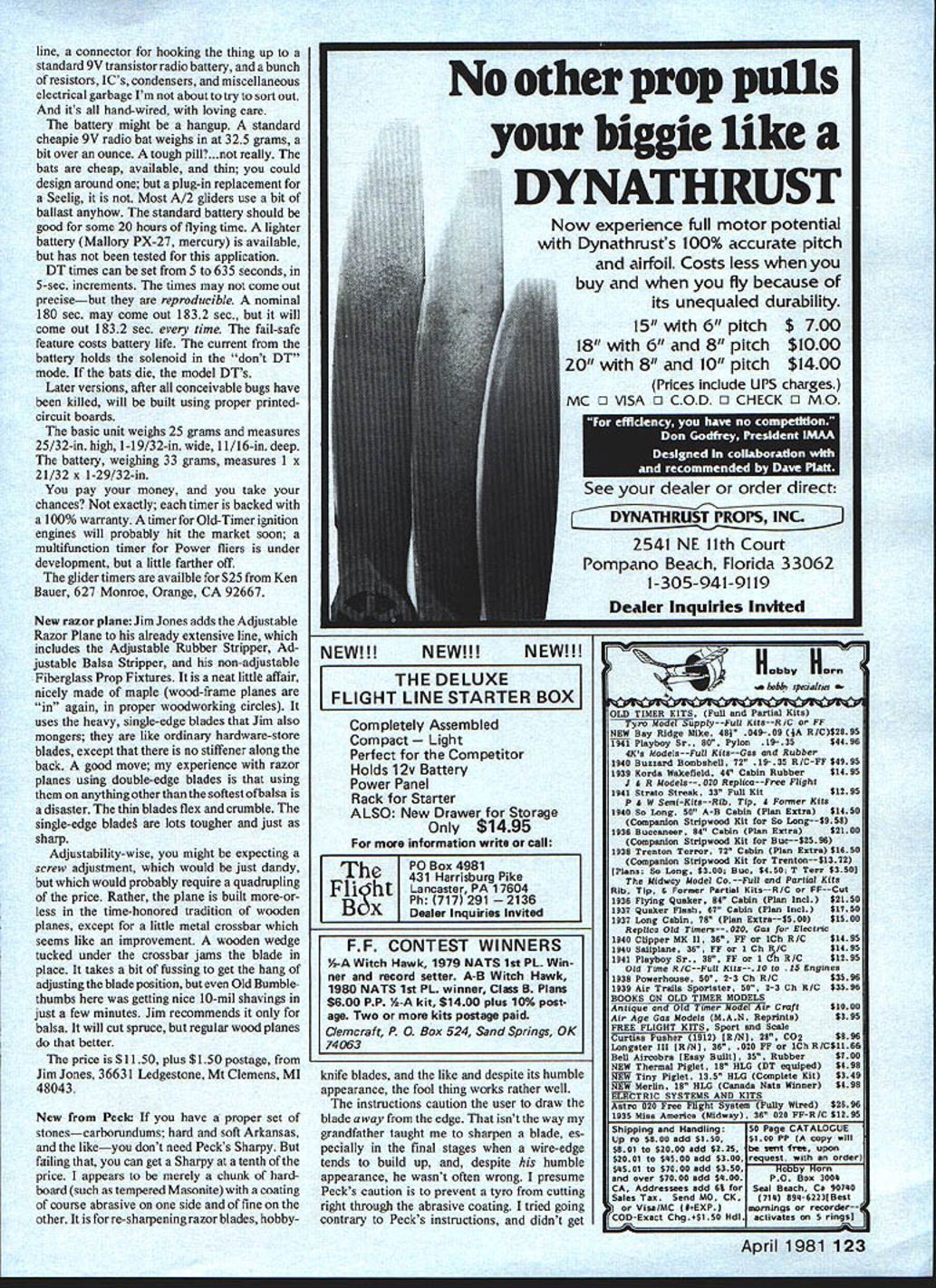
Covering flimsy wings
A covering hint from Paul McIlrath (designer of Sig's Customaire, Cabinaire, and 29'er kits):
"Covering a flimsy indoor wing panel can be difficult because light tissue or condenser paper tends to pull down and wrinkle between ribs whenever any chordwise tension is applied. If you have trouble like this, try laying a strip of writing paper about 1/8" over the frame before covering. Curl the paper slightly to match the curve of the ribs and lay the tissue right over it. You'll find the covering can be pulled quite tight without buckling.
Attach tissue to the leading and trailing edges first; slide the writing-paper endwise just far enough to permit attaching tissue to the rib ends. Finally slip the support completely out. Dope the covering as usual. Removing the supporting paper will also leave a little slack front-to-rear, reducing warping tendencies as the paper tightens with age. The system should work on straight-taper as well as constant-chord wings."
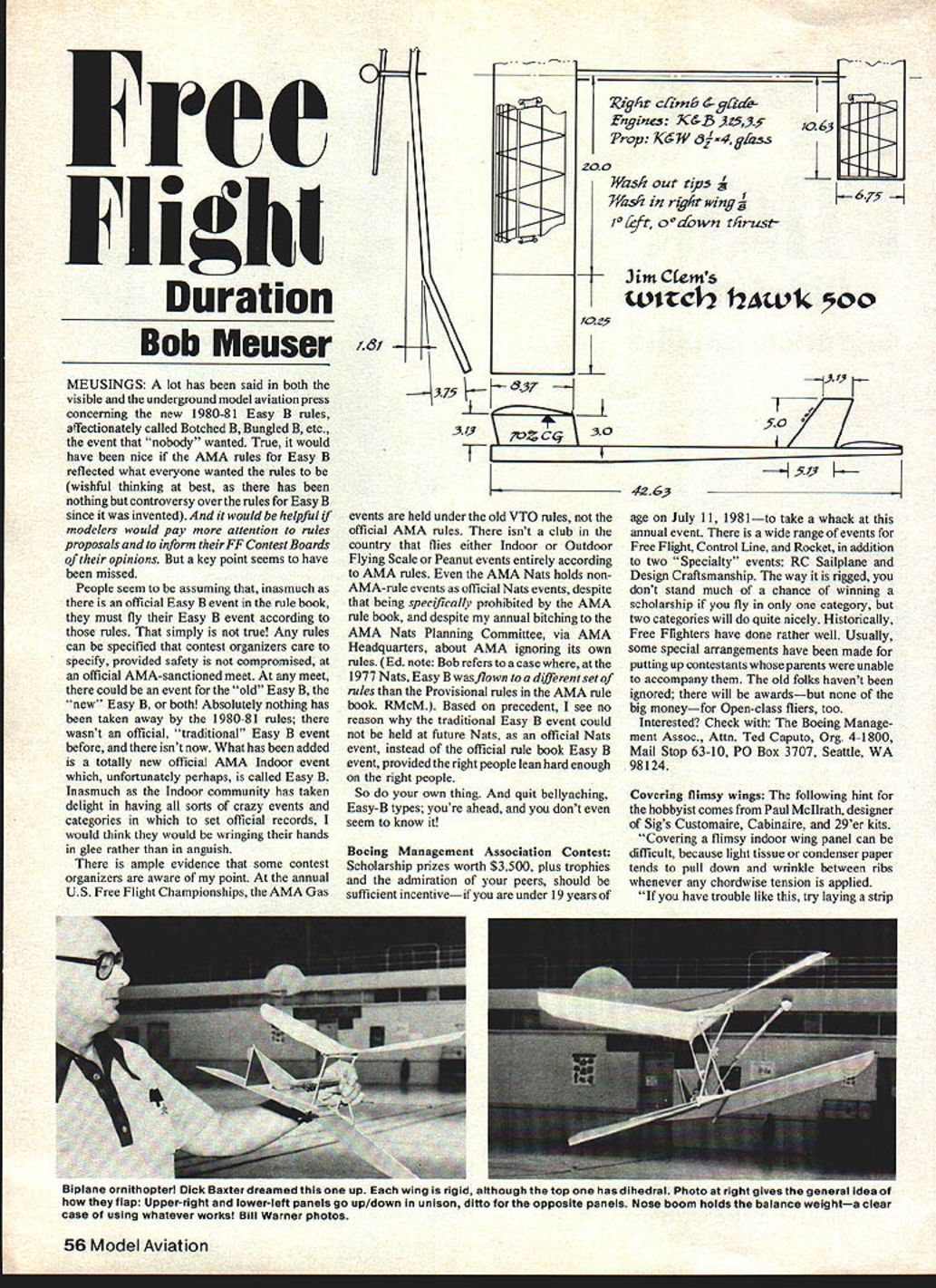
Witch Hawk
Although rather new to the Free Flight scene, Jim Clem's Witch Hawk has made an impressive impact in the hands of Bill Dunlop and Bill Jenkins. Smaller versions than the 1/4 A shown at the Nats have been successful—Jenkins set a national record (in Bill Jenkins's hands) and Dunlop took fifth. A simple model, well flown.
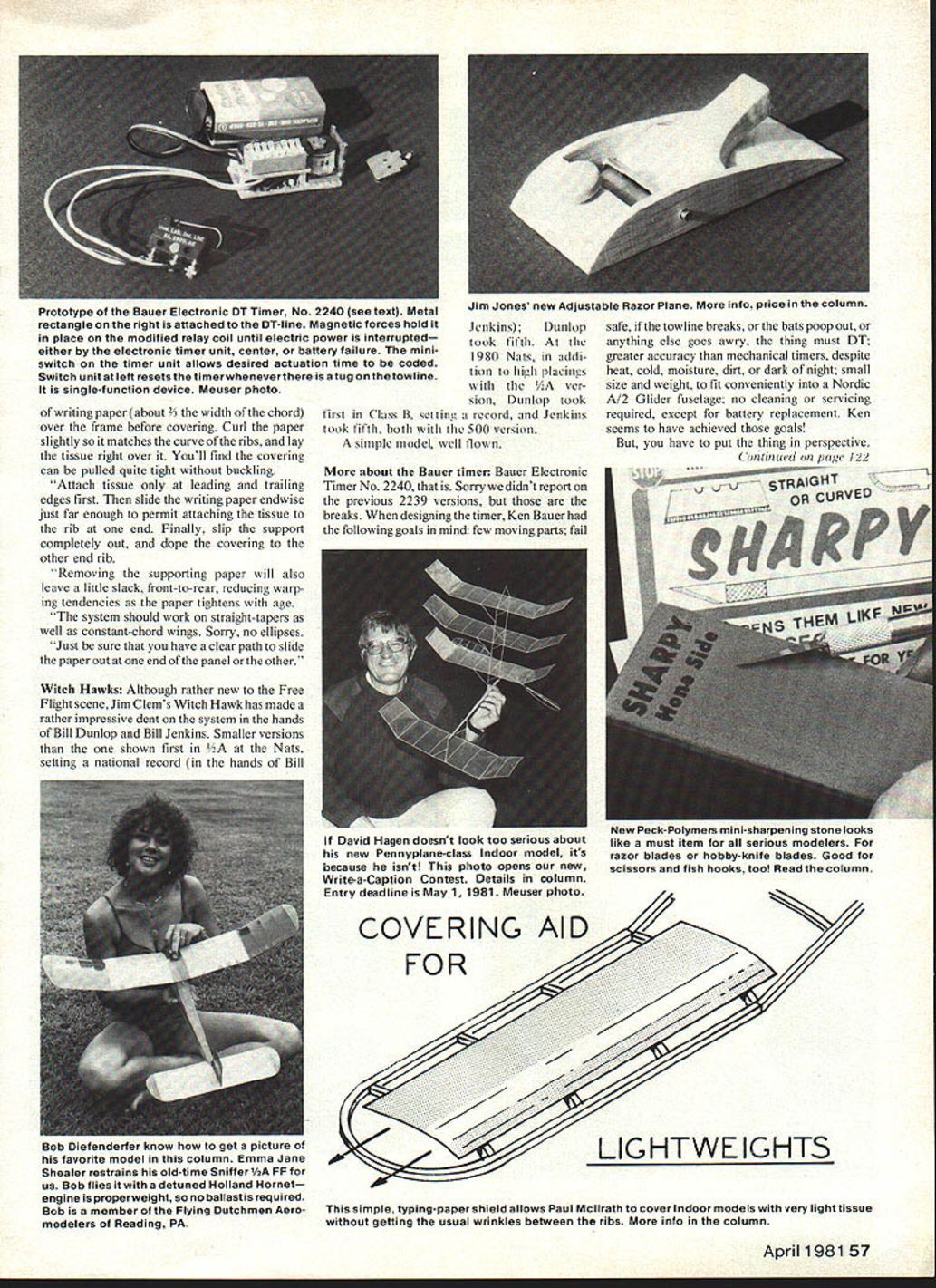
More about the Bauer timer (Electronic Timer No. 2240)
Ken Bauer's Electronic Timer No. 2240 is a commercially produced electronic dethermalizer (DT) timer designed for Free Flight models. The design goals were: few moving parts; fail-safe operation (if the towline breaks, bats fail, or battery dies, the model must DT); greater accuracy than mechanical timers despite environment; small size and weight to fit into a Nordic A/2 glider fuselage; and no servicing except battery replacement. Ken largely achieved those goals.
Features and construction:
- The unit consists of printed-circuit boards, a mini-DIP switch for selecting DT time, an 8029 integrated-circuit timer module, a solenoid to hold the "don't DT" mode, and a mini-microswitch to reset timing when the towline is tugged. A small battery provides power. The assembly is hand-wired in the early production units.
- Weight (basic unit, including battery): about 1-1/4 ounces (battery ~33 g).
- Dimensions (basic unit): 25/32 in. high × 1-19/32 in. wide × 11/16 in. deep.
- Battery dimensions: 1 × 21/32 × 1-29/32 in.
- DT times: 5 to 635 seconds, in 5-second increments. Times may not be nominally exact but are reproducible (e.g., nominal 180 sec. might be 183.2 sec. every time).
- Fail-safe: the solenoid is held by battery current; if the battery dies the unit DTs.
- Warranty: each timer is backed with a 100% warranty.
Operation:
- With the towline under tension the solenoid is energized and the microswitch held open. On release the microswitch closes and the timer begins counting. If the towline is tugged again, the microswitch reopens and the timer resets. When the timer reaches the selected time the solenoid de-energizes and a spring-loaded release snaps the DT hook free.
Installation and use:
- The unit is self-contained in a small case and is mounted in the fuselage where it can operate the DT hook or dethermalizer.
- Careful wiring and a bypass capacitor where needed will prevent interference from glow-plug leads or nearby ignition systems.
- I installed one in a small A/2 glider; takeoffs were normal, the towline-tug reset worked reliably, and the DT occurred at the selected time. A small bypass capacitor cured a little electrical noise from the glow lead.
Battery considerations:
- A standard inexpensive 9V radio battery weighs about 32.5 g (a bit over an ounce). It should be good for some 20 hours of flying time. A lighter Mallory PX-27 mercury battery is available but has not been tested for this application. Most A/2 gliders use some ballast, so the standard battery is usable.
Production and pricing:
- Later versions will be built using proper printed-circuit boards after bugs are resolved.
- Glider timers are available for $25 from:
- Ken Bauer, 627 Monroe, Orange, CA 92667.
- A timer for Old-Timer ignition engines and a multifunction timer for power fliers are planned.
Miscellaneous notes
- The new 5-to-1 winder appears identical to the one sold by Sterling and includes an anti-backlash ratchet, which can be removed easily if undesired.
- Peck's has added the notorious Lacey M-10 to its line of Peanut Scale 13-inchers. Designed by Butch Hadland, the kit includes 1/20-sq. balsa for the fuselage, printwood ribs, decals, plastic prop, bushing and wheels, two-page plans and instructions, plus proof-of-scale three-views and photos. With a wing area of nearly 50 sq. in., it performs well for a 13-incher.
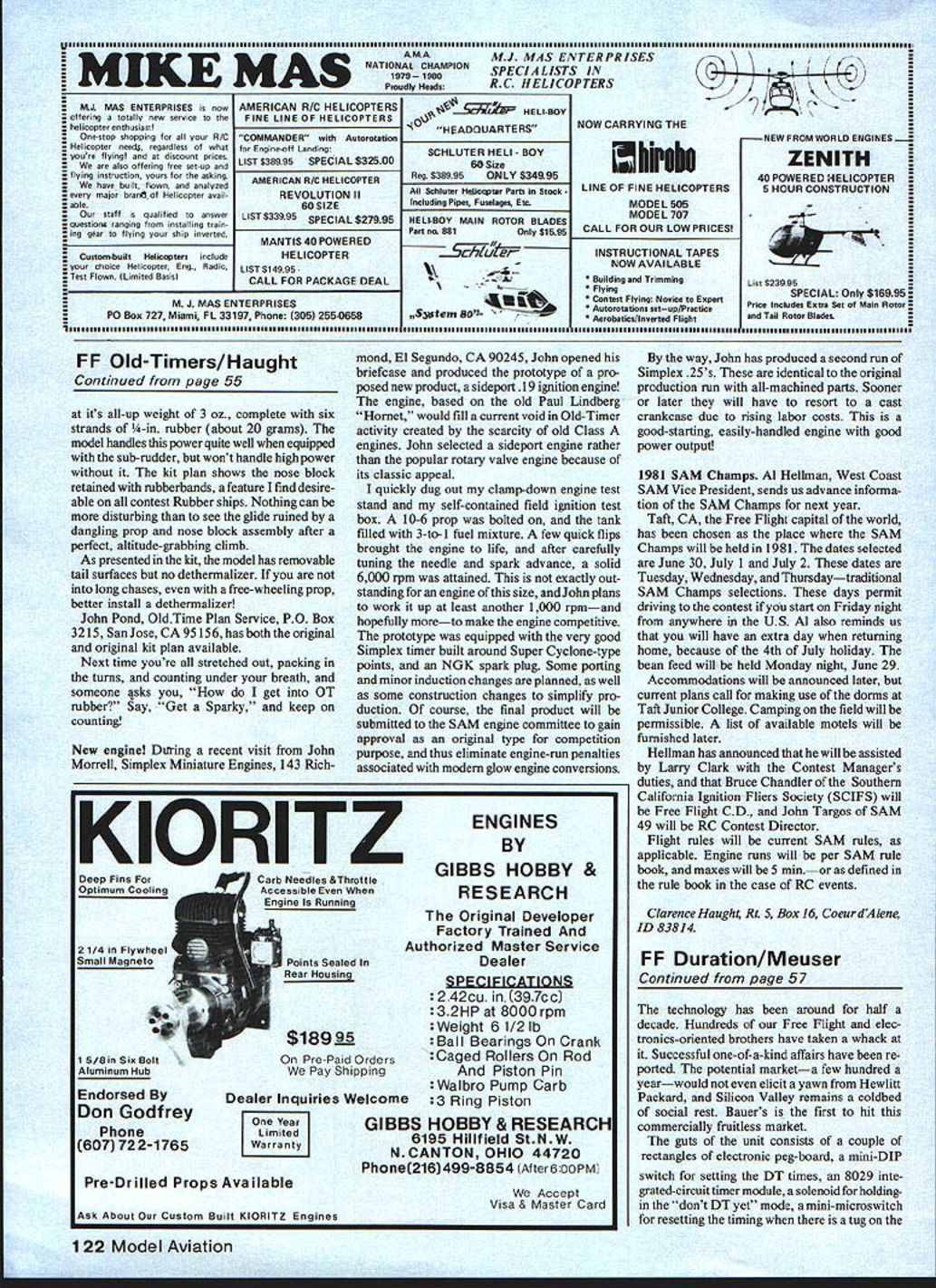
Help wanted and contest
I have been collecting old model aviation books and would like to complete my collection of Aero Modeller Annuals. The only issue I lack is the first and rarest—the 1948 issue. If you have one you are willing to part with, name your rock-bottom price and I'll either accept or reject. I'm not big on haggling.
To keep things fair, I'll give a free plug to anyone else who wants the 1948 Aero Modeller Annual and has all the other issues (after I get mine).
Caption contest:
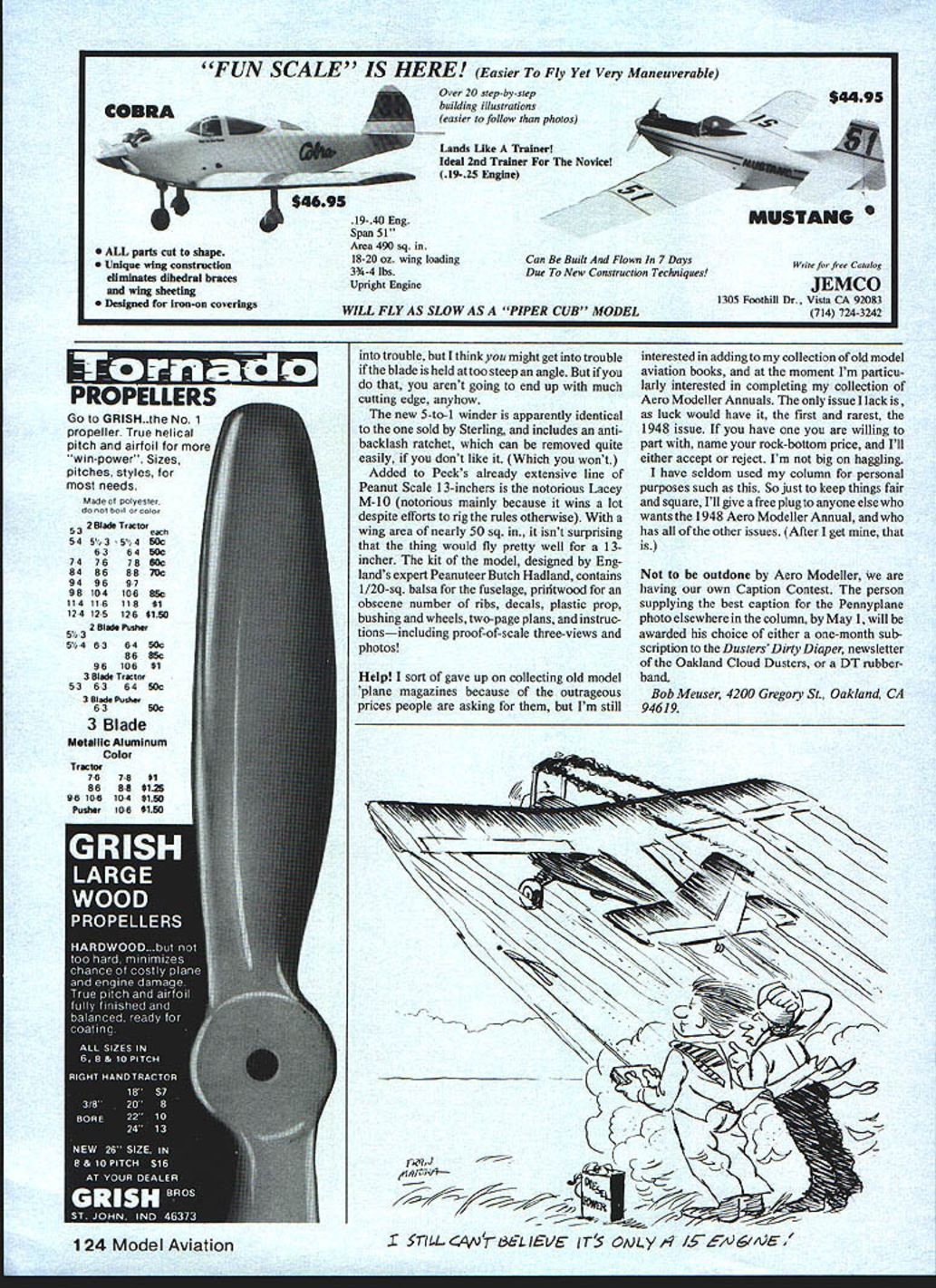
- Supply the best caption for the pen/plane photo elsewhere in the column by May 1.
- Prize: winner's choice of either a one-month subscription to the Dusters' Dirty Diaper (newsletter of the Oakland Cloud Dusters) or a DT rubber band.
Contact:
- Bob Meuser, 4200 Gregory St., Oakland, CA 94619.
Transcribed from original scans by AI. Minor OCR errors may remain.

