
Free Flight: Duration
By Bob Meuser
Stronger gas-model fuselages
For the past quarter-century almost all gas-powered models have used what amounts to a box made of balsa sheet for the fuselage. Typical construction details:
- Sides: 1/16-in. to 1/8-in.
- Top and bottom: either the same thickness as the sides or twice the thickness
- Formers: placed at appropriate intervals (about two to four times the height of the fuselage) to keep everything square during construction and to keep the sides from splitting
A respectable free-flight gas model must be able to survive a mild crash now and then. To do that, the fuselage sides must stay firmly attached to the formers.
Typically, the joint between formers and side slabs is poor: an end-grain chunk glued to side-grain. Canonical lore advises using as little glue as possible because of weight, but a little extra glue to form fillets and spread the load over three or four times the area makes sense despite a small weight penalty.
Recently Ralph Prey has advocated using paper strips bent to an "L" shape and glued into the corners where sides and formers meet. Recommended details:
- Paper: heavy, stiff, about .008–.010 in. thick
- Glue: Hobbypoxy #2 (working time ~45 minutes; cure ~3 hours)
Any glue that won't hold an end-grain to side-grain joint such that the wood fails before the glue does isn't much of a glue.
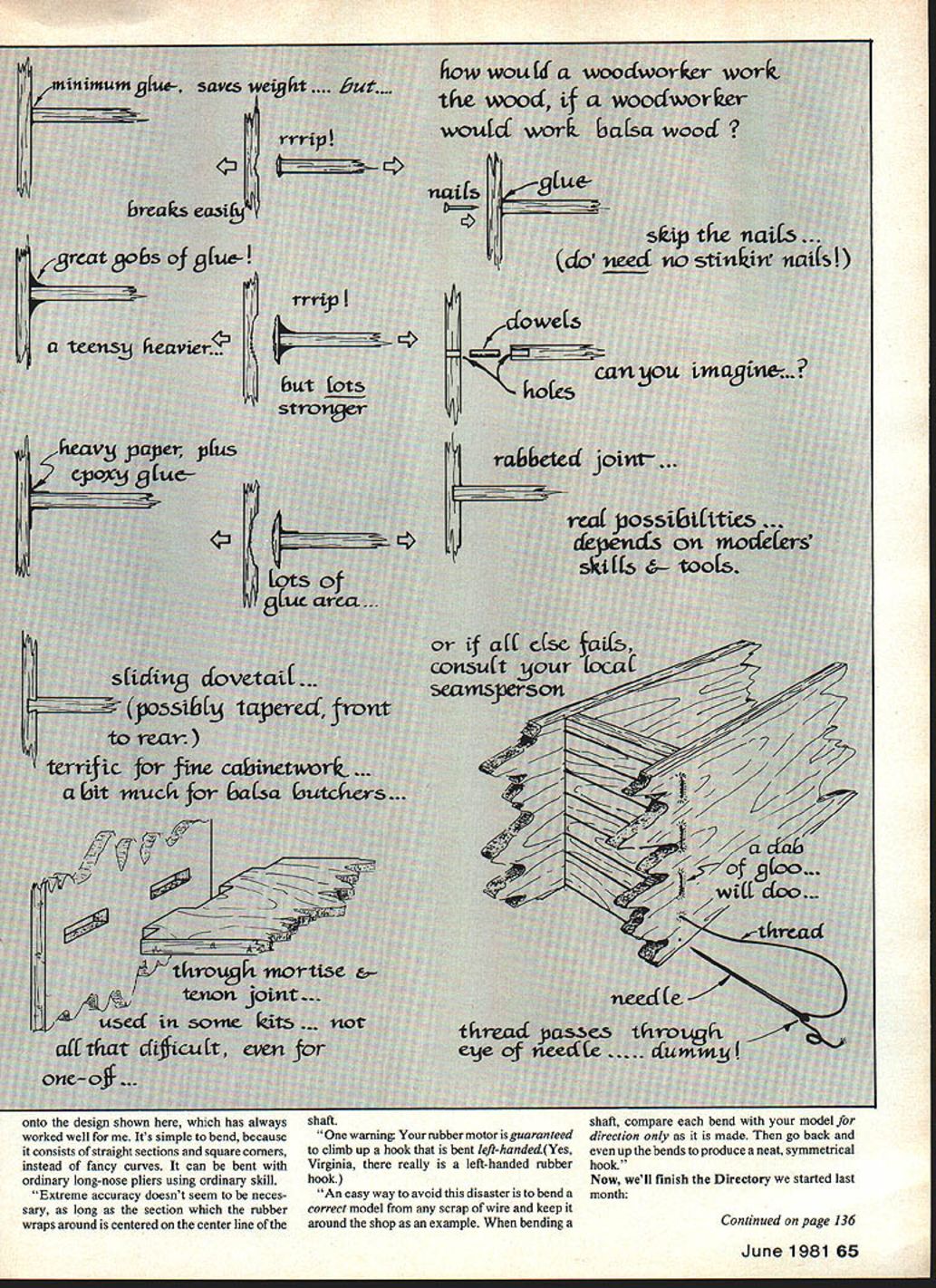
Ralph's suggestion led me to consider other solutions. The joint is essentially the same as between a shelf and the side of a cabinet. Possible approaches include:
- Glue and fasteners: cheap furniture often uses glue plus nails to hold parts while glue sets (nails can be avoided)
- Dowel joints: require many tiny dowels (e.g., 1/32-in. diam.) and matching holes — impractical for most modelers
- Rabbeted joint: cut a groove halfway through the sides and set the formers into the grooves; grooves can be cut by hand or with a Dremel setup
- Sliding dovetail (or tapered sliding dovetail): a first-rate cabinetmaker's choice; the tapered version pulls the former tight as it is driven home — effective but likely overkill for casual balsa work
- Through mortise-and-tenon: used in some kits; not common in fine cabinetry because it is visible, but not difficult to make on a one-off basis and may deserve attention
Sewing the joint
Consider how a seamstress would solve it: simply sew the assembly together. Thread is strong relative to the stresses in this application and adds negligible weight. A dab of cyanoacrylate (or other glue) will lock and stiffen the stitching. If you haven't considered it, consult a local seamsperson.
Ralph Prey — Editor, Satellite newsletter, San Valeers, Southern California; contributing editor, Piston Power, Free Flight Digest, National Free Flight Society — will be writing increasingly on big gas models. Subscription info (historical): Satellite — $3 for 12 issues; NFFS — $10/year (includes Digest). Address: 4859 W. 97th Street, Inglewood, CA 90301. For juniors: write Kit Sonesen, 8616 Maple Grove Ct., Sacramento, CA 95828.
Non-climbing rubber hook
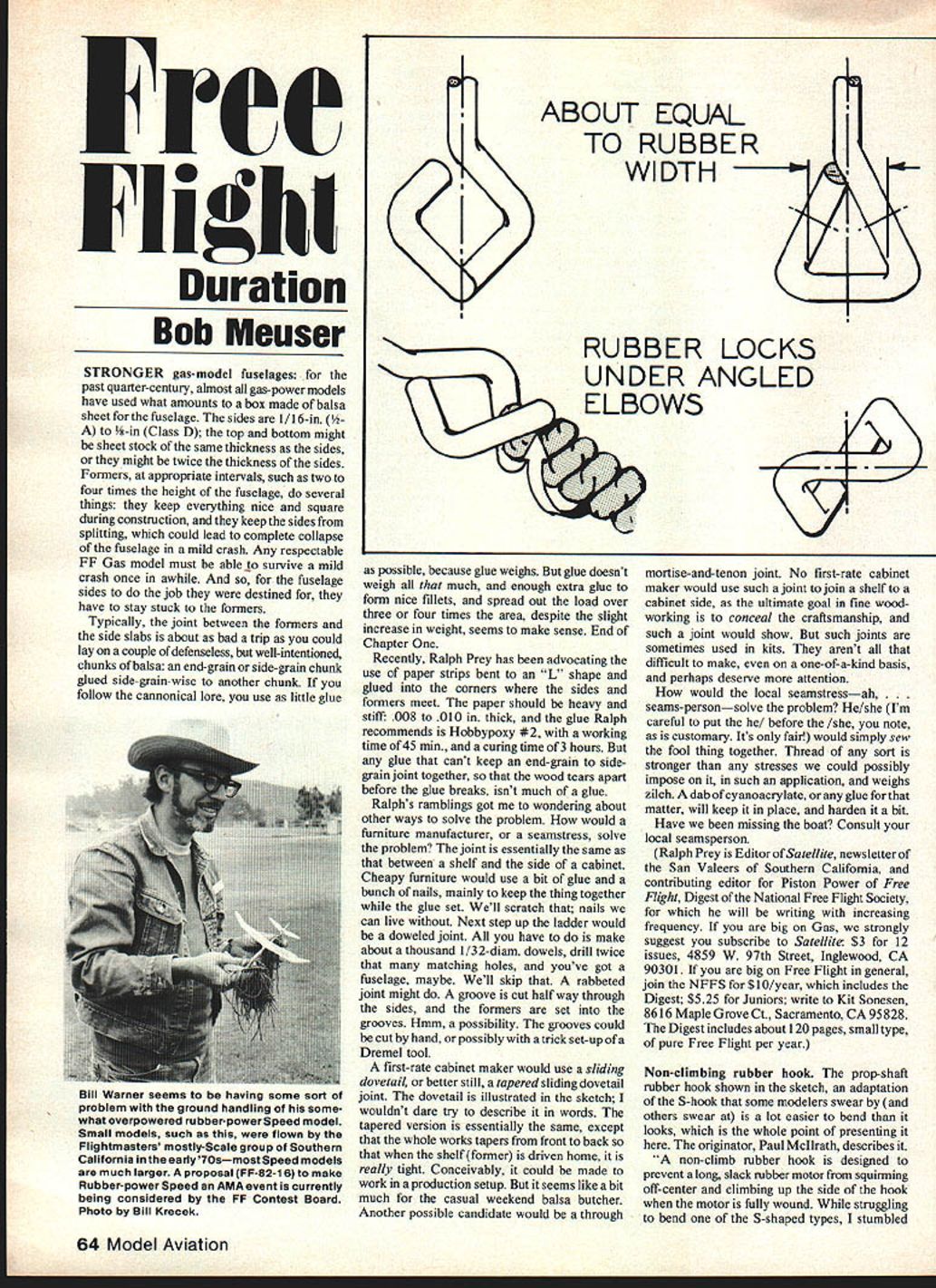
The prop-shaft rubber hook shown in the sketch is an adaptation of the S-hook and is easier to bend than it looks. Originator Paul McIlrath describes the non-climb rubber hook as designed to prevent a long, slack rubber motor from squirming off-center and climbing up the side of the hook when fully wound.
Key points:
- The design uses straight sections and square corners rather than fancy curves, making it simple to bend with ordinary long-nose pliers.
- Extreme accuracy isn't necessary, as long as the section around which the rubber wraps is centered on the shaft centerline.
- Warning: a hook bent left-handed will cause the rubber to climb. An easy way to avoid this is to bend a correct model from scrap wire and keep it as a template. Compare each bend to the template as you form the hook, then even up the bends for neatness.
This adaptation has worked well in practice and is a straightforward shop solution.
Bob Meuser 4200 Gregory St., Oakland, CA 94619
Transcribed from original scans by AI. Minor OCR errors may remain.

