
Free Flight: Duration
Bob Meuser
Even Model Aviation columnists need an occasional vacation. Bob Meuser is having a well-deserved one this month. Our relief man is Jerry Barnette, an East Coaster who has a long-time interest in Free Flight. Jerry resides in Fredericksburg, VA. Bob Meuser will return next month.
THE SHADDO KNOWS
It is no great secret that most successful designs are the result of an evolutionary process — a continuing program of eliminating weak aspects and refining desirable ones. John Sites of Rockville, MD has traveled this design-evolution road in developing his hand-launched glider, Shaddo. Having built 35–40 of the buggers over a five-year development period, John’s Shaddo is now a fully developed competition glider.
Shaddo’s heritage harks back to Ron Wittman’s Supersweep, itself a product of lengthy evolution. John began by adapting an indoor record-holding design to be suitable for outdoor work, flying both 22- and 24-inch wingspans. Several development problems were encountered early, such as the inability to achieve high altitude on launch. The exact problem/solution development sequence is lost to history, but several distinctive features were incorporated, most notably clipped, undercambered tips.
Shaddo’s wing tips reflect both John’s philosophy and an idea used by Richard Schreder (former modeler and champion sailplane pilot/builder) on the HP-series sailplanes.
Mean Chord Line Tip Theory and Tip Design
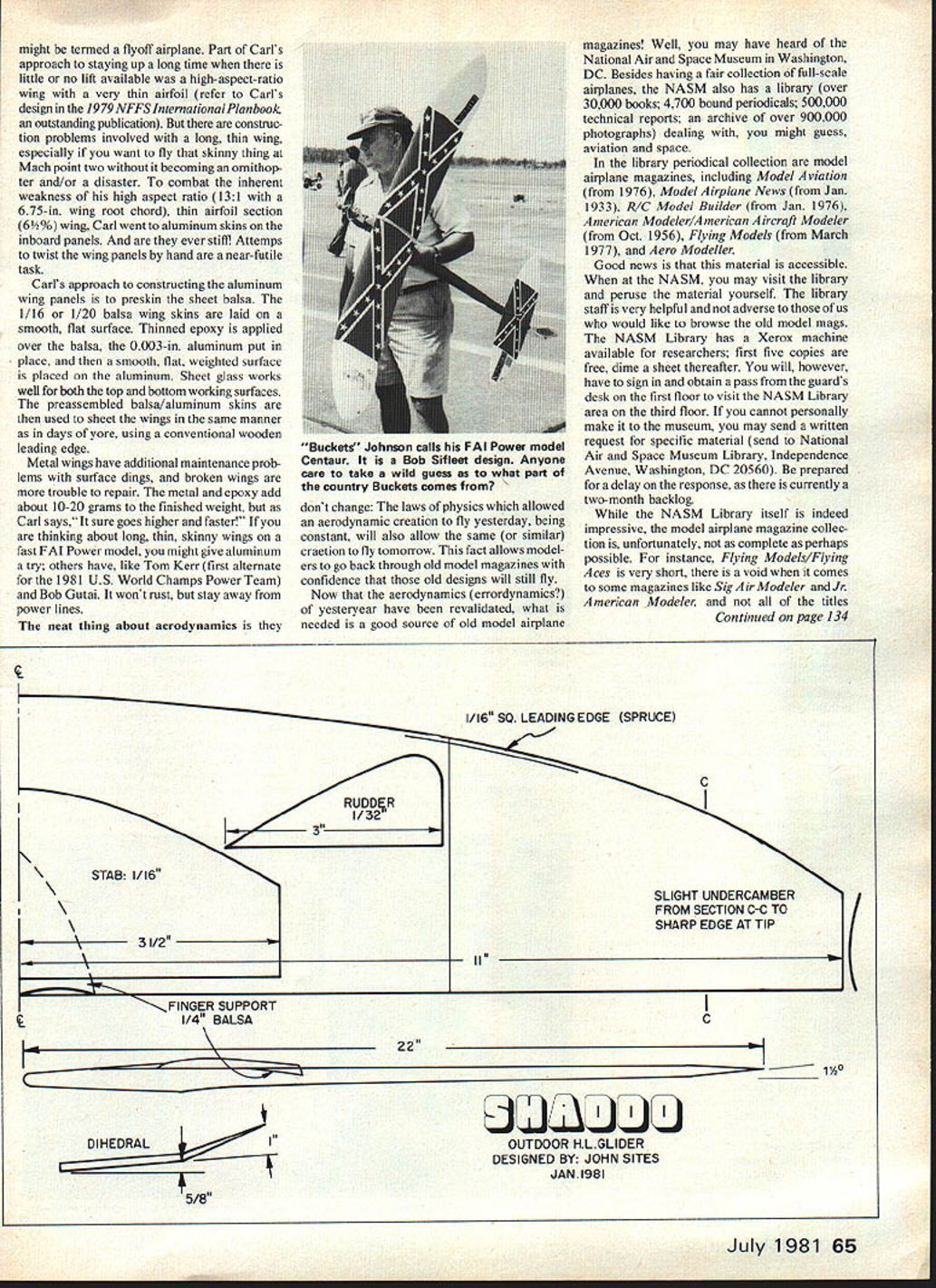
Schreder’s idea, called the Mean Chord Line Tip Theory, modifies normal wingtip geometry beginning about a half-chord length from the tip. In full-scale sailplane applications this modification can increase the effective aspect ratio. To that concept John added an undercambered section in the wing tips, progressing gradually from the normal flat-bottomed section to a fully undercambered, sharp edge at the tip.
John chose undercamber rather than washout, reasoning that both approaches serve similar stability purposes (the tip stalls later than the rest of the wing) but that an undercambered tip might be more efficient in normal glide. John feels Shaddo’s unique tip geometry helps increase flight time, though when a stall does occur it can be more severe than normal. Another possible contributor to increased flight times is that Shaddo’s undercambered tips enclose less wood volume than a conventional tip, resulting in less tip weight.
Whatever the aerodynamic reasonings, the result is an excellent HLG with outstanding flying characteristics. Shaddo has excellent calm-air flight times (no surprise with Supersweep bloodlines) and good windy-weather traits — John has many contest wins under windy conditions by simply shifting the center of gravity forward a bit. A hallmark of the design is its thermal-hooking capability: Shaddo tends to center easily even in light lift.
Construction (typical for hand-launch):
- Wing: 1/16 in. sheet
- Stabilizer: 1/16 in.
- Rudder: 1/32 in.
- Fuselage: about 1/8 in. hard balsa
- Leading edge: small entry (about 1/32 in.)
- High-point: at about 25–30% of chord
Take-apart HLG (Jerry Murphy)
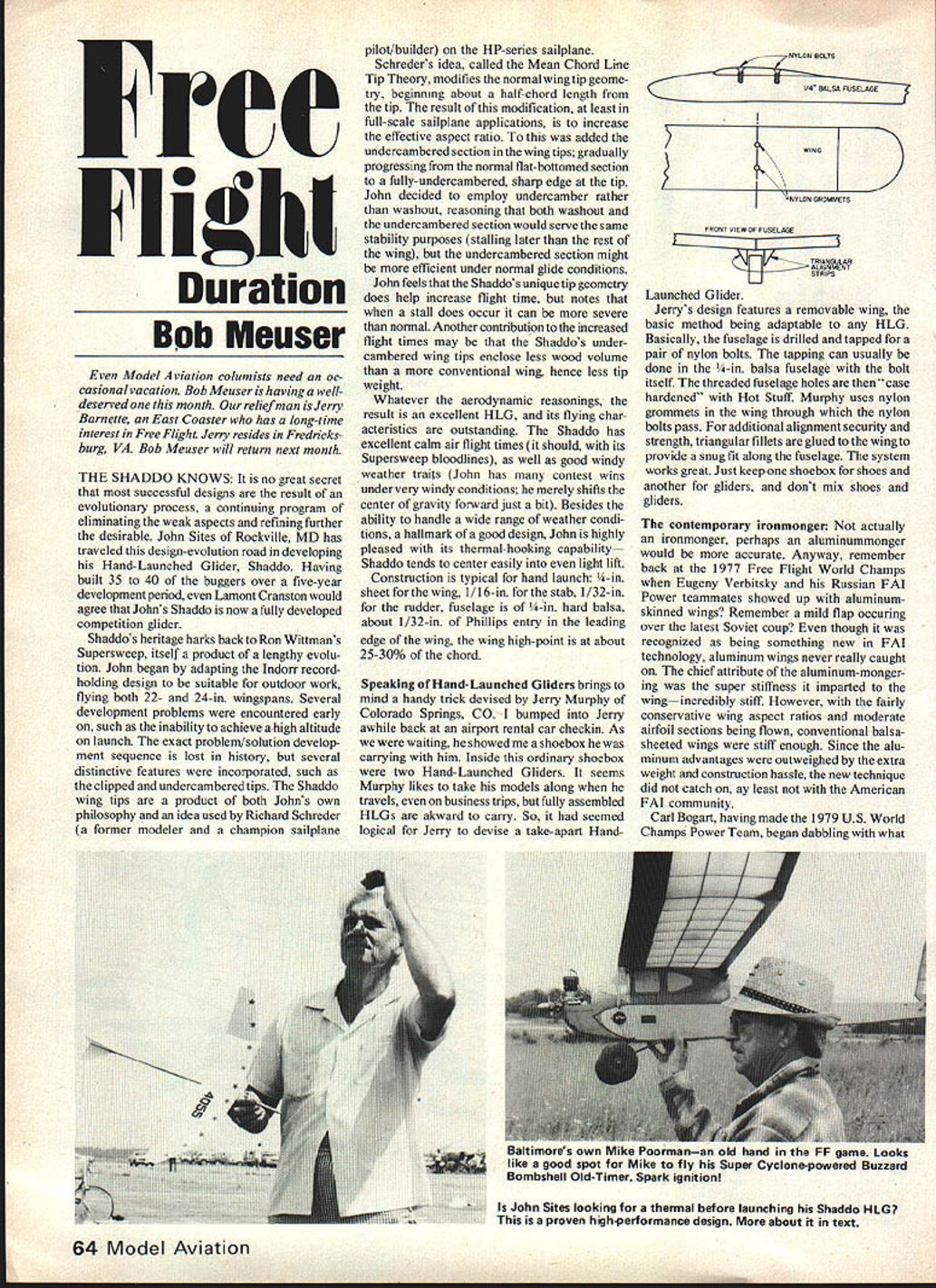
Speaking of hand-launched gliders brings to mind a handy trick devised by Jerry Murphy of Colorado Springs, CO. Murphy likes to take his models along when he travels, even on business trips, but fully assembled HLGs are awkward to carry. He devised a take-apart HLG that fits in a shoebox.
The basic method is adaptable to any HLG:
- Drill and tap the fuselage for a pair of nylon bolts (the bolt itself is threaded into the fuselage).
- Use nylon grommets in the wing through which the nylon bolts pass.
- Glue triangular fillets to the wing to provide a snug fit along the fuselage for additional alignment, security, and strength.
The system works great. Just keep one shoebox for shoes and another for gliders — don’t mix shoes and gliders.
The contemporary ironmonger
Not actually an ironmonger — perhaps aluminum-monger would be more accurate. Remember the 1977 Free Flight World Champs when Evgeny Verbitsky and his Russian FAI power teammates showed up with aluminum-skinned wings? It was recognized as something new in FAI technology, but aluminum wings never really caught on widely. The chief attribute of metal skins was super stiffness — very stiff — but with the conservative wing aspect ratios and moderate airfoil sections commonly used, conventional balsa-sheeted wings were usually stiff enough. The extra weight and construction hassle of aluminum outweighed its advantages for many in the American FAI community.
Carl Rogers, a member of the 1979 U.S. World Champs Power Team, experimented with what might be termed a flyoff airplane. To stay aloft longer when little or no lift was available, he used a high-aspect-ratio wing with a very thin airfoil (13:1 aspect ratio with a 6.75 in. wing root chord; about 6.5% wing thickness). Long, thin wings are prone to structural problems, so Carl used aluminum skins on the inboard panels to combat inherent weakness. The result: extraordinarily stiff panels that resist twisting.
Carl’s construction method for aluminum-wing panels is to pre-skin the sheet balsa:
- Lay the 1/16 or 1/20 in. balsa wing skins on a smooth, flat surface.
- Apply thinned epoxy over the balsa.
- Place 0.003 in. aluminum sheet on the epoxy.
- Place a smooth, flat, weighted surface (sheet glass works well) on top to cure.
- Use the preassembled balsa/aluminum skins to sheet the wings in the conventional manner, with a wooden leading edge.
Metal wings have additional maintenance issues (surface dings), and broken metal wings are more difficult to repair. Metal and epoxy add about 10–20 grams to finished weight, but the performance gain can be substantial: “It sure goes higher and faster!” If you’re contemplating long, thin FAI power wings, aluminum is an option used by others such as Tom Kerr (first alternate for the 1981 U.S. World Champs Power Team) and Bob Gutai. It won’t rust, but stay away from power lines.
National Air and Space Museum: Model Magazines
Aerodynamics don’t change; laws of physics that made older designs fly will still allow similar creations to fly today. That encourages digging through old model magazines — and the National Air and Space Museum (NASM) in Washington, DC is a good source.
The NASM Library holdings include:
- Model Aviation (from 1976)
- Model Airplane News (from Jan. 1933)
- R/C Model Builder (from Jan. 1976)
- American Modeler / American Aircraft Modeler (from Oct. 1956)
- Flying Models (from March 1977)
- Aero Modeller
The material is accessible: you may visit the NASM Library and peruse the collections. The library staff is helpful. A Xerox machine is available for researchers — the first five copies are free, then ten cents a sheet thereafter. Visitors must sign in and obtain a pass from the guard’s desk on the first floor to access the library on the third floor.
If you cannot visit personally, send a written request for specific material to: National Air and Space Museum Library Independence Avenue Washington, DC 20560
Be prepared for delays — there is often a backlog (currently about two months).
Note: While the NASM Library is impressive, the model magazine collection is not complete. For example, Flying Models/Flying Aces holdings are limited; there are gaps for some titles like Sig Air Modeler and Jr. American Modeler.
Fresno Gas Model Airplane Club — 41st Annual Invitation
An open invitation from the Fresno Gas Model Airplane Club recalls: “In November of 1939, a group of people gathered together in an open area outside of Fresno, California, for the purpose of flying model airplanes.” Some 41 years later (1981), their offspring and successors are still meeting for the same purpose.
Highlights from the club’s history and invitation:
- The first annual fair was held in May 1940; prizes were awarded to all contestants.
- In 1981 the Annual was planned for September 26–27 (Saturday and Sunday).
- The club planned to award approximately $3,000 worth of trophies, motors, kits, and parts.
- Most contests have been AMA-sanctioned and attracted entrants from the U.S. and abroad; typical participation has been 175–200 entries.
Thanks to Russ James of the Fresno GMAC for passing along the invitation. If you are in the neighborhood on September 26–27, consider stopping by and trying for part of that $3,000 jackpot.
NFFS Free Flight Hall of Fame — 1981 Inductees
The National Free Flight Society announced the 1981 Free Flight Hall of Fame recipients, honoring individuals who contributed to Free Flight model airplane activities:
- Maxwell Bassett — The revolution man. Challenged 1932 competition rules by flying internal-combustion-powered models in events previously flown by rubber power; developed successful competition models built by the thousands.
- William L. Effinger — Developer and manufacturer of a wide variety of award-winning kits (notably Berkeley models).
- Duke Fox — Developer and manufacturer of engines priced within reach of most modelers; helped start the trend of “hot” fuels used today.
- Joe Lucas (deceased) — Writer, teacher, and expert on model airplanes in the 1920s Chicago area; authored columns in newspapers and magazines; winner of the 1926 and 1928 Mulvihill event.
- Joe Ott — Known to American youth in the 1930s and 1940s as an aeronautical “expert.” His company produced kits found in hobby shops and general stores; developed simplified model-assembly techniques.
The awards were to be presented by the NFFS at the 1981 AMA Nationals in Seguin, TX on August 6 at 7:30 p.m.
FF Indoor / Tenny (continued)
Back to indoor models. Stiffness rather than ultimate strength is often more important for balsa used in indoor models. However, if a model only needed to resist flight loads, it could be built extremely lightly — and few of us have the delicate touch required to handle such a model without damaging it.
A super-light, very stiff model may not survive many flights, especially if the ceiling and air conditions bring out steering balloon or rafter bounces. A very stiff structure can be bent beyond its elastic limit and shatter; a bit of flexibility can allow the model to absorb impacts and last longer.
How to get a more flexible model that is still light and strong? Use denser balsa (heavier wood) but reduce the cross-sectional area so the overall structure weight remains about the same. For example, use six-pound balsa instead of four-pound balsa and make the cross section smaller. Note that balsa varies not just in density but in strength and overall quality.
Before cutting a spar from any sheet of balsa, examine the sheet under a magnifying glass.
Transcribed from original scans by AI. Minor OCR errors may remain.

